
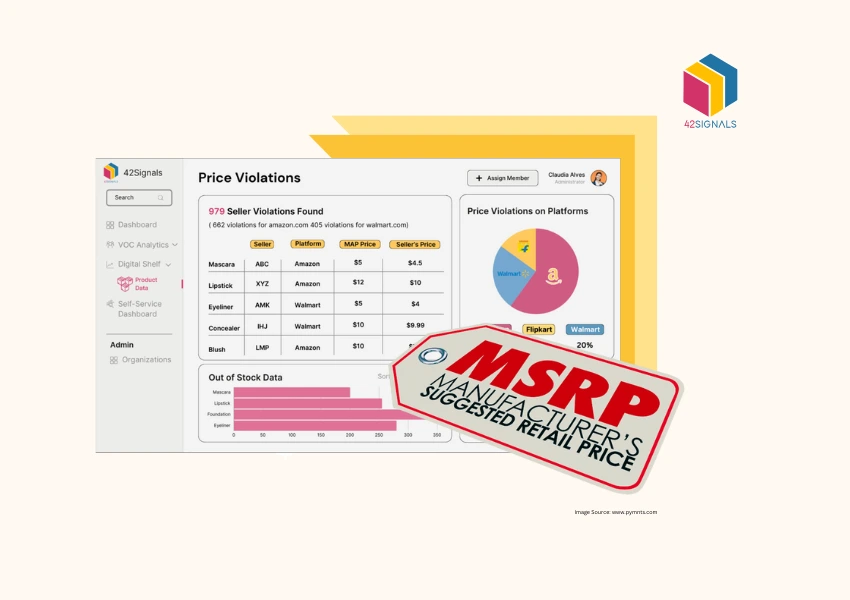
** TL;DR ** MSRP, or Manufacturer Suggested Retail Price, is the price recommended by manufacturers to retailers to help maintain consistent pricing, protect brand value, and give consumers a benchmark for fair deals. However, in the digital age, this suggested price often faces challenges from unauthorized sellers and price violations, making it essential for brands to actively monitor and enforce their pricing strategies using tools like 42Signals to prevent erosion of brand equity and ensure market consistency.
Walk into any car dealership or browse any major online retailer, and you’ll see it: a price tag with a familiar acronym, MSRP. But what does it really mean? For consumers, it’s often the starting point of a negotiation. For brands, it’s a critical part of their pricing strategy. Understanding the manufacturer suggested retail price is more than just knowing what a label says; it’s about understanding the delicate dance of value, perception, and market economics.
Let’s try to understand what MSRP is and what it means for brands and consumers.

Image Source: Investopedia
What is MSRP (Manufacturer Suggested Retail Price)?
Let’s start with the absolute basics. What is MSRP? The acronym stands for Manufacturer Suggested Retail Price. It’s exactly what it sounds like: a price recommendation made by the manufacturer to the retailers who sell their products.

Think of it like this. A company, say a furniture maker, produces a new sofa. They calculate their costs, desired profit margin, and market positioning. Based on that, they determine that the sofa should sell for $1,200 to be profitable for them and perceived as a quality product by consumers. This $1,200 figure is the manufacturer suggested retail price. They “suggest” that retailers use this price when selling to the public.
It is crucial to remember that this is a suggestion, not a command. In the United States and many other countries, retailers are generally free to set their own final selling price. This is due to laws against price-fixing, which are designed to encourage competition.
A retailer might choose to sell the sofa for the full $1,200 MSRP, or they might discount it to $1,000 to attract more customers, or even mark it up to $1,400 if they are in a high-end market with limited competition.
Why MSRP Exists: Benefits for Brands and Consumers
You might wonder, if retailers can just ignore it, why do manufacturers bother setting an MSRP at all? The reason is that it serves several vital purposes for both the creator of the product and the person who eventually buys it.
Here’s a quick way how MSRP is calculated –

For Brands and Manufacturers:
- Price Consistency: The primary goal of the manufacturer suggested retail price is to create a consistent pricing experience across different sales channels. Whether a customer shops at a big-box store, a small local shop, or an online marketplace, they see a similar price. This prevents a “race to the bottom” where retailers undercut each other to the point where the brand’s product is perceived as cheap.
- Brand Value Protection: The price of a product heavily influences its perceived value. A luxury handbag with a fluctuating price tag loses its luxury appeal. By suggesting a stable retail price, manufacturers can maintain the premium positioning they have worked hard to build.
- Fair Margin for Retailers: The MSRP is typically calculated to ensure that retailers have a healthy profit margin after they purchase the product from the manufacturer. This encourages retailers to stock and actively promote the product.
For Consumers:
- A Benchmark for Value: The suggested retail price gives shoppers a baseline to understand a product’s value and intended market segment. It answers the question, “Is this a budget, mid-range, or high-end product?”
- A Tool for Comparison Shopping: When you know the MSRP, you can easily identify a good deal. If one retailer is selling a product at the full MSRP and another has it for 20% less, you have clear, comparable data to inform your purchase decision.
- A Starting Point for Negotiation: In industries like automotive, the MSRP is the published “sticker price.” It is the advertised figure from which negotiations begin, giving the consumer a reference point to argue for a lower price.
Manufacturer Suggested Retail Price vs. Other Common Pricing Terms

Image Source: Differences between MAP vs MSRP
MSRP is just one number in a sea of pricing terminology. To avoid confusion, it’s essential to understand how it differs from other common terms you’ll encounter.
MSRP vs. Invoice Price
This is a common comparison, especially in car buying.
- MSRP (Sticker Price): The price the manufacturer suggests the consumer should pay. It’s on the window sticker.
- Invoice Price: The price the dealership pays to the manufacturer to buy the car. It is typically lower than the MSRP.
While the invoice price is a useful data point for negotiation, it’s not the dealer’s final cost. Dealers often receive hidden incentives and holdbacks from the manufacturer, meaning their true profit margin can be more complex than just the difference between invoice and sale price.
MSRP vs. List Price
List price is often used interchangeably with MSRP, and in many contexts, they mean the same thing. However, “list price” can sometimes be a more general term for any advertised price before discounts, whereas MSRP is specifically set by the manufacturer.
MSRP vs. MAP (Minimum Advertised Price)
This is a critical distinction for brands. While MSRP is a suggestion for the selling price, MAP is a policy that sets the lowest price a retailer is allowed to advertise the product for.
- Manufacturer Suggested Retail Price: “We suggest you sell this for $100.”
- MAP: “You cannot advertise this product for less than $80.”
A retailer can still sell the product for less than the MAP price once a customer adds it to their cart or inquires in person, but they cannot publicly display a price below the MAP threshold. MAP pricing is a powerful tool to prevent brand erosion from deep discounting in advertisements, and monitoring for MAP violations is a key task for modern brands.
According to a recent industry analysis, brands that actively enforce MAP policies see a 15-20% higher brand value perception among consumers.
Ready to Take the Next Step?
See how our solutions can help you achieve your goals and drive measurable results.
The Million-Dollar Question: Is MSRP Negotiable?
This is perhaps the most common question consumers have. The answer is: it depends entirely on the product and the retailer.
Typically Negotiable:
- Cars: The automotive industry is built on negotiation. The MSRP is the starting point, and haggling for a price below it is standard practice.
- Large Appliances: At many appliance stores, the posted price is often the MSRP, but salespeople may have the authority to offer discounts, especially if you are buying multiple items.
- Furniture: Similar to appliances, furniture stores often have room to move on the manufacturer suggested retail price.
Typically Non-Negotiable:
- Big-Box Retailers: You cannot walk into a large chain store and haggle over the price of a video game or a toaster. The price on the shelf is the price you pay.
- Most E-commerce Websites: The price listed on Amazon, Best Buy, or other major online retailers is almost always fixed. You might find a coupon code or wait for a sale, but you can’t negotiate in real-time.
The general rule of thumb is that the more commoditized and high-volume the product, the less negotiable the price will be. For high-ticket, complex purchases, there is often more flexibility.
The Modern Challenge: MSRP in a Digital World
The internet has complicated the simple idea of a suggested retail price. In the past, a brand could reasonably expect its price to be consistent within a geographic region. Today, a consumer can compare prices from dozens of retailers across the globe in seconds.
This creates significant challenges:
- Unauthorized Sellers: Products can be sold by third-party sellers on marketplaces like Amazon or Walmart.com who are not authorized retailers. These sellers often ignore the MSRP entirely, selling at deep discounts that damage the brand’s image.
- Price Scraping and Dynamic Pricing: Sophisticated algorithms allow retailers to automatically adjust their prices based on competitors. This can lead to a volatile market where the manufacturer suggested retail price becomes irrelevant as prices fluctuate wildly throughout the day.
- Cross-Border Pricing Discrepancies: Differences in currency, taxes, and distribution costs can lead to vastly different prices for the same product in different countries, which can be easily discovered online and lead to consumer confusion and distrust.
For brands, maintaining control over their pricing in this environment is a constant battle. This is where understanding MAP pricing and monitoring for MAP violations becomes not just important, but essential for survival.
Beyond MSRP: How 42Signals Empowers Brands to Protect Their Value
Setting an MSRP is the first step. Ensuring that your brand’s value is maintained across the vast digital shelf is the real challenge. This is where a strategic approach to retail analytics becomes your most valuable asset.
While MSRP defines your value, the market’s adherence to it defines your brand’s strength. When rogue sellers or aggressive competitors consistently undercut your suggested price, it erodes consumer trust and cheapens your brand perception. Monitoring this manually across hundreds of online retailers and marketplaces is impossible. This is the core problem that 42Signals exists to solve.
42Signals provides brands with the pricing intelligence needed to move from having a suggested price to having an enforced market reality. Our platform acts as your eyes and ears across the entire digital retail landscape.
Ready to Take the Next Step?
See how our solutions can help you achieve your goals and drive measurable results.
Turning Pricing Data into Strategic Action
How does this work in practice? 42Signals moves beyond simple price tracking to deliver actionable insights.
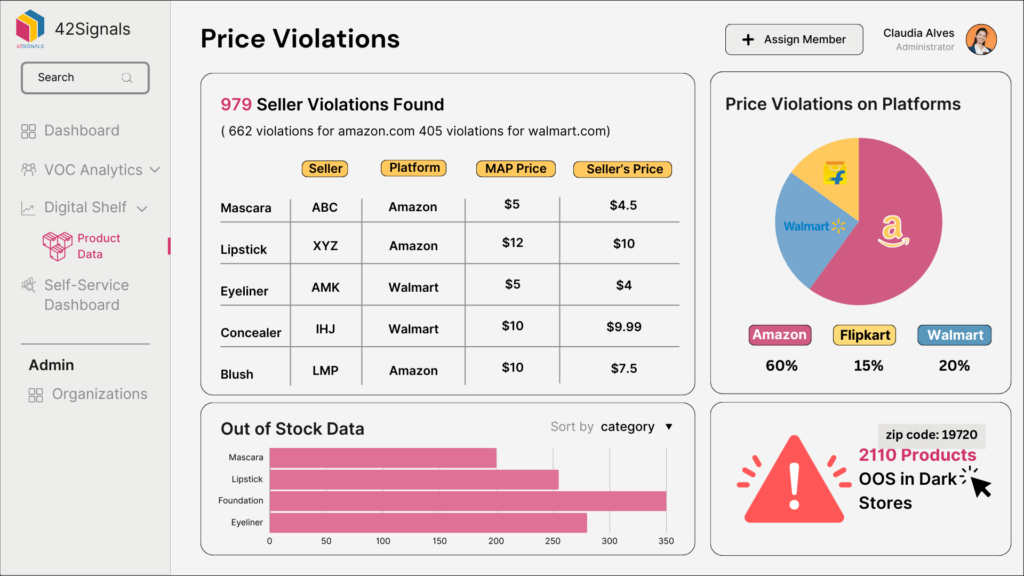
- Real-time MAP Violation Monitoring: We automatically scan the web to identify retailers who are advertising your products below your agreed-upon Minimum Advertised Price. This allows you to quickly enforce your policies and protect your brand equity. A study by the Harvard Business Review found that consistent pricing enforcement can lead to a 5-10% increase in profitable sales volume.
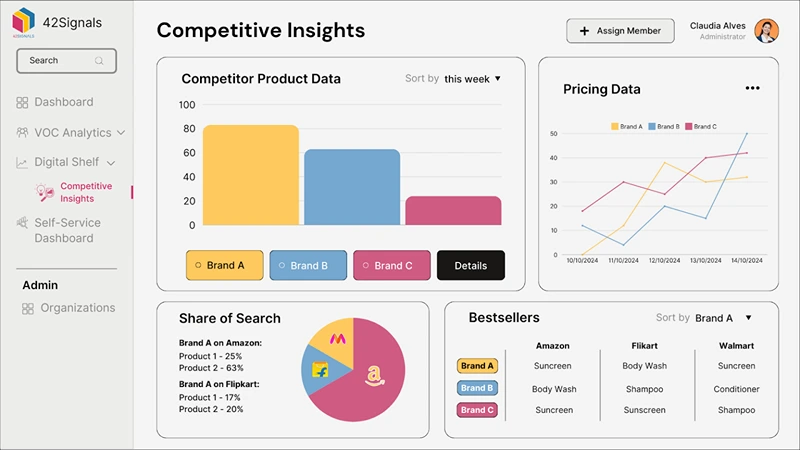
- Competitive Price Tracking: Understand not just your own pricing, but how your entire category is behaving. See how your MSRP stacks up against competitors and identify market trends that allow you to make smarter pricing decisions.
- Identifying Unauthorized Sellers: Our tools help you discover sellers who are distributing your products without authorization, allowing you to take steps to shut down channels that are harming your brand.
By leveraging a platform like 42Signals, brands can ensure that their carefully calculated manufacturer suggested retail price remains a meaningful benchmark in the market, rather than a suggestion that is constantly ignored.
Manufacturer Suggested Retail Price (MSRP): More Than Just a Number
The manufacturer suggested retail price is far more than just a number on a tag. It is a fundamental tool for communication between brands, retailers, and consumers. For shoppers, it provides a benchmark for value and a starting point for deals. For brands, it is the cornerstone of a pricing strategy designed to build lasting value and ensure fair play across retail channels.
However, in today’s fast-paced digital economy, simply setting an MSRP is not enough. Brands must actively defend their pricing integrity against unauthorized sellers and MAP violations. The ticker price a consumer sees online must reflect the brand’s value, or that value will quickly diminish.
Understanding what is MSRP and its role is the first step. The next, more critical step is leveraging advanced tools to protect it. By doing so, brands can ensure their products are perceived accurately and purchased confidently, building a stronger, more profitable future.
42Signals is a great MAP Violations tracking software, helping brands understand sellers or platforms that have violated MAP.
If you’re curious, get in touch with us today.
Frequently Asked Questions
MSRP (Manufacturer’s Suggested Retail Price) is a price recommended by the manufacturer at which a retailer should sell a product. It’s commonly used in the United States and other Western markets. MSRP is not legally binding, but it acts as a pricing guideline to maintain uniformity across retailers and protect perceived product value.
MRP (Maximum Retail Price) is the legally enforceable maximum price printed on goods sold in countries like India. Retailers cannot charge above this price, and doing so can attract penalties. MRP includes the product cost, taxes, packaging, logistics, and profit margin.
In short:
MSRP = suggested (flexible, common in the US)
MRP = maximum (mandatory, common in India)
MSRP is the suggested price set by a manufacturer for selling a product to the public. It’s meant to standardize pricing across retailers and maintain brand consistency. While retailers can choose to sell at or below the MSRP, it’s used as a benchmark for pricing strategies and discounting.
For example, if a car’s MSRP is $30,000, a dealer might sell it for $29,000 as a promotional price—but the MSRP helps the consumer understand the original value.
MSRP is typically calculated by adding a markup to the wholesale or manufacturing cost. The markup covers distribution, taxes, marketing, and profit margins for both the manufacturer and retailer.
Basic formula:
MSRP = Cost Price + Manufacturer Margin + Distributor Margin + Retailer Margin
Or for a simplified retail model:
MSRP = Wholesale Price × (1 + Markup Percentage)
Example:
If the wholesale price of a product is $50 and the desired markup is 100%, then MSRP = $50 × (1 + 1.0) = $100.
Brands may also factor in perceived value, competition, and market positioning when setting MSRP.
In the United States, MSRP is a commonly used pricing reference, especially in industries like automotive, electronics, appliances, and branded consumer goods.
MSRP is not mandatory—retailers can legally offer discounts or sell at different prices based on promotions, competition, or stock levels.
For example, car dealerships often advertise prices “below MSRP” to attract buyers, while electronics retailers may price products at or near MSRP during launches.
MSRP serves as a starting point for negotiations or comparisons, not a legally fixed price.