

Investment01 / 05
Amazon’s largest bet on fast delivery
The $3 billion plan funds neighbourhood warehouses, inventory systems and demand forecasting for Amazon Now.
$3BBy 2030
NEW REPORT - How did Dussehra prices differ across Indian cities? Download our report to find out!

Amazon has committed to its largest investment yet in Indian quick commerce. The company plans to invest $3 billion in the business by 2030, including about $1 billion by the end of 2027, and to expand Amazon Now from about 750 sites to around 1,300 by April 2027. Amazon begins from a distant position in a market led by three local platforms. For brands, the more immediate consequence is a significant increase in the number of individual shelves on which their products must be priced, stocked and found.
Most of the investment will fund neighbourhood fulfilment sites for Amazon Now, along with inventory software, demand forecasting and a broader range in each location. The quick commerce business has already passed $1 billion in annualised gross sales.
The expansion is also geographic. Amazon intends to extend Amazon Now across about 300 Indian cities, taking fast delivery well beyond the largest metros where quick commerce first developed. That reach builds on Amazon’s existing logistics network and customer base, which gives the company a different starting point from the specialist platforms. The scale of Amazon quick commerce ambitions therefore matters as much for smaller cities as for the competitive position in Delhi, Mumbai or Bengaluru, where the market leaders are already established.
Measure
Figure
Timing
Total planned investment
$3 billion
By 2030
First tranche
About $1 billion
By the end of 2027
Amazon Now sites
From about 750 to around 1,300
By April 2027
Annualised gross sales
More than $1 billion
Current
Amazon market share
About 6.2%
2026 estimate
Total market size
About $19 billion, rising to $41 billion
Today to 2030
India’s quick commerce market is concentrated. Blinkit, Swiggy Instamart and Zepto together hold about 77% of the market. Flipkart holds about 11% and Amazon about 6.2%. The market is valued at about $19 billion and is expected to more than double, to around $41 billion, by 2030.
Estimated market shares as publicly reported, September 2026.
Amazon’s strategy is to add density quickly in cities where it already has a large customer base, rather than to match the leaders city by city. The size of the expected market growth leaves room for a later entrant, but the leading platforms have already established strong shopping habits among frequent users.
Amazon is concentrating its quick commerce assortment on products that customers buy repeatedly, such as groceries and household items. Products unlikely to be repurchased are being excluded for now. This is why, unlike some competitors, Amazon does not sell smartphones such as the iPhone through Amazon Now. The approach prioritises order frequency and inventory efficiency over range.
Use the arrows or swipe to move through the slides.
Investment01 / 05
The $3 billion plan funds neighbourhood warehouses, inventory systems and demand forecasting for Amazon Now.
$3BBy 2030
Competition02 / 05
Blinkit, Swiggy Instamart and Zepto hold about 77% of the market between them.
77%Combined share
Assortment03 / 05
Amazon is focusing on products customers reorder frequently. Items unlikely to be repurchased are excluded for now.
RepeatPurchase focus
Growth04 / 05
Quick commerce accounts for an estimated 16–17% of India’s e-retail and is expected to drive 45–50% of its growth over five years.
45–50%Of e-retail growth
Behaviour05 / 05
Quick commerce sessions typically last under five minutes, and visits convert to orders about eight times more often than in standard e-retail.
~8xHigher conversion
Quick commerce accounts for an estimated 16–17% of India’s e-retail and is expected to contribute 45–50% of incremental e-retail growth over the next five years. More than 7,000 micro-fulfilment centres now operate across more than 200 cities. Shopping sessions typically last under five minutes, and visits convert to orders about eight times more often than in standard e-retail.
In quick commerce, each dark store is a separate shelf with its own price, stock level and ranking.
42Signals tracks quick commerce prices, availability and search rankings for each dark store and pin code across major platforms.
A shopper on a quick commerce platform sees only the stock held by one nearby dark store, at the price set for that location. As Amazon adds hundreds of sites, brands face a growing number of small shelves where conditions differ from street to street. The priorities for brands are:
The 42Signals guide to improving visibility on quick commerce platforms covers ranking factors in more detail.
Amazon quick commerce expansion is likely to intensify competition in the cities where Amazon adds the most sites. In the short term, new entrants and expanding platforms typically compete through delivery fees, minimum order values, introductory offers and promotions on high-frequency products. Those measures can change effective prices for shoppers even when listed product prices remain stable.
For brands, increased competition creates both opportunity and complexity. More platforms and more dark stores provide additional routes to shoppers, but they also multiply the number of prices, promotions and stock positions that must be managed. A promotion funded by one platform in one city can create a price difference that shoppers notice on another platform nearby.
The competitive response from the market leaders will also matter. Blinkit, Swiggy Instamart and Zepto have each expanded their networks rapidly, and Flipkart has continued to build Flipkart Minutes. The combination of these expansions with Amazon quick commerce investment means that the number of dark stores serving major Indian cities is likely to continue to rise through 2027. Festive periods add further pressure, as covered in our analysis of the 2026 festive sales.
Amazon plans to invest $3 billion in its Indian quick commerce business by 2030, including about $1 billion by the end of 2027.
Amazon Now is Amazon’s quick commerce service in India, delivering everyday essentials from neighbourhood sites within minutes. It is expected to grow from about 750 sites to around 1,300 by April 2027.
Blinkit, Swiggy Instamart and Zepto hold about 77% of the market combined. Flipkart holds about 11% and Amazon about 6.2%.
Each dark store holds its own stock and can show different prices and search rankings. A product can be available across a city but missing from the store serving a particular area, so city-level averages can hide lost sales.
Amazon’s investment will accelerate a shift already under way in India: frequent purchases of essentials, delivered in minutes, from shelves that differ by neighbourhood. Brands that understand their availability, price and visibility in each dark store will be better placed to win share than those relying on city or national averages. 42Signals tracks those measures across the major quick commerce platforms, down to the individual dark store.
Monitor price, stock and search rank for each quick commerce location.
As the festive sale season begins, many headline discounts are calculated from reference prices that shoppers have never paid. The gap between the badge and the real saving is now a regulatory and reputational issue for brands.
New York’s legislature has passed a ban on prices set using personal data, while Indian marketplaces routinely vary prices by pin code. The distinction between the two is becoming a compliance question for brands.
Flipkart’s Big Billion Days and Amazon’s Great Indian Festival begin within a day of each other. The listed price is only one part of the comparison; bank discounts, exchange offers and earlier sales often decide which platform is cheaper.

Empowering clients with smart insights for a better future. Get eCommerce insights on promotions, product stocks, and market trends. 42Signals equips consumer brands with rich data to turn customer insights into retail excellence.
COMPANY
RESOURCES
NEWSLETTER

We at 42Signals are committed to GDPR compliance and the secure handling of your data. We guarantee that your information is never shared with external parties and is never stored or processed beyond its necessary purpose.

• THIS WEEK ON YOUR SHELF
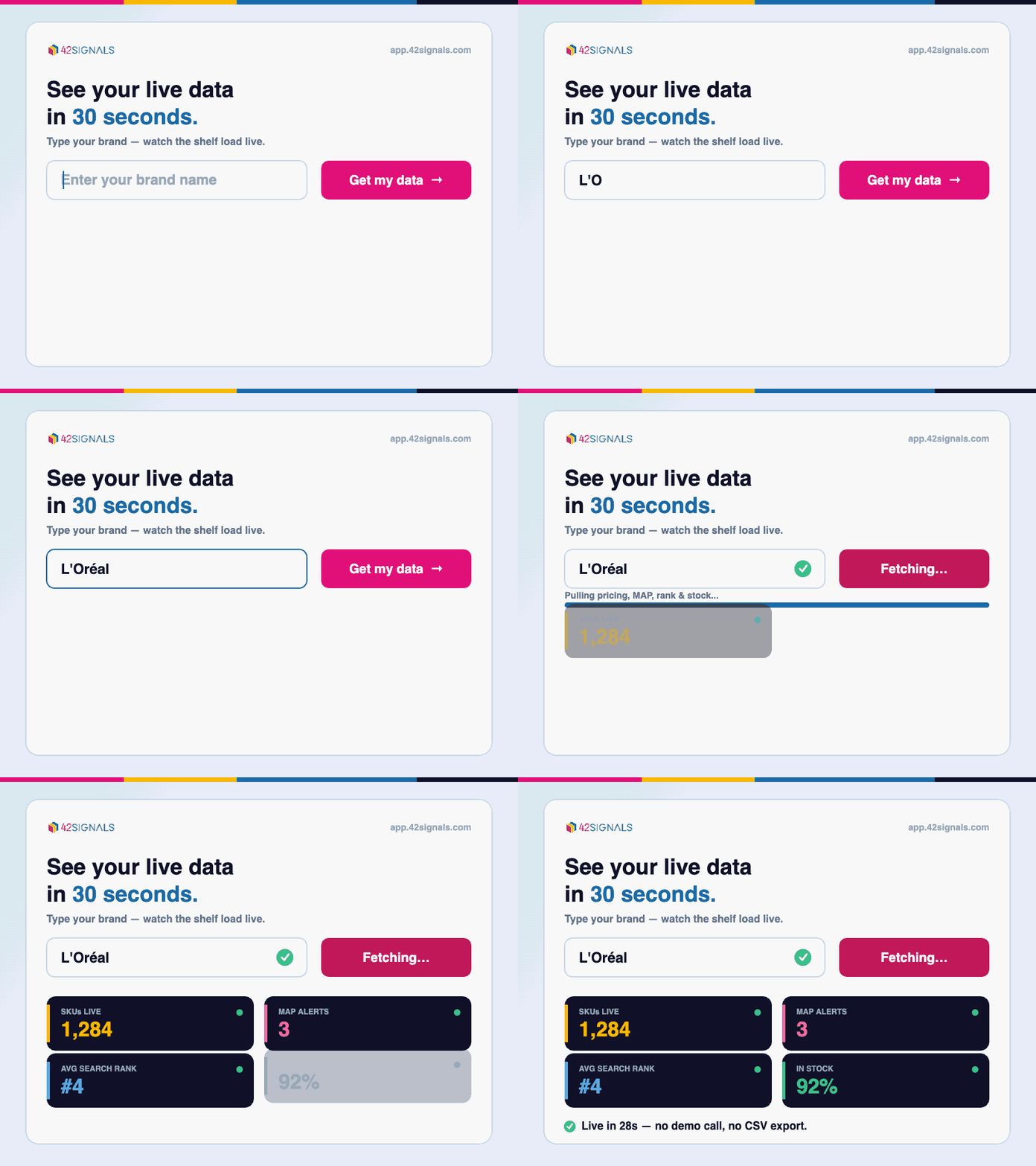
Unlock near real time digital shelf data, map violation, and competitor moves. Create your free account below.
🛡️ Free Instant Access • No Credit Card Needed
www.42signals.com
200+ Brands • 18M+ SKUs • 20+ Retailers • 4 Continents
www.42signals.com