

What’s the need for keyword research services? While Google keeps us on our toes with all the algorithm updates they keep rolling out, one thing that has remained pretty consistent for marketers looking to optimize their websites for search is keyword research.
Keyword research helps you find which keywords are best to target and delivers valuable insight into the queries that your target audience is searching on Google. Insights from these actual search terms can help inform your content strategy as well as your larger marketing strategy.
Choosing between keyword research services is harder than it looks, because the tools overlap heavily on the surface and differ substantially underneath. Most offer search volume, difficulty scoring, and keyword suggestions. Where they diverge is in data freshness, how they calculate difficulty, how much competitor intelligence they expose, and whether they cover the channels your customers actually search on. This guide covers what to evaluate, how the leading services compare, and where each one fits.

Source: Semrush
What is Keyword Research?
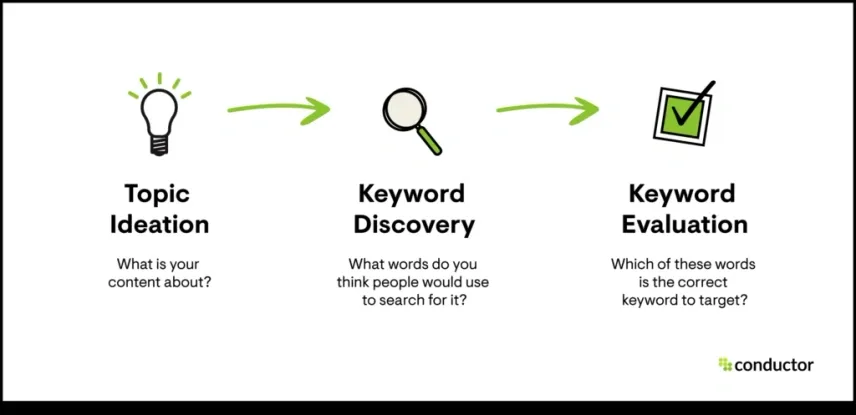
Source: Conductor
Keyword research is a fundamental practice in search engine optimization (SEO) where you identify popular words and phrases people enter into search engines. Understanding these keywords helps you craft content that is more likely to attract traffic to your website. Keyword research can uncover queries to target, the popularity of these queries, their ranking difficulty, and more.
A keyword research service is the software or agency support that makes this practical at scale. Doing it manually, typing queries into Google and noting what appears, works for a handful of keywords and collapses beyond that. A service provides the search volume data, difficulty scoring, competitor visibility, and trend history that turn a list of guesses into a prioritised plan.
The distinction worth drawing early: keyword research tells you what people search for, while keyword tracking tells you where you currently rank for those terms. Most services do both, but they are different jobs, and the strength of a tool in one does not predict its strength in the other.
Criteria for Choosing Keyword Research Services
A business strategy starts with understanding its audience and their needs.
- What do they want?
- What do they need?
- What keeps them awake at night?
- What could solve their problem?
Keyword research is an extension of understanding your audience by first considering their needs and then the phrases, keywords, or queries they use to find solutions. Keyword research services are also important for SEO because it can show you where the opportunities are by knowing what your audience is searching for. This will help you to find new areas of business and to prioritize where to focus attention and resources.
When evaluating keyword services, consider the following criteria:
- Data Accuracy: Reliable data is crucial for making informed decisions. Search volume figures are estimates, not measurements, and different tools produce different numbers for the same keyword. What matters more than absolute accuracy is consistency; a tool that reports volumes 20% low across the board is still useful for prioritisation; one that fluctuates unpredictably is not.
- Comprehensiveness: A good service offers not just keyword suggestions but also insights into trends, seasonality, and keyword difficulty.
- User Interface: The tool should be easy to use and integrate with other SEO tools.
- Price: Ensure the service provides good value for money and has scalable pricing options.
- Support and Resources: Look for robust support options and educational resources to help you make the most of the tool.
Three criteria worth adding to that list, because they separate tools more sharply than price does:
- Competitor visibility: Can you enter a competitor’s domain and see which keywords they rank for, which pages earn that traffic, and where the gaps between their coverage and yours sit? This is the single most useful capability for most teams and the one that varies most between tools.
- Index freshness and refresh rate: How often is the keyword database updated, and how quickly do new terms appear? For fast-moving categories, a tool refreshing monthly will consistently miss emerging queries.
- Channel coverage: Nearly all keyword research services are built around Google. If a meaningful share of your customers search on Amazon, a marketplace, or YouTube, a Google-only tool gives you a partial picture of demand.
Top Keyword Research Services
Ahrefs

Source: Ahrefs
Ahrefs is an all-in-one SEO toolset for growing search traffic and optimizing websites. Ahrefs crawls the entire web and collects and processes petabytes of data every day. Their crawlers process up to 8 billion pages a day. Known for its robust dataset and comprehensive analysis capabilities, this tool provides detailed insights that help marketers optimize their search engine strategies.
Key Features
- Extensive Keyword Database
- Keyword Difficulty Score
- Search Volume and Click Metrics
- SERP Analysis
- Advanced Keyword Suggestions
- Clicks Per Search (CPS)
- Return Rate
Semrush

Source: Semrush
SEMrush is one of the popular comprehensive keyword research services that offers a variety of tools to help businesses improve their online visibility and discover marketing insights. It’s widely recognized for its capabilities in SEO, PPC, content, social media, and competitive research.
Key Features
- SEO Toolkit
- Advertising Toolkit
- Content Marketing Toolkit
- Social Media Toolkit
- Competitive Research Toolkit
- Reporting and Management
Moz

Source: Moz
Moz is a highly respected name in the SEO industry, offering a suite of tools that cater to various aspects of SEO strategy, from tracking search engine rankings to analyzing and improving your inbound marketing efforts.
Key Features
- SEO Toolbar (MozBar)
- Keyword Research Tools
- Site Audits
- Rank Tracking
- On-Page Optimization
- Link Analysis
- Local SEO Solutions
- Moz Content
- Custom Reports
- Moz Community and Learning Resources
Google Keyword Planner

Source: Search Engine
Google Keyword Planner is a tool specifically designed for building strong keyword lists and helping you get your pay-per-click (PPC) campaigns off to a running start. It is a part of Google Ads and is primarily aimed at advertisers but can also be invaluable for SEO purposes.
Key Features
- Keyword Discovery
- Search Volume and Forecasts
- Competition Level and Bid Estimates
- Grouping Keywords
- Geographical and Language Targeting
- Seasonal Trends
KWFinder

Source: Medium
KWFinder by Mangools is a specialized keyword research services tool that’s known for its user-friendly interface and powerful features tailored to assist in finding long-tail keywords with low SEO difficulty. It’s particularly popular among bloggers, small business owners, and SEO professionals who are looking for an efficient way to improve their site’s organic search performance.
Key Features
- Keyword Research
- Keyword Analysis
- SERP Analysis
- Competitor Keyword Research
- Local Keyword Research
| Service | Best for | Competitor analysis | Free tier | Main limitation |
|---|---|---|---|---|
| Ahrefs | Large sites, agencies, deep backlink and keyword data | Extensive — domain-level keyword and gap analysis | Limited (Webmaster Tools only) | Higher price point; no free trial |
| Semrush | All-round marketing teams covering SEO, PPC and content | Extensive — plus paid search and ad copy data | Limited free account | Breadth can be overwhelming for narrow use cases |
| Moz | Teams that value ease of use and learning resources | Moderate | Limited free queries | Smaller keyword index than Ahrefs or Semrush |
| Google Keyword Planner | PPC campaign planning and volume validation | None | Free with a Google Ads account | Volume shown in broad ranges unless running ads |
| KWFinder | Bloggers, small businesses, long-tail discovery | Moderate | Limited daily searches | Less suited to large-scale or enterprise use |
Competitor Keyword Research: The Capability That Separates Services
Most teams get more value from competitor keyword research than from keyword discovery, because it answers a sharper question. Discovery tells you what people search for. Competitor analysis tells you what is already working for someone else in your category, which is a far better starting point than a list of terms sorted by volume.
Three things to look for in how a service handles this:
- Domain-level keyword extraction. Enter a competitor’s URL and see every keyword they rank for, with position and estimated traffic per term. Ahrefs and Semrush both do this well; free tools generally return a truncated sample that is useful for a quick check and not much else.
- Keyword gap analysis. Compare your domain against two or three competitors and surface terms they rank for and you do not. This is where most genuinely actionable content opportunities come from, and it is the feature most often missing from cheaper tools.
- Position tracking over time. A competitor’s current rankings are a snapshot. What matters strategically is direction — which terms they are gaining on, which they are losing, and whether a recent content push is working. A service that only shows today’s position cannot answer that.
A practical note on free competitor keyword tools: most work by sampling rather than crawling the full index, which means the keywords they return skew toward high-volume head terms. The long-tail queries where smaller sites realistically compete are exactly the ones free tools under-report. For an occasional check, this is fine; for building a content plan, it produces a systematically distorted picture.
Where Standard Keyword Research Services Fall Short: Ecommerce
Every service covered above is built around Google. For most businesses, that is the right scope. For brands selling on marketplaces, it leaves a significant gap, because a substantial share of product searches never touch Google at all — they happen inside Amazon, Flipkart, Walmart or a retailer’s own site search.
The practical consequences are threefold:
- Different search behaviour. Marketplace queries skew heavily transactional and specification-led. A shopper on Google might search ‘best wireless headphones’; the same shopper on Amazon searches ‘wireless headphones noise cancelling over ear’. Google-derived keyword data does not reliably predict marketplace demand.
- Different ranking factors. Marketplace search algorithms weight sales velocity, conversion rate, review volume, and stock availability — factors that have no equivalent in Google’s ranking. Knowing a keyword’s Google difficulty tells you little about how hard it is to rank for on Amazon.
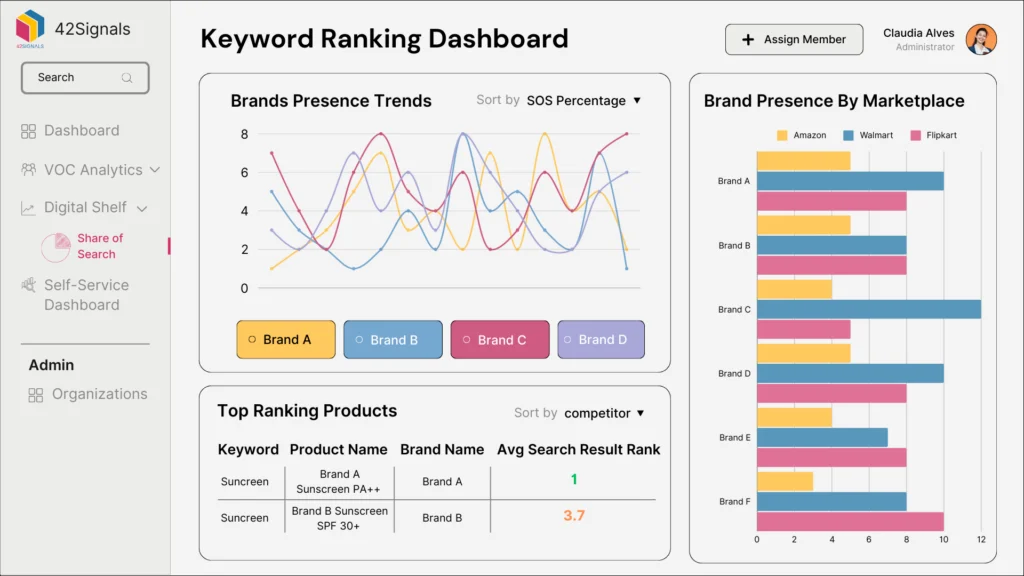
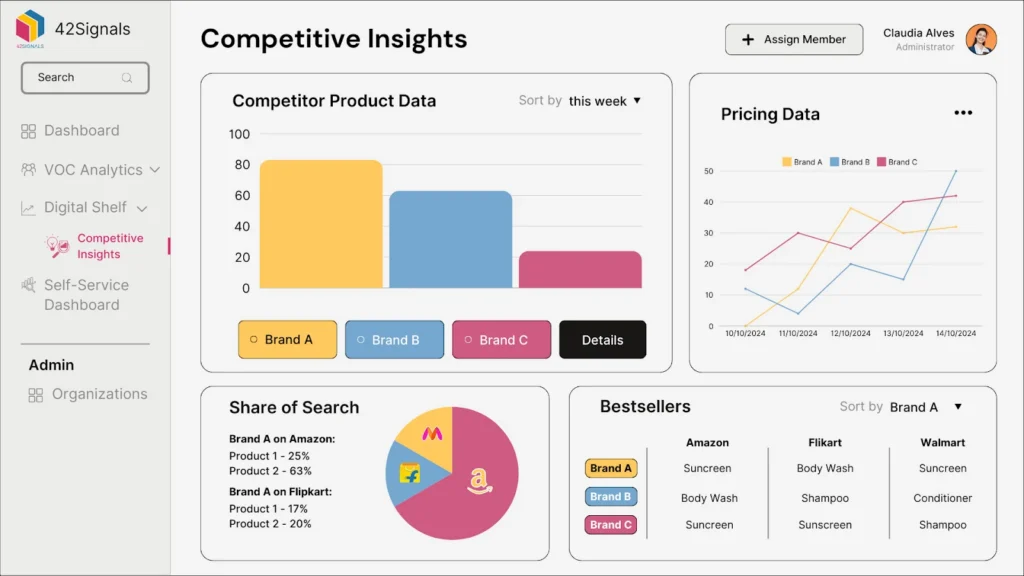
- No competitor visibility. Standard tools cannot tell you which competitor holds the top organic positions for your category terms on a marketplace, how that has shifted, or what share of category search results your products occupy.
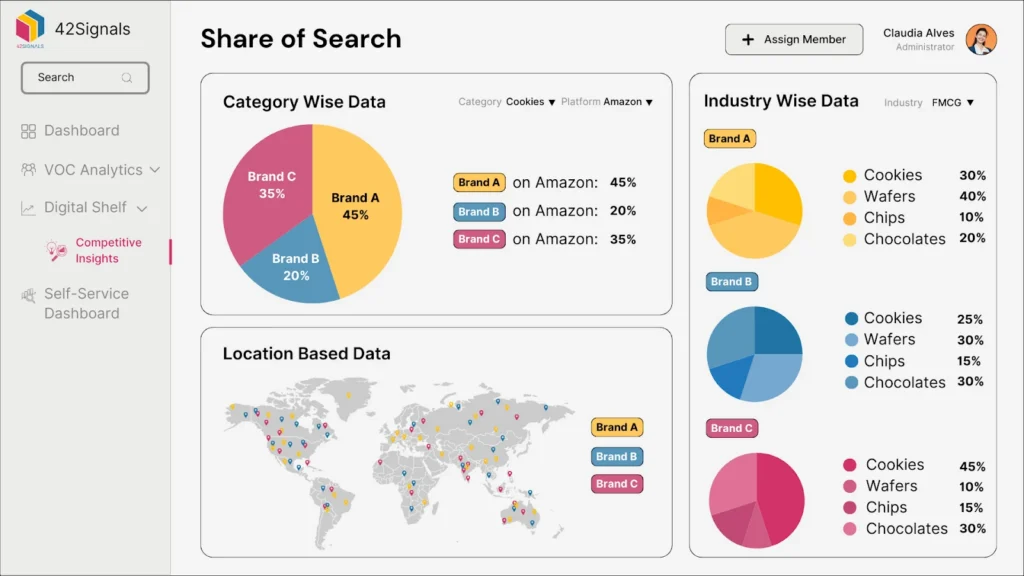
That last point is measured as share of search, the proportion of search result impressions your brand captures relative to competitors for a given set of terms. It is the marketplace equivalent of share of voice, and it is the metric that shows whether you are gaining or losing category visibility while absolute traffic moves for reasons unrelated to your performance.
Brands selling across marketplaces typically run both: a Google-focused keyword research service for content and brand-site SEO, and a marketplace intelligence platform for the channels where the purchase actually happens. They answer different questions and neither substitutes for the other.
Making the Right Choice for Your Business
Choosing the right keyword research services depends on your specific SEO goals, budget, and the scale of your SEO projects. For instance, if you’re a small business focusing on a niche market, KWFinder might be ideal. Conversely, if you’re a larger organization or an agency managing multiple clients, tools like SEMrush or Ahrefs might be more appropriate due to their extensive features and scalability.
Investing in the right keyword research service is pivotal for maximizing your SEO efforts and achieving long-term success in digital marketing. By carefully considering each service’s strengths and limitations against your needs, you can select a tool that not only fits your budget but also effectively supports your SEO strategy.
| If you are… | Start with | Why |
|---|---|---|
| A blogger or small site owner | KWFinder or Google Keyword Planner | Long-tail discovery at low cost; Keyword Planner is free if you have a Google Ads account |
| An in-house marketing team | Semrush | Covers SEO, PPC, and content in one subscription, which suits teams wearing several hats |
| An SEO agency or large site | Ahrefs | Deepest keyword and backlink index; built for managing multiple domains |
| Running paid campaigns primarily | Google Keyword Planner | Volume and bid data direct from the source, free with an active account |
| Selling on marketplaces | A Google tool plus marketplace intelligence | Google-based services do not cover Amazon, Flipkart, or retailer site search |
If your products sell through Amazon, Flipkart, or other marketplaces, the keywords that matter most are the ones your Google-focused tool cannot see. 42Signals tracks marketplace keyword rankings, share of search against competitors, and category visibility across the channels where your customers actually buy. Book a demo to see what your category looks like.
Frequently Asked Questions
What are keyword research services?
Keyword research services are software platforms or agency offerings that identify which search terms your audience uses, how often those terms are searched, how difficult they are to rank for, and which competitors currently rank for them. The software category includes tools like Ahrefs, Semrush, Moz, Google Keyword Planner, and KWFinder. The agency category covers consultancies that conduct the research and deliver a prioritised keyword strategy rather than access to a tool. Most businesses start with software and bring in agency support when they need strategy rather than data.
What is the best keyword research tool for SEO?
There is no single best tool, but there is usually a clear best fit. Ahrefs has the deepest keyword and backlink index and suits agencies and large sites. Semrush is the strongest all-rounder for in-house teams covering SEO, PPC, and content from one subscription. Moz is the most approachable for teams newer to SEO. Google Keyword Planner is free and gives volume data directly from the source, though it shows broad ranges unless you are actively running ads. KWFinder is the most cost-effective option for long-tail discovery on smaller sites. The right choice depends on your scale and whether competitor analysis or keyword discovery is your primary need.
How do I analyse my competitors’ keywords?
Enter a competitor’s domain into a tool with domain-level keyword extraction — Ahrefs, Semrush and Moz all support this — and review the keywords they rank for, their position on each, and the pages earning that traffic. The more useful step is gap analysis: compare your domain against two or three competitors and filter for terms they rank for and you do not. Those gaps are where realistic content opportunities sit, because a competitor ranking proves the term is winnable in your category. Finally, track positions over time rather than reading a single snapshot, since a competitor gaining ground on a term signals an active content push worth responding to.
Is there a free competitor keyword research tool?
Several tools offer free tiers — Semrush, Moz, and KWFinder all allow a limited number of queries per day, and Google Keyword Planner is free with a Google Ads account. The limitation worth understanding is that free competitor analysis generally works by sampling rather than querying the full index, which skews results toward high-volume head terms. The long-tail queries where smaller sites realistically compete are systematically under-reported. For a quick check on what a competitor ranks for, this is adequate; for building a content plan, it produces a distorted picture that will push you toward terms you cannot win.
How do you choose the right keywords for SEO?
Work through four filters in order. First, relevance — does the term describe what you actually sell, and would someone searching it be a plausible customer? High-volume terms that attract the wrong audience cost more than they return. Second, intent — is the searcher looking to learn, compare, or buy? Match the term to a page type that serves that intent rather than pointing everything at a product page. Third, difficulty — can you realistically rank given your domain’s current authority? A term where every result is a major publisher is not winnable regardless of how well you write. Fourth, business value — would ranking for this term change anything commercially? Some high-volume terms generate traffic that never converts, which is worth knowing before you invest in them.
What is the difference between keyword research and keyword tracking?
Keyword research is forward-looking: it identifies which terms to target based on search volume, difficulty, and relevance. Keyword tracking is backward-looking: it monitors where you currently rank for terms you have already targeted, and how those positions move over time. Most services offer both, but strength in one does not predict strength in the other — a tool with an excellent keyword database may have basic rank tracking, and dedicated rank trackers often have limited discovery features. If ranking visibility is your primary need rather than discovery, evaluate tools on tracking frequency, keyword limits, and whether they track the specific locations and devices that matter to you.
How accurate is keyword search volume data?
Search volume figures are estimates, not measurements. Google is the only party with actual query counts, and Keyword Planner reports them in broad ranges unless you are running active campaigns. Third-party tools model volume from clickstream data, Keyword Planner ranges, and their own crawling, which is why the same keyword returns different numbers across Ahrefs, Semrush and Moz. The practical implication is that absolute figures matter less than relative ones. A tool that consistently reports volumes 20% low is still useful for deciding which of two keywords to prioritise. Where accuracy does matter is in comparing across tools — never mix volume data from different sources in the same analysis, because the inconsistency will produce the wrong ranking of opportunities.
Do keyword research tools work for Amazon and other marketplaces?
Not well. Ahrefs, Semrush, Moz, and the other major services are built around Google’s index and do not cover marketplace search. This matters because a large share of product searches begin on Amazon or another marketplace rather than on Google, and the behaviour differs — marketplace queries skew more transactional and specification-led than their Google equivalents. Ranking factors differ too: marketplace algorithms weight sales velocity, conversion rate, review volume and stock availability, none of which have a Google equivalent. Brands selling through marketplaces generally run a Google-focused tool for content and brand-site SEO alongside a dedicated marketplace intelligence platform for the channels where purchases actually happen.
Should I use a keyword research tool or hire a keyword research service?
A tool gives you data; a service gives you a strategy. If you have someone on the team who can interpret keyword data, build a content plan from it, and measure results, a software subscription is almost always better value. If keyword research is something you need done rather than something you want to learn, an agency or consultant delivers a prioritised plan without the learning curve — though you will still want tool access afterwards to track whether the plan is working. The most common mistake is buying an enterprise tool subscription without anyone to use it properly, which costs more than agency support and produces less.