

What are MAP violations, Amazon MAP Violations in particular?
If you sell on Amazon — whether as a brand owner, authorized reseller, or 1P vendor — you have almost certainly encountered an Amazon MAP violation. A competitor lists your product below your Minimum Advertised Price, your authorized retailers complain, your Buy Box erodes, and the brand equity you have spent years building starts to crack.
However, they must also navigate a number of policies to stay in compliance and maintain a fair marketplace.
One such policy is the Minimum Advertised Price (MAP) policy. Understanding what constitutes a map violation on Amazon, how to report it, how long enforcement takes, and what documentation you need is crucial for any brand competing on the platform.
This guide covers what constitutes an Amazon MAP violation, how to report it through Brand Registry, what documentation Amazon requires, enforcement timelines by path, and how to stop violations before they compound.
Understanding Amazon MAP Violations
Let’s start with the basics. A MAP violation occurs when a seller advertises a product for a price lower than the Minimum Advertised Price set by the brand or manufacturer. It goes against the MAP policy set by the business for its items.
An Amazon MAP violation can inflict severe damage on both sellers and brands. For sellers, it can lead to account suspensions, loss of Buy Box privileges, and even expulsion from the Amazon marketplace.
Brands, on the other hand, suffer diminished brand value, erosion of profit margins, and strained relationships with authorized sellers. Ultimately, Amazon MAP violations undermine the trust and equity a brand has painstakingly built over the years.
Types of Amazon MAP Violations (Amazon-Specific)
Not all Amazon MAP violations look the same. Brands need to recognise the full spectrum of ways sellers circumvent MAP on the platform:
| Violation Type | How It Appears on Amazon | Why It’s Hard to Catch |
|---|---|---|
| Listed Price Below MAP | Product page shows a price lower than your MAP threshold | Straightforward — automated tools catch this easily |
| “Add to Cart” Price Hidden | Advertised price shows MAP-compliant, but actual checkout price is lower | Amazon’s own interface can obscure this; requires cart-level monitoring |
| Coupon/Promotion Stacking | Seller applies coupons or Lightning Deals that bring the effective price below MAP | Not always captured in price monitoring — need to check active promotions |
| Bundle Pricing Loophole | Seller bundles your product with a low-value item and prices the bundle below MAP for the main product | ASIN-level monitoring misses bundle listings |
| Third-Party / Rogue Seller | Unauthorised seller acquires inventory and lists below MAP with no policy agreement | No prior relationship — enforcement requires Brand Registry and Amazon reporting |
Why Do Brands Institute MAP Policies?
Brands don’t create MAP policies to be difficult. They do it to preserve three core pillars of their business:
- Brand Value & Perception: Premium pricing is often synonymous with premium quality. A brand that invests heavily in research, development, and marketing needs to maintain a certain price point to justify its market position. If their products are consistently discounted across the web, it cheapens the brand’s image and erodes consumer confidence in its value proposition. Why would a customer pay full price at an authorized retailer if they see it for 30% less on Amazon from an unknown seller?
- Protecting Retailer Margins: Brands rely on a network of authorized retailers, both online and in brick-and-mortar stores. These retailers invest in marketing, customer service, and inventory. If rogue Amazon sellers can undercut them drastically, it makes it impossible for these retailers to compete, leading them to drop the brand altogether. This severely limits the brand’s distribution channels and overall market reach.
- Ensuring a Fair Competitive Landscape: MAP policies prevent a “race to the bottom” where the only differentiator between sellers is price. This destructive competition squeezes profit margins for everyone, including the brand, and often leads to corners being cut on customer service, packaging, and product support. It shifts the competition from a healthy battle over service and value to a destructive war of attrition based solely on who can survive the slimmest margins.
Amazon MAP violations can inflict severe damage on both sellers and brands. For sellers, it can lead to account suspensions, loss of Buy Box privileges, and even expulsion from the Amazon marketplace. Brands, on the other hand, suffer diminished brand value, erosion of profit margins, and strained relationships with authorized sellers. Ultimately, Amazon MAP violations undermine the trust and equity a brand has painstakingly built over the years.
The Legal Landscape: Is MAP Enforcement Legal?
A common question is whether enforcing a MAP policy violates antitrust or price-fixing laws. In the United States, MAP policies are generally considered legal under the “Colgate Doctrine,” based on a Supreme Court case. The crucial factor is that the policy must be unilateral. A brand can suggest a minimum advertised price and choose not to do business with retailers who fail to comply. What is illegal is vertical price fixing—a collusive agreement between a brand and its retailers to set actual resale prices. The line is thin but distinct: a brand acts independently when it sets a policy and enforces it across the board without negotiation or agreement.
The Ripple Effects: Consequences of MAP Violations on Amazon
The impact of a MAP violation is not isolated; it creates a damaging ripple effect across the entire ecosystem.
- For the Violating Seller: The immediate consequence is often a stern warning from the brand, followed by a formal complaint to Amazon. Amazon itself does not proactively enforce a brand’s MAP policy, but it will act on complaints from Rights Owners. This can lead to:
- Listing Suppression: Amazon may remove the buy box or completely suppress the ASIN, making it un-sellable.
- Loss of Seller Privileges: Repeated offenses can lead to the suspension of shipping to certain countries or, in severe cases, a full account suspension.
- Termination of Supplier Relationship: The brand or its authorized distributors will likely cut off the supply of products to the violating seller, effectively ending their ability to source that inventory.
- For the Brand: The damage can be long-lasting.
- Brand Erosion: Constant price slashing trains consumers to wait for discounts and devalues the product in their eyes.
- Authorized Seller Revolt: Your most valuable retail partners will become frustrated and may stop promoting your products or even drop your line entirely, citing an inability to compete.
- Resource Drain: Enforcing MAP policies is a time-consuming and expensive process, diverting resources from product development and marketing to policing the market.
How to Report an Amazon MAP Violation — Step-by-Step
This is the most actionable section for Amazon-seller and brand ICPs. Amazon does not enforce MAP directly, but it provides formal channels through which brands can take action. Here is the exact process:
Step 1: Confirm the Violation and Capture Evidence
Before filing anything, lock down your evidence. Amazon will reject vague or undocumented complaints.
- Take timestamped screenshots of the product listing page showing the offending price, the ASIN, the seller name, and the date.
- If the violation is a hidden “add to cart” price, go through the full checkout flow and screenshot each step.
- If a coupon is involved, screenshot the coupon badge and the final checkout total.
- Record the exact price, the MAP threshold from your policy document, and the delta (e.g., “Listed at $34.99; MAP is $49.99 — $15.00 below MAP”).
- Note the date and time, seller storefront URL, and ASIN.
Step 2: Identify the Seller Type
Your enforcement path depends on whether the violating seller is authorized or unauthorized:
| Seller Type | First Action | Escalation Path |
|---|---|---|
| Authorized reseller (has a signed MAP agreement) | Send a direct MAP violation notice to the reseller using your documented enforcement process | If unresolved after 2 warnings, terminate supply agreement and file with Amazon Brand Registry |
| Unauthorized / rogue seller (no agreement) | File directly via Amazon Brand Registry — Report a Violation tool | If listing persists, escalate to Amazon’s Notice of Claimed Infringement (NOCI) if IP rights are involved; or pursue supply chain investigation |
| Amazon itself (1P vendor selling below MAP) | Submit a case through Vendor Central to your Vendor Manager | Escalate with pricing data and margin impact documentation to your Amazon account team |
Step 3: Use Amazon Brand Registry to Report the Violation
Amazon Brand Registry is the primary tool for brand owners to act on Amazon MAP violations. Here is the exact path:
- Log in to brandregistry.amazon.com with your brand owner account.
- Navigate to Protect > Report a Violation.
- Search for the ASIN in question.
- Select the violation type. For MAP, the closest category is typically “Pricing violation” or “Incorrect product information” — note: Amazon does not have a dedicated MAP reporting category. Frame your report around policy violation or, where applicable, IP infringement if a rogue seller is involved.
- Upload your timestamped screenshots and include the specific price discrepancy in the notes field.
- Submit and record the case reference number.
Important: Amazon does not guarantee action on MAP-only complaints through Brand Registry because MAP is a brand policy, not an Amazon policy. The more effective route for rogue sellers is to demonstrate IP infringement, counterfeit risk, or listing accuracy issues alongside the pricing complaint.
Step 4: Send a Formal MAP Violation Notice to the Seller
In parallel with any Amazon filing, contact the violating seller directly. Your notice should include:
- Your company name and brand name
- The specific ASIN and product name
- The MAP price per your current policy
- The advertised price at time of violation (with screenshot reference)
- The date and time of the violation
- A clear deadline to correct the price (typically 24–48 hours for a first warning)
- The consequences for non-compliance (supply termination, escalation to Amazon)
- A reference to the signed MAP agreement (for authorized sellers)
Keep all correspondence on record. Consistent, documented enforcement is what makes MAP policies legally defensible.
Amazon MAP Violation Enforcement Timelines — What to Expect
One of the most common questions from brands is: “How long does it take for Amazon to act on a MAP violation?” The honest answer is: it depends on the path you take.
| Enforcement Action | Typical Timeline | Success Rate | Notes |
|---|---|---|---|
| Direct warning to authorized seller | Resolution within 24–72 hours in most cases | High (if MAP agreement is signed) | Fastest path — leverage your supplier agreement |
| Amazon Brand Registry — Report a Violation | Amazon review: 3–7 business days; listing action if approved: within 24 hours after decision | Moderate (for rogue sellers without IP angle) | Include evidence upfront to avoid back-and-forth |
| Amazon NOCI (IP infringement route) | 5–10 business days for Amazon to act | High (if IP infringement is substantiated) | Requires registered trademark or copyright |
| Supply chain suspension (cut off rogue seller’s inventory source) | Immediate for direct distributors; 2–4 weeks for grey market to exhaust inventory | Very high long-term | Most effective permanent solution |
| 1P Vendor Central case | 7–21 business days; outcome not guaranteed | Low to moderate | Amazon’s own pricing decisions are hardest to override |
Documentation Brands Need to Enforce Amazon MAP Violations
Enforcement without documentation is a complaint without teeth. Before you can act on an Amazon MAP violation, you need to have the following in place:
1. A Written, Dated MAP Policy Document
- Must clearly state the MAP price for each SKU (or link to a current price sheet)
- Must define what constitutes a violation (advertised price, not just sale price)
- Must outline the enforcement process and consequences
- Must be version-controlled and dated — if your MAP prices change, keep prior versions on record
- Should specify that Amazon listings, Buy Box prices, and “add to cart” prices all constitute “advertised prices” under the policy
2. Signed MAP Agreement from Every Authorized Seller
- Every authorized reseller, distributor, or retailer should sign a MAP agreement before receiving inventory
- The agreement should reference the MAP policy document by version and date
- Keep signed copies on file — these are your primary enforcement instrument against authorized sellers
- For new sellers, incorporate MAP terms into your standard reseller agreement
3. A Violation Evidence File for Each Case
For every amazon map violation you report or act on, maintain an evidence file containing:
- Timestamped screenshot of the violating listing (full page, showing ASIN, seller name, price, and date in browser bar)
- Screenshot of the checkout flow if the violation is at cart level
- Screenshot of any active coupons, promotions, or Lightning Deals applied to the listing
- Your current MAP policy price for that SKU, with policy document version reference
- Date/time of discovery
- Seller storefront URL and seller ID
- History of prior violations by the same seller, if applicable
4. An Enforcement Communication Log
- Record every warning sent, with date, method (email, Amazon seller messaging, Brand Registry case), and case/reference number
- Log seller responses or non-responses
- Track resolution status: corrected, escalated, supply terminated
- This log demonstrates consistent, unilateral enforcement — which is essential for legal defensibility
5. ASIN-Level MAP Price History
- If your MAP prices change over time, maintain a dated log of price changes per ASIN
- This prevents disputes where a seller claims they were compliant with an older version of your MAP policy
How to Monitor MAP Violations on Amazon
Amazon, although a juggernaut in the e-commerce space, does not directly monitor or report MAP violations. The responsibility falls squarely on the shoulders of the brand or manufacturer.
As a brand, proactive MAP monitoring is your first line of defense against potential violations. Thankfully, there are tools and service providers at your disposal to help you with this.
You can start by employing an automated MAP monitoring software, which can scan Amazon listings for potential violations around the clock. These tools alert you to any discrepancies between advertised prices and the set MAP, enabling swift corrective action.
Or, consider investing in an e-commerce analytics brand’s solution for monitoring MAP violations. These specialized services offer in-depth insights into pricing trends, and competitor activities, and can even generate customized reports. This comprehensive approach ensures that you remain ahead of the curve when it comes to MAP compliance.
1. Manual Monitoring (The “DIY” Approach):
For very small brands with a limited number of SKUs and sellers, manual checks might be feasible. This involves:
- Regularly searching for your products on Amazon and noting the prices.
- Setting up “fake” buyer accounts to see if sellers are using hidden coupons or offers that circumvent the advertised price.
- Checking other major e-commerce platforms like Walmart.com, eBay, and Target.com.
However, this method is incredibly time-consuming, prone to human error, and impossible to scale. Violations can appear and disappear within hours, making it easy to miss them.
2. Automated MAP Monitoring Software (The Efficient Solution):
This is the most effective and scalable method for the vast majority of brands. You can start by employing an automated MAP monitoring software, which can scan Amazon listings for potential violations around the clock. These tools use sophisticated bots to crawl thousands of product pages across the internet, tracking prices, stock levels, and seller identities. They alert you to any discrepancies between advertised prices and the set MAP, enabling swift corrective action. Key features to look for include:
- Real-time alerts via email or SMS.
- Comprehensive dashboards showing pricing trends over time.
- The ability to track not just Amazon, but all major online marketplaces.
- Historical data to identify repeat offenders and track patterns.
- Cart-level price monitoring to catch “add to cart” violations that bypass standard price crawlers.
- Automated screenshot capture that produces timestamped, court-ready evidence files for every violation detected.
- Seller identity tracking — linking seller IDs to known rogue networks across multiple ASINs.
3. Dedicated E-commerce Analytics Solutions (The Strategic Approach):
Or, consider investing in an e-commerce analytics brand’s solution for monitoring MAP violations. These specialized services offer in-depth insights that go beyond simple price tracking. They can:
- Identify the Source of Illegitimate Inventory: Often, MAP violators are unauthorized sellers who have acquired products through liquidation pallets, retail arbitrage, or even counterfeit channels. Advanced analytics can help trace these sellers back to their supply source.
- Analyze Competitor Pricing: Understand how your MAP fits within the broader competitive landscape.
- Generate Customized Reports: Create detailed compliance reports to share with your retail partners, demonstrating your commitment to a fair marketplace.
- Provide Legal Support Documentation: The data collected serves as crucial evidence if you need to pursue formal enforcement actions against persistent violators.
This comprehensive approach ensures that you remain ahead of the curve when it comes to MAP compliance.
Tips for Avoiding Amazon MAP Violations
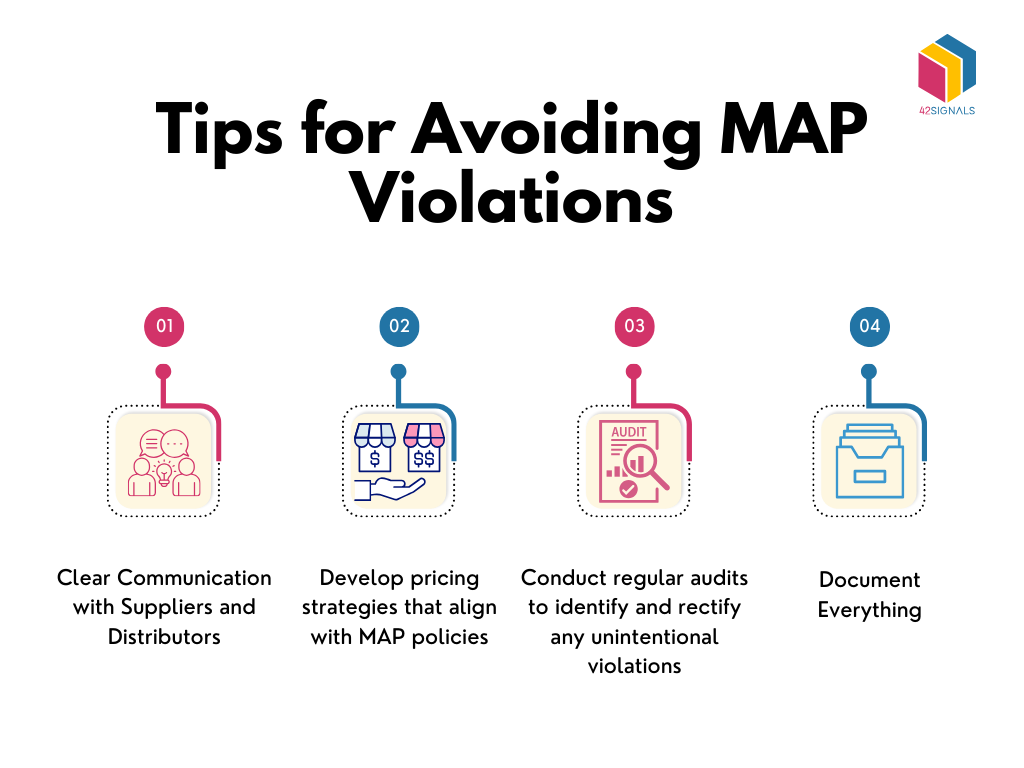
To avoid falling afoul of a MAP policy, sellers should embrace a proactive stance. Here are some practical tips to ensure compliance:
1. Clear Communication with Suppliers and Distributors
Establish open and transparent lines of communication with your suppliers and distributors. Ensure they are aware of your commitment to MAP compliance and request their assistance in monitoring the market for potential violations. For brands, this means having a clearly written, unambiguous MAP policy that is distributed to all partners upon signing. The policy should define what constitutes a violation, the enforcement process, and the consequences for non-compliance.
2. Pricing Strategies
Develop pricing strategies that align with MAP policies. This might involve setting prices slightly above the MAP to create a buffer or employing dynamic pricing algorithms that adjust prices in real-time to maintain compliance.
3. Regular Audits
Conduct regular internal audits to identify and rectify any unintentional violations via MAP monitoring. For brands, enforcement must be consistent and impartial. All violators, whether a small seller or a large retail partner, must be treated equally. A typical enforcement process might look like: a) Automated alert of a violation, b) A screenshot is taken as evidence, c) A first warning email is sent to the seller, d) If unresolved, a second warning is sent, and the seller’s supplier is notified, e) A formal complaint is filed with Amazon if the violation persists.
4. Document Everything
Keep meticulous records of your pricing policies and communications with suppliers and violating sellers. In case of disputes or claims, having a well-documented trail can be your saving grace. This is also essential to demonstrate that your enforcement is unilateral and not collusive.
5. Build Your Brand Authority
Ultimately, the best defense against a race to the bottom is to build a brand that customers seek out for reasons beyond price. Invest in marketing that highlights quality, innovation, customer service, and brand story. When customers are loyal to the brand itself, they are less likely to jump ship for a minor discount from an unauthorized seller.
Conclusion: Taking Control of Amazon MAP Violations
Navigating an Amazon MAP violation is not a one-and-done exercise — it is an ongoing operational discipline. The brands that win long-term are those that combine a watertight MAP policy, consistent enforcement documentation, and the right monitoring technology to catch violations before they compound.
Knowing exactly how to report a map violation on Amazon, what evidence Amazon requires, and how long enforcement typically takes puts you ahead of the vast majority of brands who react to violations rather than systematically eliminating them.
The right MAP monitoring software — one that captures cart-level violations, generates timestamped evidence, and automates seller outreach — is the difference between a policy that exists on paper and one that actually protects your brand on Amazon.
Take the proactive approach. Build your documentation stack, use the Brand Registry reporting tools, enforce consistently, and let MAP violations on Amazon become the exception rather than the norm.
Contact us at sales@42Signals.com to see how 42Signals can automate your Amazon MAP violation monitoring, evidence capture, and enforcement workflow.
Frequently Asked Questions
1. What is a violation at Amazon?
A violation at Amazon refers to any action by a seller that breaches Amazon’s policies, guidelines, or terms of service. This can include issues like listing prohibited products, manipulating customer reviews, engaging in price gouging, infringing on trademarks, or misrepresenting inventory. Violations are taken seriously and can lead to penalties such as listing removal, account suspension, or even permanent banning if not addressed properly.
2. How long do violations stay on Amazon?
The duration that a violation stays on record with Amazon depends on the severity of the offense and the seller’s compliance history. Minor issues may be resolved and removed after corrective actions are taken. However, serious or repeated violations can remain in a seller’s performance history indefinitely and impact account health metrics. Amazon doesn’t disclose a fixed expiration timeline for violations, so it’s essential to maintain ongoing compliance and respond to policy warnings promptly.
3. How to report violations on Amazon?
To report an Amazon MAP violation specifically:
Log in to brandregistry.amazon.com and navigate to Protect > Report a Violation.
Search for the violating ASIN.
Select the most applicable violation type (Pricing violation or Incorrect product information — Amazon has no dedicated MAP category).
Attach your timestamped screenshots and document the price discrepancy clearly.
Submit and save the case reference number for your enforcement log.
For IP-related violations tied to unauthorized sellers, also file via Amazon’s Notice of Claimed Infringement form.
4. Does Amazon use MAP tracking?
Amazon itself does not enforce or guarantee MAP (Minimum Advertised Price) policies for third-party sellers on its marketplace. However, many brands and manufacturers use external MAP monitoring tools to track whether sellers are advertising their products below agreed-upon prices on Amazon.
That said, Amazon’s Fair Pricing Policy does monitor for deceptive pricing and price gouging, which can sometimes be leveraged alongside a MAP complaint — particularly when an unauthorized seller’s below-MAP listing is causing consumer harm.
5. What documentation do I need to enforce an Amazon MAP violation?
To enforce a map violation on Amazon, you need: (1) a written, dated MAP policy document specifying prices per SKU; (2) a signed MAP agreement from the violating seller if they are authorized; (3) timestamped screenshots of the violation including ASIN, seller name, price, and date; (4) a record of prior warnings sent and any seller responses. Without this documentation, both Amazon and courts will have limited basis to act on your complaint.
6. How do I stop unauthorized sellers from listing my products below MAP on Amazon?
The most effective strategies are: (1) Enroll in Amazon Brand Registry and use the Report a Violation tool to flag unauthorized sellers; (2) Conduct a supply chain audit to identify where grey market inventory is leaking from — liquidators, overstocked distributors, or retail arbitrage are common sources; (3) File Notice of Claimed Infringement if the unauthorized listing involves counterfeit or IP issues; (4) Work with your authorized distributors to add serial-number tracking or MAP-compliant reseller agreements to cut off the supply to rogue sellers at the source.
7. How long does it take Amazon to resolve a MAP violation complaint?
Timeline varies by path: direct warnings to authorized sellers typically resolve within 24–72 hours if a signed MAP agreement is in place. Amazon Brand Registry reports take 3–7 business days for review, with listing action following within 24 hours of a positive decision. IP-based enforcement (NOCI) takes 5–10 business days. For 1P vendor pricing issues through Vendor Central, expect 7–21 business days with no guaranteed outcome.