


Executive Summary
A fast-growing fashion brand was selling across five major marketplace platforms without marketplace intelligence while simultaneously running its own Shopify storefront. On paper, the multi-channel strategy was working — GMV was growing, SKU count was expanding, and the brand had visibility across every major consumer touchpoint.
Beneath the surface, something else was happening. Third-party and grey market sellers were consistently undercutting the brand’s own prices on the same SKUs — not just at the listed price level, but through cart-drop discounts and active coupon codes that the brand had no way of monitoring.
The result: their Shopify storefront — where they kept 100% of the margin and owned the customer relationship — was structurally uncompetitive without the brand even knowing it. They were spending on D2C acquisition and losing the conversion to cheaper alternatives one click away.
The brand wasn’t losing to competitors. They were losing to their own ecosystem — and they couldn’t see it.
The Brand’s Situation
To understand why this problem is structural — and not a one-off pricing mistake — it helps to understand how multi-channel fashion selling actually works in practice.
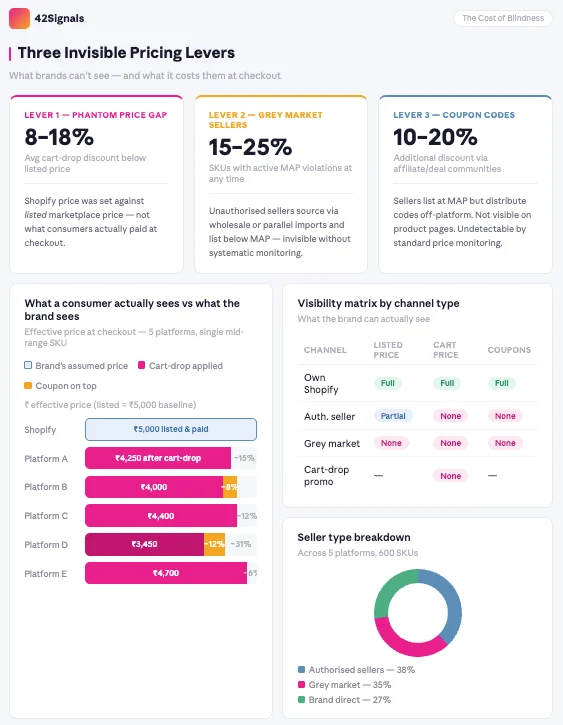
The channel landscape
The brand sold across five marketplace platforms alongside its Shopify store. Each marketplace has its own seller ecosystem, its own discount mechanics, and its own promotions engine. A brand that sells wholesale to distributors, or that has authorized sellers on marketplaces, is essentially operating a pricing environment it cannot fully control.
| Channel type | Who controls the price? | Visibility to brand |
| Own Shopify store | Brand (full control) | Complete |
| Marketplace (authorised) | Seller (listed price) | Listed price only |
| Marketplace (grey market) | Unauthorised seller | None |
| Cart-drop discounts | Platform algorithm | Zero — invisible |
The Cost of Blindness without Marketplace Intelligence
The brand’s core problem was not that it lacked a strategy. It had one. The problem was that it was executing that strategy without digital shelf performance metrics and intelligence required to know whether it was working.
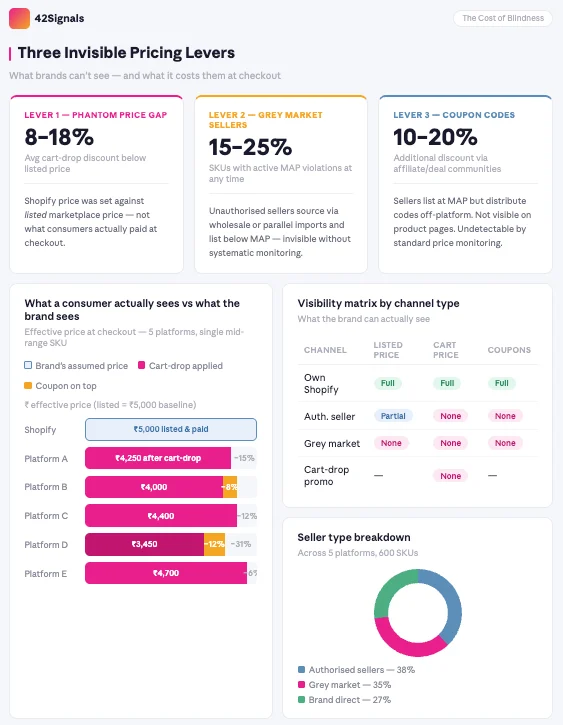
Problem 1: The phantom price gap
Marketplace listings show a ‘listed price.’ But that is rarely what a consumer actually pays. Platforms apply cart-drop discounts automatically — promotions that activate only when a product is added to cart, invisible to anyone browsing or doing manual price checks.
The brand was setting its Shopify price against the listed marketplace price. It believed it was competitive. In reality, the effective marketplace price — the price a consumer paid at checkout — was consistently 8–18% lower. The Shopify store was structurally more expensive for the same product, without anyone at the brand knowing it.
Problem 2: Unauthorised seller undercutting
Across five marketplace platforms, the brand had no systematic way to identify which sellers were listing its SKUs below the minimum advertised price (MAP). Manual spot checks happened occasionally, but with hundreds of SKUs and five platforms, it was impossible to track consistently.
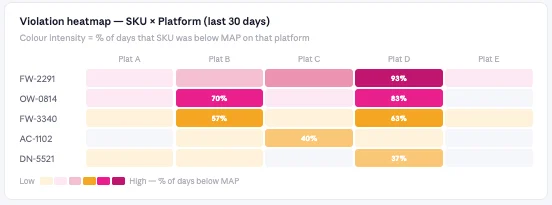
Alt text: violation heatmap and platform data by 42Signals
Grey market and unauthorised sellers — sourcing product through wholesale channels or parallel imports — were routinely listing below MAP. For a consumer comparing options, the brand’s own site was never the cheapest option.
Problem 3: Active coupon codes
Marketplace coupon codes are a third invisible lever. A seller might list at MAP, but distribute coupon codes to deal communities and affiliate networks that bring the effective price 10–20% lower. These codes are not visible on the product page and are rarely captured by standard price monitoring tools.
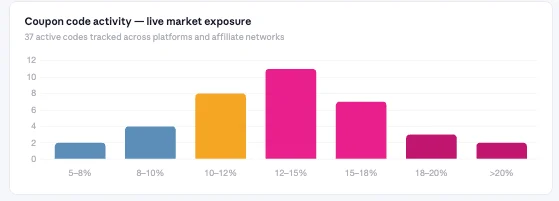
At any given moment, consumers could buy the brand’s products cheaper on a marketplace than on the brand’s own website — through three separate pricing mechanisms the brand couldn’t see.
What 42Signals Made Visible with Marketplace Intelligence
The brand deployed 42Signals, a real-time marketplace intelligence platform, to monitor pricing, seller activity, and promotional mechanics across all five marketplaces simultaneously.
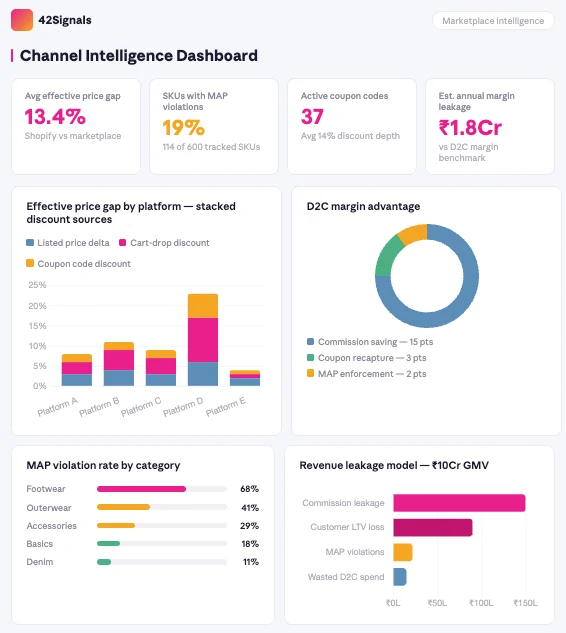
Real-time price parity monitoring
For the first time, the brand had a unified view of what every seller was charging for every SKU, updated in real time. Not the listed price — the effective price, including all platform-applied discounts.
- Identified which SKUs had the widest gap between Shopify price and effective marketplace price
- Flagged which sellers were consistently undercutting MAP
- Separated authorised sellers from grey market activity by seller ID and fulfilment pattern
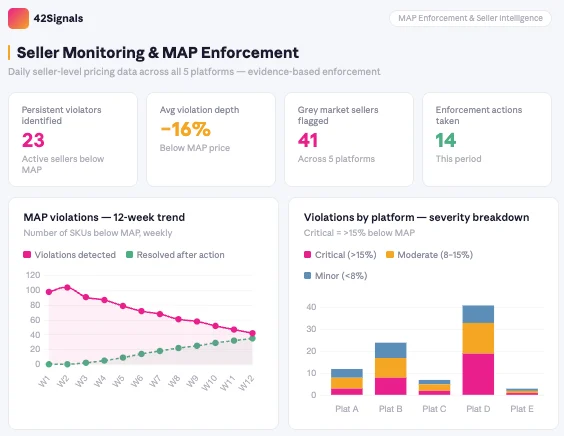
Cart-drop price capture
The platform captured prices at the cart stage — not just the product page. This is the critical differentiation: it reveals the price a consumer actually pays, not the price they first see.
- Cart-stage monitoring across all five platforms, updated daily
- Price delta reports showing Shopify vs effective marketplace price per SKU
- Trend data revealing which platforms applied the deepest cart discounts, and when
Coupon code intelligence
Active coupon codes in circulation were captured and catalogued, giving the brand a live view of promotional activity on its own SKUs — including codes it had not issued itself.
The brand now had answers to questions it didn’t even know it should be asking.
What Marketplace Intelligence Enabled
Visibility without action is just reporting. The marketplace intelligence the brand gained translated into three categories of direct action.
Action 1: D2C price competitiveness
Armed with accurate, real-time effective pricing data from all five marketplaces, the brand could make informed decisions about Shopify pricing with price benchmarking analytics. Where the gap was significant, they adjusted D2C pricing or introduced exclusive D2C promotions to make their own channel the most attractive option.
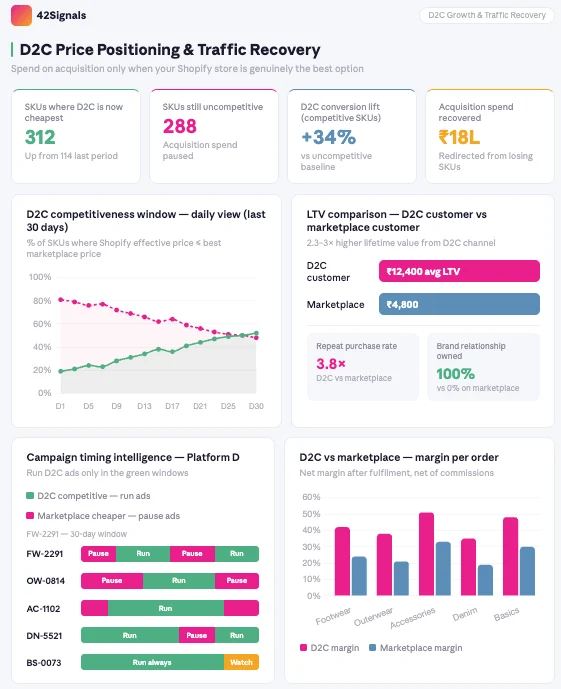
This is not simply ‘price matching.’ It is strategic price positioning based on actual market data — deciding where to compete on price and where to compete on exclusive product, service, or experience.
Action 2: MAP enforcement with evidence
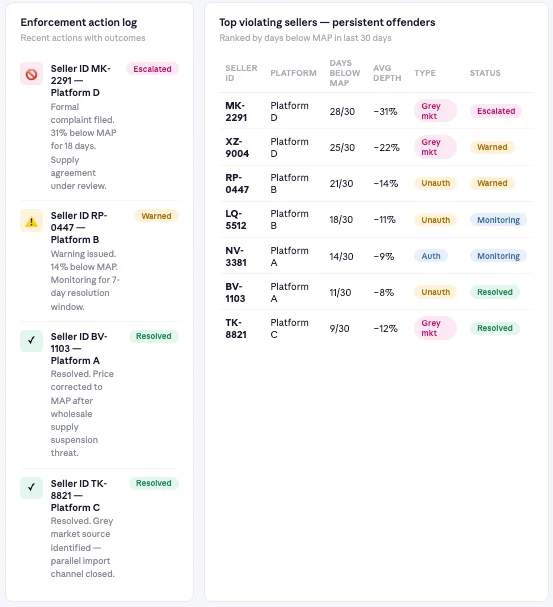
Prior to using the platform, MAP violation conversations with marketplace sellers were difficult: the brand could observe a violation when it happened to spot it, but lacked systematic evidence to build a case. With an ecommerce competitor price intelligence platform like 42Signals, the were able to understand where the violations were concentrated.
With daily seller-level pricing data, the brand could identify persistent violators, document the pattern, and take action through marketplace seller relations — either through formal complaints or by adjusting wholesale supply agreements.
Action 3: Traffic recovery strategy
With a clear picture of where price parity powered by ecommerce marketplace intelligence had been restored or maintained, the brand’s marketing team could run D2C-directed campaigns with confidence. Spending on paid acquisition to drive traffic to a structurally uncompetitive storefront is wasted. Spending on acquisition when the D2C price is genuinely the best available converts.
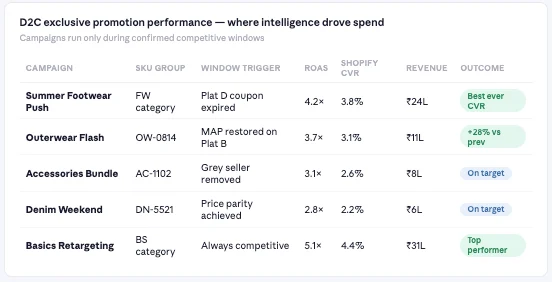
The brand used the competitive pricing data to time and target D2C promotions, knowing when the window existed to make Shopify the most attractive option across the consumer’s consideration set.
Value at Stake: The Numbers a Reader Should Run
Within 60 days of deployment, the brand had identified MAP violations on 22% of monitored SKUs and reduced the average D2C price gap from 14% to under 4% on its top 50 revenue-generating SKUs.
Benchmark: Margin differential
| Metric | Range | Source |
| Marketplace commission (fashion) | 15–25% | Industry avg |
| D2C margin advantage over marketplace | 12–18 pts | Net of logistics |
| Cart-drop discount depth (observed) | 8–18% | Platform-specific |
| Coupon code discount depth (typical) | 10–20% | Affiliate networks |
| D2C customer LTV vs marketplace customer | 2.3–3× higher | Fashion D2C benchmark |
| % of SKUs with active MAP violations | 15–25% | Category average |
Framework: Revenue leakage calculation
For a brand doing ₹10 crore annual GMV across marketplaces, the numbers look like this:
| Leakage source | Annual value at stake |
| Margin lost to marketplace commissions (vs D2C) | ₹120–180 lakhs |
| Revenue erosion from MAP violations (15% of SKUs) | ₹15–30 lakhs |
| D2C acquisition spend wasted on uncompetitive storefront | Varies (media budget dependent) |
| LTV loss from customer going to marketplace (not D2C) | 2.3–3× per customer, compounding |
The Takeaway to Use Marketplace Intelligence
The most important thing this case study demonstrates is not that the brand fixed its pricing. It’s that the brand didn’t know it had a pricing problem until it had the intelligence to see it.
Every multi-channel fashion brand operating on marketplaces alongside a D2C storefront is exposed to the same structural blindspots: cart-drop prices they can’t see, coupon codes they can’t track, and seller activity they can’t monitor at scale. The question is not whether the gap exists. The question is whether you know how wide it is and how to solve it with marketplace intelligence.
42Signals monitors marketplace pricing, seller activity, cart-drop discounts, and coupon codes in real time — so you always know the price your customers are actually paying. Book a demo and we’ll show you the grey market gap on your own SKUs in the first session.
Frequently Asked Questions
What are cart-drop discounts and why can’t brands see them?
Cart-drop discounts are automated promotional reductions applied by marketplace platforms that only become visible to the consumer when they add a product to their shopping cart. They are a platform mechanism to incentivize immediate purchase and boost conversion, often applied algorithmically or as part of a temporary platform-wide promotion.
Brands typically cannot see these discounts for two primary reasons:
They are invisible on the product page: The listed price is the only price displayed during standard browsing or manual spot-checks.
Lack of cart-level monitoring: Standard brand price-monitoring tools typically scrape the product page listed price. They do not emulate the full consumer buying journey (i.e., adding to cart and proceeding to checkout) across multiple platforms simultaneously, which is required to capture the effective final price. This invisibility creates a “phantom price gap” where the brand believes its D2C store is competitive against the marketplace’s listed price, but the D2C channel is actually 8–18% more expensive at the checkout stage.
How do grey market sellers get hold of branded products?
Grey market sellers—who are not officially authorized by the brand to sell on a particular channel—typically acquire branded products through legitimate, but non-sanctioned, means. Common sources include:
Wholesale Leakage: Products sold to authorised distributors or retailers often find their way onto secondary markets. A distributor might sell excess stock to a third-party seller who then liquidates it on a marketplace below the brand’s MAP.
Parallel Imports/International Arbitrage: Products sold into one geographic market at a lower price point are purchased and resold in another market (like the US) where the official price is higher.
Closeout and Liquidation Sales: Products sold at a discount to liquidators to clear old inventory can be quickly resold on marketplaces.
Fraudulent Returns or Sourcing: Though less common, sellers may use illicit means to acquire product, or simply liquidate genuine but unwanted stock obtained through legitimate channels.
What is MAP enforcement and how do you monitor it at scale?
Minimum Advertised Price (MAP) is the lowest price a retailer or seller is contractually allowed to display for a brand’s product. MAP enforcement is the process of monitoring, identifying, and taking action against sellers who violate these agreements by listing products below the stipulated price.
Monitoring MAP at scale requires a systematic approach, moving beyond manual spot-checks:
1. Real-Time Data Capture
This involves continuous scraping of listed prices and seller IDs across all target marketplaces (for example, tracking multiple platforms simultaneously).
Benefit: Ensures 24/7 visibility across hundreds or thousands of SKUs.
2. Seller Identification
This includes automated mapping of marketplace seller IDs to known authorised and unauthorised seller lists.
Benefit: Instantly separates legitimate channel partners from grey market activity.
3. Violation Heatmaps and Reports
This refers to generating daily reports that quantify the depth and frequency of MAP violations by SKU, platform, and seller.
Benefit: Provides clear, structured evidence for enforcement action and helps prioritize the worst offenders.
How do I make my D2C store price-competitive against marketplace listings?
Achieving price competitiveness for your D2C store requires moving beyond matching the listed marketplace price and focusing on the effective final price the consumer pays.
Restore Price Parity Visibility: Deploy a tool (like 42Signals) that captures cart-drop discounts and active coupon codes on marketplaces to determine the true, effective price. You must know the real gap before you can close it.
Strategic Price Positioning: Use the effective price data to strategically adjust D2C pricing. Instead of lowering your listed price across the board, consider: D2C Exclusives: Offer product bundles, unique colors, or complimentary services (e.g., free premium shipping) that add value without lowering the list price.
Timed Promotions: Run D2C-exclusive promotions only when the competitive data shows a window of opportunity, ensuring your site is temporarily the best-priced option.
Address Leakage (MAP Enforcement): Systematically enforce MAP against grey market and unauthorised sellers. By eliminating the cheapest alternatives on the marketplace, you structurally improve the D2C store’s position in the consumer’s consideration set.
Emphasize LTV: Compete on value metrics beyond immediate price—emphasize the loyalty programs, customer service, and direct relationship that justifies any minor price difference.