

The announcement01 / 05
Prices rose on launch day
Apple raised prices on four older models as the iPhone 18 Pro and the foldable iPhone Duo were unveiled on 9 September.
₹15,000–₹30,000Base-model increases
NEW REPORT - How did Dussehra prices differ across Indian cities? Download our report to find out!

For most of the past decade, the arrival of a new iPhone meant lower prices for the previous models. On 9 September 2026 Apple reversed that pattern in India. As the iPhone 18 Pro and the foldable iPhone Duo were unveiled, the company raised the price of four carried-over models, including a ₹17,000 increase on the year-old iPhone 17.
Base storage tiers. Apple India starting prices as publicly reported.
The primary driver is cost. An industry-wide shortage of memory chips pushed component prices higher throughout 2026, affecting most smartphone manufacturers. Apple’s response was not limited to India. In the United States the iPhone 17 rose from $799 to $899, an increase of about 12.5%.
India’s increase was larger. Indian retail prices carry several additional layers, including 18% GST on mobile phones, customs duty on imported components and the effect of a weaker rupee. Each layer is applied to a higher base, so a global cost increase is amplified by the time it reaches an Indian shelf.
India is now one of Apple’s most important manufacturing bases, and a significant share of iPhones sold in the country are assembled locally. Local assembly reduces some costs, but it does not remove taxes or the cost of imported components such as memory and processors. The result is that domestic production has not translated into domestic price parity with the United States.
The broader tax history reinforces the point. GST on mobile phones increased from 12% to 18% in 2020, and changes to customs duty on phones and components between 2018 and 2020 raised costs again. Policy changes in 2025 improved consumer sentiment for a period, but the memory-cost increase in 2026 has absorbed much of that benefit.
Use the arrows or swipe to move through the timeline of events.
The announcement01 / 05
Apple raised prices on four older models as the iPhone 18 Pro and the foldable iPhone Duo were unveiled on 9 September.
₹15,000–₹30,000Base-model increases
The cost driver02 / 05
An industry-wide memory-chip shortage raised component costs across smartphone makers through 2026.
$799 → $899iPhone 17 US price
The tax context03 / 05
GST at 18% on mobile phones, import duties on components and currency movements all compound the base price in India.
18%GST on mobile phones
The market effect04 / 05
Sellers holding stock bought at the old price faced an immediate choice: reprice, hold or undercut.
4 modelsRepriced overnight
The pricing risk05 / 05
Differences between channels became visible to shoppers and regulators within hours of the announcement.
Same dayWindow for policy breaches
A price increase at the manufacturer level is not a single event. Once Apple published new prices, every retailer, marketplace listing, comparison site and reseller in India was working from outdated information. Each seller had to decide whether to reprice immediately, hold the previous price or move in a different direction.
For shoppers, the outcome is a market in which the same phone can carry noticeably different prices across tabs and platforms on the same day. For brands, those differences are where minimum advertised price violations appear, and where unauthorised sellers can use the gap to undercut authorised channels.
A price increase announced once becomes thousands of individual price decisions across the market.
42Signals tracks listed prices for every seller of your products across Indian marketplaces, so a brand-level price change can be checked against the market within hours.
The iPhone reset illustrates a challenge that applies to any brand selling through multiple channels. When the manufacturer price changes, the brand needs to know three things quickly:
Answering those questions manually is slow, particularly when a brand has hundreds of SKUs across several marketplaces.
In previous years, Apple’s September launches followed a predictable pattern in India. The newest models entered at the top of the range, and the previous generation was either reduced in price or discontinued. Retailers and marketplaces built their festive season plans around that pattern, using older models as the main volume drivers during October and November sales.
For marketplaces, the practical effect is that festive discounts on these models will be calculated from a higher list price. A discount that appears large against ₹99,900 may still leave the iPhone 17 above the price at which it sold earlier in the year. Shoppers comparing prices across platforms are likely to notice the difference, and sellers that present the new list price as the reference point may face questions about how genuine their discounts are.
For brands outside the smartphone category, the iPhone price hike in India is a useful reference case. Any manufacturer facing rising input costs may need to raise prices on existing products mid-cycle, and the same challenges of stale listings, inconsistent channels and reseller undercutting will follow.
On 9 September 2026 Apple raised base-model prices for the iPhone 17 by ₹17,000 to ₹99,900, the iPhone 17e by ₹15,000 to ₹79,900, the iPhone Air by ₹30,000 to ₹1,49,900 and the iPhone 16 by ₹20,000 to ₹89,900.
The increases coincided with a sharp rise in memory-chip costs across the smartphone industry in 2026. Apple also raised prices in other markets, including the United States, where the iPhone 17 rose from $799 to $899.
In percentage terms, yes. The iPhone 17 rose about 20.5% in India compared with about 12.5% in the United States, before accounting for taxes and currency movements.
Retailers should update listings promptly, check that all channels show the same price, and monitor marketplace sellers who continue to advertise the previous price, as these listings can breach minimum advertised price policies.
Apple’s September price reset ends the assumption that older iPhones become cheaper when a new model arrives, at least while component costs remain elevated. For the wider retail market, the more significant lesson is operational: a single price change at the top creates a period in which many prices across the market are wrong. Brands that can see that period clearly, and act on it within hours, protect both their margin and their pricing integrity. 42Signals provides that visibility through continuous competitor price benchmarking across Indian marketplaces.
The Research Desk analyses retail pricing, promotions and availability across marketplaces and quick commerce platforms in India and global markets. Signal Desk articles are reviewed by the 42Signals editorial team before publication.
Track how quickly marketplace sellers align with a new manufacturer price.
As the festive sale season begins, many headline discounts are calculated from reference prices that shoppers have never paid. The gap between the badge and the real saving is now a regulatory and reputational issue for brands.
Flipkart’s Big Billion Days and Amazon’s Great Indian Festival begin within a day of each other. The listed price is only one part of the comparison; bank discounts, exchange offers and earlier sales often decide which platform is cheaper.
Nike reports its first-quarter results on 1 October with its shares near a 12-year low. On the same day, Nike India opens a sale with discounts of up to 40%. The overlap highlights a challenge for every brand that relies on markdowns to clear stock.

Empowering clients with smart insights for a better future. Get eCommerce insights on promotions, product stocks, and market trends. 42Signals equips consumer brands with rich data to turn customer insights into retail excellence.
COMPANY
RESOURCES
NEWSLETTER

We at 42Signals are committed to GDPR compliance and the secure handling of your data. We guarantee that your information is never shared with external parties and is never stored or processed beyond its necessary purpose.

• THIS WEEK ON YOUR SHELF
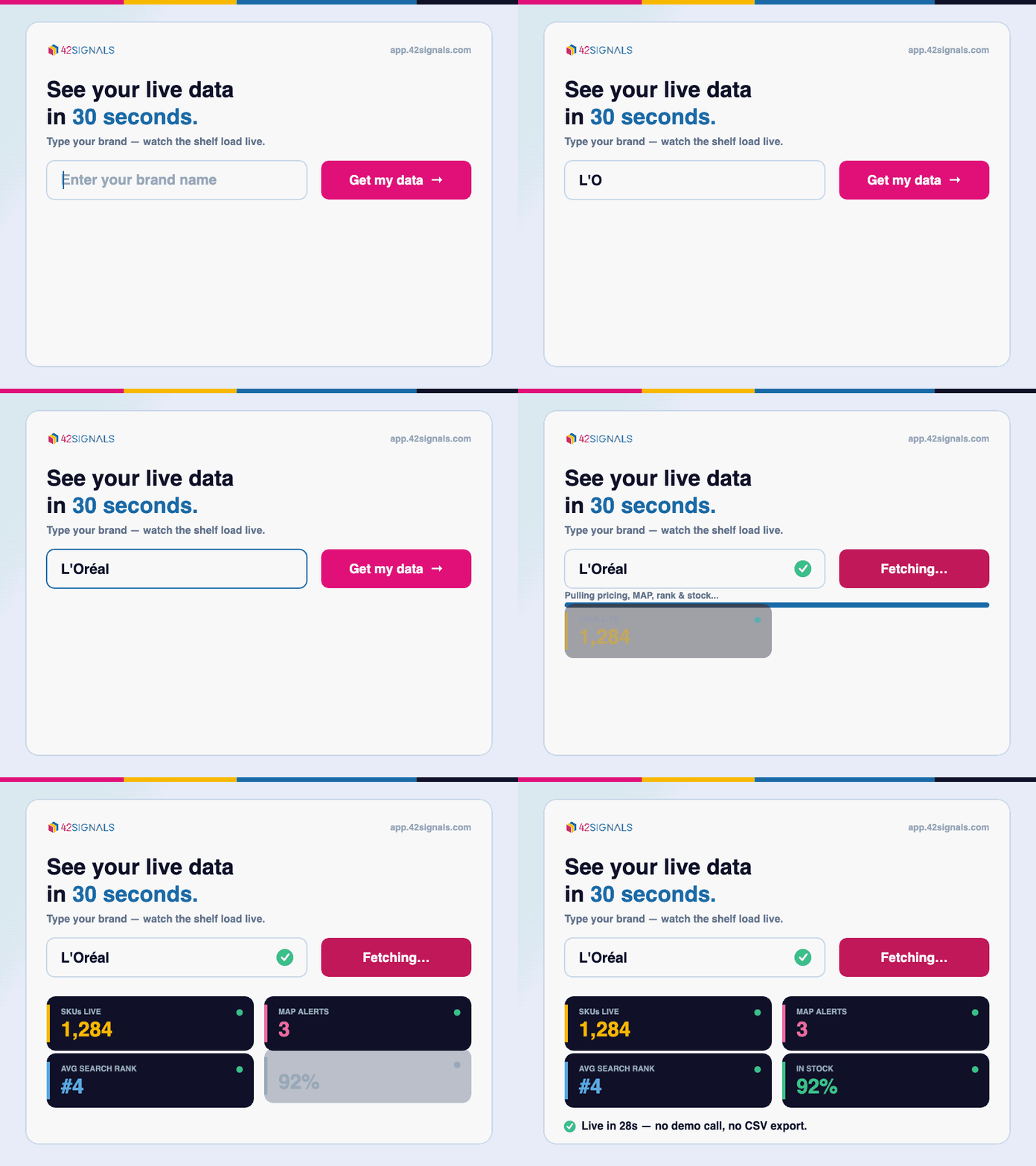
Unlock near real time digital shelf data, map violation, and competitor moves. Create your free account below.
🛡️ Free Instant Access • No Credit Card Needed
www.42signals.com
200+ Brands • 18M+ SKUs • 20+ Retailers • 4 Continents
www.42signals.com