

NEW REPORT - How did Dussehra prices differ across Indian cities? Download our report to find out!
A first-of-its-kind in-house study of the Indian festive shelf, based on 1,040 manual observations.
Finding
Quick commerce
Marketplace
Observations that could not result in a purchase
33.6%
23.7%
Lower-priced channel in 212 matched pairs
13.7%
65.1%
Like-for-like comparisons with a city price gap
28%
39%
Median gap between cities, where prices differed
12.4%
7.3%
Average discount from MRP, baseline to Dussehra
16.1% to 17.2%
24.3% to 22.6%
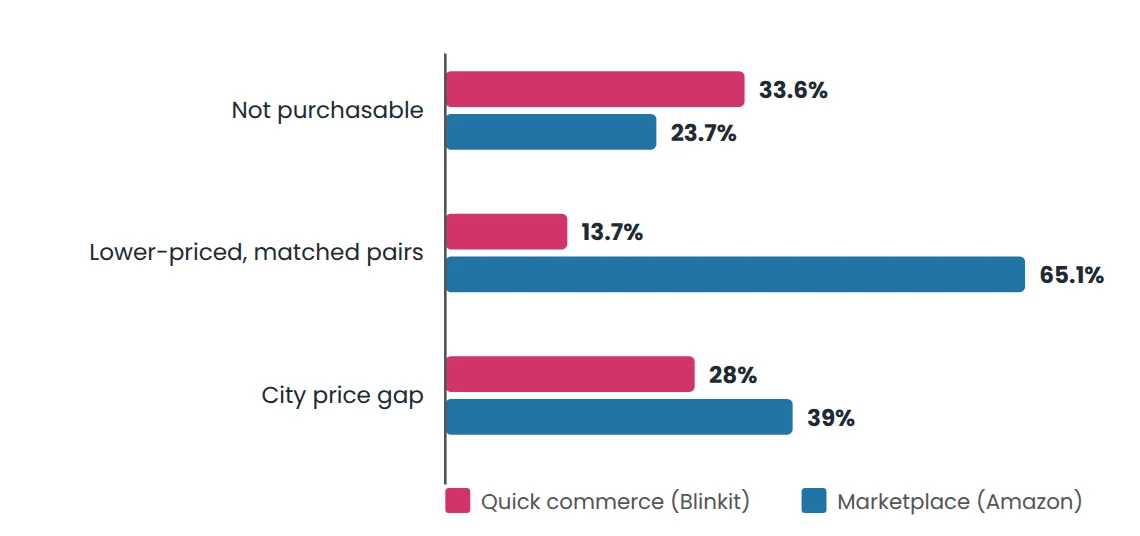
One in three quick commerce observations could not result in a purchase, and the marketplace was the lower-priced channel in nearly two thirds of matched pairs.
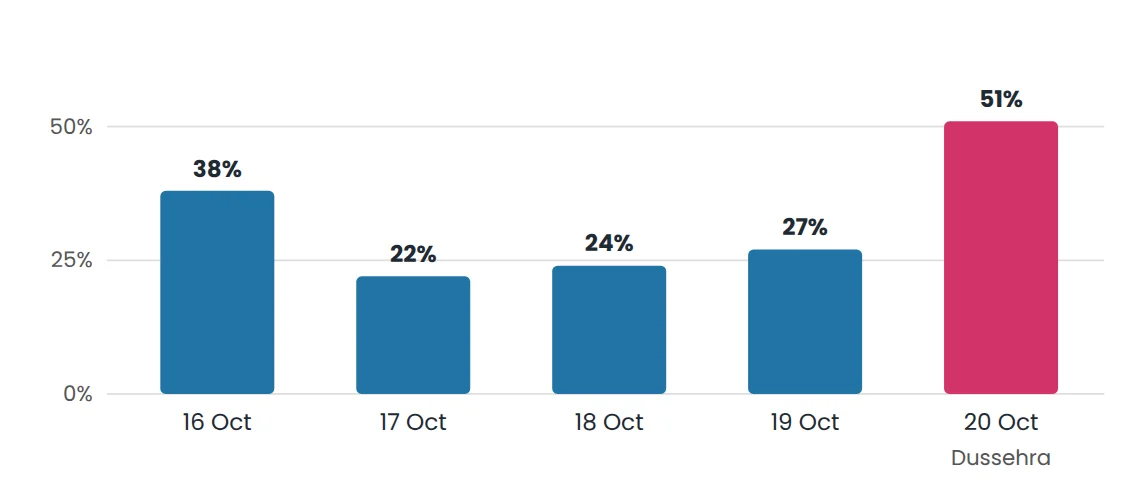
On 17 October, 22% of like-for-like comparisons showed a price gap between cities. On Dussehra, the figure was 51%.
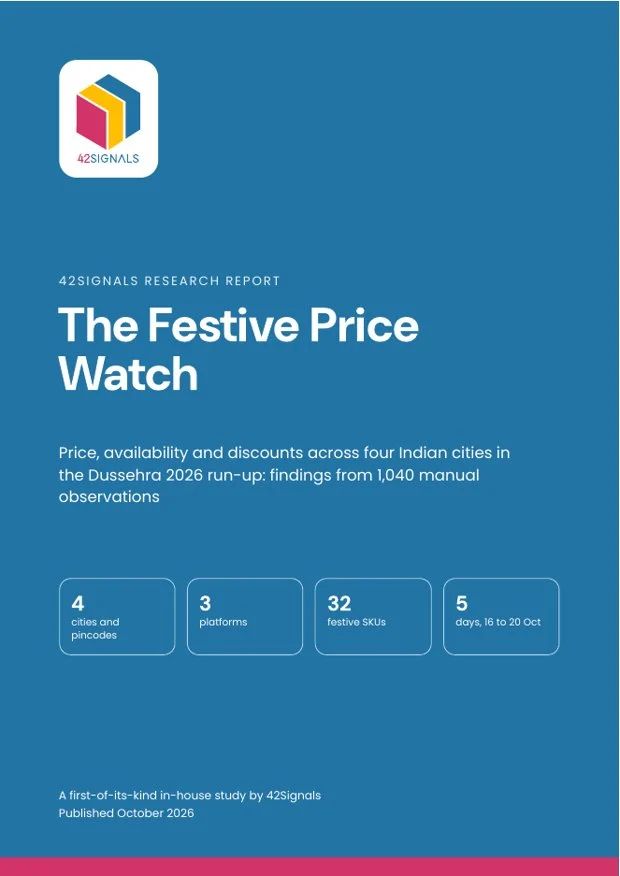
26 pages, 8 charts, 12 tables. PDF, free.
Role
The question the report answers
What you take away
Brand and category managers
Is my hero SKU available, and at what price, in the pincodes that matter during festive peaks?
City and day level evidence on availability and price for 32 festive SKUs across eight categories
Pricing and revenue teams
How far do my prices diverge across cities and channels, and did festive discounts land as planned?
Like-for-like price gaps, discount depth by day, and the quick commerce premium by category
Ecommerce and marketplace leads
Where is quick commerce costing conversions through stock-outs or price premiums?
Unavailability by category and city, and channel comparisons for the same pack
Compliance and leadership
Can we evidence a 30-day prior price for every discount from 1 January 2027?
The scale of MRP and price variation, and the monitoring record the rule requires
Sales and key accounts
What should we raise with platforms before Diwali?
Specific, dated examples of price and availability gaps to support platform discussions
Risk area
What the study observed
Potential impact
Lost sales
One in three quick commerce observations could not result in a purchase
Peak festive demand reaches listings that cannot convert
Price integrity
The same gift pack sold for ₹91 in Bengaluru and ₹145 in Mumbai on Dussehra
Uncontrolled discount depth across regions
Channel conflict
Quick commerce higher-priced in 65.1% of matched pairs
Promotions in one channel undercut the other
Compliance readiness
15 of 32 SKUs carried more than one MRP
Prior-price claims cannot be verified without a continuous record
Manual monitoring (this study)
Automated monitoring (42Signals)
Coverage
32 SKUs, 3 platforms, 4 pincodes
Over 18 million SKUs for more than 200 brands, across Amazon, Flipkart, Blinkit, Zepto, Instamart, Nykaa and 20+ retailers
Cadence
One observation per listing per day
Refreshed as often as every 15 minutes
Location
One pincode per city
Pincode and dark-store level
Consistency
Recording conventions varied across researchers and days
The same fields captured on every run
Effort
14 to 43 minutes per city per day, plus cleaning
A continuous feed for decision-making
30-day history
Five days, with gaps
A continuous record per SKU, platform and location
The Festive Price Watch is a first-of-its-kind in-house study by 42Signals. Four researchers recorded the price, MRP, discount and availability of the same 32 festive SKUs on Blinkit, Amazon and Nykaa every day from 16 to 20 October 2026, in Ghaziabad, Pune, Mumbai and Bengaluru, producing 1,040 manual observations.
In the study’s 212 like-for-like matches of the same pack, city and date, the marketplace was lower-priced in 65.1% of cases and quick commerce in 13.7%. The median quick commerce premium was 6.3%, rising to 22.4% in protein and 15.2% in beauty.
Quick commerce serves each pincode from a dark store with its own inventory, and marketplaces restrict delivery by location. In the study, the same SKU on the same platform on the same date, with the same MRP, carried a different price between cities in 39% of marketplace and 28% of quick commerce comparisons, rising to 51% on Dussehra.
During the Dussehra 2026 study period, 33.6% of quick commerce observations and 23.7% of marketplace observations could not result in a purchase because the product was out of stock, not listed or not deliverable to the pincode. Electronics reached 72% unavailability on quick commerce.
A dark store is a fulfilment centre that serves online orders for a defined delivery area rather than walk-in shoppers. Because each dark store holds its own stock, product availability on quick commerce can differ from one pincode to the next, which the study observed in 30% of quick commerce SKU-days recorded in two or more cities.
Not on the marketplace in this study. The average Amazon discount declined from 24.2% on 16 October to 21.4% on Dussehra, and more SKU and city pairs received a shallower discount (29%) than a deeper one (20%).
Under India’s Consumer Protection (E-commerce) (Amendment) Rules, 2026, in force from 1 January 2027, an announced price reduction must be shown with the prior price, defined as the lowest price offered in the previous 30 days. In the study, 15 of 32 SKUs carried more than one MRP across listings, which makes a continuous price and MRP record essential.
Manual tracking in this study produced one observation per listing per day and required 14 to 43 minutes per city per day, with gaps in coverage. Automated competitor price monitoring with 42Signals captures price, MRP, discounts, stock, pincode availability and sponsored rank at pincode and dark-store level, refreshed as often as every 15 minutes.

Empowering clients with smart insights for a better future. Get eCommerce insights on promotions, product stocks, and market trends. 42Signals equips consumer brands with rich data to turn customer insights into retail excellence.
COMPANY
RESOURCES
NEWSLETTER

We at 42Signals are committed to GDPR compliance and the secure handling of your data. We guarantee that your information is never shared with external parties and is never stored or processed beyond its necessary purpose.

• THIS WEEK ON YOUR SHELF
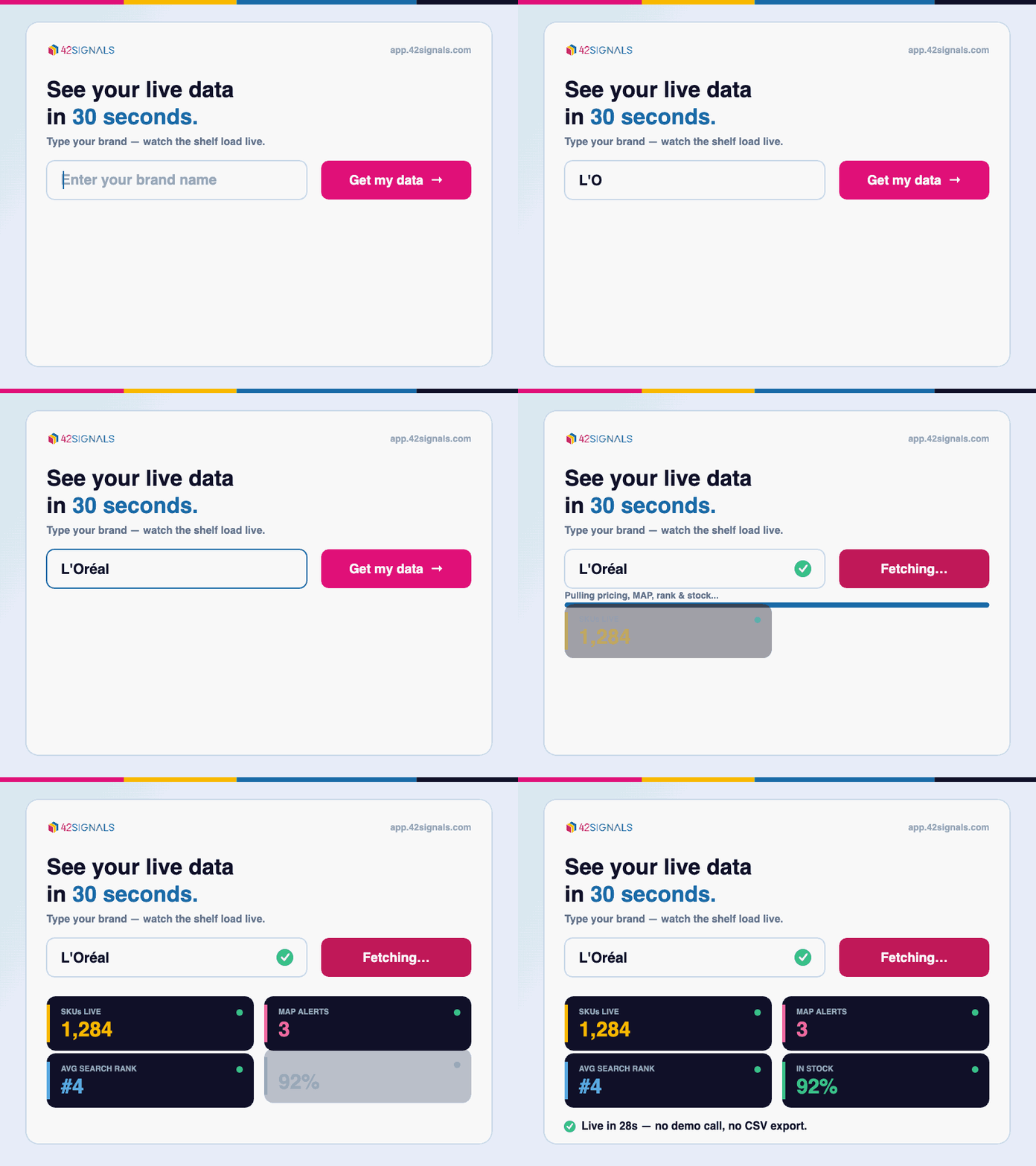
Unlock near real time digital shelf data, map violation, and competitor moves. Create your free account below.
🛡️ Free Instant Access • No Credit Card Needed
www.42signals.com
200+ Brands • 18M+ SKUs • 20+ Retailers • 4 Continents
www.42signals.com