

NEW WEBINAR - Unauthorized sellers are listing your products right now. Do you know who they are?
Duration · 10 Mins
Unauthorized sellers, grey imports, and untracked distribution routes are quietly eroding your prices, damaging your authorized channel partners, and creating customer experience problems you can’t see. This webinar shows you exactly where to look and what to do when you find them.



seller, price, product, location, and pattern, connected together, they reveal channel leakage that no single data point can
potential value impact when a ₹2,000 per-unit price gap scales across 10,000 affected units, before you’ve even spotted the source
below expected price, the threshold gap that, appearing week after week in an unexpected market, signals channel leakage, not a random promo
Brands have zero visibility into seller identity, authorization status, and regional variants, the information that actually explains a price anomaly
Products leave the factory at controlled prices with clear regional allocation.
Products move through vetted partners who have signed your distribution agreements.
Approved sellers list your products at MAP-compliant prices on agreed marketplaces.
Purchases through official channels at your intended price. Brand experience intact.
Products leak into secondary networks, sometimes from overstock, sometimes from cross-border arbitrage, sometimes from inside your own supply chain.
Genuine products intended for another geography enter your market through parallel routes. Not counterfeit, but not authorized either, and impossible for shoppers to distinguish.
Unfamiliar sellers list your SKUs at aggressive discounts, forcing authorized partners to compete with prices they structurally cannot match without destroying their margins.
Authorized partners complain. Margins compress. Customer support fields issues about regional variants. And you still don't know where the leak started.
Screenshots and weekly spreadsheets show you prices. They never show you sellers, authorization status, geographic patterns, or the connections between them.
Official brand store
₹60,000
Authorized seller A
₹58,000
Authorized seller B
₹57,000
Unknown seller C
₹53,000
Unknown seller D
₹50,000
You can see that ₹50,000 is wrong. You cannot see whether it’s a legitimate clearance promo, old inventory being liquidated, a grey import, or an unauthorized distributor actively undercutting your channel. Those are four completely different problems requiring four completely different responses.
The price anomaly is the signal. These are the actual causes, each requiring a different enforcement action.
The marketplace itself is funding the discount. No channel issue, but easy to mistake for one and trigger unnecessary enforcement.
A seller clearing ageing stock. Temporary and self-resolving, but often triggers reprices reactions that outlast the original discount.
An authorized seller subsidising from their own margin to win volume. A channel relationship conversation, not a legal enforcement action.
Products reaching the market through a route you never sanctioned. Requires legal action against the leaking distributor, not the seller.
A genuine product, wrong geography. Customer service, warranty, and regulatory risks that require immediate takedown escalation.
Who is actually listing your product? Are they on your authorized seller list? Have they appeared before? A new, unrecognized seller is the first and most critical signal. everything else connects back to it.
Not just the price itself, but the gap between it and expected pricing, how consistently it appears, and whether it's moving over time. A one-off low price differs entirely from a persistent discount 12% below floor.
Which variant is being listed, and does it match the region? A product variant not intended for your market, different SKU suffix, different language on the box, incorrect power standard, is the signature of a grey import.
Which marketplace, which geography, and is this consistent with your authorized distribution map? A product appearing in a market where you have no authorized sellers points directly to the type of leak you're dealing with.
Is this happening once, or week after week? At what cadence? Across which SKUs? A recurring pattern across multiple SKUs and multiple marketplaces is channel leakage at scale, not a random pricing event.
42 Signals Platform
Submit 10 SKUs across 2–3 marketplaces and 42 Signals will scan your digital shelf for unexpected sellers, unusual price gaps, and unauthorized distribution patterns.
Affected units
10,000
Average price erosion per unit
₹2,000
Marketplaces affected
2–3
Duration before detection
Weeks to months
Potential value impact
Before factoring in channel conflict costs, authorized partner margin pressure, and long-term brand perception damage.
Understand the routes your products actually travel versus the routes you planned and identify the specific points where unauthorized sellers enter your distribution network.
Learn to distinguish between a legitimate promotion, old inventory, seller-funded discounting, unauthorized distribution, and a grey import, because each one requires a completely different response.
Build a connected picture of seller, price, product, location, and pattern for your top SKUs and learn to spot the combinations that indicate channel leakage versus random pricing events.
Detection alone doesn't stop channel leakage. Learn how to prioritize commercially significant anomalies and route them to the right team, legal, e-commerce, or channel management, for rapid enforcement.

Empowering clients with smart insights for a better future. Get eCommerce insights on promotions, product stocks, and market trends. 42Signals equips consumer brands with rich data to turn customer insights into retail excellence.
COMPANY
RESOURCES
NEWSLETTER

We at 42Signals are committed to GDPR compliance and the secure handling of your data. We guarantee that your information is never shared with external parties and is never stored or processed beyond its necessary purpose.

• THIS WEEK ON YOUR SHELF
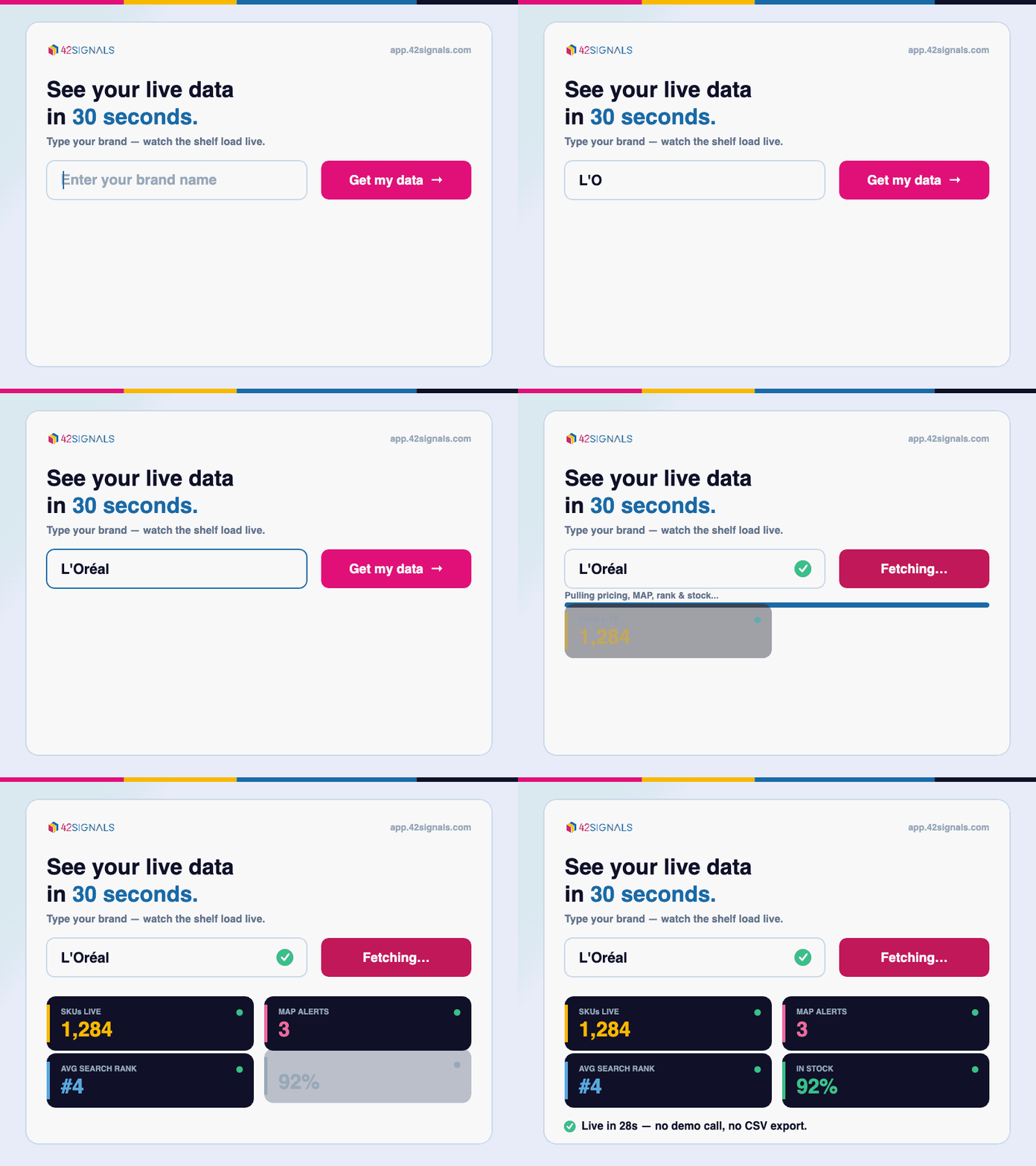
Unlock near real time digital shelf data, map violation, and competitor moves. Create your free account below.
🛡️ Free Instant Access • No Credit Card Needed
www.42signals.com
200+ Brands • 18M+ SKUs • 20+ Retailers • 4 Continents
www.42signals.com