

Cyber Monday 2026 promises to be another high-stakes opportunity for online retailers. With shoppers looking for the best discounts, e-commerce businesses face increased competition to attract buyers and achieve high sales volumes.

Image Source: Loomly
To succeed, businesses must focus on strategic promotions, smart inventory planning, and leveraging platforms like Amazon to maximize reach.
Here’s how retailers can optimize their sales approach for Cyber Monday 2026 and make the most of this critical shopping event.
When Is Cyber Monday 2026?
Cyber Monday 2026 falls on Monday, 30 November 2026.
Cyber Monday always lands on the Monday immediately after US Thanksgiving, which means it moves each year between 26 November and 2 December. In 2026, the full sequence runs:
| Event | Date | What it means operationally |
|---|---|---|
| Thanksgiving | Thursday, 26 Nov 2026 | Deals begin going live the evening before |
| Black Friday | Friday, 27 Nov 2026 | Peak single-day traffic and discounting |
| Small Business Saturday | Saturday, 28 Nov 2026 | Relevant positioning window for smaller D2C brands |
| Cyber Monday | Monday, 30 Nov 2026 | Online-focused peak; historically over-indexes on electronics and D2C |
| Cyber Week | 27 Nov – 30 Nov 2026 | The period to plan inventory and promotions around, not the single Monday |
The practical implication for inventory planning: Cyber Monday is not a separate event to stock for. It is the closing day of a four-day period during which most of your Black Friday allocation has already moved. Planning the two independently is the most common cause of running out on the Monday.
What is the Impact of Cyber Monday on E-commerce Sales?

Image Source: Demand Sage
Cyber Monday has established itself as a cornerstone for online shopping, with consumers flocking to platforms for the best deals on electronics, fashion, home goods, and more.
For e-commerce businesses, it’s a prime opportunity to drive revenue and build brand visibility. Platforms like Amazon and other popular marketplaces make it easy for businesses to access large audiences ready to spend.
Still, the competition for customer attention has grown exponentially, requiring sellers to differentiate through compelling offers, targeted ads, and a seamless shopping experience.
How to Design Winning Cyber Monday 2026 Deals That Drive Sales?
1. Building Anticipation with Early Promotions
Kicking off early promotions helps businesses generate interest before the Cyber Monday rush. “Sneak peek” campaigns and countdown offers build excitement and give early access to loyal customers.
By launching a series of promotions leading up to Cyber Monday 2026, businesses can capture early sales and spread out order volumes, which helps manage inventory more effectively.
2. Flash Sales and Limited-Time Discounts
Creating urgency is key to capturing impulse buys, and timed flash sales are highly effective for this. Many businesses schedule multiple flash deals throughout Cyber Monday 2026, giving customers a reason to revisit and purchase again.
Flash sales create a second-order problem worth planning for. Concentrating demand into a one-hour window is effective precisely because it sells through fast, which means a product that had comfortable cover before the deal can be out of stock by the time the next traffic wave arrives. Scheduling flash deals on products where you hold depth, rather than on whatever is discounted most steeply, keeps the mechanic from creating gaps on your best-converting listings.

Image Source: Wix
Highlighting high-demand items during these sales can bring in a surge of visitors, all eager for limited-time bargains.
3. Offering Product Bundles for Added Value
Bundling products is a great way to increase average order values while providing customers with perceived savings. For example, electronics retailers can bundle headphones with smartphones, or home goods stores can offer bundled kitchen items at a reduced rate.
These deals provide shoppers with added value, while businesses benefit from moving more units of related products.
4. Personalizing Promotions Based on Customer Data
Using customer data to shape promotions can significantly improve engagement. Analyzing past purchase behaviors, demographics, and browsing habits allows businesses to create ads and email offers that resonate with specific segments.

Image Source: The CMO
Offering returning customers personalized discounts on previously viewed items or related products can increase the likelihood of conversion. Additionally, targeted emails with specific product recommendations give customers a tailored shopping experience.
5. Eye-Catching Cyber Monday Ads
Cyber Monday 2026 ads must stand out in a crowded field. Well-designed ads that feature high-quality visuals, compelling offers, and clear calls to action are essential to attracting clicks. Targeted ads on platforms like Amazon and Google ensure that promotions reach the right audience.
Retargeting can also capture the attention of visitors who browsed your site previously, reminding them to return and complete their purchases.
Ad performance during Cyber Week is also a competitive signal, not just a spend decision. Cost-per-click rises across the category as every brand bids into the same four days, so a rising CPC is usually market-wide rather than a problem with your campaign. What matters more is whether your share of impressions is holding or falling relative to competitors; that tells you whether you are being outbid or simply paying the seasonal rate alongside everyone else.
How Can You Plan Inventory to Meet Cyber Monday 2026 Demand?
Effective inventory planning is crucial to capitalize on Cyber Monday’s potential without overstocking or facing stockouts.
Forecasting Demand Using Data

Preparing for demand begins with examining past sales data and understanding current market trends.
Analyzing previous Cyber Monday sales can provide insight into which products are likely to sell quickly, while monitoring industry trends can highlight emerging popular items.
Using tools such as Google Trends or 42Signals product availability analytics features helps identify in-demand products, ensuring you have sufficient stock to meet customer expectations.
Forecasting Demand Using Data
A reliable supply chain is essential to handle Cyber Monday 2026’s demand surge. Work closely with suppliers to confirm that inventory will arrive on time, and establish backup plans to address any potential supply chain disruptions.
Partnering with distribution networks like Amazon’s Fulfillment by Amazon (FBA) can help streamline shipping, ensuring timely delivery for customers who are counting on a quick turnaround.
Forecast from Cyber Week as a whole rather than from Cyber Monday in isolation. Monday’s demand is shaped by what happened over the preceding four days; products that sold through on Black Friday will not generate Cyber Monday demand, while products that underperformed on Friday often do their volume on Monday once shoppers who were comparison-browsing return to buy. Historical data at the day level across the full week gives a far better forecast than Cyber Monday totals alone.
Synchronizing Inventory Across Channels
For businesses that sell across multiple platforms, from their own websites to marketplaces like Amazon, accurate stock tracking is essential.
Using a multi-channel inventory management system enables real-time stock updates across all platforms, helping avoid overselling and enabling smart allocation. You can also analyze stock availability across pin codes to ensure where to allocate inventory.
The reason multi-channel synchronisation matters more during Cyber Week than at any other point in the year is the speed at which a discrepancy becomes expensive. In normal trading, a stock count that is a few hours out of date costs a handful of oversells. During a four-day peak, the same lag can mean hundreds of orders accepted against inventory that no longer exists — followed by cancellations at exactly the moment customer service capacity is stretched thinnest. Real-time stock visibility across every channel is the difference between allocating inventory and guessing at it.

This system allows for quick adjustments, so you can prioritize high-demand items or redirect stock to the channel experiencing the most interest.
Strategically Reducing Overstock
When inventory levels exceed demand, Cyber Monday can be a chance to reduce excess stock. Offering tiered discounts or including slow-moving items in bundles can help clear overstock while creating a sense of value for customers.
Overstock items can also be used as free add-ons for high-value purchases, creating an incentive for shoppers to spend more.
Why Online Marketplaces Are Key to Expanding Your Reach
Online marketplaces, particularly Amazon, play a major role in e-commerce growth. These platforms bring millions of potential customers to your listings, increasing visibility and accessibility.
Optimizing Product Listings for Cyber Monday
To attract shoppers on major marketplaces, product listings must be optimized with relevant keywords, engaging visuals, and clear descriptions. Properly optimized listings have a better chance of appearing in search results when customers are actively looking for Cyber Monday deals.
Listing optimisation has a deadline that is easy to miss: changes need to be live and indexed before traffic arrives, not during it. Edits made on Friday will not have taken effect by Monday. For Cyber Week, treat late October as the cut-off for listing changes, and use the intervening weeks to verify the changes actually took effect. Titles truncating differently than expected and images failing marketplace requirements are both common and both invisible until someone checks.

Detailed product descriptions with bullet points that emphasize key features give shoppers quick insights, helping them make purchasing decisions more easily.
Making the Most of Marketplace Promotions and Ads
Marketplaces like Amazon offer promotional tools that can be valuable during Cyber Monday. Consider using Amazon’s Lightning Deals or Coupons to attract budget-conscious shoppers. Paid ad options on Amazon, such as Sponsored Products and Sponsored Brands, also help boost visibility.
Placing your products prominently during Cyber Monday searches can drive traffic directly to your listings and increase conversions.
Converting First-Time Shoppers into Repeat Customers
While Cyber Monday 2026 brings in large numbers of one-time buyers, retaining these customers for future purchases helps build long-term growth. Offering exclusive post-sale discounts or inviting customers to join loyalty programs encourages them to return.
On Amazon, for example, businesses can use the Subscribe & Save feature to offer discounts on recurring deliveries, building consistent revenue beyond Cyber Monday.
How to Prepare Your E-Commerce Platform for High Traffic and Smooth Transactions?
Cyber Monday 2026 brings massive site traffic, and slow loading times or checkout issues can drive customers away. Preparing your e-commerce platform to handle increased volume ensures a smoother shopping experience.
Testing for Site Load Capacity and Optimizing for Speed
Perform load testing before Cyber Monday 2026 to confirm that your site can handle traffic surges. Optimizing your site’s performance is crucial for retaining customers—compressing images, limiting plugins, and reducing page elements can improve load times.
A quick and responsive site keeps customers engaged and increases the chances of conversion.
Streamlining Checkout for a Faster, Mobile-Friendly Experience
With many customers shopping from mobile devices, having a mobile-friendly site is essential. Simplify checkout by minimizing steps and offering guest checkout options for customers who prefer not to register.
Additionally, offer a range of payment options, including digital wallets like PayPal and Apple Pay, to ensure smooth, hassle-free transactions.
Protecting Your Digital Shelf Through Cyber Week
The sections above are about executing your own Cyber Monday well. This one is about not losing ground while you do it. Three pressures compress into the same four days, and each is significantly cheaper to prevent than to correct once the sale is running.
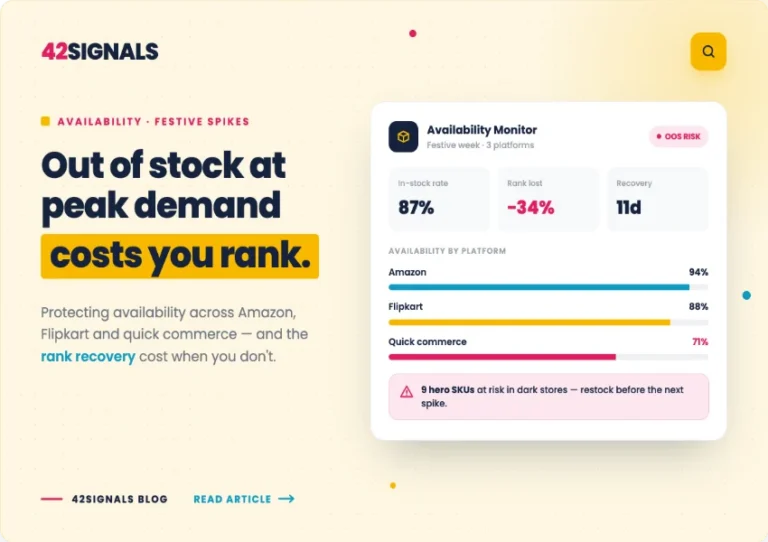
Stockouts cost ranking position, not only revenue
Cyber Week concentrates roughly a month of demand into four days, and Monday sits at the end of it. A product that held stock through Black Friday can sell out on Cyber Monday morning with no warning from a report that refreshes overnight. The lost orders are visible immediately; the ranking consequence is not. Marketplaces demote out-of-stock listings, and the position does not return automatically when inventory does recover; it means rebuilding sales velocity from lower down, through December, against competitors who held cover.
Discount stacking breaks price floors without anyone deciding to
Cyber Monday is where pricing discipline is hardest to hold, because legitimate discounting provides cover for prices nobody approved. Marketplace promotions, seller-level repricing, coupon stacking, and card-partner offers combine in ways that are difficult to see from inside a single channel and the effective price a customer sees can sit well below the floor you set. The anchor persists into December and beyond, while the retailers who held the line watch volume move to whoever did not.
Category visibility compresses when everyone bids at once
Every brand in your category is competing for the same placements across the same four days. Paid costs rise as bidding intensifies, and organic positions reshuffle daily as sales velocity reorders rankings. The reason this pressure is so often missed is that the headline numbers look healthy absolute traffic rises for everyone during Cyber Week, so a brand can lose meaningful relative position while its own dashboard shows growth. Tracking share of search against competitors, rather than tracking your own traffic in isolation, is what distinguishes a brand that gained ground over Cyber Week from one that simply rose with the tide.
The preparation sequence
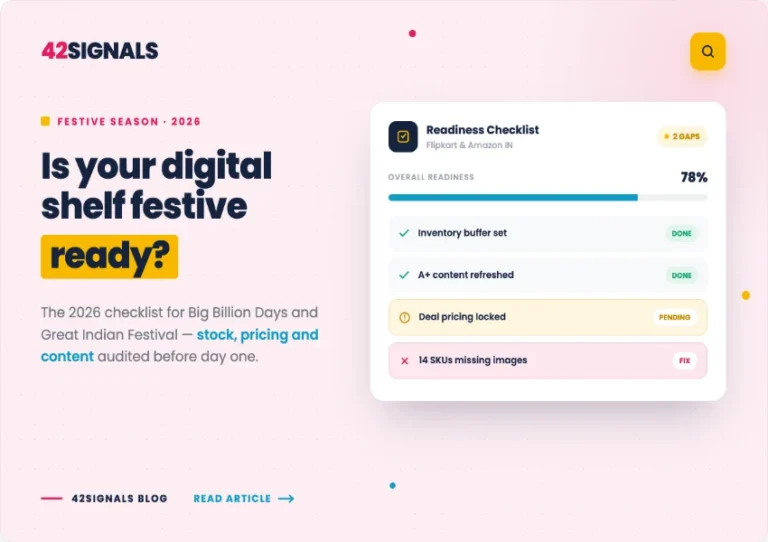
Four to six weeks before Cyber Week, in order:
- Forecast at day level across the full four days rather than Cyber Monday alone, since Monday demand depends on what sold through on Friday.
- Validate stock cover with extra headroom on anything scheduled into a flash deal or featured placement.
- Set and communicate price floors across every channel and reseller before promotions begin, so breaches during the sale stand out against a clean baseline.
- Complete listing changes by late October so edits are live and indexed before traffic arrives.
- Establish a share-of-search baseline on priority keywords so competitive movement during the week is measurable rather than inferred.
- Set alert thresholds that surface problems within hours. In a four-day event, a problem found on Sunday ran for most of the sale.
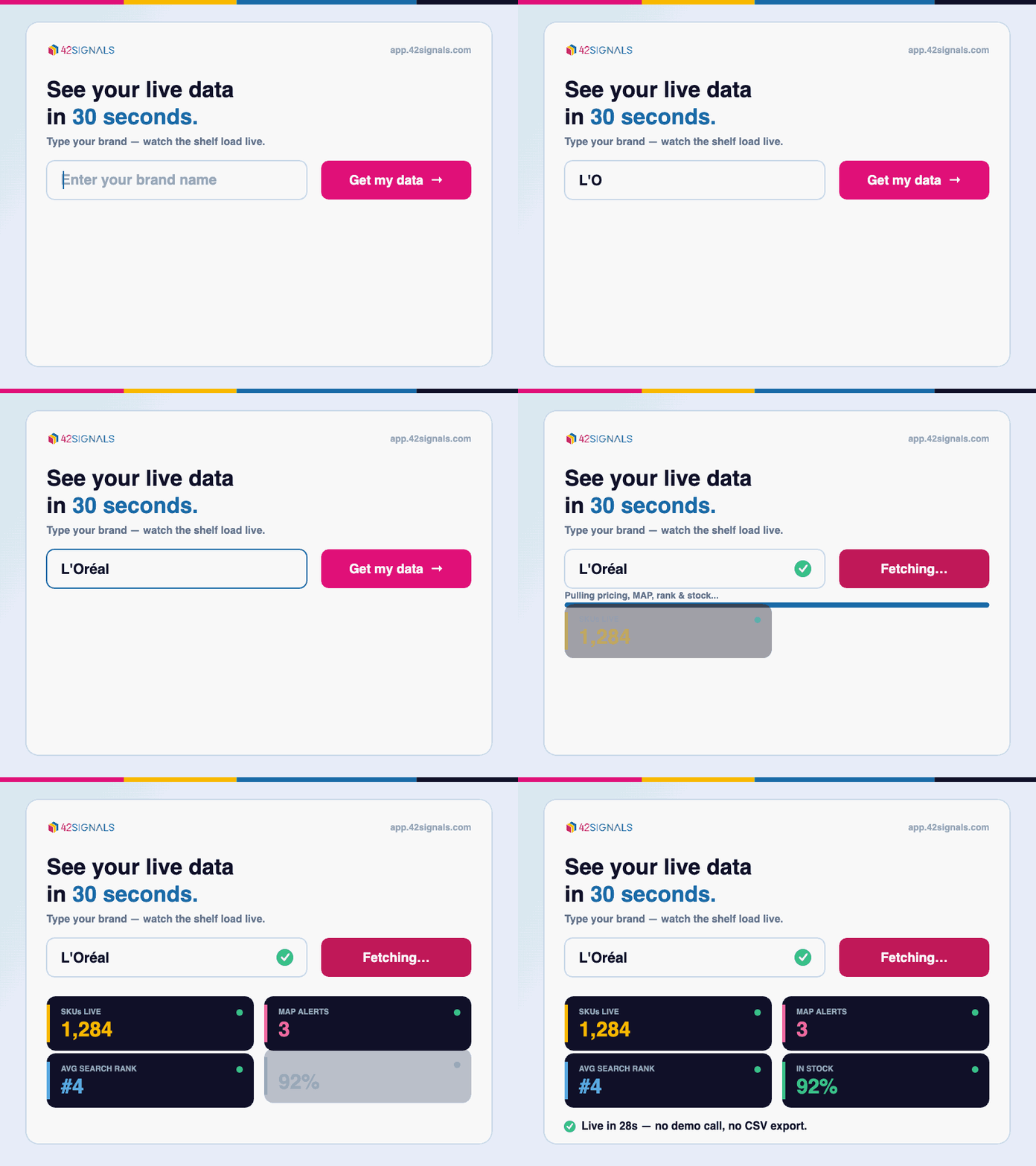
42Signals monitors availability, pricing, and price-floor compliance, competitor movement, and share of search in real time across Amazon, Walmart, and direct retail channels so issues during Cyber Week surface while there is still sale left to act on.
Conclusion
Cyber Monday 2026 holds vast potential for e-commerce businesses, but success requires careful preparation and attention to customer needs.
Combining compelling deals, efficient logistics, and user-friendly platforms creates a rewarding shopping experience that will encourage both immediate purchases and future customer loyalty.
A thoughtful approach to promotions and inventory planning is what separates a Cyber Monday that generates volume from one that generates margin.
Want to stay ahead of demand through Cyber Week 2026? Book a demo to see where your category stands going into the peak stock risk on your top SKUs, price-floor exposure across channels, and where your share of search sits against competitors right now.