

Ecommerce Market Intelligence: The Complete Framework for Signals, Decisions, and Governance
Most ecommerce teams collect market data. Very few have a systematic process for turning ecommerce market intelligence data into decisions. This guide covers both: the five signal sources that feed a mature market intelligence function, and the decision loops, governance model, and 90-day roadmap for operationalising them.
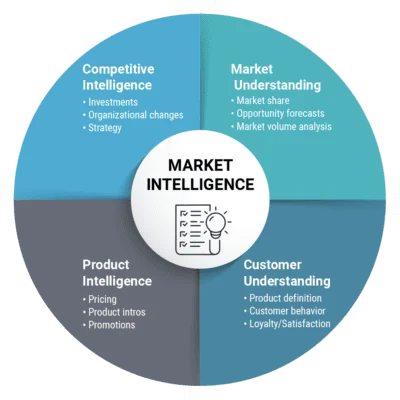
Image Source: Pragmatic Institute
Did you know that as of 2024, 85% of global consumers shop online? Due to this growing prominence, acquiring an in-depth understanding of this swiftly evolving retail setting is vital for entrepreneurs seeking enduring triumphs within their industries. Introducing Ecommerce market intelligence – an essential instrument that enables enterprises to efficiently traverse complicated markets, unearth undiscovered opportunities, and boost income streams.
However, lingering questions remain: Why ought it matter to you? Moreover, how can you successfully accumulate and decipher pertinent data embedded within this domain?
Delve further into this discussion to unearth the responses and discover how this function might propel your nascent endeavor toward greater heights.
Understanding Ecommerce Market Intelligence
Essentially, e-commerce market data entails an exhaustive examination of the entire online shopping realm.
From scrutinizing customer profiles and purchase tendencies to evaluating supply chain mechanisms and inventory administration, nothing escapes notice when exploring the rich expanse of insights available.
Stripped down to basics, it essentially enables business owners to respond accurately to three pivotal questions:
- Who am I selling to?
- What should I sell them?
- How can I stand out from my competitors?
It is imperative not to undervalue the significance of addressing these questions, particularly considering the escalating sophistication of present-day ecommerce environments.
Given that worldwide internet connectivity is expanding rapidly, paralleling this development is a surge in shoppers transitioning to web-based marketplaces.
This influx brings both unprecedented opportunity and fierce competition, making accurate market intel indispensable for success.
The Five Sources of Ecommerce Market Intelligence
Effective market intelligence isn’t a single data stream—it’s the synthesis of multiple signals that together create a complete picture of your market. Here are the five essential sources every ecommerce brand must monitor or use ecommerce price monitoring tool.
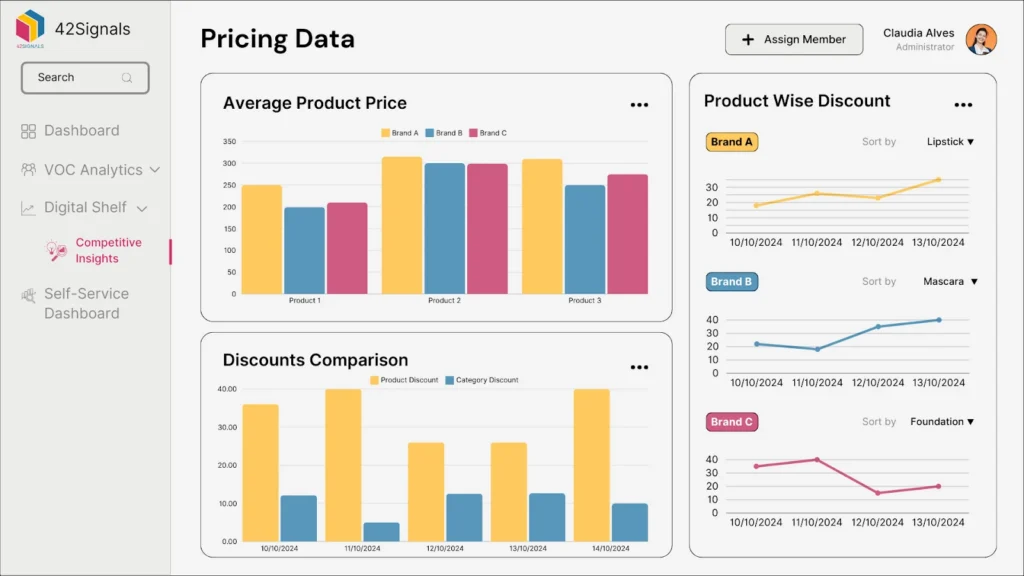
Source 1: Pricing Data
What It Is:
Systematic tracking of competitor prices across your key products and categories. This includes list prices, promotional prices, and discount patterns.
Why It Matters:
- Reveals competitive positioning and pricing strategies
- Identifies opportunities for margin optimization
- Tracks promotional cadence and depth
Key Metrics:
- Price gap to competitors (by SKU)
- Frequency of price changes
- Promotional depth and duration
- Price positioning relative to market average
Collection Methods:
- Automated price monitoring tools (42Signals, Price2Spy)
- Manual checks for small catalogs
- Marketplace API integrations
Signal Examples:
- “Competitor A dropped price on top 10 SKUs by 15%”
- “Three competitors running back-to-school promotions”
- “Market average price for category X increased 8% month-over-month”
Source 2: Ratings and Reviews
What It Is:
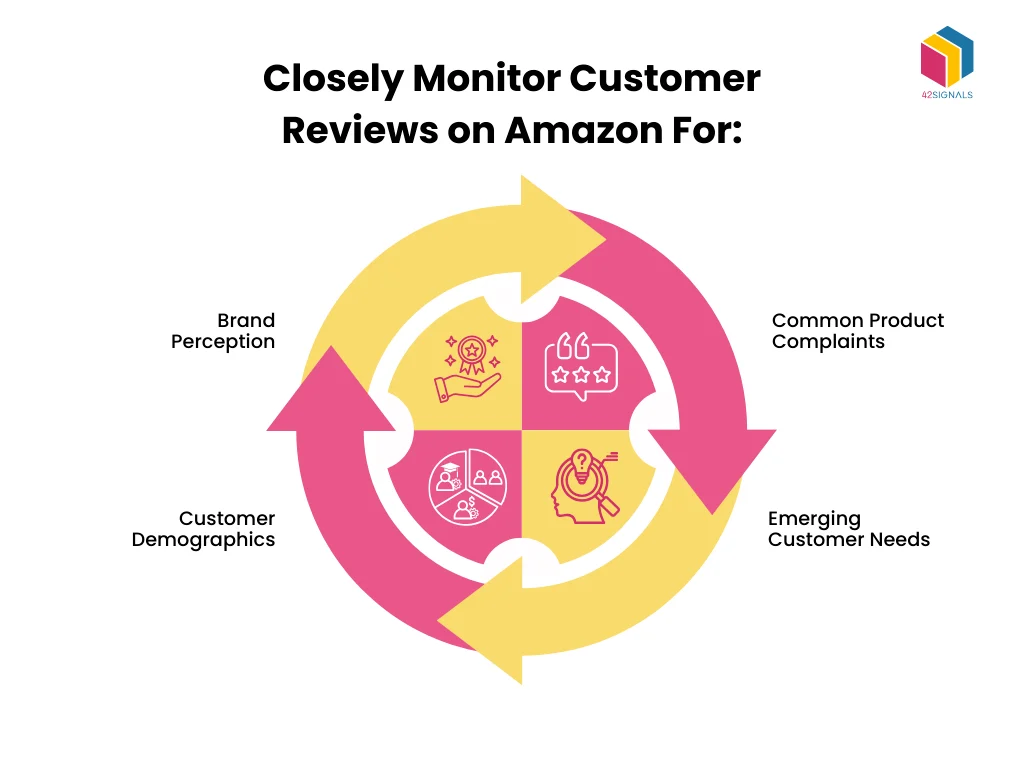
Aggregated and analyzed customer feedback via voice of customer analytics from your products and competitors’ products across marketplaces, social media, and review sites.
Why It Matters:
- Reveals what customers love and hate about products
- Identifies feature gaps and improvement opportunities
- Tracks sentiment trends over time
- Provides unfiltered voice of customer
Key Metrics:
- Average rating by product and competitor
- Review volume trends
- Sentiment distribution (positive, neutral, negative)
- Common praise and complaint themes
- Rating trends after product updates
Collection Methods:
- Review scraping from Amazon, Walmart, etc.
- Social media listening tools
- Survey platforms (post-purchase feedback)
Signal Examples:
- “Competitor’s new model has 30% one-star reviews due to battery life”
- “Customers praising our shipping speed—potential marketing angle”
- “Emerging complaint theme: sizing inconsistency”
Source 3: Availability Data
What It Is:
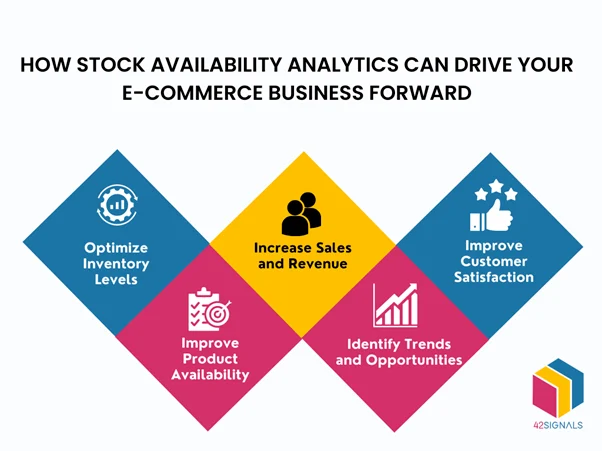
Real-time tracking of product stock status using stock availability analytics across your own inventory and competitor offerings.
Why It Matters:
- Stockouts = immediate opportunity to capture displaced demand
- Identifies supply chain vulnerabilities
- Reveals competitor inventory strategies
- Informs pricing decisions (scarcity pricing)
Key Metrics:
- In-stock rate by SKU and competitor
- Stockout frequency and duration
- Time to restock
- Backorder indicators
Collection Methods:
- Website monitoring for “out of stock” flags
- Marketplace API data
- Inventory system integration
Signal Examples:
- “Key competitor out of stock on top-selling SKU”
- “Our inventory on popular item dropping below 2 weeks supply”
- “New competitor entering category with limited stock—test launch”
Source 4: Share of Search
What It Is:
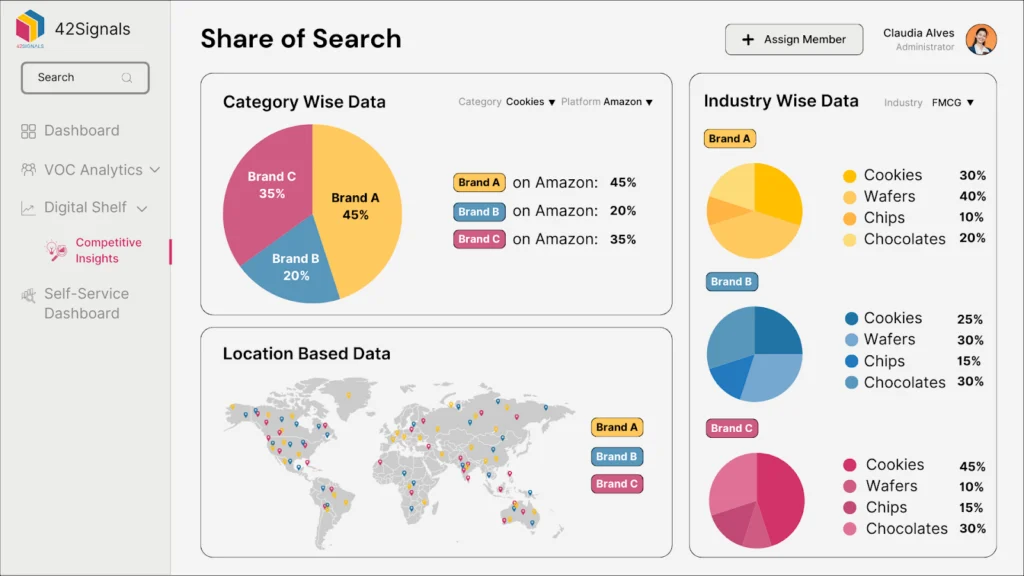
The visibility of your brand and products in search results relative to competitors using share of search analytics. This includes organic search rankings, paid search presence, and marketplace search positions.
Why It Matters:
- Leading indicator of future sales
- Reveals brand awareness trends
- Identifies SEO/SEM opportunities
- Tracks competitive visibility
Key Metrics:
- Organic keyword rankings (by product and category)
- Paid search impression share
- Marketplace search position (Amazon, Walmart, etc.)
- Brand mention volume
- Search trend direction (growing or declining)
Collection Methods:
- SEO tracking tools (SEMrush, Ahrefs)
- Marketplace analytics
- Social listening platforms
Signal Examples:
- “Our brand ranking dropped 10 positions for core keyword”
- “Competitor launched aggressive Google Shopping campaign”
- “Search volume for category up 40% year-over-year”
Source 5: Review Sentiment
What It Is:
Deep analysis of customer opinion beyond simple star ratings. This involves natural language processing to extract themes, emotions, and specific feedback from review text.
Why It Matters:
- Uncovers product improvement opportunities
- Identifies competitive weaknesses to exploit
- Reveals emerging customer needs
- Provides content ideas (FAQs, marketing copy)
Key Metrics:
- Sentiment score (by product, category, feature)
- Top positive themes
- Top complaint themes
- Sentiment trends over time
- Feature-specific feedback
Collection Methods:
- NLP-powered review analysis tools
- Social media sentiment analysis
- Customer support ticket mining
Signal Examples:
- “62% of competitor reviews mention ‘difficult setup’—opportunity to highlight ease of use”
- “Sentiment on our customer service improved after chat launch”
- “Emerging request: eco-friendly packaging”
42Signals tracks all five signal sources — pricing, reviews, availability, share of search, and sentiment — in a single platform. See a live demo of the MI dashboard.
The Five Sources Summary Table
| Source | Primary Insight | Collection Cadence | Key Metrics |
| Pricing Data | Competitive positioning | Daily/Real-time | Price gaps, promo frequency |
| Ratings & Reviews | Customer satisfaction | Weekly | Average rating, volume, themes |
| Availability | Supply/demand dynamics | Daily | Stockout rate, restock time |
| Share of Search | Brand visibility | Weekly | Rankings, impression share |
| Review Sentiment | Deep customer feedback | Weekly/Monthly | Sentiment score, theme trends |
Decision Loops: Turning Signals into Action
Market intelligence is only valuable if it drives decisions. Here’s how to structure decision loops using competitor price intelligence that convert raw signals into business impact.
The Intelligence-to-Action Pipeline
SIGNAL → TRIAGE → ASSIGN → DECIDE → ACT → MEASURE
Decision Loop Framework by Signal Type
| Signal Source | Example Signal | Triage Owner | Decision Owner | Cadence | Action Playbook |
| Pricing | Competitor dropped price 10% on top SKU | Pricing Analyst | Pricing Manager | 4 hours | • Model margin impact• Decide match, hold, or partial• Execute repricing |
| Pricing | 3 competitors running category-wide promo | Pricing Analyst | Category Lead | 24 hours | • Assess competitive threat• Decide response (match, ignore, offset)• Coordinate with marketing |
| Reviews | Negative sentiment spike on new product | CX Analyst | Product Manager | Weekly | • Investigate root cause• Prioritize fix• Communicate to customers |
| Reviews | Competitor weakness identified (e.g., “poor battery”) | CX Analyst | Marketing | Weekly | • Update marketing copy• Highlight your strength• Create comparison content |
| Availability | Competitor out of stock on key item | Channel Ops | Category Lead | 4 hours | • Verify your stock• Consider price adjustment• Promote availability |
| Availability | Your inventory below threshold | Inventory Manager | Supply Chain | Daily | • Expedite reorder• Consider price increase to slow velocity |
| Share of Search | Brand ranking dropped for core term | SEO Manager | Marketing | Weekly | • Investigate cause (algorithm, competitor activity)• Adjust SEO strategy• Consider paid search |
| Share of Search | Competitor gaining visibility | SEO Manager | Marketing | Monthly | • Analyze their strategy• Identify gaps• Update content plan |
| Sentiment | Emerging theme: “wants eco-friendly packaging” | Product Manager | R&D | Monthly | • Evaluate packaging options• Test with customers• Plan rollout |
Cadence Guidelines by Signal Type
| Cadence | Signal Types | Meeting Structure | Attendees |
| Daily Standup (15 min) | Pricing alerts, stockouts, urgent issues | Rapid triage; assign owners | Pricing, Ops, Category |
| Weekly Review (1 hour) | Share of search, review volume, sentiment trends | Deep dive; action planning | Marketing, Product, CX |
| Monthly Strategy (2 hours) | All signals, trend analysis, competitive landscape | Strategic decisions; resource allocation | Leadership, Category, Marketing, Product |
| Quarterly Business Review | All signals, year-over-year trends, market shifts | Strategy reset; major investments | Executive team |
Governance: Who Owns Market Intelligence
Market intelligence for modern retail fails when ownership is unclear. Here’s how leading brands structure MI governance.
The Market Intelligence Operating Model

Role Definitions
| Role | Primary Responsibility | Key Activities | Reports To |
| MI Program Owner | Govern the entire MI system | • Define data requirements• Select and manage tools• Facilitate council meetings• Track MI ROI | COO or CMO |
| Data Analyst | Collect and process data | • Maintain data pipelines• Ensure data quality• Create dashboards• Run ad-hoc analysis | MI Program Owner |
| Insights Manager | Translate data into insights | • Identify key signals• Write insight briefs• Present findings• Recommend actions | MI Program Owner |
| Pricing Lead | Own pricing decisions | • Monitor pricing signals• Execute repricing• Track margin impact | Category Lead |
| Category Lead | Own category strategy | • Review competitive landscape• Make assortment decisions• Set pricing strategy | GM/Ecommerce Director |
| Marketing Lead | Own positioning and messaging | • Monitor share of search• Adapt messaging based on sentiment• Plan campaigns | CMO |
| Product Lead | Own product roadmap | • Review customer feedback• Prioritize improvements• Track competitor product moves | CPO |
The MI Council Charter
Purpose: Ensure market intelligence drives coordinated, cross-functional decisions.
Meeting Cadence: Monthly, 90 minutes
Attendees:
- MI Program Owner (Chair)
- Pricing Lead
- Category Lead(s)
- Marketing Lead
- Product Lead
- CX Lead
- (Optional) Executive Sponsor
Agenda Template:
- Signal Scan (15 min): Rapid review of key signals since last meeting
- Deep Dive (30 min): One signal area explored in depth (rotating: pricing, reviews, share of search, etc.)
- **Decision Review (20 min):) Follow up on prior decisions—what worked, what didn’t
- Action Planning (20 min): Assign owners, set timelines for new initiatives
- Open Discussion (5 min): Emerging issues, resource needs
Common Governance Pitfalls to Avoid
| Pitfall | Symptom | Solution |
| No clear owner | MI happens sporadically; insights lost | Appoint MI Program Owner with clear charter |
| Siloed data | Each team has own tools, no sharing | Centralize tools; create shared dashboards |
| Analysis paralysis | Lots of data, few decisions | Define decision loops with owners and timelines |
| Tool proliferation | 5+ tools, no integration | Rationalize tool stack; prioritize integration |
| No action tracking | Don’t know if insights drove results | Track decisions and outcomes; close the loop |
Signals → Actions Template Table
Use this template to document your organization’s response playbooks for each signal type.
Pricing Signals
| Signal | Trigger | Triage (Who, How Fast) | Decision Options | Action Owner | Success Metric |
| Competitor price drop – Core SKU | Price < our price by ≥5% | Pricing Analyst, 4 hours | • Match price• Hold (margin protection)• Partial match• Bundle response | Pricing Manager | Margin impact, sales volume |
| Competitor price drop – Secondary | Price < our price by ≥10% | Pricing Analyst, 24 hours | • Monitor only• Selective response• Ignore | Category Lead | Share trend |
| Multiple competitors discounting category | 3+ competitors running promos | Category Lead, 24 hours | • Join promotion• Hold (premium positioning)• Offset with value message | Category Lead + Marketing | Category share |
| Market average price shift | Category average price ±5% | Pricing Analyst, weekly | • Adjust pricing strategy• Hold (differentiated value) | Pricing Manager | Margin trend |
Review & Sentiment Signals
| Signal | Trigger | Triage (Who, How Fast) | Decision Options | Action Owner | Success Metric |
| Negative sentiment spike | Sentiment score drop ≥15% in week | CX Analyst, 24 hours | • Investigate root cause• Prioritize fix• Communicate to customers | Product Manager | Sentiment recovery, fix time |
| Competitor weakness identified | >30% competitor reviews cite same issue | CX Analyst, weekly | • Update marketing copy• Create comparison content• Highlight your strength | Marketing Lead | Share shift, content engagement |
| Emerging customer need | >20 reviews mention same request | Product Manager, monthly | • Evaluate for roadmap• Test concept• Plan development | Product Lead | Roadmap adoption |
| Rating gap to competitor | Your rating < competitor by ≥0.5 stars | Category Lead, monthly | • Investigate drivers• Plan improvement• Adjust positioning | Product + Marketing | Rating improvement |
Availability Signals
| Signal | Trigger | Triage (Who, How Fast) | Decision Options | Action Owner | Success Metric |
| Competitor out of stock – Core SKU | Competitor OOS on top item | Channel Ops, 4 hours | • Verify your stock• Consider price adjustment• Promote availability | Category Lead | Incremental sales during OOS |
| Your stock low | WOS < 2 weeks | Inventory Manager, daily | • Expedite reorder• Increase price to slow velocity• Communicate delay | Supply Chain | Stockout avoidance |
| Competitor restock after OOS | Competitor back in stock | Channel Ops, daily | • Monitor pricing response• Adjust your price if needed | Pricing Analyst | Share retention |
Share of Search Signals
| Signal | Trigger | Triage (Who, How Fast) | Decision Options | Action Owner | Success Metric |
| Brand ranking drop | Top keyword drops ≥5 positions | SEO Manager, weekly | • Investigate cause (algorithm, competitor)• Adjust SEO strategy• Consider paid search | Marketing Lead | Ranking recovery |
| Competitor visibility surge | Competitor impression share up 20% | SEO Manager, weekly | • Analyze their strategy• Identify gaps• Update content plan | Marketing Lead | Share of search trend |
| Category search growth | Search volume up 30% YoY | Marketing Lead, monthly | • Increase investment• Expand content• Plan capture strategy | Marketing Lead | Traffic growth |
The Market Intelligence Operating System: Putting It All Together
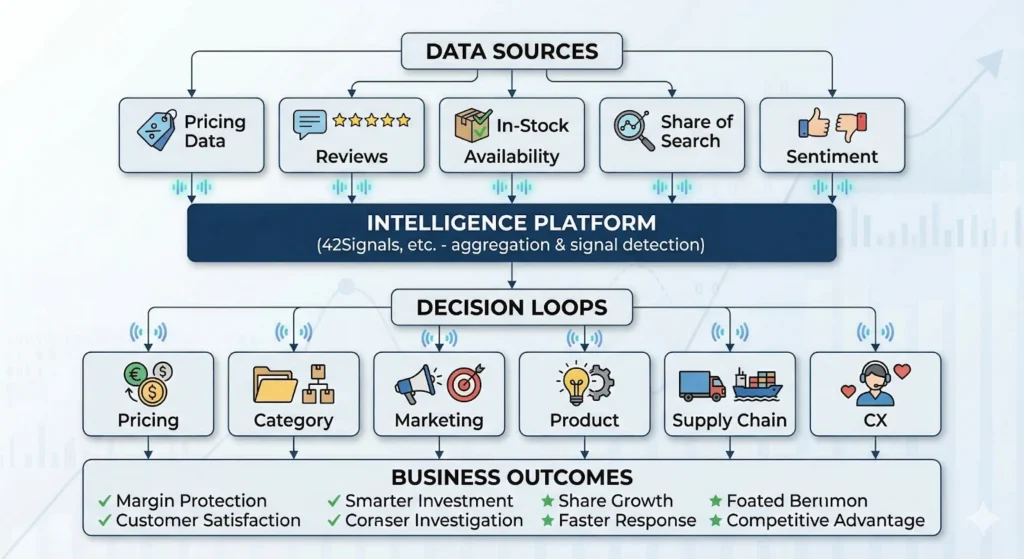
A mature market intelligence function isn’t a set of disconnected tools—it’s an operating system that continuously feeds insights into decisions.
The MI OS Diagram
Implementing Your MI OS: A 90-Day Roadmap
Days 1-30: Foundation
- Appoint MI Program Owner
- Audit current data sources and tools
- Define key signals by source
- Select and implement core MI platform (e.g., 42Signals)
Days 31-60: Process Design
- Define decision loops with owners and cadence
- Create signal-to-action templates
- Establish MI Council charter and meeting schedule
- Build initial dashboards
Days 61-90: Operationalize
- Launch MI Council meetings
- Begin tracking decisions and outcomes
- Refine thresholds and triggers
- Train teams on MI tools and processes
Ongoing: Maturity
- Quarterly MI OS review
- Expand signal sources
- Integrate MI with planning processes
- Measure and communicate MI ROI
Conclusion on ECommerce Market Intelligence
Navigating the complex waters of contemporary ecommerce necessitates a thorough comprehension of underlying market mechanics.
Armed with robust ecommerce market intelligence capabilities, however, even novice merchants can confidently chart courses toward lucrative horizons.
Ready to build your Market Intelligence OS? 42Signals provides the data infrastructure for all five signal sources, with real-time alerts, competitive dashboards, and integrations with your existing systems. Book a personalised demo, and we’ll map your current signal gaps against the five-source framework.
FAQs
What is market intelligence software & tools?
Businesses rely on market intelligence software and tools to collect, analyze, and understand essential information associated with their industry, opponents, and clientele.
Such platforms enable firms to garner vital insights, facilitating well-versed decision-making and fortifying competitive positions.
Harnessing AI and NLP, they pull valuable information from various sources.
Examples of trustworthy providers encompass 42Signals, SimilarWeb, SEMrush, Statista, and Gartner.
What is the global e-commerce market size?
In 2023, the global e-commerce market hit roughly $5.8 trillion following rapid growth attributed to escalated internet usage, modified consumer behavior, and burgeoning technology.
Additionally, the COVID-19 crisis bolstered e-commerce growth substantially.
What is a good source of marketing intelligence?
Reliable marketing intelligence stems from accurate, current, pertinent, and thorough data regarding one’s target market, competitors, and industry trends.
Trustworthy providers consist of 42Signals, SimilarWeb, SEMrush, Statista, and Gartner—each excelling at delivering precise, helpful, and timely information tailored to user demands.
How to do market research for ecommerce?
Effective e-commerce market research requires setting defined goals, pinpointing ideal clients, and inspecting competitors.
Various tools facilitate this procedure, notably those offered by 42Signals. Continuous monitoring ensures alignment with dynamic market circumstances.
What is market intelligence for the ecommerce industry?
Market intelligence refers to the process of gathering and analyzing data and information about the e-commerce industry, including trends, consumer behavior, competitors, and market conditions. It involves monitoring various sources such as social media, online reviews, customer feedback, sales data, and industry reports to gain insights that can help businesses make informed decisions. The goal of market intelligence is to provide a comprehensive understanding of the current state of the e-commerce industry, identify opportunities and challenges, and enable businesses to stay ahead of the competition.
What are the best practices for achieving market intelligence for ecommerce businesses?
Identify your target audience and their needs.
Use multiple data sources, including social media, customer feedback, and sales data.
Leverage technology, such as data analytics software and SEO tracking tools.
Monitor competitors and industry trends.
Engage with customers through surveys, focus groups, and social media.
Analyze data objectively and share insights across teams.
Continuously gather and analyze data to adapt to changing market conditions.
Use actionable insights to inform business decisions, such as offering free shipping based on customer preference.
What are ecommerce market intelligence tools?
Ecommerce market intelligence tools are software platforms that collect, analyze, and visualize data about your market, competitors, and customers. They automate the gathering of information from sources like competitor websites, marketplaces, reviews, search engines, and social media. Leading tools include 42Signals (comprehensive MI platform), SimilarWeb (traffic and engagement), and SEMrush (search visibility). The best tools integrate multiple data sources into a single dashboard with actionable alerts.
How do you do competitive intelligence for ecommerce brands?
Competitive intelligence for ecommerce involves systematically monitoring competitors across five key dimensions:
Pricing: Track competitor prices, promotions, and discount patterns using automated monitoring tools.
Product: Monitor new product launches, feature changes, and customer reviews of competitor offerings.
Marketing: Analyze competitor search presence, social media activity, and email campaigns.
Customer Experience: Review competitor ratings, sentiment, and common complaints.
Availability: Track stock status to identify opportunities during competitor stockouts.
The process: Collect data → Analyze for insights → Distribute to decision-makers → Take action → Measure results.
What is a market intelligence operating system?
A market intelligence operating system (MI OS) is a structured framework that transforms raw market data into consistent, repeatable business decisions. It includes:
Data Sources: The inputs (pricing, reviews, availability, search, sentiment)
Technology Platform: Tools that collect and analyze data (e.g., 42Signals)
Decision Loops: Defined processes for who receives which signals and what actions they take
Governance: Clear ownership, cadence, and accountability
Measurement: Tracking whether insights drove business outcomes
An MI OS moves a company from ad-hoc, reactive intelligence to systematic, proactive market awareness.
What’s the difference between market intelligence and market research?
This is a common point of confusion:
Market Research
Market Intelligence
Project-based (specific questions, defined timeline)
Continuous (always on, real-time)
Historical focus (what happened, why)
Current/future focus (what’s happening now, what’s next)
Often manual (surveys, focus groups, studies)
Automated (software-driven, scalable)
Periodic reports (monthly, quarterly)
Real-time alerts (daily, hourly)
Answers “what should we do?”
Answers “what’s happening now?”
In practice, they’re complementary: market research provides depth on specific questions; market intelligence provides ongoing awareness.
How do I get started with ecommerce market intelligence?
Follow this five-step path:
Define your objectives: What decisions do you want to improve? (Pricing? Product development? Marketing?)
Identify key signals: What data would inform those decisions? (Competitor prices? Customer complaints? Search trends?)
Select tools: Choose platforms that collect your required signals (42Signals is an excellent starting point for comprehensive coverage).
Design decision loops: Define who gets which signals and what they do with them.
Start small, then scale: Begin with one signal type (e.g., competitor pricing) and one decision loop. Prove value, then expand.