

How a Competitor Price Intelligence Solution Delivers Immediate ROI
Waiting even a few hours for pricing data can mean the difference between a profitable sale and a missed opportunity. This article dives deep into the tangible Return on Investment (ROI) of implementing a robust competitor price intelligence solution. We will explore how real-time visibility into competitor promotions and assortment allows brands to not only stay competitive but also actively protect and even expand their margins. By utilizing precise competitor data tracking and sophisticated market benchmarking, businesses can transform reactive pricing adjustments into a proactive, margin-preserving repricing strategy.
Why Real-Time Reactivity Is Now the Pricing Standard in Ecommerce
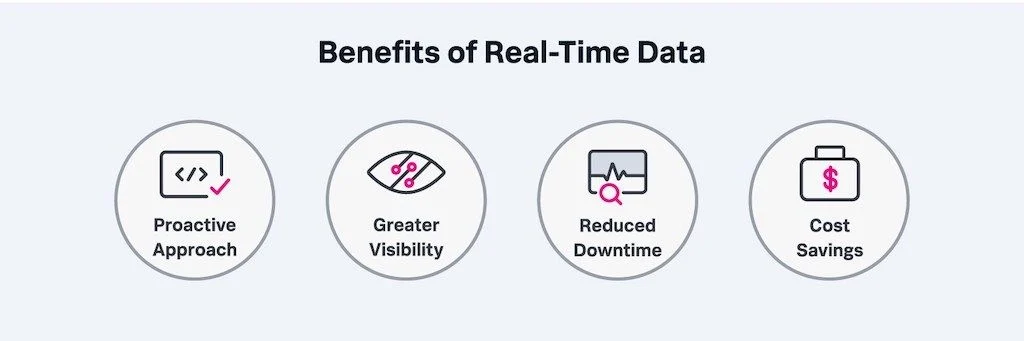
Image Source: Splunk
The digital shelf is arguably the most dynamic and competitive retail environment ever created. Prices fluctuate constantly, often changing multiple times within a single day. For brands and retailers operating online, this hyper-variability presents a critical challenge: how do you maintain profitability while ensuring your prices are attractive enough to capture the sale?
The answer lies in adopting real-time reactivity, powered by a cutting-edge competitor price intelligence solution. Gone are the days when manually checking competitor websites or relying on static, outdated data was sufficient. In modern ecommerce, speed and accuracy are non-negotiable.
If a competitor drops a price or launches a promotion, and you don’t know about it within minutes, you risk two things: either losing a sale because your price is too high, or, worse, unnecessarily eroding your margins because you matched a price that was temporary or irrelevant.
What Real-Time Competitor Data Tracking Actually Delivers
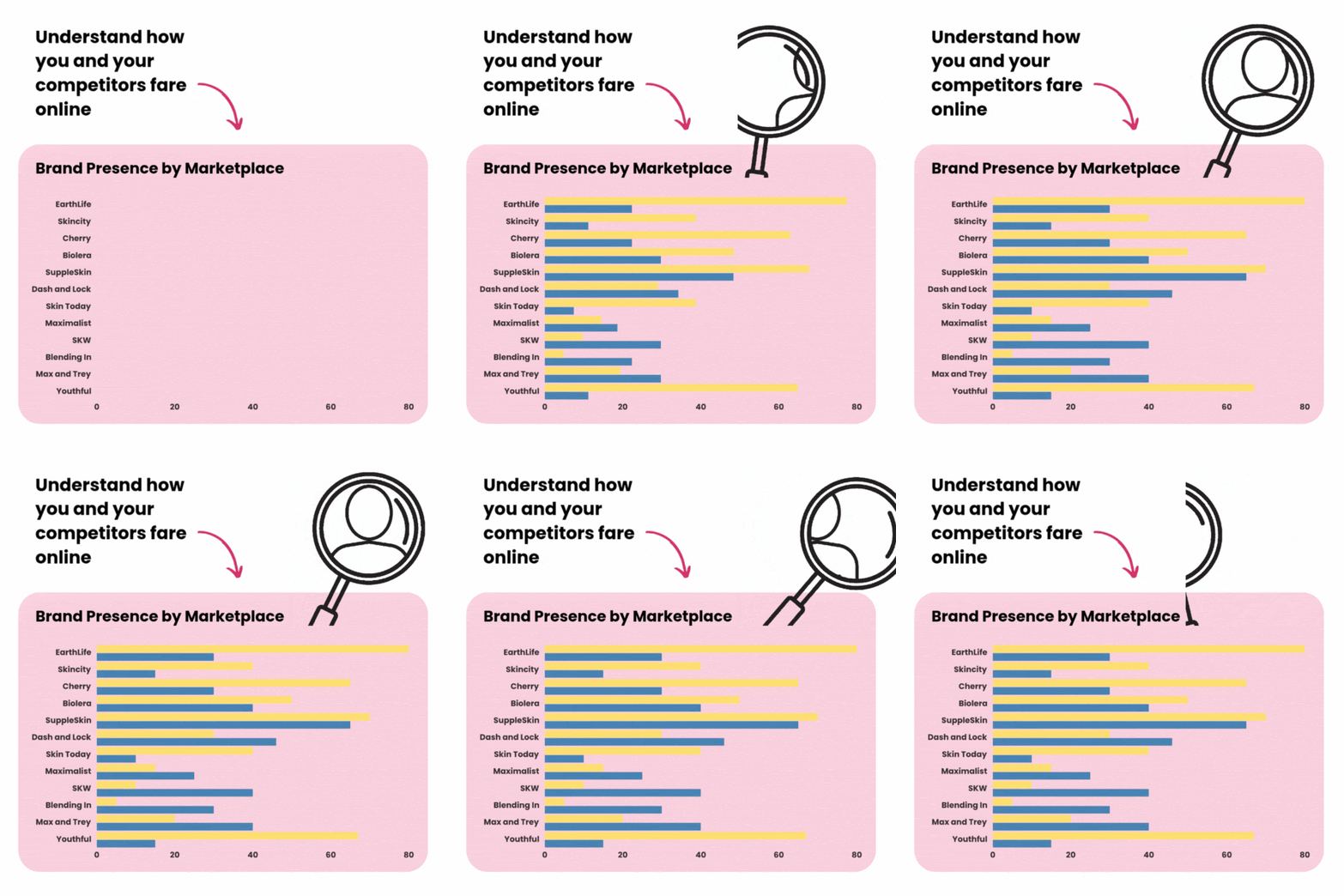
At its heart, a competitor price intelligence solution is designed to eliminate the information lag that plagues traditional pricing methods. This technology constantly monitors the online marketplace, providing a live feed of competitor activity. This isn’t just about price points; it encompasses a complete view of the competitive landscape.
Beyond Price Points: The Full Competitive Picture a Price Intelligence Solution Captures
A truly effective competitor price intelligence solution provides data points far beyond the final checkout price. To develop an effective repricing strategy, you need context with promotional price intelligence.
The most valuable systems deliver insights into:
- Promotional Activity: Is the competitor’s price drop a permanent change or a short-term promotion? Knowing the duration and nature of a promotion allows a brand to respond strategically, perhaps matching the temporary price with a limited-time offer of their own, rather than permanently lowering the list price.
- Stock and Availability: A competitor might have a fantastic price, but if the item is listed as “low stock” or “out of stock,” your response should be different. Real-time availability tracking prevents you from engaging in unnecessary price wars over products that are unavailable elsewhere. This component of competitor data tracking is crucial for maintaining margin integrity.
- Assortment Parity: Understanding which SKUs are carried by which competitors is essential for robust market benchmarking. Are you competing on a commodity item, or a private label product? The better you understand the competitive landscape, the more refined your repricing strategy becomes.
- Shipping and Fulfillment Costs: The final price a customer sees often includes shipping. A comprehensive competitor price intelligence solution accounts for these variables, ensuring that your comparison is truly apples-to-apples, preventing you from over-discounting based on misleading advertised prices.
The sheer volume of data collected is what differentiates a basic tool from a powerful intelligence platform. For instance, platforms utilising advanced techniques often provide granular data on many features, including MAP violation monitoring, such as insights derived from sources like 42Signals data, which contribute to a deeper understanding of market movements.
How Market Benchmarking Turns Price Data into Pricing Strategy
Market price benchmarking is the process of continuously measuring your business’s performance metrics against the best-in-class within your industry. When applied to pricing, it means understanding your position relative to the market average, the market leader, and specific strategic competitors.
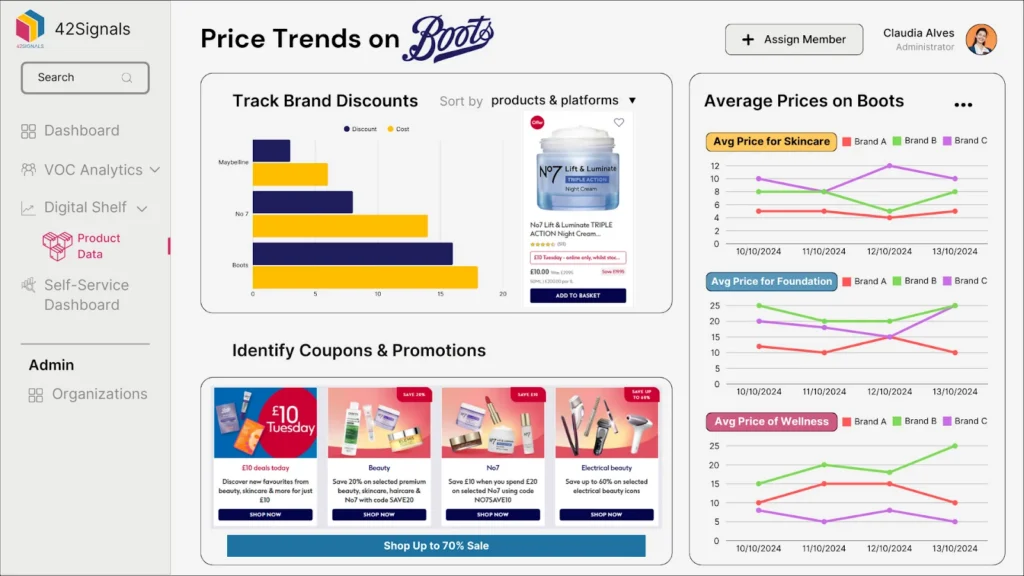
A competitor price intelligence solution automates and operationalizes this benchmarking. Instead of quarterly reviews, you have daily, even hourly, intelligence on where your products stand. This visibility is vital for defining your pricing goals, whether it’s maintaining a price premium, achieving price parity with a key rival, or aiming to be the lowest price in a specific category. Effective market benchmarking allows a business to confidently set a price floor and ceiling for every product. This control is the first step toward protecting profit margins.
Protecting Margins: The Defensive ROI of Competitor Price Intelligence
One of the most direct and measurable ROIs of a competitor price intelligence solution is its ability to protect profit margins. This is the defensive strategy of pricing equipped with retail price intelligence, ensuring you are not leaving money on the table.
Avoiding Unnecessary Price Matching
Imagine a scenario where a major competitor temporarily lowers the price of a shared product by 15% as part of a three-day flash sale.
- Without Intelligence: Your system or team detects the lower price a day later and automatically or manually adjusts your price to match, believing it’s a new, permanent floor. For the next week, you sell the product at a 15% lower margin, unnecessarily sacrificing profit.
- With a Competitor Price Intelligence Solution: The real-time competitor data tracking informs you that this is a defined, short-term promotional event. Your dynamic repricing strategy, guided by this intelligence, might opt for a less aggressive response—perhaps a 5% discount for the duration of the sale, or simply holding your price and emphasizing superior shipping or customer service. When the competitor’s price reverts after three days, your price instantly returns to its optimal, high-margin level.
This single instance of avoiding an unnecessary price match can generate substantial, immediate ROI. By having the context, you maintain a higher average selling price (ASP) and a healthier gross margin.
Ready to quantify the ROI of competitor price intelligence for your catalogue? Book a 42Signals demo, and we’ll show you exactly how our platform tracks your competitive set in real time
Strategic Inventory Management and Dynamic Pricing Using Competitor Stock Signals to Raise Prices Strategically
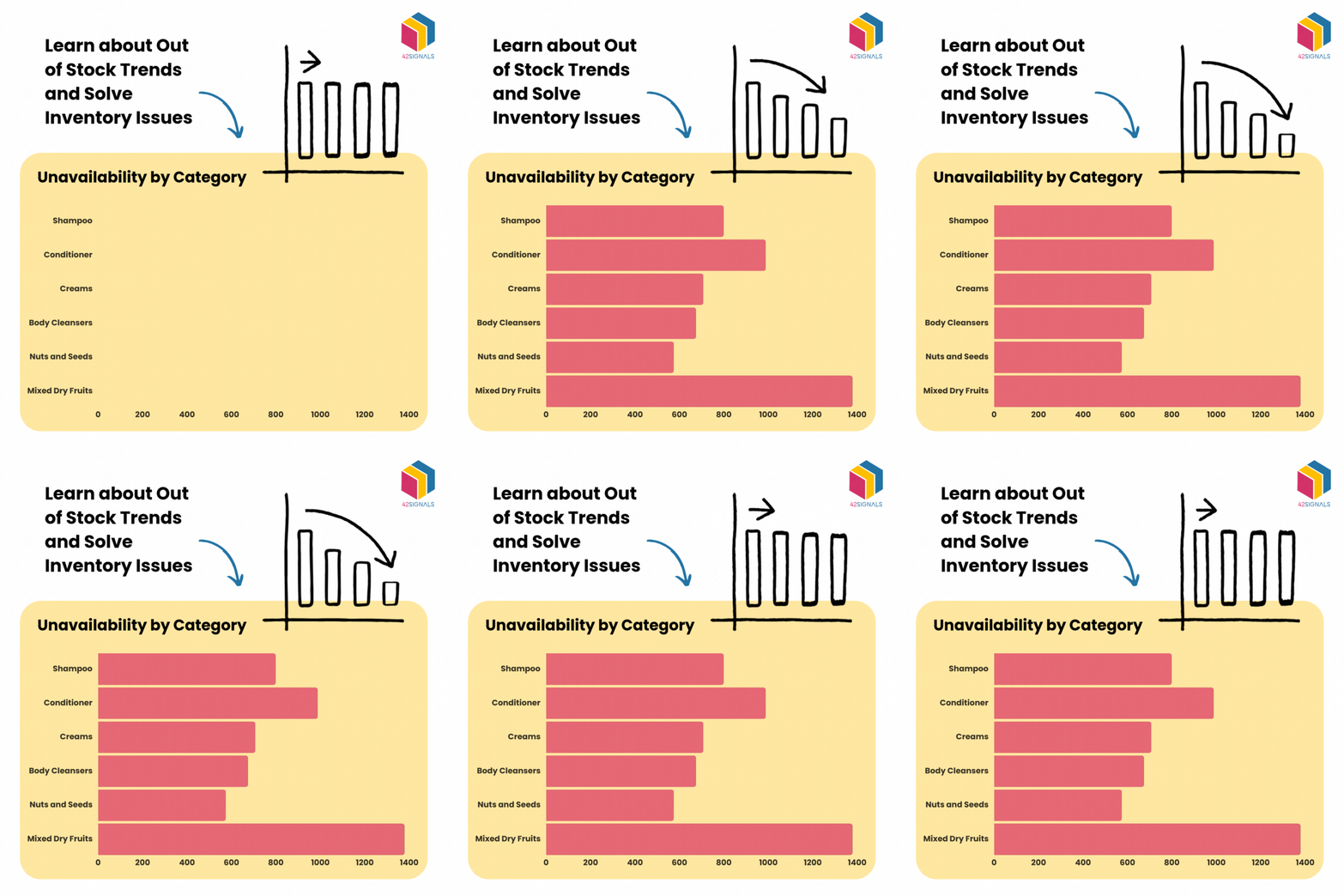
The best competitor price intelligence solution integrates with inventory data to optimize price changes. For example, if a competitor goes out of stock on a hot item, your repricing strategy should instantly adjust your price upwards, capitalizing on the temporary market dominance. This is pure, direct margin gain enabled by real-time competitor data tracking and stock availability analytics.
Conversely, if you have excess inventory on a slow-moving product, the intelligence solution can identify which competitors are also trying to clear stock and suggest the minimum necessary price drop to clear your own inventory first, ensuring you don’t over-discount. This balance between aggressive pricing for clearance and premium pricing for scarcity is a sophisticated application of ecommerce analytics.
Driving Revenue and Market Share: The Offensive ROI
While protecting margins is crucial, a competitor price intelligence solution is equally powerful as an offensive tool, driving revenue and expanding market share.
Optimizing Your Repricing Strategy for Conversions
A nuanced repricing strategy does not always mean having the lowest price. It means having the right price at the right time.
Consider the following offensive tactics:
- Price Differentiation: Use the insights from competitor data tracking to identify products where competitors are consistently priced high. These are opportunities for you to aggressively underprice by a small, but significant, margin (e.g., 2-3%), positioning yourself as the value leader and capturing market share.
- Targeted Price Leadership: For your most important, high-velocity products (often called “key value items” or KVIs), the competitor price intelligence solution ensures you are always the cheapest, or at least price-matched. The objective here is to drive traffic and increase conversion rates, accepting a potentially tighter margin with KVI pricing strategy because the customer will likely fill their basket with other, higher-margin items.
- New Product Launch Pricing: When introducing a new product, market benchmarking and ecommerce pricing analysis provide immediate insights into acceptable price ranges and customer expectations, accelerating your time to market with an optimized price point and preventing early-stage pricing mistakes that can damage long-term profitability.
According to a study published by McKinsey & Company, companies that master dynamic pricing and personalization can see margin improvements of up to 10% or more, far outpacing the typical growth of their industry peers.
While dynamic pricing is complex, the foundation of any successful dynamic pricing model is accurate, real-time competitor data provided by a dedicated competitor price intelligence solution. [Source: McKinsey & Company, various pricing studies and reports (often cited in their general pricing literature)].
Leveraging Semantic Keywords and Ecommerce Analytics
The sophisticated platforms often feed their intelligence directly into advanced ecommerce analytics dashboards. By tracking the impact of every price change against competitor moves, brands can clearly see the correlation between their repricing strategy and revenue outcomes.
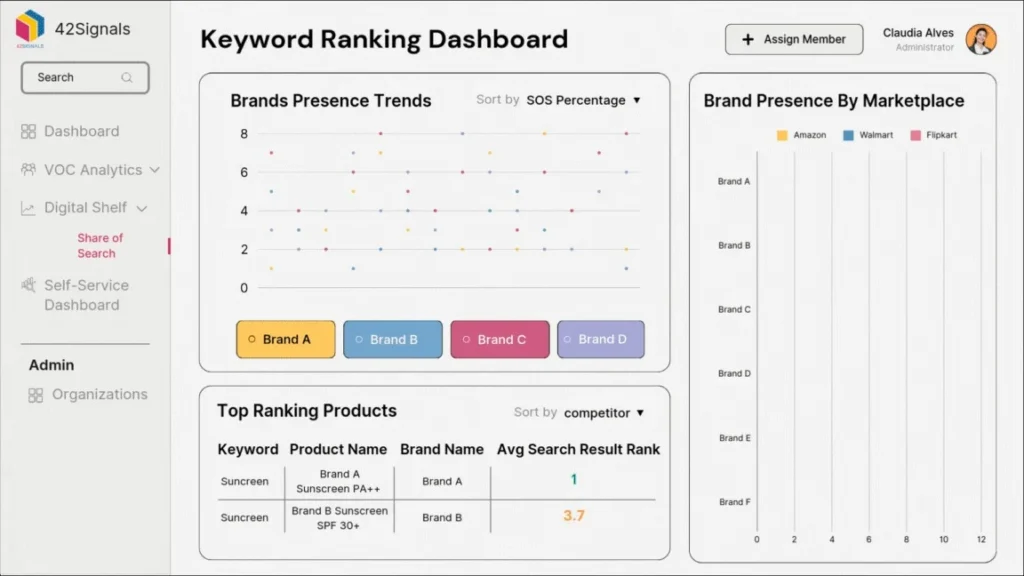
The use of specific data insights, sometimes referred to internally as leveraging 42Signals data, or similar internal metrics, helps refine the algorithms that determine optimal pricing. For instance, the system may learn that for a specific category, a small price drop is only effective if the competitor is within $5.00 of your original price, but ineffective if they are already $20.00 cheaper. This level of granular insight turns simple monitoring into predictive intelligence, maximizing the return on your investment in the competitor price intelligence platform.
Operational Efficiency: The Hidden ROI
The return on investment in a competitor price intelligence solution isn’t solely about margin and revenue; it also comes from dramatic improvements in operational efficiency.
Freeing Up Resources from Manual Competitor Data Tracking
Before implementing a solution, pricing teams or category managers might spend dozens of hours a week manually monitoring competitor websites, sifting through promotional emails, or compiling error-prone spreadsheets.
| Activity | Manual Process (Estimated Weekly Hours) | Automated Process (Competitor Price Intelligence Solution) | Efficiency Gain |
|---|---|---|---|
| Competitor Price Collection (1,000 SKUs) | 40 hours | 0 hours (Fully Automated) | 100% |
| Price Change Analysis and Reporting | 15 hours | 2 hours (Automated Alerts/Dashboards) | 87% |
| Repricing Strategy Execution | 10 hours | 1 hour (Rule-Based Automation) | 90% |
| Total Time Saved | 65 hours | 3 hours | 95.4% |
This time saved can be redirected toward high-value strategic tasks: product development, vendor negotiations, promotional planning, and deeper analysis of the market benchmarking data provided by the tool. The cost of labor saved is a direct, quantifiable element of the ROI.
Reducing Pricing Errors and Price Discrepancies
Manual competitor data tracking is inherently prone to errors. A human mistake can lead to a product being priced too low for too long, or too high, leading to lost sales. The automation and rigorous data quality checks inherent in a high-quality competitor price intelligence solution virtually eliminate these costly errors.
Every pricing mistake avoided is money saved, contributing directly to the bottom line. This stability and accuracy are critical components of a reliable and scalable repricing strategy.
How to Implement a Competitor Price Intelligence Solution: Four Steps
Implementing a competitor price intelligence solution is an investment that requires commitment, but the payoff is quick when executed correctly.
Key Steps for a Successful Deployment
- Define Core Competitors and SKUs: Don’t try to track everything at once. Start by clearly identifying your 5-10 most critical competitors and your 20% of products that drive 80% of your revenue (your KVIs). This focused approach ensures the immediate generation of actionable data.
- Establish Clear Repricing Strategy Rules: The software is only as good as the rules you set. Before launch, define clear, objective rules based on your market benchmarking goals. For example: “If Competitor A drops below Price Floor X, alert manager. If Competitor B drops price, match only by $0.50 if margin allows.”
- Integrate with Existing Systems: To maximize the ROI, the competitor price intelligence solution must integrate seamlessly with your PIM (Product Information Management) and ERP (Enterprise Resource Planning) systems. This enables true, automated repricing without human intervention, ensuring real-time reactivity.
- Measure and Refine: Use the platform’s reporting features, which leverage detailed ecommerce analytics, to track the gross margin and conversion rate of automatically priced items versus manually priced items. Continually refine your rules and the parameters of your repricing strategy based on the results.
The Imperative of Real-Time Competitor Price Intelligence
In a digital marketplace defined by volatility, having a reliable, real-time competitor price intelligence solution is no longer a luxury; it is a fundamental business imperative. The return on investment is multifaceted and profound: it protects margins by preventing unnecessary discounting, drives revenue by enabling aggressive, targeted price leadership, and creates significant operational efficiencies by automating the laborious process of competitor data tracking and market benchmarking.
By adopting this technology, brands gain the agility needed to respond instantly to shifts in competitor promotions and assortment, ensuring they capture every possible profitable sale. The ability to execute a precise, data-driven repricing strategy based on real-time intelligence is the key differentiator for success in modern ecommerce. Invest in a robust competitor price intelligence solution today and transform your pricing department from a cost center into a continuous profit engine.
Ready to quantify the ROI of competitor price intelligence for your catalogue? Book a 42Signals demo, and we’ll show you exactly how our platform tracks your competitive set in real time
FAQs: Competitor Price Intelligence Solution
What is a competitor price intelligence solution, and why is it essential for ecommerce brands?
A competitor price intelligence solution is a software platform that automatically monitors and aggregates pricing, promotion, and product data from your competitors’ online channels in real time. It is essential for ecommerce brands because it provides the data necessary to execute a dynamic repricing strategy. Without real-time competitor data tracking, brands risk either losing sales due to overpricing or unnecessarily eroding margins by underpricing or matching irrelevant competitor promotions. It ensures your prices are always optimal for both conversion and profitability.
How does a competitor price intelligence solution help protect profit margins?
It protects profit margins primarily by providing context and precision. The solution allows brands to differentiate between temporary promotional price drops and permanent price changes. By using this intelligence and robust market benchmarking data, brands can set automated rules that prevent unnecessary price matching, ensuring they only lower prices when strategically necessary. This leads to a higher Average Selling Price (ASP) and safeguards the gross margin on every transaction.
Can I use the competitor price intelligence solution for market benchmarking?
Yes, market benchmarking is one of the core functions of a quality solution. The platform continuously compares your prices and assortment against key competitors and the overall market average. This allows you to define your position—whether you aim to be the price leader, maintain price parity, or enforce a specific price premium. This strategic benchmarking is crucial for developing an effective, long-term repricing strategy.
What role does real-time data play in a modern repricing strategy?
Real-time data is the foundation of a modern repricing strategy. In a market where prices change hourly, old data is useless. A real-time competitor price intelligence solution ensures that your pricing decisions are based on the latest competitive movements, including promotions, stock levels, and price changes. This allows for immediate, automated reactions (e.g., repricing up when a competitor goes out of stock, or matching a temporary price drop) that maximize revenue and conversion rates while simultaneously protecting profit.
Is a competitor price intelligence solution difficult to integrate with existing ecommerce platforms?
Modern solutions are designed for seamless integration. The best competitor price intelligence solution platforms offer APIs and connectors that easily link with major ecommerce platforms (Shopify, Magento, Salesforce Commerce Cloud) and critical internal systems like ERPs and PIMs. This integration is essential for automating the full repricing workflow, ensuring that the insights from competitor data tracking are translated instantly into actionable price changes on your storefront.