

How a Global Sporting Goods Brand Unlocked $100M+ with Shelf Optimization

You have a superstar product. It is innovative, well-designed, and has the potential to fly off the shelves. But what if it is not actually on the shelf when your customer goes looking for it? What if the online listing is confusing, the images are poor, or a competitor’s product is dominating the search results? For a major global sporting goods brand, this was not a hypothetical fear. It was a multimillion-dollar reality.
This brand, a household name in athletic apparel and equipment, faced a common but colossal challenge. Their products were spread across thousands of physical retailers and even more online marketplaces. They had no clear, unified view of how their products were being presented, priced, and stocked. This lack of visibility was silently bleeding revenue and ceding ground to competitors.
Then, they made a strategic pivot. They stopped thinking of the “shelf” as just a physical space and started treating the entire customer journey as a digital battlefield. By implementing a sophisticated shelf optimization strategy, they did not just see incremental gains. They unlocked a staggering $100 million in revenue. This is the story of how they did it, and how any large enterprise can learn from their playbook.
The Silent Revenue Drain: The Need for Shelf Optimization
Before we dive into the solution, let us understand the problem in more detail. For this sporting goods giant, the issues were multifaceted. In physical stores, inconsistent SKU availability was a primary culprit. A best-selling running shoe might be fully stocked in one city but completely absent in another. This inconsistency frustrated loyal customers and sent them straight into the arms of competitors who could reliably fulfil their needs.

Online, the problems were even more complex. The “digital shelf” encompasses everything a customer sees before clicking “add to cart”: the product title, images, descriptions, reviews, and, crucially, its position in search results. This brand discovered that its product content was a mess.
Descriptions were copied and pasted from one retailer to another, key features were buried, and images were of low quality. This led to a poor conversion rate; customers simply did not have enough trust or information to make a purchase.
Perhaps the most insightful metric they were missing was their share of search. This measures how often your brand’s products appear in search results for relevant keywords compared to your competitors.
They were losing the “search battle” for critical terms like “best running shoes for beginners” or “durable yoga mat.” Without a strong share of search, they were invisible at the very moment a potential customer was deciding what to buy. This collective failure in competitive positioning across both physical and digital channels was the silent revenue drain they needed to plug.
The Game Plan: Redefining the "Shelf" for the Modern Era
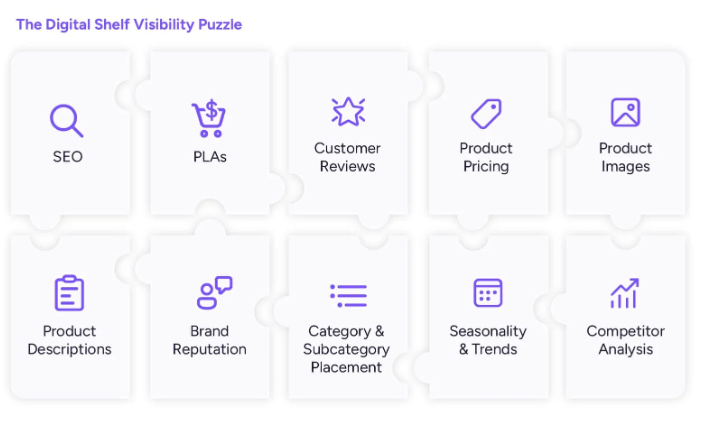
The brand’s leadership realized that a patchwork approach would not work. They needed a holistic strategy that treated every touchpoint where a customer encounters their product as part of one continuous “shelf.” This meant integrating data from brick-and-mortar partners like big-box retailers with data from e-commerce giants like Amazon and their own direct-to-consumer website.
The core of this new strategy was digital shelf optimization. Think of it as a constant, automated process of ensuring your products are not only available online but are also presented in the most compelling and discoverable way possible. It is about winning the “first moment of truth” when a shopper sees your product listing.
To execute this, they built a centralized command center. This was not just a simple dashboard; it was a system powered by advanced analytics deployed to handle repetitive but vital tasks. ‘
They could automatically check and report on SKU availability across hundreds of retailer websites, monitor price changes in real-time, and flag listings with missing or incorrect content. This freed up human analysts from manual data scraping to focus on higher-level strategic work, like interpreting the data and making informed decisions about competitive positioning. This fusion of human insight and automated efficiency was the foundation of their success.
Find out about
Winning the Digital Aisle: A Masterclass in Content and Search
and more by downloading our case study
Frequently Asked Questions
Shelf optimization is the process of arranging and managing products on retail or digital shelves in a way that maximizes visibility, sales, and customer satisfaction. It combines data analytics, consumer behavior insights, and product performance metrics to determine the best placement for each product.
In physical retail, this means identifying which products should go on eye-level shelves, how much space each SKU should occupy, and what combinations increase basket size. In e-commerce, it involves optimizing product listings, search placement, and recommendations to improve discoverability and conversions.
The goal is simple — make it easy for customers to find what they want and encourage them to buy more.
Shelf management refers to the systematic control of product placement, inventory levels, and shelf space utilization in stores or online platforms. It ensures that the right products are displayed in the right place, at the right time, and in the right quantity.
Good shelf management helps:
- Reduce out-of-stock situations
- Improve sales through better product visibility
- Maintain planogram (shelf layout) compliance
- Enhance brand performance by aligning shelf strategy with shopper behavior
Retailers often use specialized software or digital shelf analytics tools to monitor shelf performance and automate decisions.
To improve shelf availability, retailers and brands focus on preventing stockouts and ensuring replenishment happens in real time. Some proven methods include:
- Automated Replenishment: Using predictive analytics to forecast demand and restock proactively.
- Inventory Integration: Linking POS systems with supply chain data for accurate visibility.
- Regular Audits: Conducting frequent in-store or online checks to spot gaps.
- Collaborative Planning: Coordinating with suppliers and distributors to maintain consistent stock flow.
- Digital Shelf Monitoring: Using AI tools like PromptCloud’s data feeds to track product availability across e-commerce platforms in real time.
Maintaining high shelf availability ensures customer satisfaction and prevents lost sales opportunities.
Shelf technology refers to the use of digital tools, sensors, and analytics platforms to monitor and optimize shelf performance. It can include:
- Electronic shelf labels (ESLs): Automatically update prices or promotions.
- Image recognition software: Detect empty shelves or misplaced items through cameras.
- IoT sensors: Track stock levels and product movement in real time.
- Digital shelf analytics: Analyze online product visibility, pricing, and customer engagement.
In essence, shelf technology merges AI, automation, and data analytics to make retail operations smarter, faster, and more customer-centric — both in-store and online.
What are you waiting for?
Ready to Outperform in eCommerce?
Schedule a Demo with 42Signals Today to Unlock Advanced Insights and Strategic Advantages!
Schedule a Personalized Demo or Sign Up Now to see our services in action!