

** TL;DR ** Dynamic pricing models, a cornerstone of modern e-commerce profitability, fall into two main categories: predictable rule-based systems and adaptive Machine Learning (ML) AI optimization. Rule-based models use simple “if/then” logic for fast, transparent tasks like competitor matching or inventory management, but they lack the ability to learn and adjust to market complexity. ML models, conversely, leverage massive data to develop a sophisticated elasticity model, proactively finding the optimal price point to maximize profit (AI pricing optimization), though they present challenges with complexity and “black box” transparency. The most effective strategy is a hybrid approach, using rules as non-negotiable financial and compliance safeguards while deploying ML for continuous, high-return price refinement within those guardrails.
Understanding the Heart of Modern Commerce: Dynamic Pricing Models
Have you ever noticed how the price of that flight ticket changes every time you check it, or how the cost of your favorite item on an online store subtly shifts throughout the day? That’s not magic; it’s dynamic pricing models in action. Companies, especially those in ecommerce, need the agility to adjust prices based on real-time factors like demand, competitor behavior, and inventory levels.
This continuous adjustment, or dynamic pricing, is now a cornerstone of profitability for most large online retailers and marketplaces. It allows businesses to capture the maximum possible value for every transaction.
But behind this seamless, ever-changing price tag lies a complex engine. Generally, this engine falls into two major categories: the structured, predictable world of rule-based dynamic pricing models and the flexible, learning-driven realm of Machine Learning (ML) AI pricing optimization.
The Foundation: Rule-Based Dynamic Pricing Models

Image Source: Price Intel
Let’s understand the need for predictive analytics in e-commerce. Imagine a meticulous accountant who is given a rigid set of instructions and follows them perfectly, every single time. That is essentially how a rule-based dynamic pricing model operates. These systems rely on predefined “if/then” statements to dictate when and how a price should change.
See how dynamic pricing models help you optimize prices in real-time, from rule-based repricing to AI-powered optimization, and make data-driven decisions that protect margins and maximize profits. Learn more about
How Rule-Based Systems Work: Simple Logic, Fast Execution
A rule-based pricing system is built on logic gates. The business determines a set of conditions that, when met, trigger a specific price adjustment.

Here are a few common types of rules that define these models:
- Competitor Matching/Undercutting: “If Competitor A’s price for Product X is $50, set my price to $49.50.” This is one of the most common applications of repricing automation, ensuring competitive parity instantly. It’s a straightforward strategy that keeps you in the game on the digital shelf data of major marketplaces.
- Inventory Thresholds: “If the inventory level for Product Y drops below 10 units, increase the price by 10% to slow down sales.” This rule is designed to manage scarcity and maximize revenue on the last few items.
- Time-of-Day or Day-of-Week: “If the time is between 6 PM and 10 PM (peak shopping hours), increase the price by 5%.” This rule capitalizes on predictable consumer shopping habits.
- Cost-Plus Floor: “Never set the price below my Cost of Goods Sold (COGS) plus 15%.” This ensures that every sale remains profitable, acting as a crucial safety net for any dynamic pricing models.
The Strengths of Rule-Based Repricing Automation

Image Source: Minderest
One of the biggest advantages of rule-based systems is their predictability and transparency. You know exactly why a price changed, and you have complete control over the logic.
- Speed and Low Latency: Rules execute incredibly fast. Once a condition is met (like a competitor changing their price), the system can adjust your price almost instantaneously. This is crucial for winning the “Buy Box” on large platforms where milliseconds matter, making it effective for basic repricing automation.
- Cost-Effectiveness and Ease of Implementation: Setting up a rule-based system requires less complex data and computational power than an ML model. It’s often the initial go-to solution for businesses dipping their toes into dynamic pricing models.
- Guaranteed Compliance and Profit Floors: Since you hard-code minimum prices and margin requirements, you eliminate the risk of accidentally selling products at a loss, a key financial safeguard for any business focused on ecommerce insights.
The Limitations: A Lack of Nuance and Learning
While robust, rule-based systems suffer from a significant weakness: they are fundamentally static. They cannot learn or adapt to situations that were not explicitly programmed.
- Inability to Grasp Market Elasticity: A rule might tell you to raise a price during high demand, but it can’t figure out how much to raise it before demand drops off completely. It lacks the ability to develop an elasticity model, meaning it can’t predict how sensitive customers are to a price change. This often leaves money on the table or results in lost sales.
- Over-Simplicity in Complex Environments: In a volatile marketplace analysis environment with hundreds of competitors, managing thousands of complex, interconnected rules becomes unwieldy and prone to error. You are forced to generalize, which sacrifices potential revenue.
- No Self-Correction: If a rule consistently leads to poor outcomes (e.g., matching a competitor whose pricing strategy is fundamentally flawed), the system will continue to follow that rule until a human intervenes. The system lacks any form of AI pricing optimization.
Stepping into the Future: Machine Learning Dynamic Pricing Models
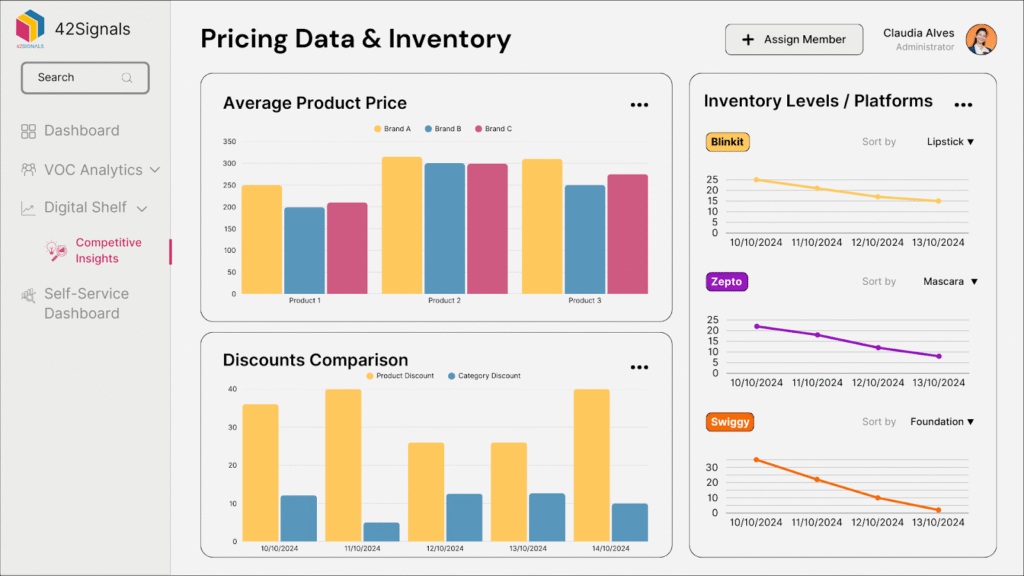
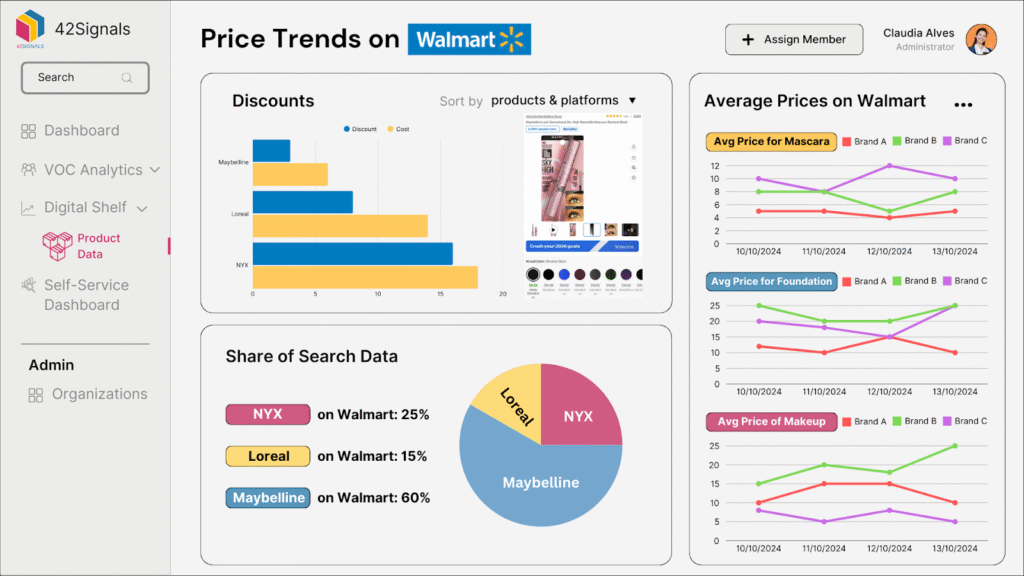
42Signals product data and pricing
If the rule-based system is a rigid accountant, the Machine Learning system is a brilliant, tireless market analyst who learns from every single transaction and constantly refines their strategy. ML dynamic pricing models use advanced algorithms to process massive amounts of data, identify complex patterns, and make pricing decisions that maximize a specific objective, usually total revenue or profit.
How ML Pricing Optimization Elevates the Strategy
ML models move beyond simple “if/then” statements. They use sophisticated statistical techniques to predict outcomes, such as how many units will sell at a given price point, under specific conditions.
The algorithms ingest data points far beyond simple competitor prices:
- Demand Forecasting: Analyzing historical sales, search traffic, seasonality, weather patterns, and even social media sentiment to predict future demand for products.
- Price Elasticity Model Development: This is arguably the biggest differentiator. ML models can calculate the elasticity model for every product, in every region, at every time of day. This means they can determine the optimal price point that maximizes profit without losing too many potential customers.
- Competitor Intent: ML models can analyze not just the current competitor price, but also their pricing pattern over time to predict their next move and preemptively adjust your price. This goes well beyond basic digital shelf data scraping.

Image Source: Competitor analysis dashboard by 42Signals
- Customer Segmentation: The model can differentiate between a price-sensitive customer and a convenience-focused customer, potentially offering different prices or promotions to different user segments, which is a key part of effective AI pricing optimization.
The Power of AI Pricing Optimization: Smarter Decisions
The advantages of adopting ML-driven dynamic pricing models are centered around achieving optimal, granular profitability that humans or simple rules simply cannot match.
- True Price Optimization: Instead of just reacting to the market (like rules do), ML models proactively optimize your price. They find the exact sweet spot, often resulting in margin improvements that significantly impact the bottom line. For instance, according to a report by McKinsey & Company, companies that use advanced analytics for pricing often see profit increases of 2 to 4 percent (Source: McKinsey & Company, “The new science of dynamic pricing”). This kind of ecommerce insights shows the real power of the technology.
- Adaptive Learning: The system learns from its own decisions. If a price adjustment doesn’t lead to the predicted sales volume, the model revises its understanding of the elasticity model and adjusts its future strategy. This continuous feedback loop is the essence of AI pricing optimization.
- Handling Volatility and Scale: ML models thrive in complex, fast-moving environments. They can process millions of data points across thousands of SKUs and hundreds of competitors, making them ideal for high-volume retailers focused on detailed marketplace analysis.
Challenges of Adopting Machine Learning Models
Despite their superior performance, ML dynamic pricing models are not without their hurdles. They require significant investment and a different approach to data management.
- The Black Box Problem: ML models, especially complex neural networks, can sometimes arrive at an optimal price without a clear, easily traceable explanation for why. This lack of transparency can make human oversight and compliance auditing difficult. Understanding the logic of your AI pricing optimization is vital for legal and competitive reasons.
- Data Requirements and Infrastructure: These models are data-hungry. They require clean, consistent streams of data, including historical sales, competitor movements, and detailed digital shelf data. Building and maintaining the necessary data infrastructure and specialized data science teams is a significant initial barrier.
- Longer Implementation and Calibration: Unlike rule-based systems that can be set up in days, ML models require time to be trained on historical data and tested in real-world scenarios before they can be fully trusted to handle repricing automation autonomously.
Rule-Based vs. ML: A Comparative Marketplace Analysis
Choosing between rule-based and ML dynamic pricing models is a strategic decision that depends heavily on the specific needs, scale, and complexity of your business environment. To help clarify this choice, we can break down the differences across several key dimensions.
Transparency and Control
| Feature | Rule-Based Dynamic Pricing | ML Dynamic Pricing Models |
|---|---|---|
| Control | Absolute. Human defines every single price change parameter. | Indirect. Human defines the objective (e.g., “maximize profit”), and the AI determines the price. |
| Transparency | High. Easy to audit and explain why a price was set. | Lower. Often referred to as a “black box,” requiring specialized tools to interpret the price decision. |
| Ideal For | Businesses with strict regulatory requirements, or those focused on simple repricing automation tasks like competitor matching. | Businesses that prioritize optimization and are willing to sacrifice some explainability for superior performance. |
Complexity and Scalability
| Feature | Rule-Based Dynamic Pricing | ML Dynamic Pricing Models |
|---|---|---|
| Complexity Handled | Low to Moderate. Struggles with thousands of rules and complex interactions. | High. Can seamlessly manage thousands of variables and optimize across entire product catalogs. |
| Scalability | Limited. Scaling to new markets or products often means writing entirely new, complicated rule sets. | High. Can be trained and deployed across vast catalogs and international markets with relative ease, making it a powerful ecommerce insights tool. |
| Data Needs | Low. Primarily needs internal cost data and basic competitor price feeds (digital shelf data). | High. Needs rich, historical, and multi-faceted data (demand, competitor history, seasonality, etc.). |
Adaptability and Financial Performance
| Feature | Rule-Based Dynamic Pricing | ML Dynamic Pricing Models |
|---|---|---|
| Adaptability | None. Cannot learn from outcomes or detect market shifts without human intervention. | Continuous. Learns from every transaction and automatically adjusts the underlying elasticity model and strategy. |
| Pricing Goal | Reactive. Focuses on achieving a defined competitive position (e.g., ‘always be 1% lower’). | Proactive/Optimized. Focuses on achieving a financial goal (e.g., ‘maximize profit margin’). |
| Financial Uplift | Moderate (primarily through efficiency gains). | Significant (through true optimization and granular pricing accuracy). AI pricing optimization is a major revenue driver. |
The Blended Approach: Leveraging Both Models for Peak Performance
In practical terms, many leading companies don’t exclusively rely on one model. They implement a hybrid system that leverages the strengths of both dynamic pricing models. This approach uses rules to establish non-negotiable boundaries, while ML handles the intricate optimization within those boundaries.
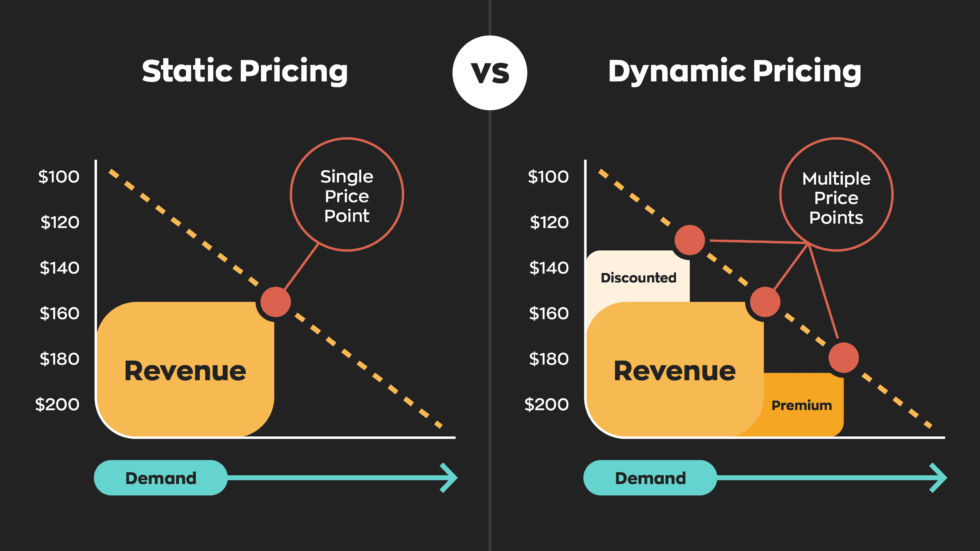
How to Implement a Hybrid Dynamic Pricing Model:
- Establish Guardrail Rules: This is where the rule-based system shines. Set strict, unbendable rules like “Never price below COGS + 10%” or “Never price above Manufacturer Suggested Retail Price (MSRP).” These rules act as a safety net, guaranteeing basic profitability and compliance.
- ML Optimization Within the Boundaries: The AI pricing optimization model is then tasked with finding the absolute best price for every product, minute by minute, between the lower and upper guardrail prices. It uses the complex elasticity model to determine the revenue-maximizing point.
- Strategic Repricing Automation: Use simple rules for products that require constant, low-margin, high-volume price matching (e.g., commodity products), and reserve the more computationally intensive ML model for high-margin, complex-demand items where optimization yields the biggest return. This is smart repricing automation.
- Enriching Digital Shelf Data: The ML model can use the rules system to quickly process and integrate basic digital shelf data like competitor price scrapes, freeing up the more powerful AI to focus on advanced behavioral analytics rather than simple data comparison.
Key Considerations for Adopting Dynamic Pricing Models
Regardless of whether you lean toward a rule-based or an ML-driven system, there are several foundational aspects that businesses must master to ensure success in dynamic pricing models.
1. Data Quality is Paramount
A rule is only as good as the digital shelf data it receives, and an ML model is garbage-in, garbage-out. Investing in reliable data sources and robust data cleaning processes is essential. This includes accurate inventory feeds, clean historical sales records, and high-fidelity, real-time competitor data gathered through careful marketplace analysis.
2. Define Clear Objectives
What is the ultimate goal of your dynamic pricing models? Is it:
- Market Share Acquisition (aggressively lowering prices)?
- Profit Maximization (finding the ideal margin)?
- Inventory Liquidation (reducing prices to clear stock)?
The objective you choose fundamentally changes the programming of the rules or the training parameters of the AI pricing optimization model. Ambiguous goals lead to indecisive pricing and suboptimal results.
3. Embrace Price Elasticity Model Thinking
Whether you use ML or are just starting with rules, you need to think about price elasticity. If you don’t have an automated elasticity model, you must manually test price points to understand how much your customers are willing to bear. A common mistake is blindly matching the lowest competitor without considering that your brand loyalty might allow you to charge a higher, more profitable price. Use ecommerce insights to constantly test your assumptions.
4. Legal and Ethical Considerations
The use of highly advanced dynamic pricing models—especially those powered by AI pricing optimization—is drawing increased scrutiny from regulators globally. Ensure your system does not engage in price discrimination based on protected characteristics. Maintain transparency (even in ML models) and ensure compliance with regional laws regarding pricing fairness. Always keep auditable records of your repricing automation decisions.
Ready to Take the Next Step?
See how our solutions can help you achieve your goals and drive measurable results.
Mastering the Algorithmic Price Tag
The shift from static to dynamic pricing models is not just an upgrade; it’s a complete reimagining of the retail and ecommerce landscape. Rule-based systems offer a great starting point, providing reliable, controllable repricing automation ideal for foundational competitive strategies and high-speed execution within defined parameters. They are the safe, reliable workhorses of the pricing world.
However, for businesses striving for a true competitive edge, deep ecommerce insights, and maximized profitability across a complex product catalog, the future undeniably lies with AI pricing optimization and its sophisticated elasticity model. Machine Learning enables a level of granular control and proactive strategy that rule-based systems simply cannot achieve.
The most successful strategy today is a hybrid one: using the structure of rules as a floor and ceiling, while deploying the intelligence of ML to find the peak profit point in the space between. By focusing on data quality, clear objectives, and continuous learning, your business can master the algorithmic price tag and secure a robust position in the ever-evolving world of digital commerce.
Use 42Signals to see how marketplace data and near-real-time pricing intelligence can help your business.
Frequently Asked Questions
What is a dynamic pricing model?
A dynamic pricing model is a pricing approach where the price changes over time based on real-world signals like demand, supply, inventory levels, time of day/season, competitor pricing, and sometimes customer context. The key idea is that the “right price” is not fixed. It is continuously recalculated within guardrails such as minimum margin, price floors, brand rules, and legal or marketplace constraints.
What are the 4 methods of pricing?
Cost-based pricing: You start with your unit cost and add a markup to hit a target margin.
Competitor-based pricing: You set prices relative to competitors or a market reference price, often to stay within a tight price band.
Value-based pricing: You price based on the value the product creates for the customer, not on cost or competition.
Demand-based pricing: You adjust price based on demand intensity and willingness to pay, which includes dynamic pricing as an operational form of this method.
What is an example of a dynamic pricing company?
Uber is a clean example. Its prices change based on real-time supply and demand conditions, increasing when demand outstrips available drivers and easing when supply catches up.
What are the four pricing models?
Pricing models usually mean “how you charge,” not “how you calculate the price.” Four common models are:
Subscription: Customers pay a recurring fee for ongoing access.
Usage-based: Customers pay based on consumption (units, minutes, API calls, volume).
Tiered or packaged: Customers choose a plan or bundle with defined limits or features.
Freemium: A free baseline is offered, with upgrades or advanced features paid.