


ECommerce all over the world has changed rapidly in the last decade alone. One of the main driving forces behind it is the launch of AI and LLM models at the end of 2022. With this new technology, AI ecommerce has ushered in a new era of change.
Instead of shopping on platforms without any interaction, customers can do much more.
- Browse outfits tailored to their vacation needs or body type
- Buy makeup that matches their skin tone via a virtual try-on
- Talk to AI chatbots about any issues with their orders or learn about product details
- Obtain a quick summary of all the customer reviews to understand the good and the bad
The potential for growth is just at the cusp of growth and there’s so much more that’s yet to happen in the domain. Let’s see what they are.
Rise of AI Ecommerce: How It’s Shaping the Future of Ecommerce?
AI eCommerce is no longer a futuristic concept—it’s a present-day reality. Several brands have begun adopting AI tools to improve operations. It can be around customer experiences or growth or even analytics.
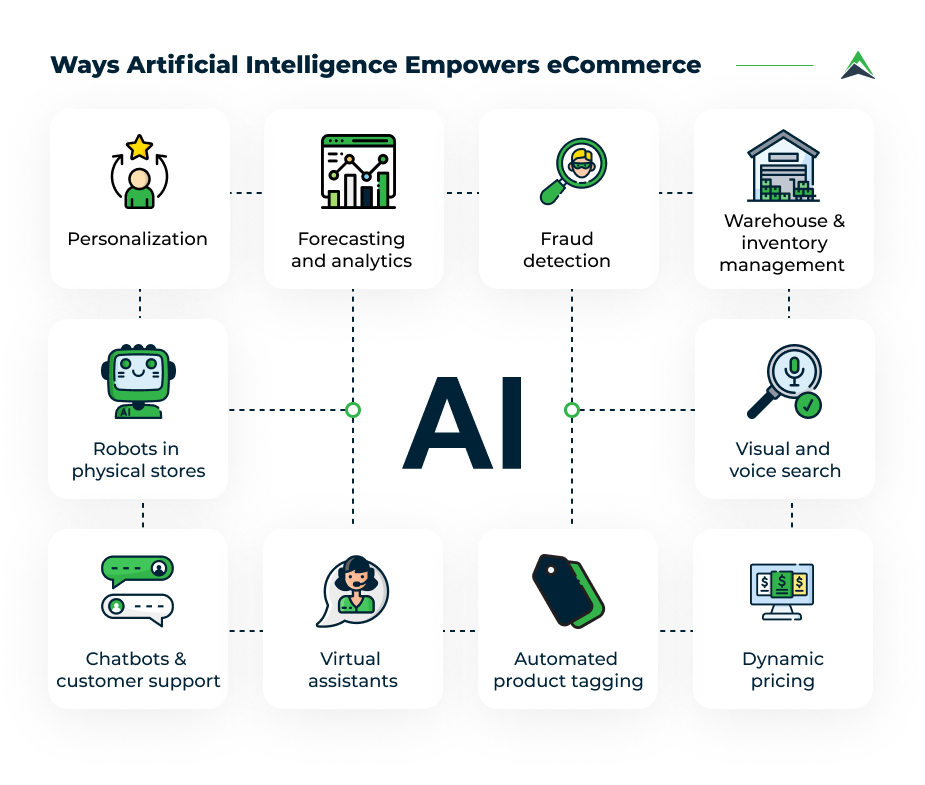
Image Source: Eastern Peak
According to a report by McKinsey, AI-driven eCommerce solutions can increase profitability by up to 59% by optimizing pricing, inventory management, and marketing strategies.
But what exactly is changing, and why is AI becoming indispensable for modern eCommerce brands?
1. Personalization at Scale
One of the most significant ways AI is transforming eCommerce is through hyper-personalization. Traditional eCommerce platforms rely on basic customer data to recommend products, but AI takes this to the next level.
Analyzing vast amounts of data—such as browsing history, purchase behavior, and even social media activity is a must. With this data, algorithms can predict what customers want before they even know it themselves.
An example in this domain would be suggesting products tailored to individual preferences. This would drastically increase the likelihood of conversions and improve sales. If a brand succeeds in doing this well, customer loyalty will increase and lifetime value too. Brands like Netflix and Amazon have already put this into play and are seeing better satisfaction.
2. Enhanced Ecommerce Analytics
Data is the lifeblood of eCommerce, but without the right tools, it can be overwhelming. AI ECommerce platforms are changing the odds by providing insights in real time. The tools can analyze all sorts of data and customer behavior. It makes it much easier to identify KPIs and trends that would be impossible manually.

Considering share of search – a critical metric measuring how often a brand appears in search results. This data can improve sales tenfold when the brand understands what keywords to prioritize. It also shows what competitors are doing and where the gap exists. AI insights can also optimize for pricing and demand forecasts. Some may even predict upcoming churn which can be so important to retain a customer.
3. Streamlined Operations with AI ECommerce Automation
AI is also transforming the backend of eCommerce operations. The prompt tracking of inventory helps brands save time and reduce costs. Proper inventory management also means sales are optimized and stock is not wasted or in storage. AI predictions based on historical data and market trends ensure nothing runs out. It reduces the instances of out-of-stock or overstocked items.
Ultra-fast delivery is also playing a crucial role in optimizing logistics. Looking at traffic patterns and delivery routes can help optimize product delivery. The faster orders reach the happier the customers will be. This level of efficiency can become a key differentiator for brands in the space.
4. Digital Shelf Analytics
In the digital age, the “shelf” is no longer confined to physical stores. Digital shelf refers to where products are displayed on eCommerce platforms. An example would be Amazon, Shopify, or Walmart’s online store. Here, knowledge about product performance, bestsellers, and competitor strategies is very important.
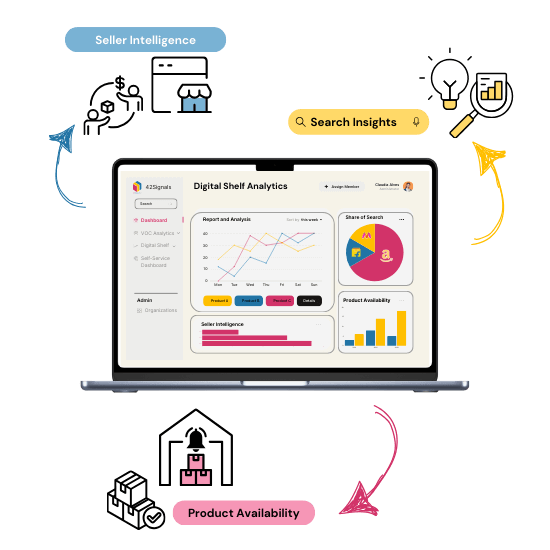
Tools like 42Signals help track metrics like product visibility and pricing competitiveness. They can also track customer reviews. This knowledge means businesses know what’s working and what’s not and can improve operations based on this data.
5. Improved Customer Support with AI Chatbots
Customer support is a critical component of the eCommerce experience, but it can also be a significant drain on resources. AI-powered chatbots are changing the game by providing instant, 24/7 support to customers.
These chatbots can handle a wide range of tasks, from answering frequently asked questions to processing returns and refunds.
Automating routine tasks helps free up human agents to focus on more complex issues. It can also make sure someone’s always present to answer queries without human intervention. This can improve satisfaction level and the bot can be trained to become smarter and better over time.
How to Effectively Use AI in Ecommerce to Boost Sales & Operations?
Now that we’ve explored the ways AI is transforming eCommerce, let’s dive into how brands can effectively implement AI in their operations.
1. Start with a Clear Strategy
Before integrating any AI into your eCommerce platform, it’s essential to have a crystal-clear strategy. This goes beyond a vague desire to “be more innovative.” Begin by conducting a thorough audit of your business to identify specific, high-impact pain points. Is your cart abandonment rate alarmingly high? Are you struggling with forecasting demand, leading to stockouts or overstock? Is your customer support team overwhelmed with repetitive queries?
Once you’ve pinpointed the challenges, define SMART goals (Specific, Measurable, Achievable, Relevant, Time-bound) for your AI initiative. For example: “Implement a chatbot to reduce first-response time to under 10 seconds and handle 40% of tier-1 support queries within six months,” or “Use a recommendation engine to increase the average order value by 15% in the next quarter.” This clarity ensures every AI investment has a purpose and a defined metric for success, preventing wasted resources on solutions that don’t move the needle.
2. Leverage AI ECommerce-Powered Tools
There are countless AI-powered tools available for eCommerce brands, ranging from analytics platforms to chatbots and recommendation engines. Some popular options include:
- Hyper-Personalization Engines (e.g., Dynamic Yield, RichRelevance): These go beyond simple “customers who bought this also bought” recommendations. They use real-time behavioral data to personalize every touchpoint—from the homepage banner a user sees to the email content they receive and the products featured at the top of a category page.
- Visual and Voice Search AI: Tools like Syte and ViSenze allow customers to upload an image to find similar products or use natural language voice commands to search your catalog. This drastically improves usability and conversion, especially on mobile devices.
- Predictive Analytics and Inventory Management (e.g., Blue Yonder, ToolsGroup): These platforms analyze countless variables—historical sales data, seasonality, emerging trends, even weather forecasts—to predict future demand with remarkable accuracy. This allows for optimized inventory levels across warehouses, reducing carrying costs and preventing lost sales.
- Blue Yonder: AI can dynamically adjust prices based on competitor pricing, demand fluctuations, inventory levels, and a customer’s willingness to pay. This ensures you remain competitive while maximizing profit margins.
- 42Signals: For digital shelf analytics and voice of customer analytics. AI monitors your product listings across platforms like Amazon and Walmart, ensuring pricing is consistent, inventory status is accurate, and promotions are live. It also aggregates voice-of-customer data from reviews to highlight common complaints or desires.

3. Invest in Data Quality
AI models are sophisticated algorithms that learn from data. The old adage “garbage in, garbage out” has never been more true. An AI tool trained on incomplete, inaccurate, or siloed data will produce flawed and unreliable insights.
To build a solid data foundation:
Break Down Data Silos: Ensure your CRM, ERP, email platform, and eCommerce platform are integrated. A unified customer view is paramount for effective personalization.
Implement Rigorous Data Governance: Establish processes for data cleansing, enrichment, and standardization. Regularly audit your data sources for accuracy.
Focus on First-Party Data: With the phasing out of third-party cookies, the zero- and first-party data you collect (e.g., from newsletter signups, preferences centers, and purchase history) becomes your most valuable asset for training AI models. Be transparent with customers about how you use their data to provide a better experience.
4. Monitor and Optimize
AI is not a magic bullet or a set-it-and-forget-it solution. It’s a powerful engine that requires fine-tuning. The initial setup is just the beginning. You must continuously monitor its performance against the KPIs you established in your strategy.
For instance, if your product recommendation engine is being ignored, you might need to A/B test its placement on the page or adjust the algorithm to prioritize best-sellers or new arrivals. If a chatbot is consistently failing to resolve issues, you need to analyze the conversation logs and feed that data back into the system to improve its natural language processing and knowledge base. This iterative process of testing, learning, and optimizing is what ultimately unlocks the full potential of AI.
Why AI is a Game-Changer for Today’s Ecommerce Brands?
AI Commerce is necessary for any business looking to do better in operations. New tech such as this cannot be ignored. Companies who understand that benefit from –
1. Competitive Advantage
Brands that harness AI effectively can deliver experiences that feel truly bespoke. They anticipate customer needs before they’re even expressed. This creates a sticky, loyal customer base that is less likely to price-shop and more likely to advocate for your brand. This level of sophistication is exceptionally difficult for competitors without AI to replicate at scale.
2. Increased Efficiency
AI-powered automation transcends simple task automation. It optimizes complex, decision-heavy processes across the supply chain. From predicting the most efficient shipping routes and warehouse layouts to automating digital ad buying for maximum ROAS, AI eliminates waste—waste of time, money, and resources. This efficiency directly translates to healthier profit margins and the ability to scale operations without a linear increase in overhead.
3. Better Customer Insights with AI Ecommerce
While humans can analyze reports, AI can detect subtle, hidden patterns in vast datasets that would be impossible to spot manually. It can segment audiences into micro-cohorts based on nuanced behaviors, predict churn risk with high accuracy, and identify emerging product trends before they hit the mainstream. These aren’t just insights; they are actionable intelligence that empowers brands to be proactive rather than reactive.
4. Future-Proofing Your Business
The trajectory of technology is clear: AI will become more deeply embedded in every aspect of commerce. From the rise of the semantic web and generative AI for content creation to the potential of the metaverse, the foundations are being built today. By adopting and integrating AI now, brands are not just solving today’s problems; they are building the data infrastructure and technical literacy needed to adapt to and capitalize on the next wave of digital innovation. The businesses that wait will be playing a perpetual game of catch-up, while the AI-powered leaders will be defining the future.
Conclusion
AI ECommerce has created a name for itself and is here to make brand operations much easier. When adopted well, it can affect and improve multiple operations.
42Signals and its AI-powered software help ecommerce brands with several insights and analytics. Knowledge about competitor strategies, share of search, and even pricing info.Try us out. Sign up for a free trial or schedule a demo.
Frequently Asked Questions
How is AI used in eCommerce?
Artificial Intelligence (AI) is transforming eCommerce by enabling automation, personalization, and smarter decision-making. Some common uses include:
- Personalized Recommendations: AI analyzes browsing history and customer behavior to suggest relevant products, increasing conversions.
- Chatbots and Virtual Assistants: AI-powered chat systems help handle customer queries instantly and 24/7.
- Inventory Management: Predictive algorithms forecast demand trends and automate stock replenishment.
- Visual Search: AI enables users to upload images and find similar products, enhancing the discovery experience.
- Fraud Detection: Machine learning models detect unusual patterns in transactions and prevent payment fraud.
- Dynamic Pricing: AI tools adjust prices in real time based on demand, competition, and user behavior.
2. What is an AI eCommerce store?An AI eCommerce store is an online shopping platform that integrates artificial intelligence into its operations to improve user experience, streamline management, and boost sales. Features of an AI-powered store might include:
- AI-generated product descriptions and SEO content.
- Smart search that understands natural language or visual inputs.
- Personalized landing pages based on user profiles.
- Automated product tagging and categorization.
- Predictive product bundling or upselling based on buying history.
These stores aim to deliver a more intelligent, responsive, and conversion-optimized shopping experience.
3. Is Zara using AI?
Yes, Zara has actively embraced AI in its operations. The fashion retailer uses artificial intelligence for:
- Inventory and supply chain optimization – AI predicts which items will be in demand and ensures rapid restocking in the right locations.
- Trend forecasting – Zara analyzes real-time sales data and social trends to update its product lines quickly.
- Customer behavior tracking – In both physical and digital stores, Zara uses AI tools to analyze foot traffic and shopping patterns.
- Visual product search and fitting tools – Some of Zara’s digital platforms use AI to enhance the shopping experience by helping users find styles that match their preferences.
Zara’s AI strategy supports its agile supply chain and fast-fashion model.
4. What is the best AI for eCommerce?
There isn’t a single “best” AI for all eCommerce needs—it depends on your goals. However, here are some of the top AI tools and platforms widely used in the industry:
- Shopify’s AI Suite (Shopify Magic) – For AI-driven storefronts, content generation, and analytics.
- Google Cloud AI/Vertex AI – Offers advanced personalization and recommendation models.
- Dynamic Yield (by Mastercard) – Specializes in real-time personalization and A/B testing for eCommerce.
- 42Signals – Ideal for competitive intelligence, pricing insights, and digital shelf analytics.
- Salesforce Commerce Cloud AI (Einstein) – Provides personalized search, product recommendations, and customer segmentation.
- ChatGPT & GPT-based tools – Increasingly used to power product copywriting, customer support, and conversational shopping experiences.
The right tool depends on whether your priority is personalization, automation, pricing, forecasting, or customer engagement.