

The story of e-commerce is one of transformative shifts and rapid adaptations, set against the larger backdrop of the digital revolution. To understand the evolution of the online retail industry, we need to go back in time and look at its origins, how technological advancements aided its journey, and the shifts in consumer behavior. E-commerce analysis helps us understand where we are today from where we came.
E-Commerce Analysis – The Evolution
The Analytical Framework: Waves of E-commerce Evolution
To move beyond a simple timeline, we can analyze the history of e-commerce in distinct “waves,” each defined by core technologies, business models, and consumer behaviors.
- Wave 1: The Foundation (1995-2005)
- Characteristics: Establishment of core online shopping basics. The model was primarily price-driven and focused on convenience over experience. Early adopters were motivated by access to a wider selection and better prices than brick-and-mortar stores.
- Business Models: Birth of the first ecommerce business models: B2C marketplaces (Amazon, eBay), direct online retailers, and the first B2B procurement platforms.
- Limitations: Slow dial-up internet, low consumer trust in online payments, and basic, utilitarian website design defined this era.
- Wave 2: Expansion & Optimization (2005-2015)
- Characteristics: Rise of mobile commerce (m-commerce), improved website UX, and the professionalization of digital marketing (SEO, PPC). The focus shifted from just price to include trust, reviews, and social proof.
- Key Developments: Widespread adoption of broadband, launch of the iPhone (2007), and the growth of social media platforms that began influencing purchase decisions.
- Wave 3: Integration & Omnichannel (2015-Present)
- Characteristics: Blurring lines between digital and physical. Features like Buy Online, Pick Up In-Store (BOPIS), AR try-ons, and live-stream shopping became common. The evolving commerce experience is now personalized, seamless, and channel-agnostic.
- Drivers: Sophisticated data analytics, cloud computing, and heightened consumer expectations for speed and convenience.
The Evolution of E-commerce: A Comparative Waves Analysis
| Wave / Era | Time Period | Key Technologies & Enablers | Primary Business Model | Consumer Behavior Driver |
|---|---|---|---|---|
| Wave 1: Foundation | 1990s – Early 2000s | Dial-up, SSL encryption, basic HTML. | B2C Marketplaces, Direct Online Retail. | Price & Selection, novelty of online shopping. |
| Wave 2: Expansion | Mid-2000s – Mid-2010s | Broadband, Mobile Smartphones, Social Media. | Marketplaces, Flash Sales, First DTC brands. | Convenience & Trust, mobile access, social influence. |
| Wave 3: Integration | Mid-2010s – Present | Cloud, AI/ML, APIs, AR/VR, IoT. | Omnichannel Retail, Subscription, Social Commerce. | Seamless Experience, personalization, instant gratification. |
1. The Humble Beginnings: 1970s-1980s
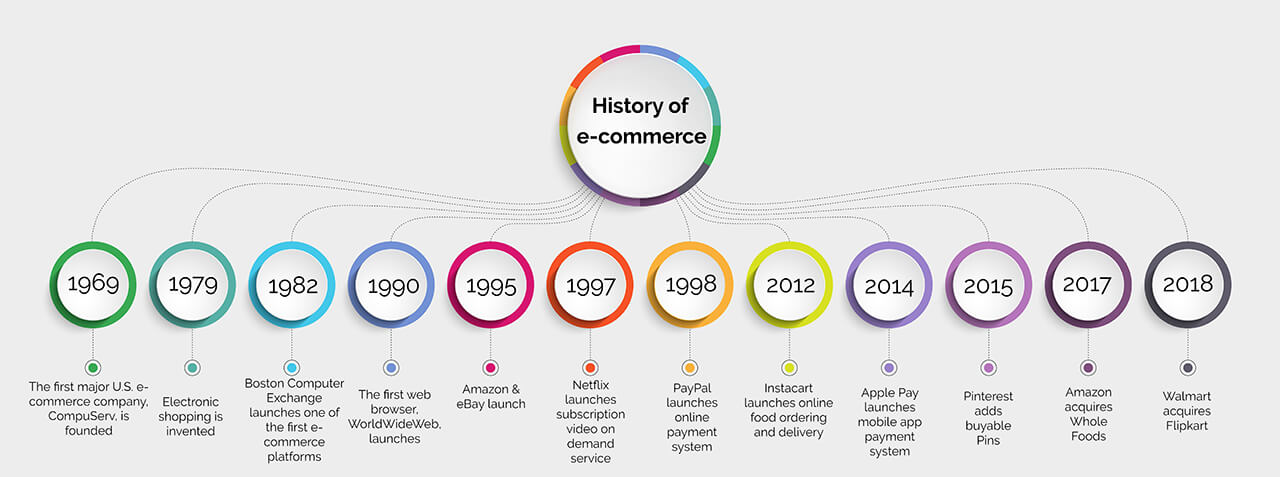
E-commerce took its first steps in the 1970s when businesses started using Electronic Data Interchange (EDI) to share business documents with other companies. This replaced the traditional method of mailing paper documents, setting the stage for more digital interactions.
However, it was in the 1980s that true consumer-focused e-commerce started budding. The advent of home computers and modems was pivotal. Pioneers, such as CompuServe, began offering electronic mail services to their users. Still, transactions remained limited due to nascent technology and consumer skepticism.
2. The Dot-Com Boom: 1990s
The 1990s were groundbreaking for e-commerce. In 1991, the World Wide Web opened to the public, and in 1994 the first secure online purchase, a Sting CD, was made on the platform called NetMarket.
With this, new establishments such as the global giant Amazon and eBay were founded in 1994 and 1995 respectively.
Two significant developments bolstered the growth of e-commerce. First, the Netscape browser provided a platform where transactions could be secured using SSL encryption. Secondly, as more households gained access to personal computers and the Internet, there was a broadening base of potential online shoppers.
3. Growing Pains and Consolidation: 2000s
Post the dot-com bubble burst in the early 2000s, many e-commerce businesses folded, but this period was far from a slowdown. Instead, the 2000s were marked by a more mature and consumer-focused approach to online retail.
Companies like Amazon diversified their product lines, moving from niche markets (like books) to virtually every product category imaginable. New entrants, such as Alibaba in China, established themselves as global e-commerce powerhouses. Moreover, payment methods evolved. Platforms like PayPal emerged, simplifying online transactions and enhancing user trust.
This era also heralded the rise of online marketplaces, as sellers were easily able to reach a global audience. By the end of the 2000s, several companies cropped up across the world and people grew comfortable with shopping online for their needs.
4. Mobile Commerce and Personalization: 2010s
The ubiquity of smartphones catalyzed the next major evolution of e-commerce – mobile commerce (or m-commerce). With the world’s information and vast marketplaces in their pockets, consumers began shopping online with an ease previously unimaginable.
This decade was marked by increased personalization in online shopping. Algorithms studied user behavior to offer personalized product recommendations, making shopping more intuitive. Subscription models, like those of Birchbox or Blue Apron, became popular, offering curated, personalized experiences.
Furthermore, the lines between social media and e-commerce started to blur. Platforms such as Instagram and Pinterest integrated “shop now” features, converting social media platforms into shopping portals.
5. E-Commerce Analysis – Today and Beyond
E-commerce today is an amalgamation of its rich history and cutting-edge technological advancements. AI-driven personalization, augmented reality shopping experiences, and drone deliveries are not just concepts but emerging realities. Moreover, direct-to-consumer brands, bypassing traditional retail channels, are redefining product creation, marketing, and distribution.
As we stand at the forefront of a new era, we see the continuous integration of technology – from blockchain-securing transactions to the Internet of Things (IoT) reshaping how consumers interact with products. With E-Commerce Analysis tools readily available to businesses and digital shelf analytics in e-commerce growing in prominence, there’s so much more we know and can do with this data today.
The once-clear boundaries of E-Commerce Analysis are now fluid, encompassing every touchpoint of our digital lives.
Global Perspectives: Case Study of Rakuten and Japan’s Ecosystem
- The Rakuten Model: Founded in 1997, Rakuten took a different path than Amazon. Instead of a pure inventory-based model, it built a “mall” style marketplace that empowered small and medium-sized merchants. Its evolution involved deep integration with logistics, banking (Rakuten Bank), and telecommunications (Rakuten Mobile), creating a unique, integrated ecosystem.
- Impact on Japan’s Supply Chain: Rakuten’s growth forced a modernization of Japan’s fragmented logistics and payment infrastructure, demonstrating how a dominant e-commerce platform can transform national supply chains. This contrasts with the warehouse-and-fulfillment-center model that dominated the early evolution in the West.
The Modern E-commerce Infrastructure: Beyond the Storefront
Today’s e-commerce evolution is underpinned by invisible but critical infrastructure, which is a key interest for professionals and e-commerce data analysts.
The Supply Chain as a Competitive Battleground: The “last mile” delivery experience, sustainability in packaging, and real-time inventory visibility are now primary competitive advantages, as seen in the strategies of giants like Amazon and Alibaba.
The Platformization of Commerce: E-commerce is no longer just about building a website. It’s about leveraging platforms (Shopify, BigCommerce), marketplaces (Amazon, Etsy), and social commerce channels (Instagram Shops, TikTok Shopping). This shift lowers barriers to entry but creates new competition and complexity.
Data as the New Currency: The modern ecommerce business evolution is driven by data. E-commerce analysis now involves predictive analytics for inventory, AI for personalized marketing, and digital shelf analytics to track competitors and optimize product listings across all online touchpoints.
Conclusion on E-Commerce Analysis
From its EDI beginnings to the AI-driven platforms of today, e-commerce has constantly evolved, mirroring larger societal and technological changes.
As we chart its journey, we see not just the transformation of commerce but a reflection of our evolving relationship with technology and its profound influence on how we live, work, and shop.
To know more about the insights available to e-commerce brands today, visit our pricing page.
Frequently Asked Questions
What is e-commerce analysis?
E-commerce analysis is the process of tracking, measuring, and interpreting data from an online store to optimize performance, increase sales, and improve customer experience. It involves analyzing website traffic, conversion rates, customer behavior, sales trends, and marketing effectiveness.
Why is e-commerce analysis important?
- Helps businesses understand customer preferences and buying behavior.
- Identifies areas for website optimization and conversion rate improvements.
- Enables data-driven decision-making for pricing, inventory, and marketing strategies.
- Improves return on investment (ROI) for digital marketing campaigns.
What does an e-commerce analyst do?
An e-commerce analyst collects and analyzes data from online sales channels to optimize business performance. Their key responsibilities include:
- Monitoring key performance indicators (KPIs) such as traffic, conversion rates, and average order value.
- Analyzing customer behavior to improve user experience.
- Conducting competitor research to identify market trends.
- Optimizing digital marketing campaigns using data insights.
- Providing actionable recommendations to increase online revenue.
What are the 5 C’s of e-commerce?
The 5 C’s of e-commerce represent key factors that drive online business success:
- Customer – Understanding target audience, preferences, and behavior.
- Content – Optimizing product descriptions, images, and SEO-friendly content.
- Commerce – Ensuring a seamless shopping experience, secure payment options, and smooth transactions.
- Community – Engaging with customers through social media, reviews, and loyalty programs.
- Conversion – Optimizing the sales funnel to turn visitors into paying customers.
How do you analyze an e-commerce website?
To analyze an e-commerce website, follow these steps:
A. Traffic Analysis:
- Use Google Analytics to track visitor demographics, traffic sources, and page views.
- Identify high-performing pages and areas with high bounce rates.
B. Conversion Rate Optimization (CRO):
- Measure cart abandonment rates and checkout funnel performance.
- Conduct A/B testing for landing pages, product pages, and CTAs.
C. Customer Behavior Analysis:
- Track session duration, heatmaps, and click patterns.
- Identify repeat customers and analyze purchase frequency.
D. SEO & Marketing Performance:
- Evaluate organic traffic, keyword rankings, and backlink quality.
- Measure PPC ad performance and social media engagement.
E. Sales & Revenue Metrics:
- Analyze average order value (AOV), customer lifetime value (CLV), and revenue growth.
- Identify top-selling products and underperforming items.
Which tools are best for e-commerce analysis?
- Google Analytics – Website traffic and behavior insights.
- Hotjar – Heatmaps and session recordings.
- SEMrush / Ahrefs – SEO and competitive research.
- Shopify Analytics / WooCommerce Reports – Sales and order tracking.
- Klaviyo / Omnisend – Email marketing performance analysis.
Q: When and how did e-commerce start?
While electronic data exchange began in the 1970s, consumer e-commerce started in 1994. The milestone is the first secure online retail transaction: a Sting CD sold on NetMarket on August 11, 1994. This demonstrated that encrypted financial transactions over the web were possible, paving the way for Amazon and eBay the following year.
Q: What industries were first transformed by e-commerce?
The first wave of e commerce most dramatically transformed industries where products were standardized and easily described: Books, music (CDs), and electronics. These items didn’t require physical inspection, shipping was straightforward, and consumers were eager for wider selection than local stores offered. Amazon (books) and eBay (collectibles/electronics) were pioneers in these categories.
Q: What is an “evolving commerce experience”?
It refers to the shift from a simple, transactional “checkout” process to a continuous, personalized customer journey. This experience now spans multiple devices and channels (web, mobile app, social media, in-store tech), uses data to predict needs, and might include interactive elements like AR to visualize products. It’s commerce that adapts to the customer, not the other way around.
Q: How has the role of an e-commerce data analyst evolved?
Initially focused on basic web traffic and sales reports, the e-commerce data analyst now must synthesize data from a vast array of sources: website analytics, CRM systems, supply chain logistics, social media sentiment, and competitive digital shelf analytics. Their role is to provide insights that drive personalization, inventory forecasting, customer lifetime value optimization, and real-time marketing adjustments.