


** TL;DR ** Review analytics is the systematic process of moving beyond simple star ratings to deeply analyze the text of customer reviews, using techniques like sentiment and aspect-based analysis to transform qualitative feedback into quantitative, actionable data. This approach enables brand managers to make evidence-based decisions, precisely guiding product improvements, refining marketing messaging, optimizing customer support, and boosting sales by leveraging authentic social proof, ultimately making it an indispensable strategic tool for building a customer-centric and competitive brand.
For brand managers, customer reviews represent a critical stream of market intelligence. While positive feedback validates the strategy, negative critiques often highlight actionable opportunities. However, the traditional focus on aggregate star ratings provides a superficial understanding of customer sentiment. This limited view overlooks the nuanced insights contained within the text of reviews themselves. Review analytics addresses this gap by applying systematic analysis to customer feedback.
This discipline transforms unstructured qualitative data into a quantitative, actionable strategic asset. This guide provides a comprehensive overview of review analytics, detailing its methodologies, benefits, and practical applications for driving informed business decisions and sustainable growth.
What is Review Analytics: From Data to Strategic Insight
Review analytics is the structured process of collecting, processing, and interpreting customer feedback from reviews to identify patterns, trends, and actionable insights. It represents an evolution from passive monitoring to active, intelligence-driven management.
This approach utilizes advanced computational techniques, such as Natural Language Processing (NLP), to move beyond basic metrics. The objective is to understand the underlying drivers of customer perception. This involves review mining to extract specific themes related to product features, service interactions, and brand sentiment. By converting subjective opinions into structured data, brand managers gain an evidence-based foundation for strategy.
Core Methodologies in Product Review Analysis
A robust product review analysis is built upon several interconnected analytical components. Understanding these methodologies is essential for interpreting data correctly.

Customer Sentiment Analysis: Measuring Emotional Polarity
This foundational technique classifies text as positive, negative, or neutral. Customer sentiment analysis quantifies the emotional tone of feedback, providing a high-level indicator of satisfaction. Tracking sentiment trajectories, for example, on Amazon product reviews over time and across product categories offers a clear measure of brand health and the impact of specific initiatives.
Topic Modeling and Theme Extraction: Identifying Discussion Drivers
While sentiment reveals the nature of feedback, topic modeling uncovers the subject. This process algorithmically identifies and clusters frequently mentioned terms and phrases. For a software product, prevalent themes might include “user interface,” “customer support responsiveness,” and “feature stability.” This allows management to prioritize issues based on volume and customer focus.
Aspect-Based Sentiment Analysis: Granular Insight into Features
This advanced methodology delivers the highest precision by linking sentiment to specific product or service attributes. A single review may express positive sentiment toward one aspect and negative sentiment toward another.

Aspect-based sentiment analysis parses this complexity, enabling teams to identify precisely which components are praised or criticized. This granularity ensures that product improvements are accurately targeted and resource allocation is optimized.
Strategic Business Applications and Benefits
The implementation of a systematic review analytics program yields measurable returns across multiple business functions.
Informing Product Development and Roadmaps
Research and development priorities should be guided by direct customer input. Review analytics provides an unbiased channel for this feedback, highlighting requested features and persistent pain points. This data-driven approach to product improvements aligns development cycles with market demand, thereby increasing adoption rates and customer retention.
Refining Marketing Messaging and Positioning
Marketing strategy benefits from the authentic language of satisfied customers. Analyzing positive reviews reveals the value propositions that resonate most strongly. Integrating these specific terms and phrases into marketing communications enhances credibility and message alignment with the customer experience.
Optimizing Customer Service Operations
Negative feedback frequently exposes systemic weaknesses in customer support or user education. A pattern of comments regarding difficult assembly, for example, indicates a need for clearer instructions. Review mining for such operational themes allows organizations to address root causes, improve efficiency, and elevate the overall customer journey.
Increasing Conversion Rates through Social Proof
Positive reviews serve as powerful social proof. Strategically showcasing analyzed insights—such as “95% of reviewers recommend this product for durability”—on product pages directly addresses consumer hesitations. This practice leverages feedback analysis to build trust and provide concrete justification for purchase decisions at the critical point of conversion.
Implementing a Review Analytics Framework: A Procedural Guide
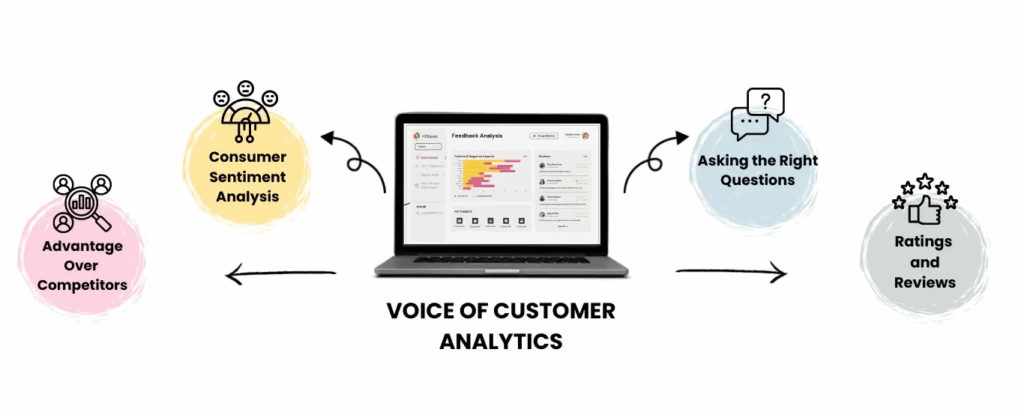
Adopting review analytics via voice of customer analytics requires a methodical approach. The following steps outline a proven implementation framework.
Step 1: Comprehensive Data Aggregation
The initial phase involves consolidating feedback from all relevant sources. This includes e-commerce platforms, third-party review sites, and direct customer surveys. A holistic data set is imperative, as customer feedback can vary significantly across different channels. A review on Amazon might focus on delivery and value, while feedback on G2 might delve into technical integration. Only with a complete picture can accurate analysis begin.
Step 2: Data Processing and Normalization
Raw review data requires refinement. This step involves deduplication, filtering of irrelevant content, and text standardization. Ensuring data integrity at this stage is crucial for the accuracy of all subsequent analysis. Cleaning the data prevents skewed results, such as a sentiment score being artificially inflated by a high volume of identical spam reviews.
Step 3: Multi-Dimensional Analysis
This is the core analytical phase, where sentiment, topic, and aspect-based analyses are performed. The objective is to identify not only static snapshots but also dynamic trends. Correlating shifts in sentiment with business events, such as a product launch or policy change, provides context for the data.
Step 4: Operationalizing Insights
The ultimate value of analysis is realized through action. Establishing clear protocols for disseminating insights to relevant departments is critical. Engineering teams require findings on product flaws, marketing needs information on perceived strengths, and customer service must be aware of common support issues. This closes the feedback loop and embeds the customer voice into operational decision-making, creating a responsive and agile organization.
Case Study: Translating Analysis into Product Enhancement
Consider the case of a consumer electronics company, “TechNovate,” which maintained a strong 4.4-star average for its wireless headphones. A superficial reading of reviews suggested high satisfaction. However, a deeper product review analysis revealed a critical nuance.
While overall sentiment was positive, an aspect-based sentiment analysis identified a concentrated negative sentiment around the “mobile app connectivity” feature. Further investigation showed that users found the pairing process unintuitive. This specific insight, which was obscured by the high overall rating, provided a clear directive.
TechNovate’s software team prioritized a redesign of the app’s onboarding and connectivity interface. Following the update, subsequent review analytics monitoring showed a 60% reduction in negative sentiment specifically related to the app connectivity aspect. This demonstrates how targeted feedback analysis enables precise product improvements that directly address user pain points, enhancing satisfaction for a key customer segment.
According to a 2023 report by BrightLocal, 79% of consumers trust online reviews as much as personal recommendations from friends or family. This statistic underscores the critical importance of not only generating reviews but also comprehensively understanding their content to manage brand reputation effectively.
Selecting an Analytical Platform: Key Considerations
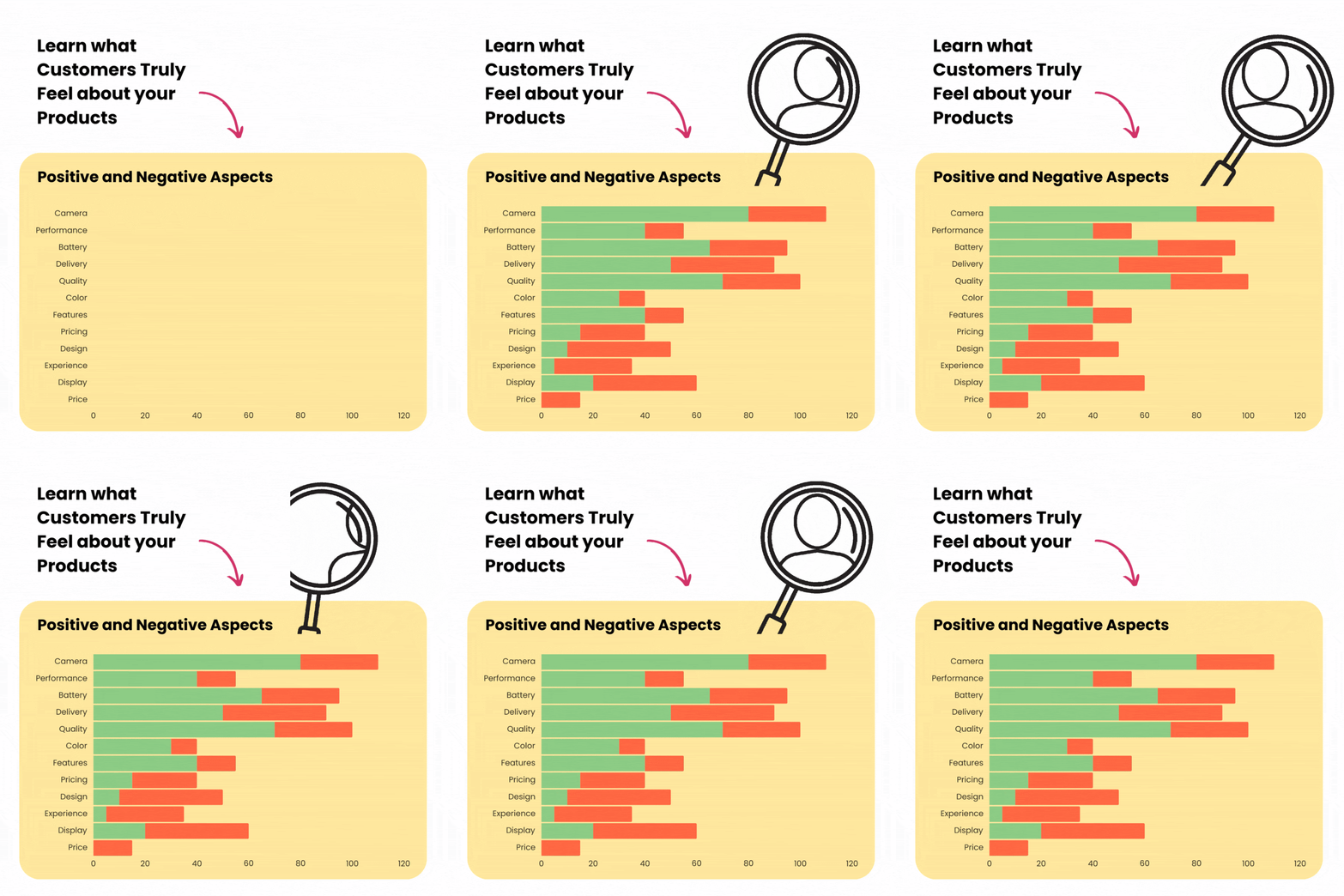
While manual feedback analysis is feasible for small data sets, specialized software is necessary for scale and depth. The market offers solutions ranging from integrated customer experience platforms to dedicated review analytics tools.
When evaluating potential platforms, key criteria include:
- Source Integration: The ability to aggregate data from all relevant review sources.
- Analytical Depth: The sophistication of NLP and machine learning capabilities for accurate customer sentiment analysis and aspect-based parsing.
- Reporting and Visualization: The capacity to generate clear, shareable reports that communicate insights effectively to stakeholders.
Phase 1: Internal Assessment and Requirement Definition
Before evaluating vendors, 42Signals must first look inward. The leadership team convenes a cross-functional committee including leaders from Marketing, Product, Customer Support, and IT. Together, they define their core business objectives for implementing review analytics. These objectives include reducing churn by identifying at-risk customers, informing the quarterly product roadmap, and equipping the sales team with compelling social proof.
Based on these goals, they draft a requirements document. This document outlines necessary features, such as the ability to integrate with their primary review sources (G2, Capterra, app stores), perform granular aspect-based sentiment analysis on specific software features, and generate automated weekly reports for different departments. They also establish a budget and key performance indicators for success, such as a target reduction in support tickets or an increase in feature adoption post-launch.
Phase 2: Vendor Evaluation and Capability Analysis
With a clear set of requirements, 42Signals begins a structured vendor evaluation. They create a scoring matrix to objectively compare platforms. Key evaluation criteria include:
- Data Aggregation and Integration: The platform must seamlessly pull data from all specified sources via robust APIs. The team assigns a high weight to this criterion, as incomplete data leads to flawed insights. They test the ease of setup and the platform’s ability to handle historical data imports.
- Analytical Sophistication and Accuracy: This is the core of the platform’s value. The team requests demonstrations focused specifically on customer sentiment analysis and topic modeling accuracy. They provide a sample of their own complex reviews to see how well the platform parses technical jargon and mixed-feedback sentences. The depth of customizability for aspect tracking is also critically assessed.
- Reporting, Visualization, and Actionability: Insights must be easily communicated. 42Signals evaluates the clarity and customizability of dashboards. Can they create a unique view for the product team that focuses on feature requests and a separate one for support that highlights service issues? The ability to set up automated alerting for sudden sentiment drops is also a key requirement.
- Scalability and Total Cost of Ownership (TCO): The platform must be able to grow with the company. 42Signals scrutinizes the pricing model is it based on review volume, number of users, or features? They calculate the projected TCO over three years, factoring in potential growth. IT assesses the vendor’s security protocols, uptime guarantees, and the quality of their technical support.
Phase 3: Pilot Implementation and Decision
42Signals narrows the field to two front-running vendors and negotiates a one-month pilot program for each. During the pilot, a dedicated test group from the product and marketing teams uses the platforms with live data. They evaluate not only the features but also the user experience and the quality of customer support received during the trial.
The pilot reveals critical differentiators. One platform offers superior visualization but its review mining algorithms struggle with industry-specific terms. The other has a steeper learning curve but provides astonishingly accurate aspect-based sentiment analysis that immediately uncovers a previously unknown issue with a recently launched API. This concrete, valuable insight during the trial period heavily sways the decision.
Based on the pilot results and the final TCO, 42Signals selects the platform that best balances analytical power, actionable reporting, and long-term scalability. The decision is not based on a single feature but on which tool most effectively addresses the business objectives defined in Phase 1.
This structured approach ensures that the selected review analytics platform is not just a tactical tool but a strategic asset integrated into the company’s core operational processes, from product development to customer success.
Investing in the right tool automates data processing and provides a depth of insight that is unattainable through manual methods.
Integrating Review Analytics into Corporate Strategy
In an era defined by the customer voice, review analytics has transitioned from a useful tactic to a core component of brand management strategy. It provides an empirical foundation for decisions that were previously based on intuition or incomplete data.
The methodology empowers organizations to move beyond reactive review management toward a proactive, insight-driven approach. By systematically decoding customer feedback, brand managers can precisely align product development, marketing, and service operations with market expectations. Mastering review analytics is no longer optional; it is a fundamental requirement for building a resilient, customer-centric, and competitive brand.

Try 42Signals today to understand your product’s performance across marketplaces – customer sentiment, positive and negative feedback, and areas of improvement.
Frequently Asked Questions
What is an analytics review?
An analytics review is the process of examining data, metrics, and performance indicators to understand how well a strategy, product, or campaign is performing. It involves evaluating trends, identifying gaps, and interpreting results so that teams can make informed decisions.
For example, an e-commerce analytics review might look at traffic sources, conversion rates, average order value, and customer behavior to evaluate what’s working and what needs improvement.
An analytics review turns raw data into meaningful insights that guide future action.
What is the meaning of review analysis?
Review analysis refers to the systematic evaluation of customer reviews to understand what people think about a product or service. It includes examining written comments, star ratings, images, and even keywords customers repeatedly mention.
The purpose of review analysis is to uncover:
– Customer satisfaction levels
– Pain points and recurring issues
– Common praise points
– Opportunities for product improvements
– Emerging trends in customer sentiment
Brands use review analysis to shape product development, pricing decisions, and customer experience strategies.
How to do review analysis?
Review analysis involves several steps that help transform customer feedback into actionable insights:
– Step 1: Collect the Reviews
Gather reviews from all relevant platforms—Amazon, Google, marketplaces, apps, or your own website.
– Step 2: Clean the Data
Remove fake reviews, spam content, and duplicates to ensure accuracy.
– Step 3: Categorize Feedback
Group comments into themes such as quality, delivery time, price, packaging, customer support, etc.
– Step 4: Conduct Sentiment Analysis
Identify whether each review is positive, neutral, or negative. This can be done manually or with tools like 42Signals, Google NLP, or in-house analytics tools.
– Step 5: Quantify the Patterns
Calculate average ratings, frequency of complaints, trending issues, and sentiment scores.
– Step 6: Interpret the Results
Explain what the data means. For example, A rise in negative reviews mentioning “late delivery” suggests fulfillment issues.
– Step 7: Recommend Actions
Provide solutions or next steps such as improving packaging, adjusting pricing, updating product descriptions, or modifying supply chain processes.