


Ecommerce Demand Forecasting – The Essential Strategy for Modern Retailers
Every online retailer faces the constant pressure of having just the right amount of inventory. Too little, and you lose sales and upset customers (stockouts). Too much, and your profits are eaten up by storage costs and markdowns (overstock). The secret weapon of top-performing brands isn’t magic; it’s robust ecommerce demand forecasting. This article dives deep into why traditional spreadsheets fail, how sophisticated demand planning software uses advanced algorithms to accurately predict future sales, and the exact steps you can take to move beyond guesswork. If you’re currently evaluating solutions to master your inventory and maximize profit, you’ve come to the right place. We will show you how to leverage data science to predict customer demand and implement intelligent replenishment automation before your competitors do.
The High Cost of Guesswork: Why Traditional Inventory Management Fails
If you’re running a growing ecommerce business, chances are you’ve felt the sting of poor inventory management. It’s a classic Catch-22: you can’t sell what you don’t have, but holding too much inventory ties up capital that could be used for marketing, product development, or hiring.
For mid-funnel buyers—those actively searching for a way out of the inventory headache—the pain points are immediate and measurable.
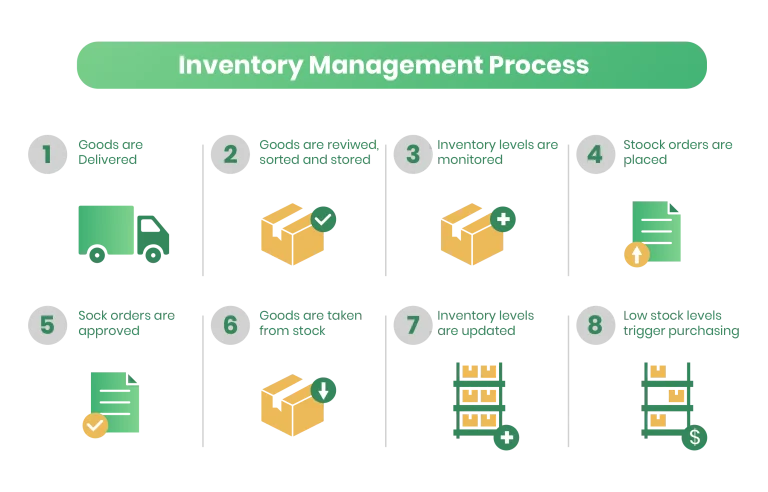
Image Source: Advotics
The Profit-Killing Duo: Stockouts and Overstocking
Let’s be honest: stockouts are frustrating. When a customer lands on your product page, ready to buy, and sees “Out of Stock,” it’s not just a lost sale; it’s a damaged customer relationship. They will likely go straight to your competitor, and studies suggest that regaining that customer is significantly harder and more expensive than acquiring a new one.
But overstocking can be just as insidious. Excess inventory means you are paying to store products that aren’t moving. This is not just physical warehousing cost; it includes insurance, depreciation, and the opportunity cost of having capital locked up in boxes instead of invested in growth. Effective ecommerce demand forecasting is the single most important tool for mitigating both of these costly scenarios. By accurately predicting when and how much a customer will buy, you move from reacting to demand to proactively meeting it.
Why Spreadsheets Are a Hindrance, Not a Solution
Many businesses start with simple methods: looking at last year’s sales data in a spreadsheet and adding a small percentage for growth. This basic approach to inventory forecasting ecommerce is fundamentally flawed for the modern, volatile market. E-commerce demand is affected by hundreds of variables, from a competitor running a flash sale to a change in social media algorithms, and even unpredictable weather patterns.
Spreadsheets cannot easily process external factors, nor can they handle the massive datasets generated by modern online stores. They rely on manual data entry and human interpretation, introducing errors and bias. To achieve true accuracy and scale, you need a system that integrates sales data, marketing spend, seasonality, trends, and promotional schedules—a core function of dedicated demand planning software.
Understanding Ecommerce Demand Forecasting: Beyond Simple Sales History
At its core, ecommerce demand forecasting is the process of estimating future customer demand over a specified period. But for top brands, it’s far more nuanced than calculating an average. They use a layered approach that incorporates multiple data inputs to paint a comprehensive picture of future needs.
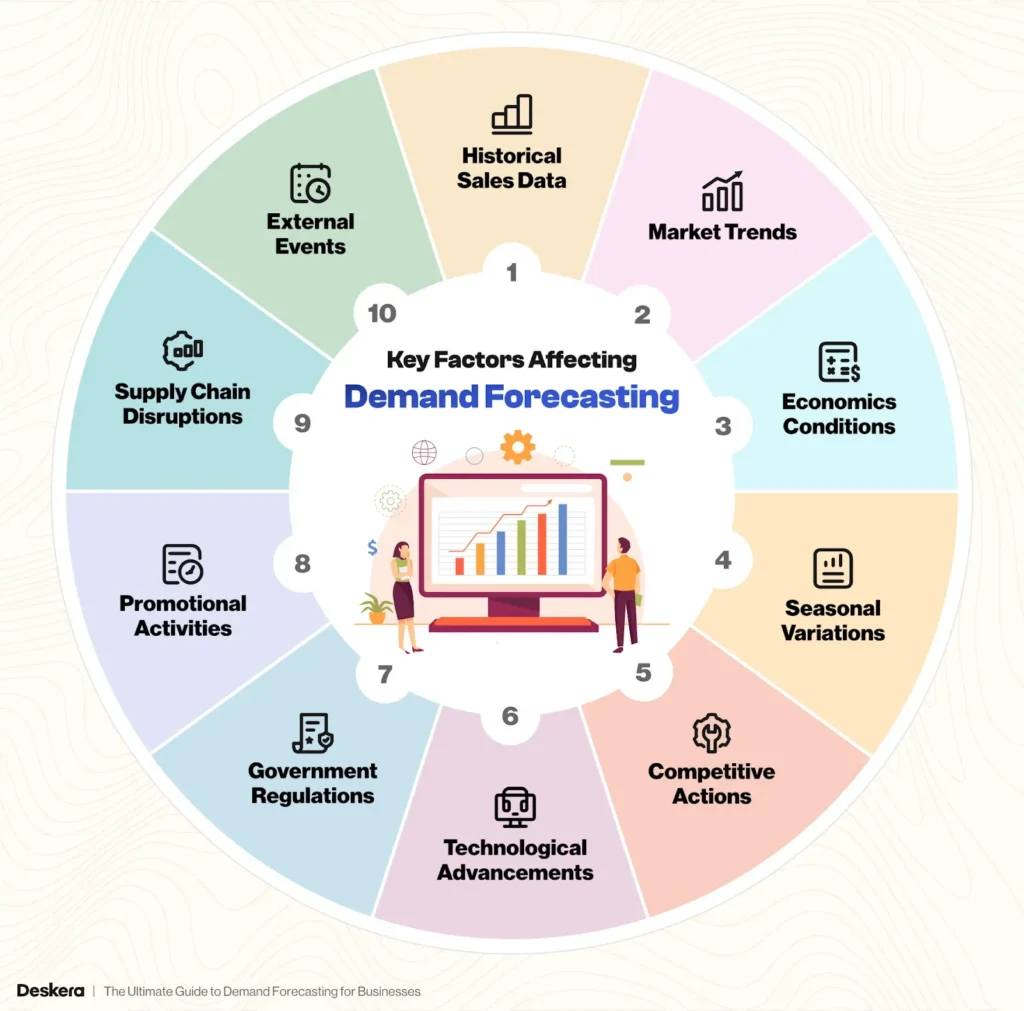
Image Source: Finaloop
The Core Components of Accurate Stock Prediction
Accurate stock prediction requires looking at three main components of data: historical sales, current market indicators, and future events.
- Time-Series Analysis (Historical Data): This is where most forecasting starts. It involves analyzing past sales data to identify recurring patterns like seasonality (holiday spikes, summer dips), trends (consistent growth or decline), and cycles. A crucial part of this is separating true demand from missed demand—sales you lost because of a stockout. High-quality demand planning software, like 42Signals’ stock availability analytics, can infer this “ghost demand” by analyzing abandoned carts and product page traffic during out-of-stock periods.
- Causal Factors (Market Indicators): These are external or internal events that directly influence demand.
- Internal Factors: Planned promotions, price changes, product launches, and changes in advertising spend. If you plan to spend $50,000 on a new Facebook campaign, your forecast must account for the expected uplift in sales.
- External Factors: Competitor actions (which can be tracked with competitor price intelligence), economic indicators, industry growth rates, and even major news events. The ability to integrate these external signals sets advanced ecommerce demand forecasting apart.
- Qualitative Factors (Expert Input): While data reigns supreme, human knowledge is still essential. This includes input from sales teams regarding large wholesale orders, marketing teams about viral trends, or product developers about imminent product obsolescence. A good forecasting system blends the quantitative power of algorithms with the qualitative insights of experienced employees.
Industry Insight: According to a recent E-commerce Study on supply chain efficiency, businesses that employ advanced analytical models for inventory forecasting ecommerce see, on average, a 15-20% reduction in forecasting errors compared to those relying solely on manual methods. This reduction directly translates into millions of dollars saved in working capital and lost sales.
The Role of Supply Chain Analytics
In the modern competitive landscape, demand forecasting is inseparable from overall supply chain analytics. It’s not enough to know what customers will buy; you need to know when you can get it and where it should be stored.
Supply chain analytics integrates the demand forecast with lead times, transit times, supplier performance, and warehouse capacity. This holistic view is vital for setting realistic safety stock levels and optimizing inventory movement. For instance, if your forecast predicts a massive spike in product X, but your supplier for component Y has a known three-month lead time, the system will flag this risk long before it becomes a stockout crisis.
Strategic Benefits: How Inventory Forecasting Ecommerce Drives Growth

Moving to sophisticated inventory forecasting ecommerce isn’t just about reducing costs; it’s a fundamental growth strategy. Top brands leverage precise forecasts to improve cash flow, enhance customer experience, and gain a competitive edge.
1. Maximizing Cash Flow and Working Capital
Inventory is a major drain on working capital. By reducing overstocking, businesses free up significant capital. Instead of having $100,000 tied up in slow-moving stock for six months, that money can be immediately reinvested into high-impact areas like performance marketing or new product development. This is the difference between sluggish growth and exponential scaling.
2. Optimizing Replenishment Automation
One of the most powerful applications of accurate ecommerce demand forecasting is the implementation of replenishment automation. When a system can reliably predict the optimal stock level needed for the next 30, 60, or 90 days, it can automatically generate purchase orders (POs) and transfer orders (TOs) when inventory drops to a pre-calculated minimum threshold.
Replenishment automation means:
- Faster reaction times: The system reacts instantly to demand shifts, day or night.
- Reduced human error: Automated orders eliminate typos, miscalculations, and forgotten tasks.
- Optimal order quantities: The system calculates the precise economic order quantity (EOQ) to minimize holding costs and ordering costs simultaneously.
This level of operational efficiency is impossible without high-quality stock prediction at the core, which can be done with price and availability ecommerce data.
3. Boosting Sell-Through Rate
The sell-through rate is a critical metric for any retailer, calculated as the percentage of inventory received that is sold to customers. A higher sell-through rate indicates healthier inventory performance and less need for costly markdowns. Accurate forecasting directly leads to a higher sell-through rate because you are buying inventory that perfectly matches the predicted demand profile.
For product categories with short lifecycles or high seasonality (like fashion or electronics), maximizing the sell-through rate during the peak season is essential. Precision in inventory forecasting ecommerce ensures you have maximum availability when demand is highest and minimal leftover stock when demand inevitably drops.Need to see the power of automated forecasting in action?
Advanced Techniques: The Algorithms Driving Modern Stock Prediction
What exactly makes modern demand planning software so much better than the old methods? The answer lies in sophisticated algorithms and the ability to process unstructured data.
Machine Learning and AI in Demand Forecasting
Top brands don’t just rely on moving averages; they use machine learning (ML) models like ARIMA, Prophet, and specialized neural networks. These models excel at identifying complex, non-linear relationships between various data points.
- Deep Learning for Volatility: Deep learning models can analyze massive datasets quickly, identifying correlations between thousands of variables, such as “Product X sales in Europe” and “weather patterns in Asia.” This is critical for highly volatile or fashion-driven inventory where demand can shift dramatically.
- Scenario Planning: Advanced systems allow planners to model different future scenarios.
- What if a key competitor goes out of business?
- What if shipping costs triple?
Ecommerce demand forecasting models with ecommerce market intelligence can instantly recalculate inventory requirements and contingency plans based on these hypotheticals, preparing the business for any eventuality.
Leveraging Data Integration for Superior Forecasting
The quality of the forecast is directly proportional to the quality and breadth of the data input. Modern demand planning software integrates seamlessly with various systems:
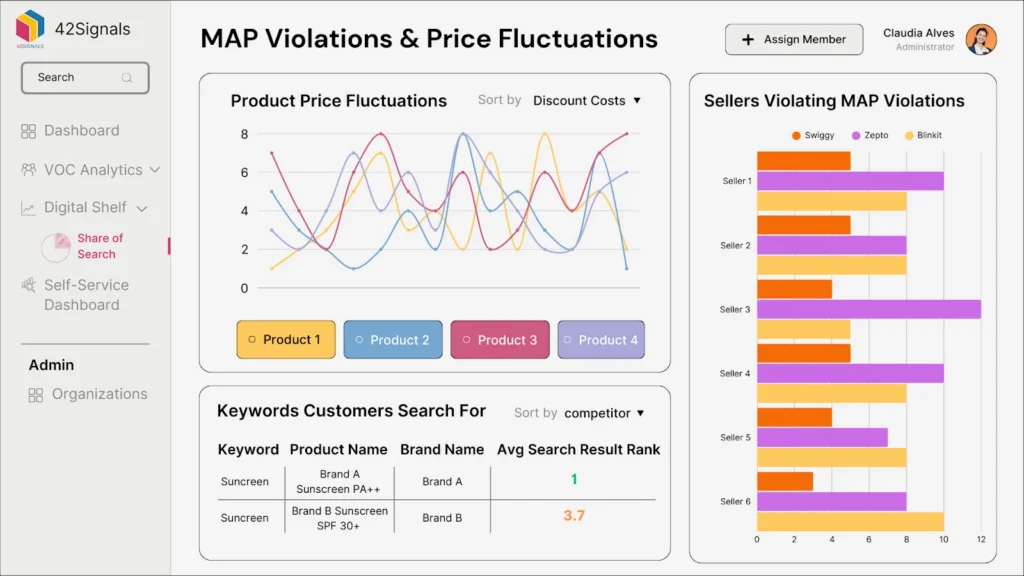
- E-commerce Platform (e.g., Shopify, Magento): Provides real-time sales, cart abandonment data, and product page views. 42Signals provides inventory forecasting with near-real-time data.
- Marketing/CRM (e.g., Klaviyo, HubSpot): Supplies data on upcoming campaign spend, email open rates, and customer lifetime value (CLV).
- ERP/WMS (Enterprise Resource Planning/Warehouse Management System): Offers lead times, vendor reliability scores, and physical stock levels.
This integrated approach ensures that every piece of data influencing demand is factored into the final stock prediction.
42Signals provides the competitive intelligence layer that most demand planning systems lack — real-time competitor stock levels, share of search data, and marketplace pricing signals that indicate when a competitor stockout will drive demand to your listings. These external signals, accessible via 42Signals’ API, feed directly into the demand planning software platforms described in this guide, enabling forecast models to account for competitive dynamics as well as historical sales patterns.
The Implementation Roadmap: Adopting Demand Planning Software
If you’re ready to transition from reactive inventory forecasting ecommerce to proactive ecommerce demand forecasting, a structured implementation roadmap is essential.
Phase 1: Data Audit and Preparation
Before implementing any demand planning software, you must clean your existing data.
- Data Integrity Check: Ensure historical sales data is accurate, complete, and free of anomalies (e.g., sales spikes caused by a one-time clearance event should be flagged so the system doesn’t project that spike into the future).
- Define SKUs and Groupings: Grouping similar products (e.g., by color, size, or material) is crucial for low-volume SKUs. If a specific product hasn’t sold much, the system can use the aggregated sales data of its product family to create a more reliable stock prediction. This is often referred to as ‘hierarchical forecasting.’
Phase 2: Pilot Program and Model Selection
Not all forecasting models work equally well for every product. This phase involves testing different approaches.
- Test and Validate: Run a pilot program using the new ecommerce demand forecasting model alongside your current method for a subset of products. Compare the accuracy and bias of the new model against your old one.
- Baseline Metric: Establish clear KPIs, primarily focusing on forecast error (e.g., Mean Absolute Percentage Error or MAPE). Your goal should be to continuously reduce MAPE through calibration.
Phase 3: Integration and Automation
This is where the power of the new system truly takes hold, enabling replenishment automation.
- System Integration: Integrate the demand planning software with your ERP and WMS. This allows the forecast to automatically trigger purchasing and fulfillment workflows.
- Set up Automation Rules: Define the rules for replenishment automation. For example, “If stock dips below 14 days of predicted demand and the supplier lead time is 21 days, generate a PO for the next 45 days’ worth of stock.” This ensures purchasing decisions are made based on future demand, not current stock levels.
The Future of Inventory: Supply Chain Analytics and Proactive Management
Image Source: 42Signals inventory alerts
The long-term success of an ecommerce business hinges on its ability to leverage supply chain analytics to inform every operational decision. Demand forecasting is the engine, but the integration with logistics, fulfillment, and marketing is the vehicle.
Mitigating Risk with Real-Time Data
The global supply chain remains complex and fragile. Top retailers use real-time supply chain analytics to predict delays before they occur. By tracking supplier production schedules, port congestion, and shipping vessel locations, they can adjust their ecommerce demand forecasting instantly, shifting demand to different channels or initiating early ordering if a critical component is delayed. This level of proactive management dramatically reduces the financial impact of external disruptions.
Continuous Optimization of Sell-Through Rate
Forecasting is not a one-time event; it is a continuous cycle of prediction, measurement, and adjustment. Successful brands regularly review their sell-through rate and use that feedback to refine their forecasting models with digital shelf performance metrics.
For example, if the forecast overestimated demand for a specific item, resulting in a low sell-through rate and subsequent markdowns, the planning team investigates: Was the marketing impact overestimated? Did a competitor release a superior product? These insights are fed back into the demand planning software to make the next forecast even more accurate.
Ecommerce Demand Forecasting – The Competitive Edge
The retail landscape is unforgiving. Customers expect instant availability, and margins are constantly under pressure. The ability to execute precise ecommerce demand forecasting is no longer a luxury reserved for massive corporations; it is a necessity for any growing online retailer aiming for profitability and sustainable scaling.
By embracing modern demand planning software, integrating comprehensive supply chain analytics, and implementing intelligent replenishment automation, you move beyond the pain of stockouts and overstock. You move into a future where your inventory perfectly aligns with customer desire, ensuring maximum sell-through rate and optimized working capital. This isn’t just about better inventory management; it’s about building a fundamentally healthier, more resilient business.
Ready to add real-time competitor intelligence to your demand forecasting model? 42Signals feeds live competitor stock levels, share of search signals, and marketplace pricing data directly into your demand planning system — giving your forecast the external visibility that historical sales data alone can’t provide. Book a demo, and we’ll show you how 42Signals integrates with your existing inventory management stack.
Alt text: 42Signals is trusted by leading brands like New Balance, Sugar Cosmetics, Tata Group, ID Fresh Foods, Ramy Brook New York, Dabur and Mama Earth
Frequently Asked Questions (FAQs) About Ecommerce Demand Forecasting
How does demand planning software account for new products with no sales history?
Forecasting demand for new products is one of the biggest challenges in inventory forecasting ecommerce. Advanced demand planning software uses a technique called analogy forecasting. This involves identifying a “proxy” or “parent” product that shares similar characteristics—such as size, price point, material, target audience, and marketing spend—and using that product’s historical sales data as a temporary forecast baseline. As the new product accumulates its own sales data, the system gradually transitions to using the actual product history for a more accurate stock prediction.
What is the difference between demand forecasting and demand planning?
While often used interchangeably, there is a distinct difference. Demand forecasting is the process of estimating future demand (the “what and when”). Demand planning, however, is the broader strategy that takes the forecast and turns it into operational decisions. Demand planning involves coordinating the forecast with procurement, manufacturing, warehousing, and marketing plans. Essentially, the accurate ecommerce demand forecasting output is the essential input for the overall demand planning process, leading to actions like replenishment automation and setting optimal safety stock levels.
How does external data like competitor activity impact supply chain analytics?
Modern supply chain analytics platforms continuously monitor external factors to improve the accuracy of stock prediction. Competitor activity, such as a major price drop or a new product launch by a rival, can significantly depress your expected demand. Conversely, if a key competitor experiences a major service outage or recall, your demand may spike unexpectedly. Advanced demand planning software integrates with external data feeds to factor these causal variables into the model, allowing for rapid adjustment of the forecast and proactive inventory adjustments.
Why is calculating the sell-through rate important for forecasting accuracy?
The sell-through rate measures how effectively you are liquidating the inventory you purchase. If your sell-through rate is consistently low, it indicates two major problems: either your procurement team is over-ordering, or your ecommerce demand forecasting is consistently overestimating market interest. Tracking and analyzing the sell-through rate serves as a vital feedback loop. By investigating low rates, a company can pinpoint flaws in the initial forecast assumptions (e.g., overestimating the impact of a marketing campaign) and use that information to refine the forecasting model for future products, improving overall accuracy and reducing costly inventory surplus.