
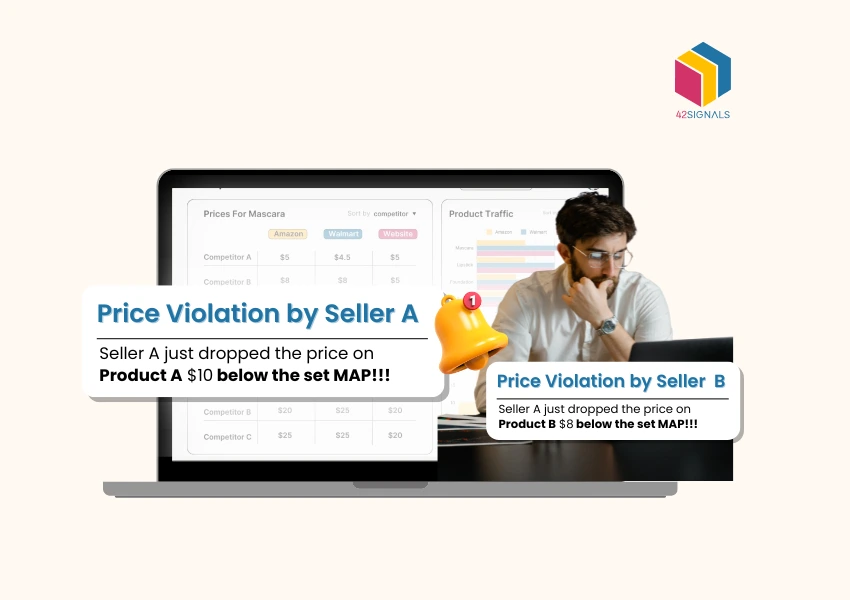
** TL;DR ** MAP monitoring is the continuous, automated tracking of advertised prices across the internet to catch Minimum Advertised Price violations the moment they appear. This page is the complete reference for how MAP violation monitoring and violation tracking work end to end: the monitoring workflow, how to configure alert thresholds so you catch real violations without drowning in noise, and the retailer-specific enforcement timelines that turn a detected violation into a resolved one.

Image Source: Capterra
Why MAP Monitoring Matters
If you sell products, you have probably felt that jolt of frustration: your top product is being advertised for twenty percent less on a random website, and within minutes one of your best retail partners is on the phone asking what you are going to do about it. When your advertised prices erode, so does your reputation and your relationship with the retailers who are the lifeblood of your business.
A MAP policy is only as good as its enforcement, and enforcement starts with detection. For what MAP is and why brands adopt a policy, see the MAP pricing guide; for what legally counts as a breach, see what a MAP violation is. This page focuses on the part those guides don’t: actually monitoring for violations and tracking them to resolution.
The MAP Monitoring Workflow, End to End
Every effective MAP monitoring program runs the same closed loop. Catching a violation is only step four of seven; the value is in what happens before detection (so matches are accurate) and after (so violations actually get resolved). The full tracking loop:
INGEST → CRAWL → MATCH → IDENTIFY SELLER → ALERT → CAPTURE EVIDENCE → TRACK TO RESOLUTION
Stage 1: Catalog Ingestion
Monitoring accuracy is decided here, before a single page is crawled. You feed the system a structured catalog — not just product names — so it can match listings precisely. Core fields: SKU, UPC/GTIN/EAN, Manufacturer Part Number (MPN), product title, brand, category, the MAP threshold per SKU, optional product images for image matching, and MSRP for reference. Best practice is a live, API-connected feed; manual CSV uploads go stale and drive false matches. Ask vendors whether they support API catalog syncing and how often the catalog can refresh.
Stage 2: Price Scan (Crawling)
Automated crawlers continuously visit pages to record advertised prices. They begin with seed marketplace URLs, run automated brand/product searches, follow links to discover new sellers, parse HTML to extract product IDs and prices, structure the raw data, and match it back to your catalog. The hard parts they must handle: JavaScript-rendered prices (the crawler has to execute the page, not just read the HTML), bot detection (IP rotation, headless browsers), product variants with different prices, and international sites with currency and language differences. Ask vendors how they handle JavaScript-heavy sites and their success rate against sites that block crawlers.
Stage 3: Product Matching
A crawl is worthless if it matches the wrong item. Matching resolves a discovered listing to a specific SKU using identifier matching (UPC/GTIN/MPN), title and attribute matching, and image recognition as a tiebreaker. The output is a confidence score; high-confidence matches flow straight through, while borderline matches are queued for review so a near-identical variant isn’t reported as a violation.
Stage 4: Seller Identification
A price violation is meaningless until you know who is responsible. “Sold by thirdparty_seller123” doesn’t tell you whether it’s an authorized retailer breaching policy, an unauthorized seller, or one bad actor running several storefronts. Identity resolution — storefront analysis, domain mapping, taxonomy matching against your authorized-retailer list, network-graph analysis on shared payment/IP/inventory signals, and historical behavior — builds a seller graph that drives the right enforcement response. (Full detail in the seller-identity section below.)
Stage 5: Alert Generation
When a matched listing falls below the SKU’s MAP threshold, an alert fires — but intelligent alerting is context-aware, not a blunt trigger on every cent. Thresholds, severity tiers, and suppression rules (covered next) decide whether a below-MAP price is signal or noise. Real-time systems should alert in under an hour; cheaper batch systems run 24–48 hours behind.
Stage 6: Evidence Capture
An alert is a notification; evidence is what lets you act. Each capture should include a full-page screenshot with visible URL, a UTC timestamp, the SKU/UPC match, seller name/ID, detected price, MAP threshold, violation amount (absolute and percentage), the full URL, and optionally the raw HTML source. Advanced packs add video capture for hover/click pricing, a DOM snapshot, a cryptographically signed certificate of authenticity, and a chain-of-custody log. This is what ends arguments with retailers and supports platform takedowns or legal action.
Stage 7: Track to Resolution
This is where monitoring becomes tracking. Every violation moves through a case lifecycle — New → Assigned → Investigating → Contacted → Resolved → Closed — with notes, evidence, and communications logged against it, automatic escalation reminders if a case stalls, and time-to-resolution reporting. Tracking each violation to a confirmed, compliant re-check (not just a sent email) is what separates real MAP violation tracking from a dashboard of unresolved alerts.
The Need for a MAP Monitoring Service
It is helpful to start with a clear definition. MAP stands for Minimum Advertised Price. It is an agreement between a brand or manufacturer and its retailers that sets the lowest price at which a product can be advertised to the public. It is crucial to understand the word “advertised.” This policy covers the listed price on a website, in a flyer, in a Google Shopping ad, or in an email promotion. It does not dictate the final selling price at the physical checkout counter. A store can still choose to offer a lower final price to a customer in person.
You might wonder why so many brands invest time in creating and enforcing a MAP policy. The reasons are deeply connected to the core of your business health.
First, it is about protecting the value of your brand. Consumers make judgments based on price. A high quality product that is consistently advertised at a deep discount starts to look less premium. People begin to question its worth. By maintaining consistent pricing, you reinforce the perception that your products are valuable and worth the investment.
Second, it is about fairness for your retail partners. Your authorized retailers, especially the smaller local stores, make significant investments. They buy inventory, hire and train staff, and build out beautiful displays. They cannot possibly compete with a massive online marketplace that uses your product as a loss leader, a product sold at a loss to attract customers. When you enforce MAP, you are telling your retailers that you value their business and you are committed to ensuring a level playing field. This fosters immense loyalty.
Finally, it is about preserving profit margins for everyone. This is sometimes called price erosion. When one seller cuts prices, others often feel forced to follow suit to stay competitive. This creates a race to the bottom that squeezes the profitability out of your product for every single person in the sales chain, including you, your distributors, and your retailers. A strong MAP policy is a defense against this erosion.
Ready to Take the Next Step?
See how our solutions can help you achieve your goals and drive measurable results.
The Impossible Task: Why You Can’t Manually Monitor MAP Violations
The natural first instinct for many brand managers is to handle monitoring internally. It seems simple enough. You assign someone to do a Google search for your key products a few times a week. This approach might work for a week or two, but it quickly reveals itself to be completely inadequate for several important reasons.
The sheer scale of the internet makes it impossible. Your products are not just on Amazon and Walmart.com. They are on countless niche online stores, auction sites, and social media marketplaces. According to a report by the e-commerce analytics firm Pattern, a typical brand’s products can be found on over 500 different online retailers. Manually checking each one is a task that would require a full time employee, and that is just for one brand.
Even if you had the manpower, the process is incredibly time consuming. The hours your marketing manager spends scrolling through page after page of search results are hours they are not spending on developing new campaigns, engaging with customers, or planning strategy. The opportunity cost of manual monitoring is enormous.
Human error is another major factor. People get tired. They miss details. They might glance over a violation because the website looks unofficial, or they might forget to check a particular marketplace altogether. These missed violations can often be the most damaging, as they are allowed to continue unchecked.

Perhaps the most critical flaw is the lack of concrete, legal grade evidence. If you find a violation and want to take action, a simple screenshot is weak evidence. It can be easily disputed or dismissed as being altered. To effectively enforce your policy, you need time stamped, unalterable proof that clearly shows the product, the price, the date, and the URL. Building this kind of evidence case manually is practically impossible. This is why the automated power of a MAP monitoring service is not just a luxury; it is a necessity for any serious brand.
How a MAP Monitoring Service Works as Your 24/7 Watchdog

A professional MAP monitoring service functions as your automated, always alert digital watchdog. It uses sophisticated technology to scan the entire internet for your products, never taking a break. But how does it actually work? The process is both powerful and straightforward.
These services utilize advanced MAP enforcement software that is powered by web crawlers and data scraping tools. You provide the service with a list of your products, usually by SKU number, and a digital copy of your official MAP policy. The software then gets to work. It continuously scans all the major online marketplaces like Amazon, eBay, and Walmart, but it also delves deep into the long tail of the internet, checking thousands of smaller e-commerce sites that you have probably never even heard of.
The software is designed to identify your specific products based on their SKUs, UPCs, or even image recognition. It records the advertised price for each product on each site. When it detects a price that falls below your set minimum, it immediately flags it as a potential MAP violation.
But a good service does not stop at simply finding the problem. It compiles all this data into a clear, intuitive, and actionable dashboard. This dashboard shows you your overall compliance rate, your top violators, and detailed reports on each incident, complete with timestamped screenshots that serve as legal grade evidence. This seamless process of automated surveillance, detection, and evidence collection is the cornerstone of modern brand protection. It transforms you from being reactive to powerfully proactive.
Setting MAP Alert Thresholds
The fastest way to kill a monitoring program is alert fatigue. If every one-cent dip and every approved promo fires a notification, your team stops reading alerts and real violations slip through. Good MAP pricing monitoring is mostly about configuring when not to alert as carefully as when to alert.
Threshold types
Configure layered thresholds rather than a single rule:
| Threshold type | What it does | Typical setting |
| Hard MAP breach | Alerts on any price below MAP | Always on — baseline |
| Severity-based | Only fires past a depth threshold | Alert at 5–10%+ below MAP |
| Seller-tier-based | Different rules by seller relationship | Tier 1: alert + personal email; Tier 4: alert + takedown |
| Product-based | Rules by category or lifecycle stage | New launches strict; clearance relaxed |
| Time-based | Rules by season or promo window | Suppress during approved sale weeks |
Exclusions — when NOT to alert
Build an explicit exclusion list so the system ignores predictable non-violations: pre-approved promotional windows (Black Friday, Cyber Monday); bundled products priced as a package where policy allows; designated clearance/outlet or refurbished channels; membership-gated pricing behind a login (Costco, Sam’s Club); geographic regions with different MAP thresholds; and transient glitches such as 404s or out-of-stock placeholder prices that correct themselves.
Promotional-window suppression
Most brands run seasonal promos where temporary drops are allowed. Define the promotion in the system (dates, products, permitted discount depth), suppress alerts inside that window, monitor normally outside it, and audit immediately after to confirm pricing returned to compliance. Example: Black Friday, Nov 24–27, all electronics, up to 15% below MAP permitted, alerts suppressed for those four days only.
A practical default
If you’re starting from scratch: alert on any hard breach for authorized sellers, set a 5% severity floor for long-tail noise, exclude approved promo windows and membership sites, and route anything 30%+ below MAP straight to priority regardless of seller. Tighten from there using your own violation data.
Retailer-Specific Enforcement Timelines
Detection only matters if the response is timed correctly, and the right timeline depends on who is violating. Treating a strategic Tier 1 partner like an anonymous unauthorized seller damages relationships; treating a counterfeiter like a partner wastes time while damage spreads. Map alert routing and response SLAs to seller tier:
| Seller type | First response SLA | Channel / owner | Escalation timeline |
| Tier 1 strategic partner | 24 hours | Channel manager (personal outreach) | Day 3: manager call → Day 7: VP review |
| Tier 2–3 authorized seller | 48 hours | MAP coordinator | Day 3 final notice → Day 7 supply hold |
| Unauthorized seller | 24 hours | Legal + MAP coordinator | Immediate cease-and-desist → takedown |
| Severe (30%+ below MAP) | 4 hours | Legal + sales leadership | Same-day legal review |
| Repeat pattern (3+ from one seller) | Weekly review | MAP coordinator + channel ops | Treat as one escalated case, not N alerts |
Two principles keep these timelines defensible. First, consistency: apply the same clock to a one-person seller as to a national chain, or you create antitrust exposure and lose credibility. Second, close the loop: every timeline ends in a re-check that confirms compliance, with the case marked resolved only after the price is verified corrected.
These timelines govern when monitoring hands off to action. The full enforcement playbook — strike frameworks, penalty ladders, and the legal guardrails behind cease-and-desist and termination — lives in how to enforce MAP pricing, and Amazon-specific takedown steps are in Amazon MAP violation policies.
More Than Just Catching Bad Guys: The Surprising Benefits of Professional Monitoring

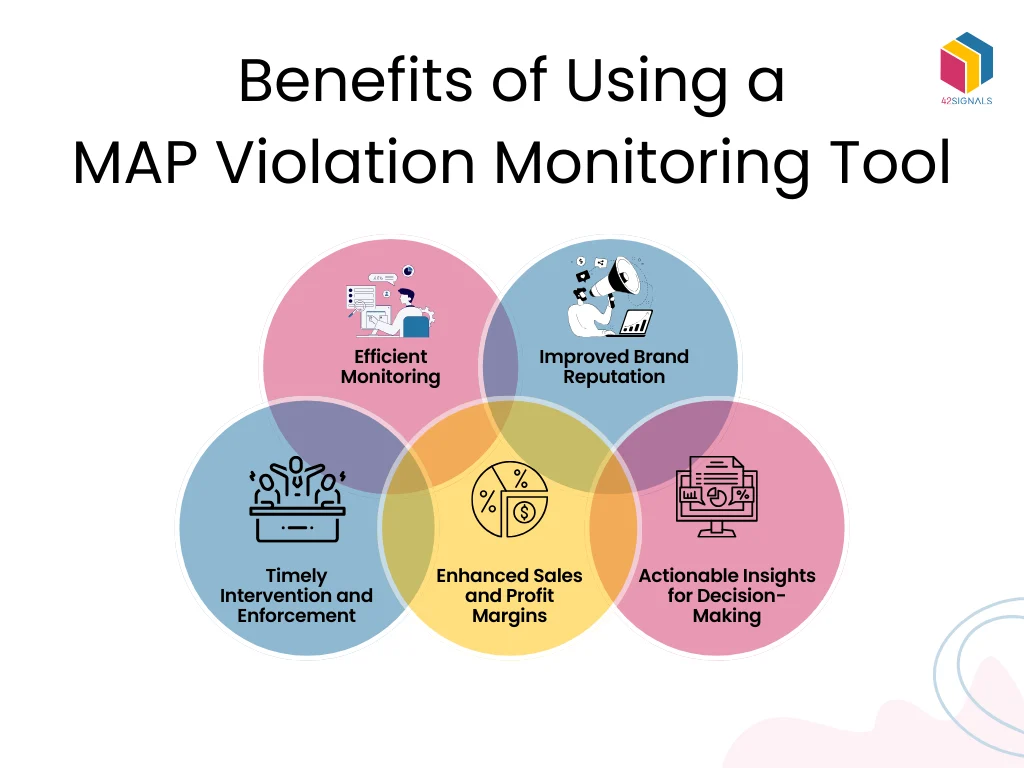
While identifying violations is the primary job, the advantages of using a dedicated MAP monitoring service extend far beyond simply catching rule breakers. The data and insights you gain become a strategic asset that can benefit your entire company.
The most obvious benefit is the direct protection of your profit margins. By putting a stop to price erosion at its source, you safeguard the healthy margins that are essential for your business and for your retail network. This has a direct and positive impact on your company’s profitability and valuation.
The amount of time and resources you save is significant. Automating the tedious and endless task of price monitoring frees up your key employees to focus on high value activities that actually grow the business, such as innovation, customer service, and strategic partnerships. You are not just saving money; you are enabling growth.
You also gain access to incredible market intelligence. Your monitoring service is effectively a window into the entire online market for your products. You can see competitor pricing strategies emerge in real time. You can identify new, unauthorized sellers the moment they appear. You can understand pricing trends and fluctuations across different sales channels. This business intelligence is incredibly valuable for informing your own sales, marketing, and product development strategies.
Furthermore, actively enforcing your policy dramatically strengthens retailer trust and loyalty. When your retail partners see that you are serious about defending fair pricing, their confidence in you grows. They know you are invested in their success as much as your own. This fosters stronger, more collaborative relationships and makes them more likely to invest in stocking and promoting your products wholeheartedly.
Finally, this process builds a foundation for legal action if it ever becomes necessary. In cases of persistent and malicious violators, having a meticulously documented history of violations and your attempts at enforcement is crucial. The evidence gathered by your MAP monitoring service is exactly what you would need to present if you ever have to pursue formal legal action to protect your trademarks and your market.
Ready to Take the Next Step?
See how our solutions can help you achieve your goals and drive measurable results.
Coverage Map: Where MAP Monitoring Actually Works
Not all monitoring services cover the same ground. Here’s what comprehensive coverage looks like in 2026.
Tier 1: Major Marketplaces (Non-Negotiable)
| Marketplace | Coverage Importance | Monitoring Complexity |
| Amazon | CRITICAL | High (3P sellers, variations, Buy Box) |
| eBay | CRITICAL | Medium (auction vs. fixed price) |
| Walmart | CRITICAL | Medium (marketplace sellers) |
| Target | HIGH | Low (direct retail) |
| Best Buy | HIGH | Low (direct retail) |
| Home Depot | MEDIUM | Low (direct retail) |
| Etsy | NICHE | Medium (handmade/craft) |
| Newegg | NICHE | Medium (electronics focus) |
Tier 2: Regional and Niche Marketplaces
| Region | Marketplaces |
| Europe | Allegro (Poland), Cdiscount (France), Otto (Germany), Zalando |
| Asia | Shopee, Lazada, Rakuten, Gmarket, Flipkart |
| Latin America | MercadoLibre, Linio, B2W |
| Australia/NZ | TradeMe, Catch, Kogan |
| Specialty | Reverb (music gear), Poshmark (fashion), StockX (sneakers) |
Tier 3: Long-Tail Retailers (The Hidden Violation Hotspots)
The “long tail” refers to thousands of smaller, independent e-commerce sites that are:
- Often overlooked by basic monitoring
- Frequently operated by unauthorized sellers
- Difficult to discover manually
- Where many violations hide
Examples:
- Regional independent electronics stores
- Niche hobby and enthusiast sites
- Discount aggregator sites
- Social commerce stores (Instagram/Facebook shops)
- Flash sale and daily deal sites
Tier 4: Non-Traditional Channels to Look at for a MAP Monitoring Service
| Channel | Monitoring Challenge |
| Google Shopping Ads | Ad content changes rapidly |
| Social Media | Facebook Marketplace, Instagram shops, TikTok Shop |
| Email Marketing | Requires access to retailer emails |
| Price Comparison Sites | Shopzilla, PriceGrabber, Google Shopping |
| Discount/Coupon Sites | RetailMeNot, Honey, CouponCabin |
Coverage Checklist for Vendor Evaluation:
- Do you monitor all major marketplaces (Amazon, eBay, Walmart)?
- Do you monitor regional marketplaces in my key geographies?
- How many long-tail retail sites do you cover? (Look for 10,000+)
- Can you monitor Google Shopping and paid search ads?
- Do you track social commerce platforms?
- What about price comparison and coupon sites?
Choosing the Right Partner: What to Look for in MAP Enforcement Software
The market for MAP monitoring services has grown, and not all providers are the same. When you are evaluating different options, whether it is a solution like 42SignalsF or another vendor, there are several key features you should prioritize to ensure you get the best protection.
Comprehensive coverage is non negotiable. The service must monitor all the major marketplaces everyone knows about, but its real value is in its ability to also track the vast number of smaller e commerce sites and obscure online retailers where violations frequently occur. You need a net that is cast wide.
The platform must provide you with a clear and user friendly dashboard. You should be able to get an at a glance view of your overall compliance health, quickly identify the worst offenders, and drill down into the specifics of each violation. Data is only useful if it is understandable and actionable.
The quality of evidence is critical. Look for a service that provides automated, timestamped screenshots that are considered legally admissible. This proof is what gives your enforcement efforts real teeth and makes your communications with violators unquestionable.
Some of the best tools like 42Signals’ MAP violations service now offer automated enforcement capabilities. This can include features that send automatic first notice emails to violators on your behalf, escalate cases through pre defined workflows, and allow you to track the status of each violation from detection all the way to resolution. This automation streamlines the entire process.
Scan Frequency: Real-Time vs. Daily vs. On-Demand with a MAP Monitoring Service
How often prices are scanned dramatically impacts your ability to respond. Here’s what different frequencies mean for your brand.
Real-Time Monitoring (Continuous)
What It Is:
Crawlers continuously scan target sites, often checking each product multiple times per day. When a price changes, detection happens within minutes.
Best For:
- High-velocity products (electronics, trending items)
- Brands with severe gray market issues
- Products where violations spread quickly
- Amazon and major marketplace sellers
Pros:
- Immediate violation detection
- Ability to respond before damage spreads
- Competitive intelligence in fast-moving categories
Cons:
- Higher cost
- More data to process
- Requires automated response workflows to keep up
Daily MAP Monitoring Service
What It Is:
Each product is checked once every 24 hours. Most violations are detected within a day of occurrence.
Best For:
- Mid-sized catalogs
- Stable categories without rapid price fluctuation
- Brands with moderate violation history
Pros:
- Good balance of coverage and cost
- Sufficient for most consumer goods
- Manageable alert volume
Cons:
- 24-hour gap allows violations to persist
- May miss short-term promotions or flash sales
- Harder to pinpoint exact violation time
Weekly MAP Monitoring Service
What It Is:
Products checked once per week. Significant gaps in coverage.
Best For:
- Very small catalogs
- Low-risk categories
- Brands just starting enforcement (temporary)
Pros:
- Lowest cost
- Minimal data
Cons:
- Violations can persist for days or weeks
- Retailers lose confidence in your enforcement
- Not defensible as “active monitoring”
On-Demand MAP Monitoring Service
What It Is:
Manual or triggered scans when you suspect a problem.
Best For:
- Supplemental to automated monitoring
- Investigating specific sellers
- Audit purposes
Pros:
- Flexible
- Low ongoing cost
Cons:
- Not proactive
- Misses violations between scans
- Requires manual initiation
Frequency Recommendation:
| Brand Type | Recommended Frequency | Rationale |
| Enterprise (1000+ SKUs) | Real-time + Daily | Critical coverage, automated response |
| Mid-Market (100-1000 SKUs) | Daily + Real-time for top SKUs | Balance cost and coverage |
| Small Brand (<100 SKUs) | Daily | Sufficient for manageable catalog |
| Luxury/High-Value | Real-time | Reputation risk too high for delays |
What to Ask Vendors:
“What’s your standard scan frequency? Can I configure different frequencies for different SKUs or channels?”
Seller Identity Resolution: Knowing Who You’re Dealing With
One of the most sophisticated capabilities in modern MAP monitoring is seller identity resolution—connecting the dots between anonymous marketplace accounts and real-world entities.
The Problem: Anonymous Sellers
On Amazon, a seller might appear as “deals4u_123.” On eBay, the same person might be “bargainhunter_99.” On their own site, they might be “Discount Electronics.” Without identity resolution, these appear as three separate sellers when they’re actually one bad actor.
Identity Resolution Techniques
| Technique | What It Does | Example |
| Domain Matching | Links seller names to owned websites | “deals4u_123” → “www.discountelectronics.com“ |
| Contact Info Matching | Compares email, phone, address across accounts | Same phone number on multiple seller profiles |
| Payment Method Linking | Connects accounts using same credit card or PayPal (requires cooperation) | Advanced, often through investigations |
| Inventory Pattern Analysis | Identifies sellers with identical product mixes and pricing strategies | Two “different” sellers always have same 20 items in stock |
| IP Address Correlation | Links accounts operating from same network (legal boundaries apply) | Multiple seller accounts from same IP range |
| Return Address Analysis | Tracks where products are shipped from (requires customer cooperation) | Returns from different sellers go to same warehouse |
The Seller Graph
Advanced MAP platforms build a seller graph—a visual map of all entities selling your products and their relationships:
                    ┌─────────────────┐
                    │  BestDeals USA  │
                    │  (Authorized)   │
                    └────────┬────────┘
                             │
                    ┌────────▼────────┐
                    │  Same Owner?    │
                    └────────┬────────┘
                             │
        ┌────────────────────┼────────────────────┐
        │                    │                    │
┌───────▼───────┐    ┌───────▼───────┐    ┌───────▼───────┐
│  Amazon:      │    │  eBay:        │    │  Website:     │
│  bestdeals123 │    │  bargains_usa │    │  bestdeals.com│
└───────────────┘    └───────────────┘    └───────────────┘
        │                    │                    │
        └────────────────────┼────────────────────┘
                             │
                    ┌────────▼────────┐
                    │  Violation      │
                    │  Pattern:       │
                    │  -5% below MAP  │
                    │  Weekends only  │
                    └─────────────────┘
Why This Matters for Enforcement
- Stop the game of whack-a-mole: When you shut down one storefront, the same seller can’t just open another
- Escalate appropriately: A seller with 10 storefronts is a different problem than 10 individual sellers
- Legal action: You need to know who to sue
- Supply chain investigation: Multiple sellers with same inventory patterns point to a distribution leak
What to Ask Vendors:
“Can your platform identify when the same seller is operating under multiple storefront names? How do you handle identity resolution?”
Alert Workflow: From Detection to Action
An alert is just the beginning. A professional MAP monitoring service provides a complete workflow for managing violations from detection through resolution.
Alert Thresholds: When to Trigger
Configure different thresholds for different scenarios:
| Threshold Type | Description | Example |
| Hard MAP Breach | Any price below MAP | Always alert |
| Severity-Based | Alert only below certain % | Alert if 10%+ below MAP |
| Seller-Based | Different rules by seller tier | Tier 1: alert + personal email; Tier 4: alert + immediate takedown |
| Product-Based | Different rules by product category | New products: stricter enforcement; clearance: relaxed |
| Time-Based | Rules by season or promotion | Suppress alerts during Black Friday week |
Exclusions: When NOT to Alert
Configure exclusions to avoid false positives and wasted effort:
| Exclusion Type | Description | Example |
| Promotional Windows | Pre-approved sale periods | Black Friday, Cyber Monday |
| Bundled Products | Items sold together | “Camera + lens kit” vs. camera alone |
| Clearance/Outlet | Designated discount channels | Outlet store, refurbished section |
| Membership Sites | Price requires login | Costco, Sam’s Club |
| Geographic | Regions with different MAP | Europe vs. US pricing |
| Temporary Glitches | Price errors corrected quickly | 404 pages, out-of-stock placeholders |
Promotional Window Suppression
Most brands run seasonal promotions where temporary price drops are allowed. Your monitoring should respect these windows.
How to Configure:
- Define the promotion in your system (dates, products, discount depth)
- Set monitoring to suppress alerts during this period
- Monitor outside the window normally
- Audit after promotion to ensure compliance returned
Example:
- Black Friday: Nov 24-27
- Products: All electronics
- Allowed discount: Up to 15% below MAP
- Monitoring: Suppress alerts during these 4 days
Alert Routing: Who Gets Notified by the MAP Monitoring Service
Different violations should go to different people:
| Alert Type | Primary Recipient | Secondary | SLA |
| Tier 1 Partner Violation | Channel Manager | Sales Director | 24 hours |
| Tier 2-3 Authorized Seller | MAP Coordinator | Channel Ops | 48 hours |
| Unauthorized Seller | Legal | MAP Coordinator | 24 hours |
| Severe Violation (30%+ below) | Legal + Sales Leadership | Executive | 4 hours |
| Pattern Detection (3+ same seller) | MAP Coordinator | Channel Ops | Weekly review |
Case Management: Tracking Resolution
Professional platforms include case management features:
- Status Tracking: New → Assigned → Investigating → Contacted → Resolved → Closed
- Notes and History: Every interaction logged
- Attachment Storage: All evidence and communications
- Escalation Triggers: Automatic reminders if case stalls
- Reporting: Time-to-resolution metrics, violator trends
What to Ask Vendors:
“Can I configure different alert rules for different seller tiers? How do I handle promotional exceptions? Show me your case management workflow.”
An Investment in Your Brand’s Long-Term Health
In the complex and often overwhelming world of modern e commerce, your pricing strategy is a direct reflection of your brand’s identity and value. Allowing it to be constantly undermined by unchecked MAP violations is a risk that can severely damage your reputation and your revenue.
Implementing a professional MAP monitoring service is far more than a simple business expense. It is a strategic investment in your brand’s future. It is an investment in maintaining the premium value your customers see in your products. It is an investment in the health and loyalty of your retail relationships. And most directly, it is an investment in protecting your company’s profitability from the slow drain of price erosion.
By leveraging automated MAP enforcement software, you reclaim control over your pricing destiny. You secure your profit margins, you gain invaluable market insights, and you secure the peace of mind that comes from knowing a dedicated system is guarding your brand twenty four hours a day, seven days a week.
A strong MAP policy enforced by a powerful MAP monitoring service does not just protect your prices; it protects everything you have worked so hard to build.
42Signals has helped several brands enforce prices by alerting them on time about MAP violations.
Try it out for yourself. Schedule a demo or get a free trial.
Frequently Asked Questions
What is MAP violation monitoring?
MAP violation monitoring is the continuous, automated tracking of advertised prices across marketplaces, retailer sites, ads and social commerce to detect when a product is advertised below its Minimum Advertised Price. It pairs detection with evidence capture and case tracking so each violation can be resolved, not just spotted.
What’s the difference between MAP monitoring and MAP enforcement?
Monitoring is detection and tracking, finding violations and following them to resolution. Enforcement is the action taken once a violation is confirmed (notices, penalties, takedowns, termination). They work together; see how to enforce MAP pricing for the enforcement side.
How often should prices be scanned?
It depends on catalog size and risk: real-time for high-velocity or luxury products and top marketplace SKUs, daily for most consumer goods, and weekly only as a temporary starting point. Many brands combine daily baseline scanning with real-time on their highest-risk SKUs.
Which is the best MAP monitoring service?
The best fit depends on your channel mix and catalog. Prioritize broad long-tail coverage, legally admissible timestamped evidence, configurable alert thresholds, and case tracking to resolution. 42Signals offers MAP monitoring with automated alerts and enforcement workflows. you can schedule a demo or start a free trial.