
MAP and MSRP are two of the most commonly confused pricing terms in retail. One is contractually enforceable. The other is not. Getting this distinction wrong can expose your brand to either margin erosion or antitrust risk — sometimes both.
Pricing in retail is a strategic tool that merchants utilize to achieve profitability and market positioning. It involves:
- Establishing the optimal price points for products.
- Understanding cost structure and market demand.
- Balancing competitive pricing with profitability objectives.
Retail prices depend on factors like production costs, competition, and brand image. Stores use strategies like discounts or premium pricing to attract different customers. To know more about it let’s understand the differences between MAP vs MSRP.
Who This Article is For: Mastering MAP for Your Business
This deep dive into MAP and MSRP is specifically designed for the professionals who deal with the complexities of pricing every day. If you fall into any of these categories, the following sections are your essential playbook:
- Brand Owners and Founders: You need to understand how MAP protects the equity you’ve built and ensures your brand isn’t devalued by price wars .
- Channel Operations and Sales Managers: You are on the front lines of managing retailer relationships. This guide will give you the tools to enforce policies fairly and maintain a healthy, profitable sales channel .
- Legal and Compliance Teams: You are responsible for drafting policies that are legally sound and enforceable without running afoul of antitrust laws .
- Pricing and E-commerce Teams: You need to understand the strategic levers of MAP and MSRP to set competitive yet profitable price points across all online and offline channels .
Image Source: https://brandly360.com/
What is MAP Pricing?
Think of Minimum Advertised Price (MAP) as a rule made by brands. It’s like the lowest price a product can be shown for in ads. Sellers can still sell the product for any price, but when they advertise it, they can’t show a price lower than the agreed MAP.
This rule helps keep the brand’s value high, stops sellers from fighting over prices, and protects smaller sellers from getting pushed out by bigger ones. Many industries use this strategy, especially when how people see the brand and how much sellers make are important.
Minimum Advertised Price (MAP) is a pricing policy set by a manufacturer or brand that establishes the lowest price at which a retailer is permitted to advertise a product. It is crucial to understand that MAP is not necessarily the selling price, but the lowest price that can be shown in any public-facing advertisement, which is usually managed by a MAP pricing software.
The primary purposes of a MAP policy are:
- Protect Brand Value & Perception: Prevents the brand from being perceived as a “discount” or low-value commodity.
- Ensure Fair Competition: Creates a level playing field for all retailers (especially small businesses) by preventing large retailers from using their scale to advertise unsustainable, rock-bottom prices that drive others out of the market.
- Preserve Retailer Margins: By preventing a race to the bottom on price, MAP ensures that retailers can maintain a healthy profit margin, which incentivizes them to invest in customer service, product demonstrations, and other value-added services.
What is Manufacturer’s Suggested Retail Price (MSRP)?
Within the retail sector, understanding the Manufacturer’s Suggested Retail Price (MSRP) is paramount. This term refers to the price recommended by manufacturers for selling their products, holding considerable significance in the industry.
It acts like a pricing guide, set by the maker of the product. The MSRP is basically a recommended selling price that helps keep prices consistent among different sellers. It ensures:
- Consumer Transparency: By suggesting a price, consumers have an idea of the cost of an item, regardless of where they shop.
- Retailer Guidance: It offers retailers an established price point, potentially assisting with inventory planning and preventing price wars.
- Brand Value Protection: Maintaining a consistent price across locations aids in safeguarding the perceived value of the product.
Adhering to the MSRP, although not enforceable by law, can affect the relationship between manufacturers and retailers, impacting supply and marketing support.
The Manufacturer’s Suggested Retail Price (MSRP), also known as the “sticker price,” is the price that a manufacturer recommends a retailer charge for a product. Unlike MAP, the MSRP is a suggestion with no contractual enforcement behind it.
The key functions of the MSRP are:
- Establish a Value Benchmark: It gives consumers a reference point for the product’s intended value, helping them recognize a “deal” when they see a price below MSRP.
- Ensure Price Consistency: It guides retailers toward a uniform pricing structure across different locations and channels.
- Simplify Consumer Comparison: It allows customers to compare the value of similar products from different brands on a more level playing field.
MAP vs MSRP: The Key Differences Explained
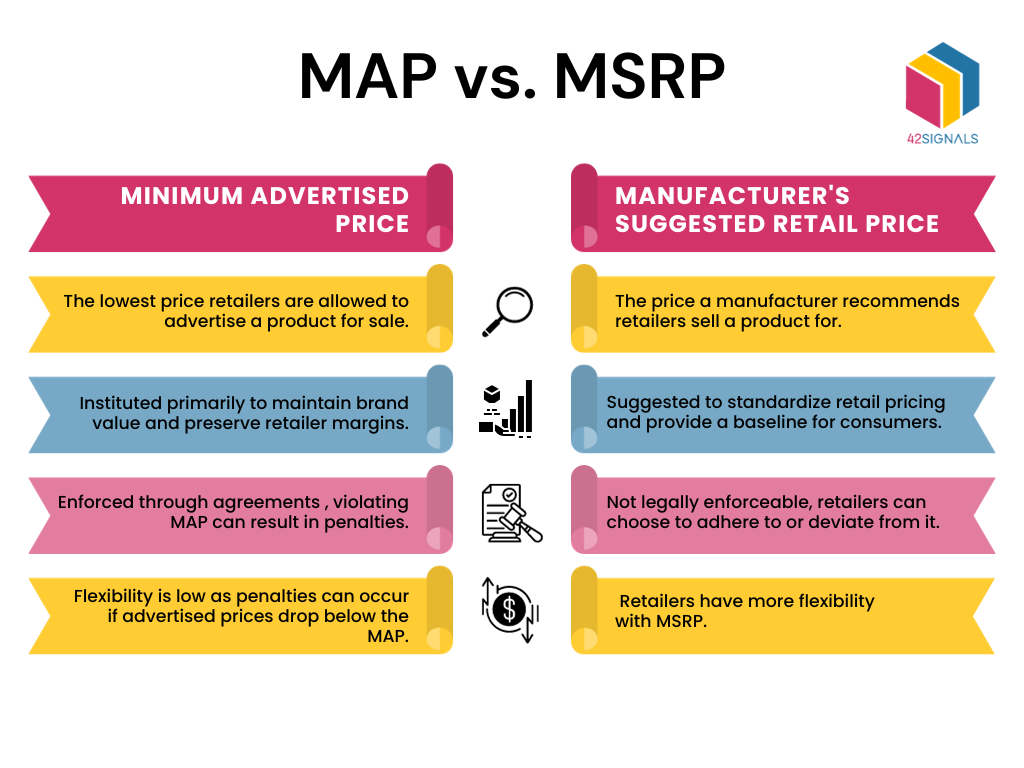
Here are some of the key differences between MAP vs. MSRP:
- Definition: MAP pricing is the lowest price retailers are allowed to advertise a product for sale. Conversely, MSRP (Manufacturer’s Suggested Retail Price) is the price a manufacturer recommends retailers sell a product for.
- Purpose: MAP is instituted primarily to maintain brand value and preserve retailer margins, whereas MSRP is suggested to standardize retail pricing and provide a baseline for consumers.
- Enforcement: Manufacturers enforce MAP policies through agreements with retailers; violating MAP can result in penalties. MSRP, on the other hand, is not legally enforceable, and retailers can choose to adhere to or deviate from it.
- Flexibility: Retailers have more flexibility with MSRP since they can adjust prices without manufacturer consequences. The flexibility with MAP is limited because penalties can occur if advertised prices drop below the MAP threshold.
| Feature | MAP (Minimum Advertised Price) | MSRP (Manufacturer’s Suggested Retail Price) |
|---|---|---|
| What it Controls | The advertised price (online, in flyers, on TV). | The actual selling price. |
| Enforceability | Contractually enforceable via agreements with retailers. Violations can have penalties. | A non-binding suggestion. Retailers are free to ignore it. |
| Primary Goal | Protect brand image and retailer margins from destructive price wars. | Standardize pricing and set a consumer value benchmark. |
| Flexibility for Retailers | Low flexibility in advertising. Can still sell at any price. | Complete flexibility. Can advertise and sell at any price. |
| Example | A brand’s MAP is $50. A store can list it for $50 but sell it for $45 at the checkout. | A brand’s MSRP is $50. A store can choose to list and sell it for $40, $50, or $60. |
How MAP and MSRP Affect Retailers, Resellers, and Shoppers
When retailers implement rules like Minimum Advertised Price (MAP), it’s a way to keep their brand strong and protect profits for both the brand and the stores. This makes sure that everyone plays by the same rules in the competition. However, some stores might feel a bit stuck because they can’t freely use different pricing strategies.
For shoppers looking for great deals, MAP can be a bit of a challenge as it limits the chances for discounts. This might be frustrating when it seems like prices are fixed and not flexible.
Manufacturer’s Suggested Retail Price (MSRP) is like a starting point for a product’s price. It helps customers get an idea of what something usually costs. The cool part is that stores can still change the price during special deals and promotions.
At-a-Glance Comparison: MAP vs. MSRP vs. MRP vs. iMAP
The world of pricing acronyms can be confusing. To help you distinguish between these common terms, we’ve broken down their key features across several critical dimensions .
Legal Implications and Enforcement of MAP vs MSRP
Manufacturers establish MAP pricing and Manufacturer’s Suggested Retail Price (MSRP) policies to maintain brand reputation and pricing consistency. However, their enforcement and legal implications differ:
- MAP: Legally, manufacturers can enforce the MAP pricing compliance guide and agreements through contracts with retailers. MAP violations can lead to consequences like suspension of supply or termination of the partnership. MAP policies are monitored to prevent price fixing, which would violate antitrust laws.
- MSRP: Although manufacturers suggest retail prices, retailers are generally free to sell goods at any price. MSRP infringement typically does not carry legal penalties, as it is merely a recommendation, not a binding agreement.
Retail compliance is essential for maintaining market stability and upholding brand value through these pricing strategies.
Policy Language Pitfalls: Weak vs. Strong MAP Clauses
The success of your MAP policy hinges on the language you use. Vague terms lead to loopholes retailers can exploit. Here are three examples of MAP enforcement strategies on how to turn weak language into strong, enforceable policy .
Pitfall 1: Vague Scope
- Weak Language: “Retailers cannot advertise our products at a low price.”
- Why it’s weak: What constitutes a “low price”? Does it apply to an email newsletter? What about a banner ad on a deal site? It’s subjective and unenforceable.
- Strong Language: “The Minimum Advertised Price (MAP) for each SKU is listed in Appendix A. For purposes of this policy, ‘advertised price’ includes, but is not limited to, prices displayed on product detail pages, in paid search ads (e.g., Google Shopping), in social media posts, in email marketing, and in print or television advertisements.”
Pitfall 2: Ambiguous Exceptions
- Weak Language: “MAP does not apply during special promotions.”
- Why it’s weak: This completely nullifies the policy. What is a “special promotion”? A retailer could claim every day is a special promotion.
- Strong Language: “Temporary promotional waivers to the MAP policy may be issued at Brand’s sole discretion for specific holidays (e.g., Black Friday). Such waivers will be provided to all authorized retailers in writing at least fourteen (14) days in advance and will specify the exact start and end dates and the discount depth permitted” .
Pitfall 3: Unclear Penalties
- Weak Language: “Violations of the MAP policy may result in consequences.”
- Why it’s weak: This lacks teeth. It doesn’t deter violators or give you a clear path for enforcement.
- Strong Language: “Enforcement will follow a structured penalty ladder: (1) First Violation: Written warning and a 48-hour cure period. (2) Second Violation: Suspension of all new product allocations for 30 days. (3) Third Violation: Termination of authorized retailer status and cessation of all product supply”
Real-World Examples of MAP vs MSRP in Action
Example 1: High-End Electronics
- Product: A new drone from DJI.
- MSRP: $1,299. This is the price you’ll see prominently displayed on DJI’s website and in marketing materials, establishing its premium value.
- MAP: $1,199. Best Buy, Amazon, and other authorized retailers cannot advertise the drone for less than $1,199. However, they are free to sell it for any price once you are in the checkout cart or in-store. This is why you might see “See price in cart” for a lower amount.
Example 2: Outdoor & Sporting Goods
- Product: A Yeti cooler.
- MSRP: $350.
- MAP: $300. Retailers like REI, Dick’s Sporting Goods, and local outfitters must advertise it for at least $300. This prevents Walmart from running a national ad campaign selling it for $250, which would devalue the Yeti brand and anger smaller retailers who can’t compete at that margin.
How to Implement MAP and MSRP Policies: A Step-by-Step Guide
To effectively comply with Minimum Advertised Price (MAP) and Manufacturer’s Suggested Retail Price (MSRP) policies, manufacturers and sellers should adhere to the following steps:
- Thoroughly understand the distinct terms of the agreements. MAP relates to the lowest price at which a product can be openly advertised, while MSRP is merely a recommended selling price.
- Implement consistent monitoring systems to track advertised prices across various platforms to ensure that all sellers adhere to MAP policies.
- Communicate MAP policies clearly to retailers and distributors, highlighting the importance of maintaining brand value and customer perception.
- Be prepared to enforce consequences for MAP violations, which can include the removal of advertising funds or termination of seller agreements.
- Use legal counsel to draft and review these policies to ensure they do not fall afoul of antitrust laws and other regulations.
Common Misconceptions and Legal Nuances of MAP vs MSRP
Is MAP Pricing Legal?
Yes, MAP pricing is generally legal in the United States, but it operates in a legal grey area that requires careful structuring. The key is that it controls advertised prices, not selling prices. A manufacturer cannot dictate the final sale price due to antitrust laws (specifically, the Sherman Act). However, they can set terms for how their products are marketed by their partners.
MAP is NOT Minimum Selling Price:
This is the most critical distinction. A retailer that agrees to a MAP policy is only bound to not advertise below the set price. They are still entirely free to sell the product for a penny if they choose, as long as that final price isn’t used in public marketing.
MAP is NOT Price Fixing:
Price fixing is an illegal collusion between competitors to set prices. MAP is a vertical agreement between a manufacturer and its distributors/retailers, which is treated differently under U.S. law.
What You Can Enforce vs. Can’t: Antitrust Guardrails
Understanding the legal boundaries of MAP is critical. Overstepping can turn a legal pricing policy into an antitrust violation. The key is to remember that MAP is about your brand’s advertising rules, not about controlling a retailer’s pricing freedom .
You CAN Enforce (The Guardrails):
- A Unilateral Policy: You can create a policy and say, “Here are the terms under which we choose to do business and provide advertising support.” It must be a statement from you, not a negotiated agreement with retailers .
- Advertising Restrictions: You can control what price is displayed in public. You can enforce this by withholding co-op advertising funds or, under a Unilateral Policy, by ceasing to supply the product to the violating retailer .
- Consistency: You must apply and enforce your policy equally across all retailers. Playing favorites by letting one big-box store slide while punishing a small online seller can create legal exposure .
You CAN’T Enforce (The Red Lines):
- Fix the Final Selling Price: You absolutely cannot dictate or agree with a retailer on what price they sell the product for. This is illegal “resale price maintenance.” A retailer is free to sell a product for any price, as long as they don’t advertise it below your MAP .
- Collude with Competitors: You cannot work with other brands to set prices jointly. MAP is a vertical agreement (between you and your retailers), not a horizontal one (between you and your competitors) .
- Negotiate the Policy: The policy must be unilateral. If you sit down with a retailer and “agree” on the terms, it transforms from a lawful policy into a potentially unlawful agreement to fix prices
Promotion Exceptions: Navigating Holidays and Bundles
A rigid MAP policy can be a problem during key sales events. The solution is to build flexibility into your policy from the start. This allows you to drive traffic during peak seasons while maintaining overall price integrity .
- Planned Promotional Windows: Your policy should allow for temporary waivers. For example, you might issue a company-wide email in November stating: “MAP will be temporarily lifted on all 4K TVs from the Monday of Black Friday week through Cyber Monday.” This gives retailers clear guidelines to compete .
- The Bundle Exception: Be explicit about how bundles are treated. A strong policy might state: “MAP applies to the price of individual items. However, a ‘bundle’ containing a covered product and at least two other distinct items of significant value may be advertised at a combined price that is lower than the sum of the individual MAPs, provided the bundled price is clearly for the package.”
- The “Add to Cart” Grey Area: Most policies define “advertised price” as any price visible without a customer action. However, some brands make a specific exception for “in-cart” pricing, allowing the final lower price to be revealed only after a customer adds the item to their cart. If you allow this, you must state it explicitly in your policy .
Why MAP Monitoring is Essential for Brands
A MAP policy is only as good as its enforcement. With thousands of online sellers, marketplaces, and brick-and-mortar retailers, manually tracking advertised prices is impossible. This is where MAP monitoring software becomes critical.
Effective MAP monitoring allows brands to:
- Automatically Detect Violations: Scan e-commerce pages, marketplaces (Amazon, Walmart), and online ads 24/7 for prices that breach the MAP agreement.
- Gather Enforcement Evidence: Capture screenshots and data to prove violations when contacting non-compliant retailers.
- Protect Brand Equity: Ensure a consistent and premium brand presentation across all sales channels.
- Maintain Retailer Trust: Demonstrate to your loyal, compliant retailers that you are serious about enforcing the policy and protecting their margins.
42Signals monitors MAP compliance in real time across Amazon, Walmart, Flipkart, and hundreds of retailer sites — automatically flagging violations with screenshot evidence before they damage your brand. See how MAP monitoring works.
Conclusion
Navigating the complex terrain of retail pricing involves understanding the distinct functions and implications of MAP vs. MSRP. MAP pricing emphasizes a competitive yet equitable market, preventing price wars that could be detrimental to brand reputation and retailer margins.
MSRP, meanwhile, serves as a suggested price, offering consumers a benchmark while allowing retailers to determine the final sale price. I hope this cleared up and helped you understand what MAP pricing is, if not, here’s a MAP monitoring complete guide.
Both strategies interact with consumer perception, competition, and marketing tactics, forming an intricate web that businesses must master to successfully position their products in the market and maintain a harmonious relationship with both customers and supply chain partners.
Frequently Asked Questions on MAP vs MSRP
Can a retailer sell a product below the MAP price?
A: Yes. This is the most common point of confusion. A retailer can sell a product for any price they want. The MAP policy only restricts the price they can advertise to the public. This is why you often see “Add to cart to see price” or in-store-only discounts that are not advertised online.
What happens if a retailer violates a MAP policy?
A: Consequences are outlined in the retailer’s agreement with the manufacturer. They can include:
- A formal warning letter.
- Suspension of cooperative advertising funds.
- Withholding of future shipments or new product allocations.
- Termination of the authorized retailer relationship.
Is MSRP the same as the retail price?
A: Not necessarily. The retail price is the price the store actually charges. The MSRP is the manufacturer’s suggestion. The retail price can be at, above, or below the MSRP.
What’s the difference between MAP and a Minimum Resale Price (MRP)?
A: A Minimum Resale Price (MRP) or Minimum Selling Price is a policy that sets the absolute lowest price a retailer can sell a product for. This is much more restrictive than MAP and is subject to stricter antitrust scrutiny. In many jurisdictions, it is considered illegal resale price maintenance.
Do all brands use MAP pricing?
A: No. MAP is most common for brands that have invested heavily in building a premium image, such as electronics, outdoor equipment, cosmetics, high-end tools, and designer apparel. For commodity goods or brands that compete primarily on price, MAP is less frequently used.
By integrating these sections, your article becomes the definitive, go-to resource that thoroughly answers every question a searcher might have about MAP and MSRP pricing.