
** TL;DR ** Review analytics is essential for moving beyond simple star ratings to understand the true “Voice of Customer” (VoC). By utilizing tools like sentiment analysis and feedback mining, businesses can systematically process large volumes of customer reviews to identify subtle quality gaps (e.g., usability issues, manufacturing flaws) and evaluate the perceived value of their pricing. Critically, this data reveals both hidden weaknesses and unexpected strengths, informing product development by quantifying unmet needs (“I wish it could…”) and pinpointing the true Unique Selling Proposition (USP), ultimately driving a data-informed cycle of continuous product improvement and market strategy refinement.
Have you ever wondered what your customers really think about your product? Beyond the star ratings and surface-level comments, there’s a treasure trove of information waiting to be uncovered. It’s about finding the subtle, game-changing insights that can propel your product ahead of the competition. The key to unlocking this potential? Review analytics.
Every customer review, every social media comment, and every piece of direct feedback is a valuable signal. Ignoring these signals is like throwing money away. By systematically analyzing the voice of customer analytics embedded in this feedback, you can pinpoint the hidden flaws that are frustrating users and, just as importantly, discover the unexpected features they absolutely love.
This deep dive into customer feedback—often called feedback mining is essential for sustained growth and product excellence. Ready to turn those scattered comments into actionable intelligence? Let’s explore how review analytics helps you decode the true customer experience.
The Signal and the Noise: Why Review Analytics are Your Best R&D Team
Think of your product reviews as an unsolicited, free, and incredibly detailed report from thousands of beta testers. They’re telling you what’s broken, what’s confusing, and what delights them, all in real-time. But with hundreds or even thousands of reviews pouring in, how do you sort the genuine, high-impact insights from the noise? That’s where intelligent review analytics steps in.
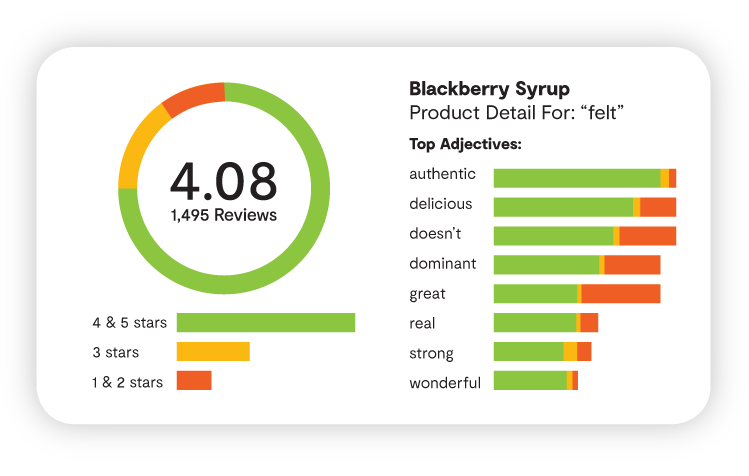
Image Source: Power Reviews
Customer reviews—whether on your e-commerce site, app store, or third-party platforms—are the most authentic source of the voice of customer analytics. They represent unfiltered opinion, often expressed immediately after a moment of delight or frustration. These opinions are potent because they directly influence potential buyers. According to a 2024 study by BrightLocal, 78% of consumers say they have looked at online reviews in the last year, highlighting the massive impact this feedback has on purchasing decisions.
Decoding Customer Sentiment: Moving Beyond Star Ratings
A four-star rating might seem great, but it doesn’t tell the full story. Was the user happy with the product but frustrated with the delivery? Did they love Feature A but despise Feature B? Sentiment analysis is the technology that helps us look past the number and truly understand the emotion behind the words.
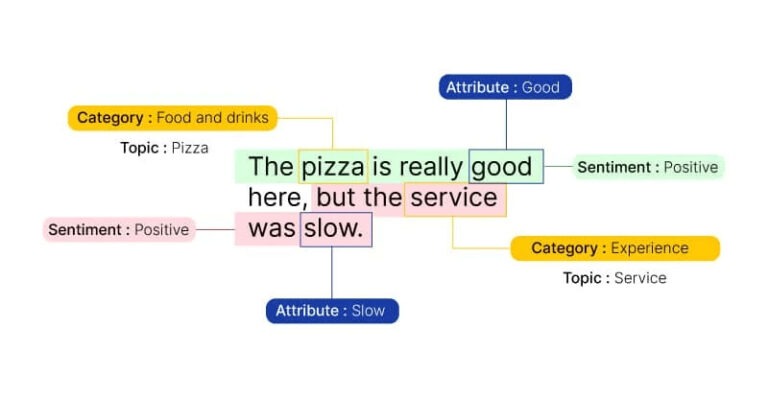
Using advanced natural language processing (NLP), review analytics tools can process massive volumes of text to determine whether a comment expresses positive sentiment, negative sentiment, or neutral feelings. More importantly, they link that sentiment to specific product attributes.
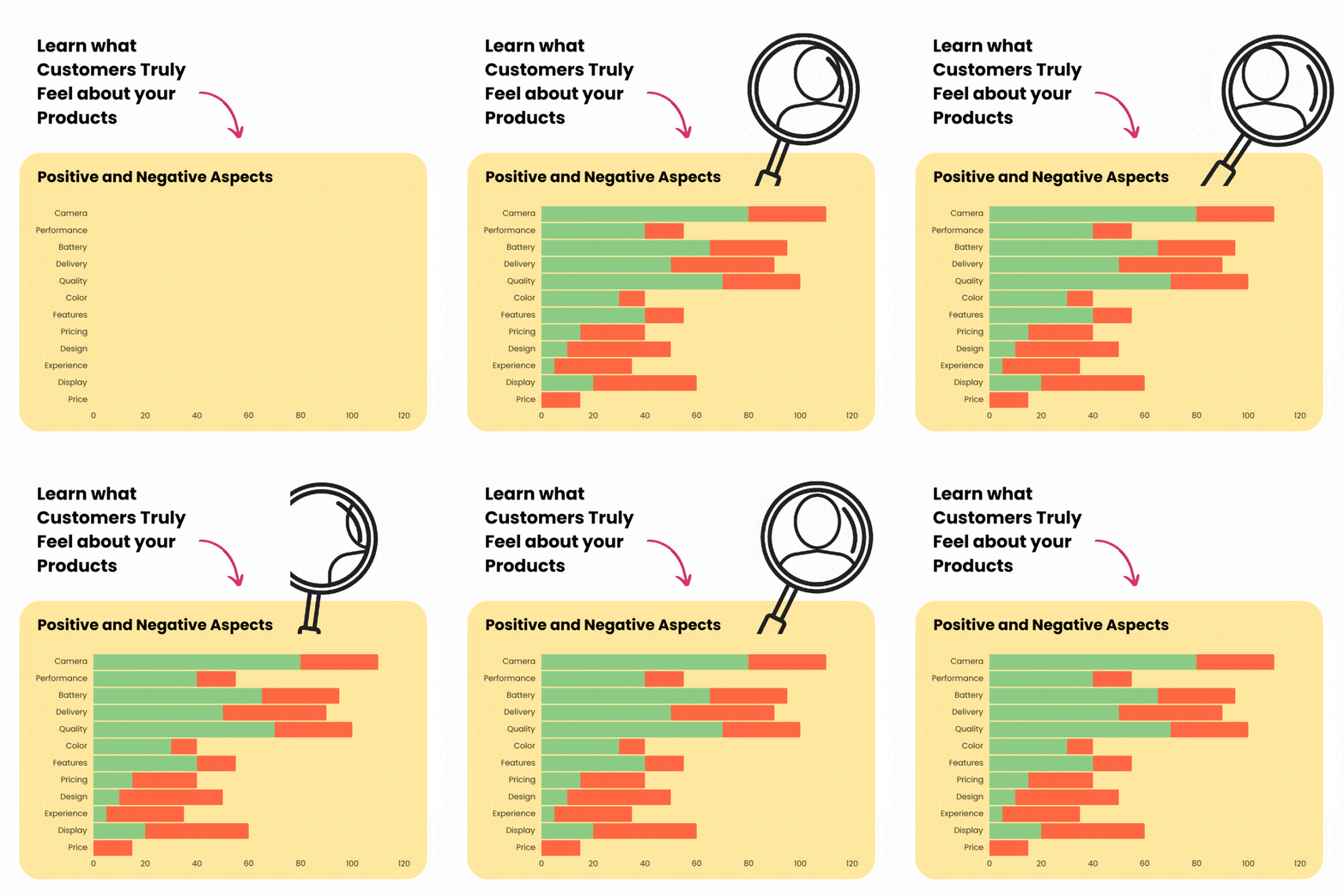
For example, a review might read: “The battery life is fantastic (positive sentiment linked to ‘battery life’), but the instruction manual was impossible to follow (negative sentiment linked to ‘instruction manual’).” Without sentiment analysis, you might just see the four stars and move on. With it, you instantly identify a critical documentation gap that’s harming the user experience.
Identifying Blind Spots: Where VoC Signals Reveal Quality Gaps
One of the most powerful applications of review analytics is its ability to reveal quality issues that internal testing often misses. These are often the “death by a thousand cuts” issues—small, recurring problems that individually seem minor but collectively lead to high customer churn.
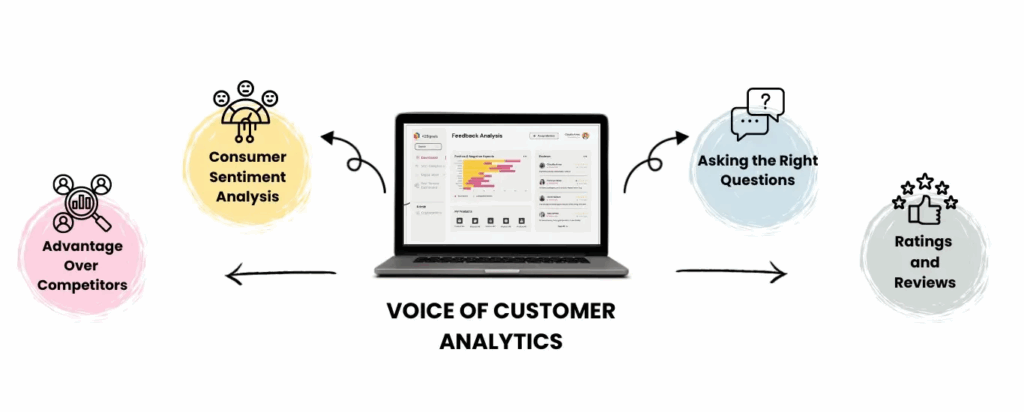
Voice of customer analytics focuses on recurring themes in negative sentiment. If you see a spike in complaints about a specific component failing after three months of use, that’s a clear VoC signal pointing to a material or manufacturing quality gap.
- Manufacturing Defects and Durability: Customers are surprisingly good at quality assurance. If multiple reviews across different platforms mention a hinge breaking, a seam ripping, or a software crash occurring during a specific action, this is concrete evidence of a quality flaw. Traditional QA testing might miss wear-and-tear issues that only emerge after prolonged, real-world use.
- Usability and Intuition: A product might function perfectly according to specs, but if users constantly complain that a key feature is “hidden,” “confusing,” or “takes too many clicks,” that’s a quality issue related to user experience (UX). These gaps are often subjective and only become apparent when analyzing patterns in user complaints. Review analytics flags these usability issues by clustering complaints around terms like “can’t find,” “confusing menu,” or “too complicated.”
The Price is Right (or Wrong): Using Feedback Mining to Evaluate Value
Product success isn’t just about quality; it’s about perceived value. Customers constantly weigh the cost of your product against the benefit they receive, and their reviews are a direct reflection of this calculation. Review analytics provides an indispensable lens through which to evaluate your pricing strategy.

When customers talk about price, they rarely use simple terms like “expensive.” Instead, they express their feeling about value indirectly. Customer feedback mining helps you track these subtle signals:
- The “Nickel-and-Diming” Effect: If you notice a spike in negative sentiment correlated with phrases like “extra fee,” “premium feature,” or “subscription required,” your customers are signaling that your monetization model is too aggressive or confusing. They might love the core product but feel slighted by the way the pricing is structured.
- The Feature-to-Cost Ratio: Look for phrases like “worth the price,” “good value for money,” or conversely, “overpriced for what it does.” By analyzing these rating trends, you can see which features, when mentioned alongside price discussions, justify the cost and which ones fall short. If customers consistently love one specific feature but still call the product “a little expensive,” it suggests that the other features aren’t pulling their weight in the value equation.
Understanding the interplay between pricing and sentiment is crucial. If your review analytics shows that high-priced items are generating positive sentiment based on reliability, your premium strategy is working. If the same high-priced items are generating negative sentiment tied to “missing basic features,” you know exactly where to reinvest.
The Innovation Edge: How Review Analytics Drives Product Development
Innovation isn’t about guessing what the next big thing is; it’s about listening for unmet needs. Your customers are already telling you what features they want, sometimes without even realizing it. They describe their workarounds, their wish lists, and the features they wish your competitors didn’t have. This is gold for your product development roadmap.
Discovering Unmet Needs and Feature Requests
Voice of customer analytics excels at identifying latent demand. This often comes in the form of frustrated suggestions rather than polite requests.
- The “I wish it could…” Gap: When reviewers consistently use phrases like “I wish it had a…” or “It would be perfect if…” they are essentially drafting your next sprint backlog. Review analytics aggregates these suggestions, providing quantitative data on which features are requested most frequently. This moves feature prioritization from internal debate to data-driven decision-making.
- Competitor Feature Gaps: If your sentiment analysis flags numerous comments mentioning a competitor’s name alongside negative feedback about your product, you have a clear innovation gap. For instance, if users repeatedly say, “I miss the auto-save feature that [Competitor X] has,” you know exactly what feature is causing churn and needs immediate attention.
Spotting “Hidden” Strengths and Unexpected Use Cases
While it’s vital to address weaknesses, review analytics is equally powerful in spotlighting your product’s “hidden” strengths. These are the aspects that customers unexpectedly love and that often become your most effective marketing differentiators.
- The Delight Factor: Sometimes, customers will use a feature in a way you never intended, and they’ll rave about it. If review analytics reveals a cluster of positive sentiment surrounding an obscure feature or an unconventional use case, you’ve found a new selling point. You can then amplify this feature, perhaps even developing it further, to capture a new segment of the market.
- Identifying Your True USP: Your marketing team might be pushing “Speed,” but your voice of customer analytics might show that customers overwhelmingly focus their praise on “Reliability” and “Customer Support.” This indicates that your true Unique Selling Proposition (USP) is different from what you thought. Pivoting your messaging to match the genuine areas of customer delight can dramatically improve conversion rates.
For instance, an analysis of 1.3 million consumer reviews by a major software firm showed that while the company marketed “Ease of Use,” the highest positive sentiment was repeatedly linked to “System Integration.” By recognizing this true strength through review analytics, they shifted their marketing focus and saw a 15% increase in enterprise customer acquisition.
Mastering the Data: Practical Steps for Effective Review Analytics
Implementing a successful review analytics strategy requires more than just buying a tool; it requires a structured approach to data collection, analysis, and action.
Step 1: Centralizing and Aggregating Feedback
The first challenge is data dispersion. Customer feedback is scattered across multiple platforms: Amazon, Google Play, Apple App Store, social media (X, Facebook), and your own support tickets.
- Data Silo Breakdown: Effective review analytics starts with aggregating all these sources into a single platform. This holistic view is necessary for tracking accurate rating trends and ensuring that a localized problem isn’t a systemic flaw. For example, if you only look at your App Store reviews, you might miss a consistent complaint in your support tickets that is actually related to a recent software update.
- Prioritizing Volume and Velocity: Focus your initial efforts on platforms with high review volume and velocity. High volume provides statistical significance, while high velocity ensures you are catching trends early.
Step 2: Applying Sentiment Analysis and Feedback Mining
Once the data is centralized, the real work of feedback mining begins. The goal is to move beyond mere word counts to contextual understanding.
- Topic Modeling: Review analytics tools use topic modeling to automatically group comments by theme (e.g., “login issues,” “checkout process,” “packaging quality,” “color options”). This is significantly more efficient than manually tagging. You can then track rating trends for each topic. A drop in the average rating specifically for the “speed” topic signals a critical performance issue.
- Aspect-Based Sentiment Analysis: This advanced form of sentiment analysis drills down to attach sentiment to specific aspects within a topic. For instance, within the “Battery Life” topic, it can differentiate between positive sentiment toward the “charging speed” and negative sentiment toward the “overall duration.” This precision is essential for targeted product improvements.
Step 3: Closing the Loop with Data-Driven Action
The insights generated by review analytics must be integrated into your product and business workflows. An insight is worthless if it doesn’t lead to action.
- Product Roadmap Integration: The top three most-requested features, identified via feedback mining of “I wish it could…” comments, should be prioritized for your next quarterly roadmap. This ensures that every development cycle is directly informed by the voice of customer analytics.
- Customer Support Optimization: Identify the issues generating the highest volume of negative reviews. These are often indicators of poor self-service support. If review analytics shows repeated complaints about setup complexity, the action isn’t necessarily a product fix, but the creation of a better, clearer, step-by-step video tutorial.
- Marketing Message Validation: Use the terms associated with high positive sentiment to refine your marketing copy. If customers consistently use the word “seamless” to describe the checkout, that word belongs in your next ad campaign.
The Continuous Cycle of Review Analytics
Review analytics is not a one-time project; it’s a continuous feedback loop. Products evolve, markets change, and customer expectations rise. What was considered a strength yesterday might be an expected baseline today. Maintaining a competitive edge requires constantly monitoring rating trends and adjusting your strategy based on the voice of customer analytics.
By diligently using tools for sentiment analysis and committing to regular feedback mining, you move from passively reacting to problems to proactively designing solutions that genuinely delight your users. The “hidden” weaknesses and strengths of your product are right there, waiting for you in the customer reviews. It’s time to stop guessing and start listening. Embrace review analytics, and watch your product—and your business—thrive.
Try 42Signals today to see review analytics and customer sentiment data for your products or your competitors’ products.
Frequently Asked Questions
What is an Analytic Review?
An analytic review (or analytical procedure) is a process used primarily in auditing and business analysis that involves studying plausible relationships among both financial and non-financial data. The objective is to identify fluctuations, trends, or relationships that are inconsistent with other relevant information or that deviate significantly from expected amounts. Essentially, an analytic review helps uncover unusual patterns, potential errors, or subtle underlying issues within a large dataset, allowing businesses or auditors to focus investigative efforts where they are most needed. In the context of product feedback, it refers to the systematic examination of customer metrics and textual data to understand performance deviations.
What are the 4 Types of Analytics?
The four generally recognized types of data analytics, often viewed as a hierarchy of complexity and value, are:
Descriptive Analytics: What happened? This is the most basic form, summarizing past data to describe what occurred during a given period. It involves reporting, data aggregation, and creating visualizations (e.g., total sales, average rating, customer demographics).
Diagnostic Analytics: Why did it happen? This type of analysis looks deeper into the data to determine the factors and causes behind past events. It often uses techniques like data discovery, drill-down, and data mining to isolate anomalies and identify causal relationships (e.g., investigating why the average rating dropped last month).
Predictive Analytics: What will happen? This form uses statistical models, forecasting techniques, and machine learning to project future outcomes and probabilities based on historical data. It provides estimates rather than certainties (e.g., predicting customer churn rate or future demand).
Prescriptive Analytics: What should we do about it? This highest level of analysis recommends specific actions or decisions to achieve a desired outcome. It utilizes optimization, simulation, and business rules to weigh potential consequences and provide guidance (e.g., determining the optimal pricing point or recommending specific product features to prioritize).
What is a Review Analysis?
Review analysis (or review analytics) is the specialized process of collecting, aggregating, and interpreting customer feedback left on various platforms (e.g., e-commerce sites, app stores, social media). Its primary purpose is to transform unstructured text data into quantitative insights. Unlike a simple summary of star ratings, a review analysis uses techniques like natural language processing (NLP) and sentiment analysis to understand the why behind the ratings, linking specific emotions (sentiment) to particular product attributes or aspects (e.g., usability, battery life, design, customer service).
How to Analyze Review Data?
Analyzing review data involves a structured, multi-step approach:
Data Collection and Aggregation: Centralize Sources: Gather all reviews from disparate sources (app stores, e-commerce platforms, social media, surveys) into a single, unified database or analytics platform.
Clean the Data: Remove spam, duplicate entries, or irrelevant data points to ensure the analysis is based on genuine feedback.
Pre-processing and Sentiment Analysis: Tokenization and Normalization: Break the text into usable components (words/phrases) and standardize formatting.
Sentiment Scoring: Apply Sentiment Analysis to assign a polarity (positive, negative, neutral) to each review or, more accurately, to specific sentences within the review.
Topic Modeling and Feature Extraction (Feedback Mining): Identify Themes: Use topic modeling to automatically group reviews discussing similar subjects (e.g., all complaints about “login issues” or all praise for “shipping speed”).
Aspect-Based Sentiment: Drill down further to link the sentiment score to specific product features or aspects (e.g., negative sentiment linked specifically to the size of the product).
Trend Analysis and Quantifying Insights: Rating Trends: Track changes in average ratings and sentiment scores over time, correlating them with product updates, marketing campaigns, or competitor actions.
Volume and Frequency: Quantify the frequency of recurring complaints (the “I wish it could…” statements) to prioritize development efforts based on customer demand.
Visualization and Reporting: Dashboard Creation: Present the quantified insights (e.g., the top 5 most criticized features, the most frequently requested feature) through easy-to-read tables and charts to enable data-driven decision-making across product, marketing, and support teams.