

** TL;DR ** This ultimate guide outlines a complete strategy for competitor price comparison, moving beyond simple tool use to establish a robust, ongoing practice. It begins by identifying your real competitors and then details methods to track not just prices, but also shipping, promotions, and bundles. The core of the process is analysing this data to understand your competitive positioning and spot market trends, enabling you to make data-driven decisions. Finally, it explains how to translate these insights into an actionable pricing strategy that avoids common pitfalls, protects your profit margins, and ensures your prices are always strategically set to compete effectively.
Let us be honest for a second. Setting prices for your products or services can feel like a shot in the dark. You look at your costs, you add a markup you feel comfortable with, and you hope customers bite. But in today’s hyper-connected market, that approach is a risky one. Your prices do not exist in a vacuum. They are in a constant, silent conversation with every other price tag on similar products, both online and in stores. Ignoring this conversation means you could be leaving money on the table without even realising it. You might be pricing yourself too low, sacrificing potential profit. Or, you might be priced too high, unknowingly pushing customers into the waiting arms of your competitors. This is where a structured approach to competitor price comparison becomes your most powerful strategic tool.
It is not about blindly copying what others are doing. It is about understanding the market landscape so you can make intelligent, data-driven decisions that protect your profit margins and solidify your competitive positioning.
What Exactly is Competitor Price Comparison? (And Why It’s a Game Changer)
At its core, competitor price comparison is the process of systematically collecting and analysing the pricing data of your business rivals. But it is so much more than just seeing who sells something for less. A true competitor pricing analysis looks at the bigger picture. It examines pricing patterns, discount strategies, shipping costs, and bundle deals. It answers critical questions like: How do my prices stack up against the market leader? When do my competitors run sales? Are they targeting a different type of customer with their pricing model?
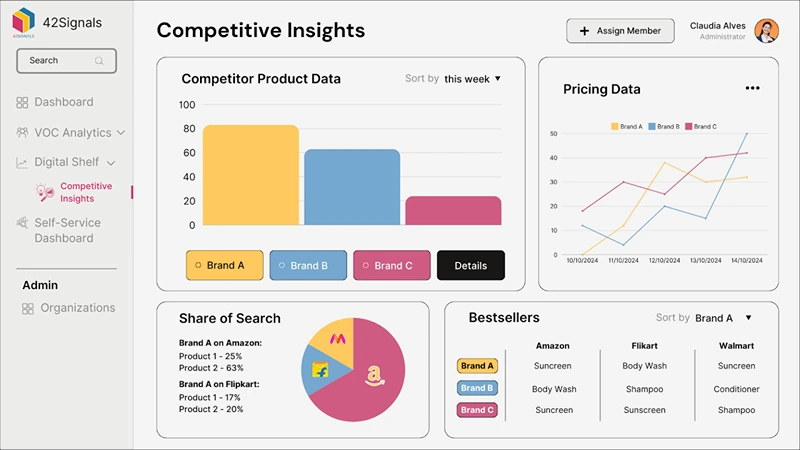
Investing time in this process is a game-changer for several key reasons:
- Protect and Increase Profit Margins: By understanding the upper and lower price boundaries in your market, you can identify opportunities to adjust your prices without scaring customers away. A McKinsey & Company study found that a 1% price improvement can result in an 8.7% increase in operating profits, assuming no loss of volume. This highlights the direct impact of strategic pricing on your bottom line.
- Win the Battle for Customer Attention: Price is often the final deciding factor for a customer choosing between two similar products. Having a competitive price, or being able to justify a premium one, directly influences sales.
- Identify Market Trends: Consistent price tracking helps you spot industry-wide trends. For instance, you might notice that all your competitors are starting to offer subscription models, signalling a shift in how customers prefer to pay.
Ready to Take the Next Step?
See how our solutions can help you achieve your goals and drive measurable results.
Laying the Groundwork: Identifying Your Real Competitors
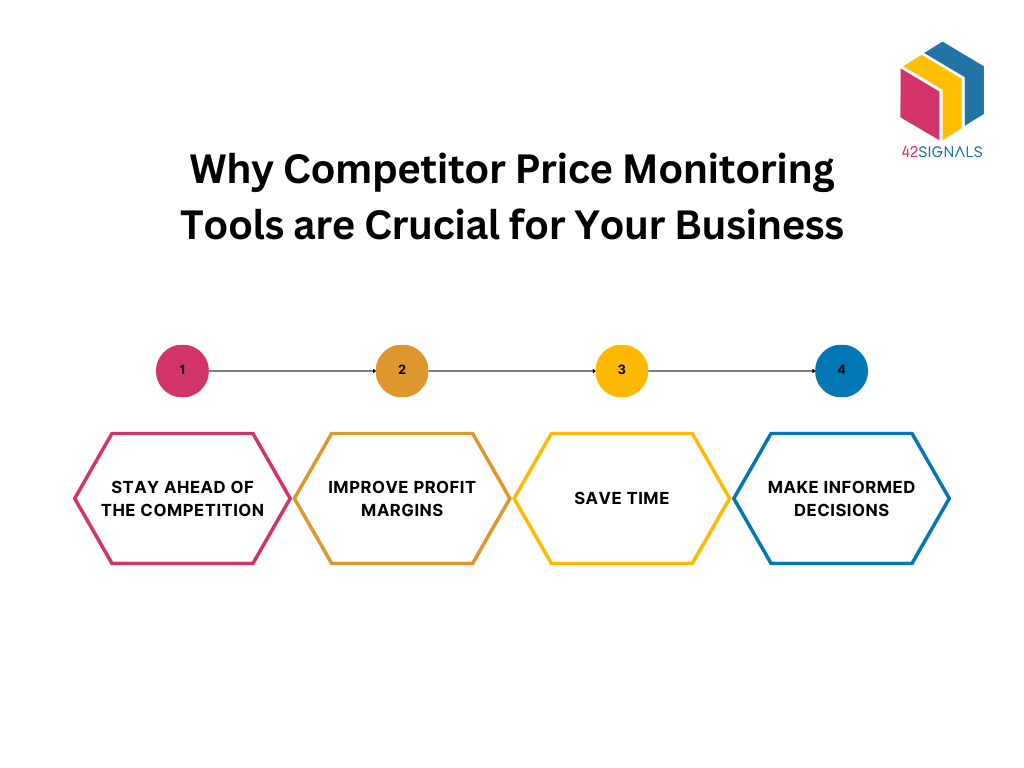
Before you can compare anything, you need to know who you are comparing yourself to. Not every company in your industry is a direct competitor. You need to categorise them.
- Direct Competitors: These are the businesses offering a nearly identical product or service to the same target audience. If you sell organic coffee beans online, another online store selling a similar range of organic beans is a direct competitor. Their prices are your most critical benchmark.
- Indirect Competitors: These companies solve the same customer problem but with a different product or service. For your organic coffee business, an indirect competitor could be a local coffee subscription box or a large supermarket chain with a strong organic section. Their pricing can influence your customers’ perception of value.
- Market Leaders and New Entrants: Keep a special eye on the biggest player in your space, as they often set pricing trends. Also, watch new, agile companies that might be using aggressive pricing to gain market share quickly.
Make a list of 5 to 10 key competitors across these categories. This list will be the foundation of your entire competitor pricing analysis.
Your Toolkit for Effective Competitor Price Comparison
Gathering pricing data can be as simple or as sophisticated as you need it to be. Here are the primary methods.
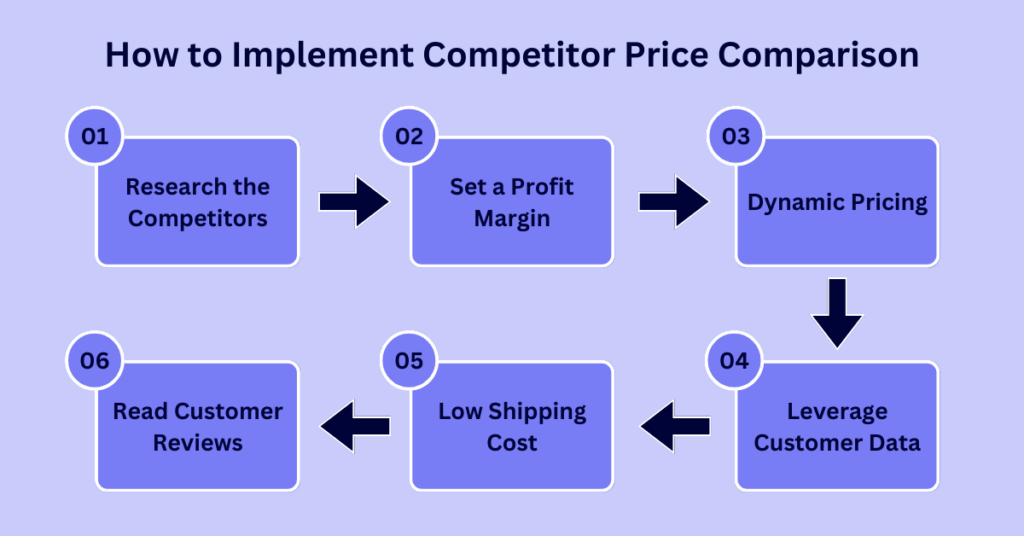
Image Source: Price Intel Guru
Manual Checking: The Hands-On Approach
This involves physically visiting competitor websites, checking their Amazon stores, or visiting their physical locations to record prices. It is a good starting point for a very small business with only a handful of products.
- Pros: It is free and gives you a direct feel for the customer experience.
- Cons: It is incredibly time-consuming, difficult to scale, and prone to human error. Prices can change multiple times a day, making manual price tracking inefficient for anything beyond a snapshot.
Ready to Take the Next Step?
See how our solutions can help you achieve your goals and drive measurable results.
Using a Price Tracking Software: The Power of Automation
For any serious business, using a dedicated tool is the most effective path forward. These software platforms automate the entire data collection process.
- Pros: They track hundreds or thousands of products 24/7, provide historical data charts, and send alerts when a competitor changes a price. This automation frees up your team to focus on analysis and strategy, not data entry.
- Cons: There is a cost involved, and you need to ensure the tool can accurately track your specific competitors and product categories.
Web Scraping: The Technical Method
Web scraping uses bots to extract large amounts of data from websites. While powerful, it comes with significant technical and legal considerations.
- Pros: Can be highly customised to pull very specific data points.
- Cons: Requires technical expertise, and many websites have terms of service that prohibit scraping. It can also be resource-intensive to set up and maintain.
For most businesses looking to build a sustainable pricing strategy, a dedicated price tracking software offers the best balance of power, accuracy, and ease of use.
What to Track Beyond the Sticker Price
A smart competitor price comparison goes far beyond the base product price. To get a true picture, you must account for all the factors that affect the final cost to the customer.
- Shipping Costs and Policies: A product with a low sticker price but high shipping costs might be less attractive than a slightly higher-priced item with free shipping. Track their standard shipping rates, free shipping thresholds, and expedited options.
- Discounts and Promotional Offers: Note down their common sales cycles. Do they have a “20% off first order” pop-up? Do they run flash sales every Friday? This information is gold for planning your own promotions.
- Bundle Pricing: How do they price items sold together? A competitor might sell a camera, a case, and a memory card for a bundled price that is cheaper than buying each item individually. Understanding their bundling strategy can reveal their perceived value propositions.
- Membership or Loyalty Programs: Prices for members (like Amazon Prime) can be significantly different. You need to understand the value and pricing within these exclusive ecosystems.
From Raw Data to Actionable Insights: How to Analyse Your Findings
Once you have collected a robust set of data, the real work begins: analysis. Do not just look at the numbers; interpret what they mean for your business.
Step 1: Create a Competitor Price Matrix.
A simple spreadsheet is a great way to start. List your products down the left side and your competitors across the top. Fill in the cells with their current prices, shipping costs, and any other relevant notes. This visual aid makes it easy to see where you stand at a glance.
Step 2: Determine Your Competitive Positioning.
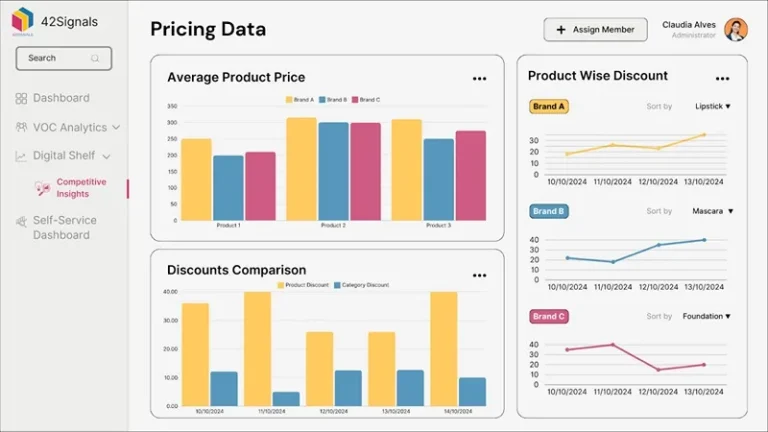
42Signals’ Pricing Data
Based on your matrix, how are you positioned?
- The Premium Option: Are your prices consistently higher? This can be a valid strategy if you can clearly communicate superior quality, better customer service, or exclusive features that justify the cost.
- The Value Leader: Are your prices consistently the lowest? This can help you win price-sensitive customers, but it can also start a price war that erodes everyone’s profit margins.
- The Middle Ground: Are you priced in the middle of the pack? This is common, but it requires a strong brand story and unique value to prevent customers from viewing your product as a generic option.
Step 3: Look for Patterns and Gaps in your Competitor Price Comparison Analysis
Use your historical data from your price tracking software. Do certain competitors drop prices every quarter? Do they run a major sale before the holidays? Identifying these patterns allows you to anticipate market moves. Also, look for gaps. Is there a price point no one is serving? For example, maybe there is a market for a super-budget option or a hyper-premium one that your competitors have missed.
Ready to Take the Next Step?
See how our solutions can help you achieve your goals and drive measurable results.
Making the Move: Turning Analysis into a Winning Pricing Strategy
Your analysis is useless unless you act on it. Here is how to translate your insights into a concrete pricing strategy.
Scenario 1: You Need to Match a Competitor’s Price.
If a key competitor permanently lowers a price on a high-volume product, you may have no choice but to match it to stay in the game. However, do this strategically. Can you reduce costs elsewhere to protect your margin? Can you bundle it with an accessory to maintain the average order value?
Scenario 2: You Can Justify a Higher Price.
If your analysis shows you are the premium option, double down on that. Ensure your marketing, product descriptions, and customer service all scream “premium.” Explain why your product is worth more. Perhaps you use better materials, have a longer warranty, or offer unparalleled support. Your competitor pricing analysis gives you the confidence to hold your price and articulate your value.
Scenario 3: You Discover a New Opportunity.
Your research might reveal an untapped customer segment. Perhaps you notice that all your competitors have slowly increased prices, leaving budget-conscious customers behind. This could be a chance for you to introduce a more affordable, streamlined product line to capture that audience.
Common Pitfalls to Avoid in Competitor Price Comparison Analysis
Even with the best data, it is easy to fall into these common traps.
- The Race to the Bottom: Engaging in a relentless price war is a dangerous game. It trains customers to only buy based on price and can make your business unsustainable. Compete on value, not just cost.
- Analysis Paralysis: Do not get so caught up in collecting data that you never make a decision. The goal is to gather enough information to act confidently, not to achieve perfect, infinite knowledge.
- Ignoring Your Own Costs: Your pricing must ultimately cover your costs and allow for a healthy profit. Never set a price below your cost just to beat a competitor, unless it is a very specific, short-term loss-leading strategy.
Price Comparison as an Ongoing Practice
A single competitor price comparison is a helpful snapshot, but the real power comes from making it an ongoing practice. The market is not static. New competitors emerge, customer preferences shift, and market trends evolve.
By building a systematic process for price tracking and analysis, you move from guessing to knowing. You empower yourself to make proactive, data-driven decisions that strengthen your competitive positioning and safeguard your profit margins. Stop looking at your prices in isolation. Start listening to the conversation happening in the marketplace, and use that intelligence to build a smarter, more resilient business.
Try 42Signals’ price comparison features to make your brand’s online tracking easier.
Frequently Asked Questions
1. How do you compare prices with competitors?
To compare prices with competitors, businesses typically track pricing across multiple channels and analyze how their offers stack up in real time. This can be done through:
Manual checks on competitor websites and marketplaces for a small number of SKUs.
Price comparison tools or automated monitoring platforms like 42Signals, which collect and structure competitor price data at scale.
APIs or scraping to retrieve live price feeds from multiple e-commerce listings.
Historical tracking to spot pricing patterns or promotional tactics competitors use.
Effective price comparison allows companies to stay competitive without blindly slashing prices, helping them maintain both market share and profit margins.
2. What is a competitor price analysis?
Competitor price analysis is the process of evaluating how competitors set and adjust their prices over time. It involves:
Identifying key competitors in the same product category.
Tracking their pricing behaviour across channels and geographies.
Understanding discount strategies, promotional windows, and seasonality.
Comparing their pricing with your own to find underpricing or overpricing gaps.
This analysis helps businesses decide whether to match, beat, or differentiate on value—ultimately guiding strategic pricing decisions rather than reactive ones.
3. What is competitor pricing?
Competitor pricing refers to a pricing strategy where businesses set their prices based on what competitors are charging for similar products or services.
There are three main approaches:
Price Matching – Aligning with competitor pricing to stay on par.
Price Undercutting – Setting slightly lower prices to capture more market share.
Value-Based Pricing – Charging more but justifying it with better features, quality, or service.
Competitor pricing strategies are common in industries with low differentiation and high price sensitivity, such as consumer electronics, apparel, and fast-moving consumer goods (FMCG).
4. How to check competitor price?
There are several practical ways to check competitor pricing, depending on the scale of your operations:
Manual checks – Visiting competitor websites or marketplaces to note prices.
Price comparison engines – Using tools like Google Shopping or marketplace aggregators.
Automated monitoring – Platforms like 42Signals track real-time competitor prices across SKUs, channels, and locations.
API integrations – For larger businesses, connecting directly to retailer feeds or scraping data for continuous tracking.
Automated methods are typically the most accurate and efficient, especially when monitoring hundreds or thousands of products.