

Quick commerce India platforms have been receiving a lot of funding and have quickly become the platform of choice for many consumers. One of the reasons for this convenience is the availability of dark stores that promise ultra-fast deliveries – ensuring that orders are quick and customers are happy.
With this shifting consumer behavior of purchases, brands have to adapt and look at where to be present based on fast-delivery trends. That’s where 42Signals helps brands on these platforms understand how to refine strategies and optimize sales.
How Quick Commerce is Transforming the Indian Market?
Global Quick Commerce Market Overview 2025
Market Size & Projections:
- Global Market: Projected to reach $12.7 billion by 2030
- US Market: Valued at $7.5 billion in 2023 with 8% CAGR
- Indian Market: $5 billion+ with Blinkit and Zepto leading
- European Market: $3.2 billion led by Getir and Gorillas
Regional Performance Metrics:
- India: Average delivery time 12-15 minutes, order volume growing 25% quarterly
- Middle East: GCC market expanding rapidly with 18-minute average delivery
- Europe: Mixed performance with some markets seeing consolidation
- United States: Selective urban penetration with longer average delivery times
Quick commerce, often referred to as q-commerce, represents the new way of shopping and as the name suggests, it’s quick. Q-commerce relies on several dark stores that are basically warehouses located in several areas of a zip code to enable fast delivery. In urban areas, setting up such stores is worth the investment due to the number of people concentrated and ordering from online.

Image Source: Market Brew
The quick commerce market has seen meteoric growth, and with platforms like Blinkit, Zepto, and Swiggy Instamart there seems to be a lot of potential for growth. These platforms offer a wide range of products and services from groceries and household items to niche products.
Why Quick Commerce Succeeded in India But Struggled in the US
India’s Success Factors:
- Dense Urban Populations: High population density in cities like Mumbai and Delhi
- Mobile-First Consumers: 700+ million smartphone users comfortable with app-based services
- Lower Labor Costs: Affordable delivery infrastructure
- Cultural Factors: Preference for daily shopping vs bulk purchasing
- Competitive Landscape: Blinkit, Zepto, and Swiggy Instamart driving innovation
US Market Challenges:
- High Operational Costs: Real estate and labor expenses in urban centers
- Suburban Sprawl: Lower population density outside core urban areas
- Established Competition: Amazon Prime, Instacart, and DoorDash already serving similar needs
- Consumer Habits: Preference for weekly grocery shopping vs immediate needs
- Profitability Pressure: Low average order values struggling to cover delivery costs
How 42Signals Powers Quick Commerce in India with Data Insights?
42Signals specializes in scraping and analyzing product data from various quick commerce platforms in India. Doing so provides the right data insights to inform strategies.
Let’s take a look at how 42Signals helps –
1. Comprehensive Product Data Scraping
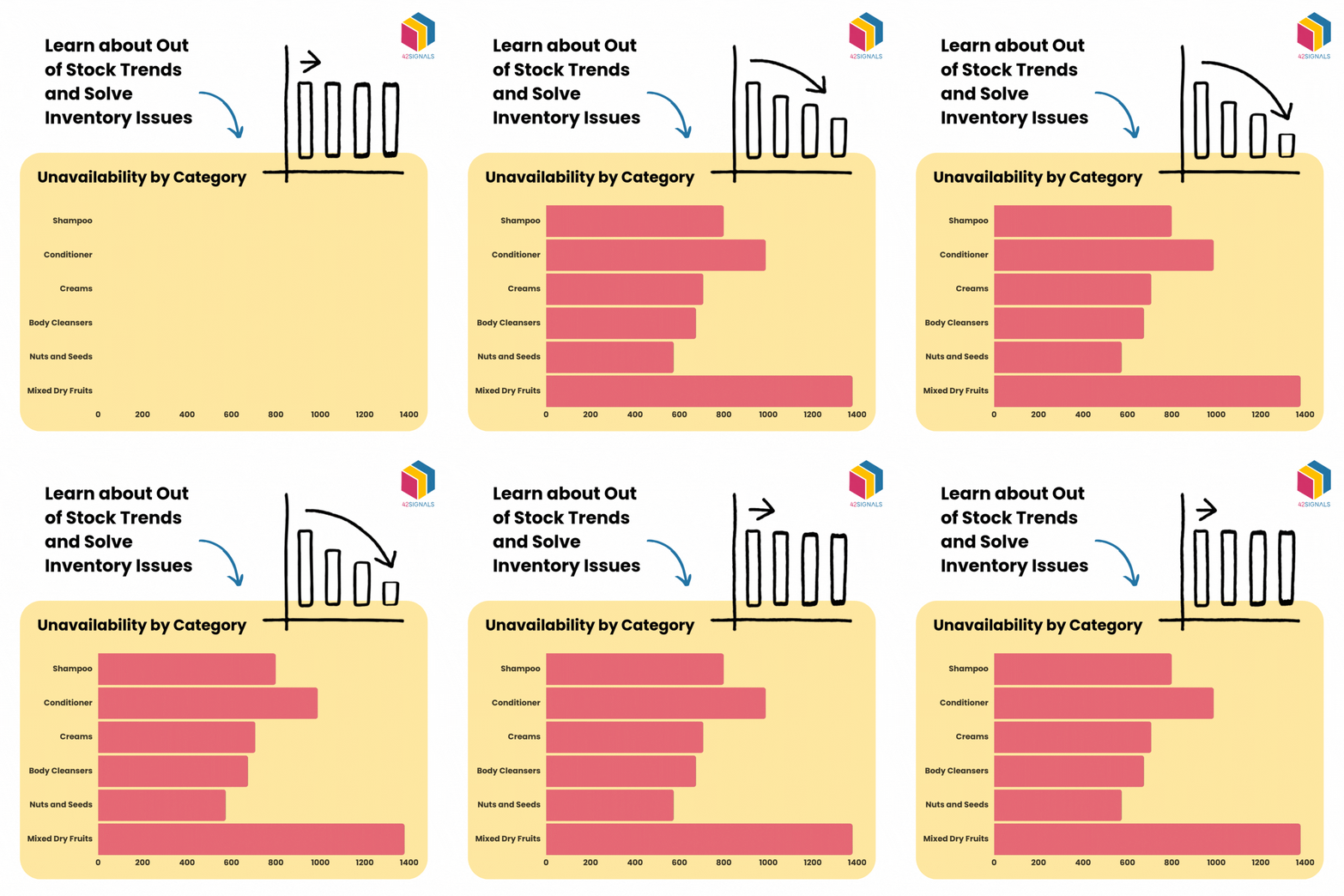
At the heart of 42Signals’ capabilities is its ability to scrape vast amounts of product data from quick commerce India platforms. This includes information about:
- Product availability
- Pricing trends
- Stock levels
- Promotions and discounts
- Customer reviews and ratings
This data is so important for businesses looking to understand their market position and identify opportunities.
An example would be of a beverage company that can monitor the pricing and availability of its products across platforms like Blinkit and Zepto. This data helps the beverage brand ensure its pricing is competitive and also maintains proper stock levels.
2. Enhanced Ecommerce Analytics
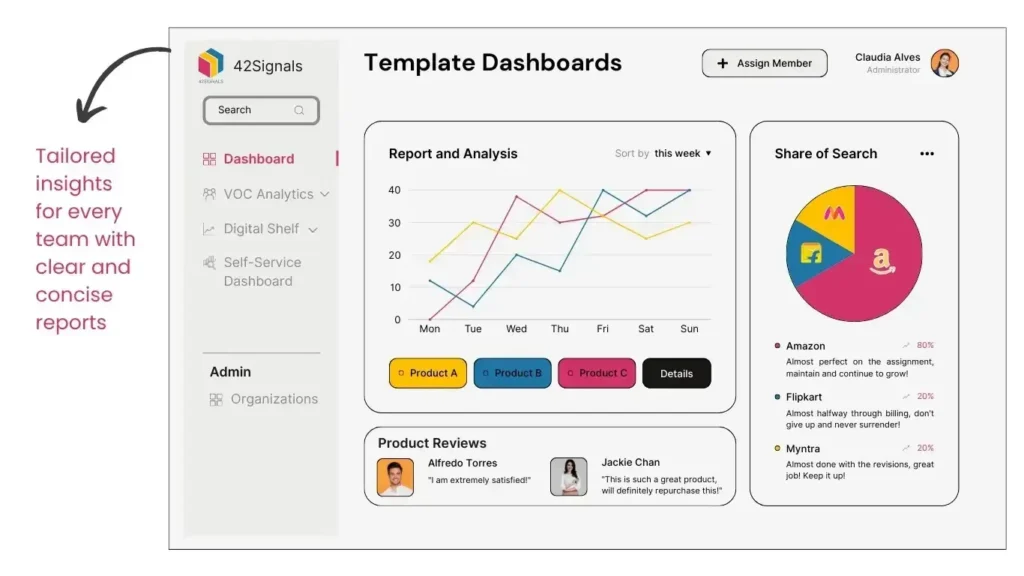
The way ecommerce in India is currently developing, robust analytics can make or break a business. 42Signals provides businesses with detailed ecommerce analytics, offering insights into:
- Sales performance
- Seasonal trends
- Consumer preferences
- Regional demand variations
These data points enable businesses to align the way they work with what’s currently in demand.
An example of a snack brand would be that it might discover its products are in higher demand during certain festivals or seasons. This can translate into more promotions and discounts during these high shopping seasons.
3. Competitor Analysis
Understanding what competitors are doing is important to stay on par with the industry. With competitor analysis, this information is easily available via –
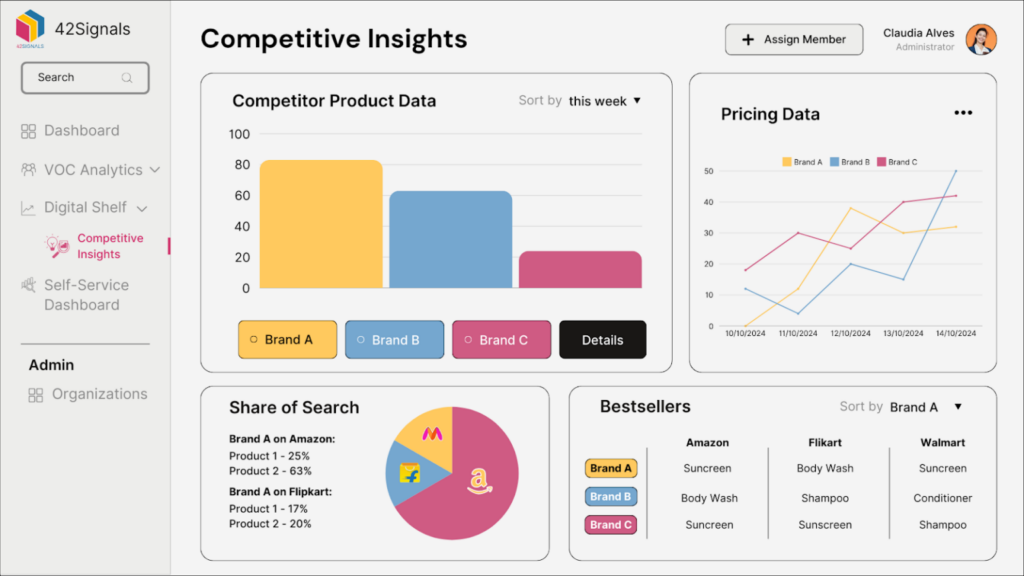
- Pricing strategies
- Product launches
- Promotional campaigns
- Upcoming trends
A business with access to this data can identify gaps in the market and develop strategies to outperform its competitors.
A beauty brand might learn that a rival has introduced a new product category on q-commerce platforms. WIth that information they can begin R&D and create a competitive product that outperform’s this brand’s item.
4. Measuring Share of Search
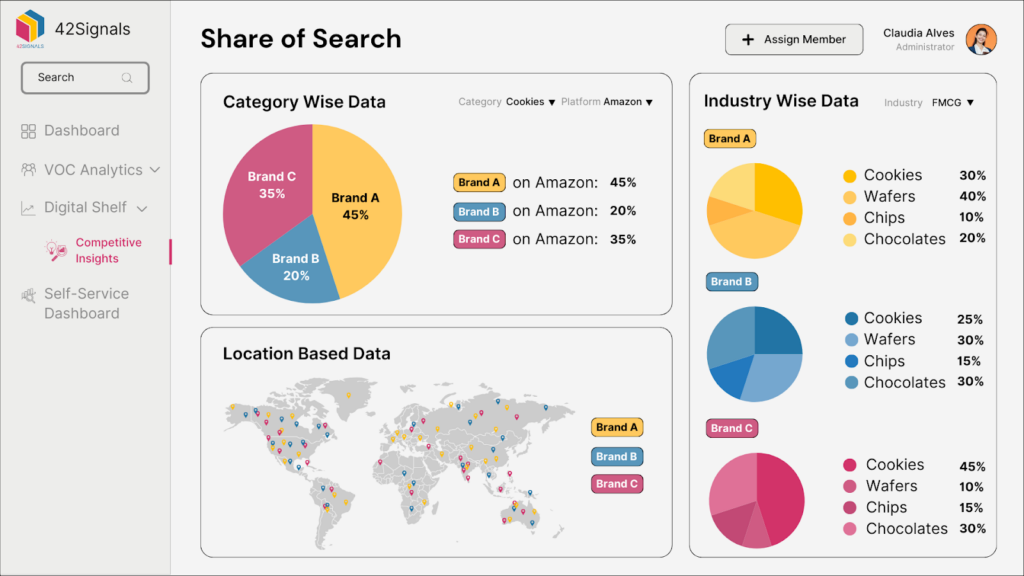
The share of search analysis metric is another powerful indicator of brand visibility and consumer interest.
A platform like 42Signals helps businesses to track their share of search across quick commerce India platforms, giving information about –
- How often their products appear in search results
- The effectiveness of their product descriptions and keywords
- Their visibility compared to competitors
For instance, a personal care brand can identify what products are not doing so well and optimize their keywords to improve search rankings.
Leading Quick Commerce Companies and Their Strategies
Global Players:
- Getir (Turkey): Pioneer expanding globally with focus on urban centers
- Gorillas (Germany): Known for rapid delivery but facing restructuring
- Gopuff (USA): US market leader with 15-minute delivery promise
- Blinkit (India): Acquired by Zomato, dominating Indian market
- Zepto (India): Fast-growing competitor focusing on 10-minute delivery
Traditional Retailers Adapting:
- Walmart: Express delivery through Spark Driver network
- Target: Same-day delivery via Shipt acquisition
- Tesco: “Whoosh” service delivering in 30 minutes
- Carrefour: Partnership with Cajoo for quick commerce in France
The Technology Stack Powering Quick Commerce
Micro-Warehouse Management:
- AI-Powered Inventory: Predictive algorithms stock products based on neighborhood demand
- Automated Picking: Robotics and optimized layout for faster order fulfillment
- Real-Time Tracking: Live inventory management across dark store networks
Delivery Logistics Software:
- Route Optimization: Algorithms calculating fastest delivery paths
- Dynamic Dispatch: Automatic rider assignment based on proximity
- Performance Analytics: Monitoring delivery times and operational efficiency
Data Intelligence Platforms:
- Demand Forecasting: Tools like 42Signals providing real-time market insights
- Price Monitoring: Tracking competitor pricing and promotions
- Digital Shelf Analytics: Optimizing product visibility across quick commerce apps
Profitability Challenges and Solutions
Major Cost Centers:
- Real Estate: Premium rents for urban dark store locations
- Labor: Delivery rider costs and dark store staff
- Customer Acquisition: High marketing spend to attract users
- Last-Mile Delivery: The most expensive part of the supply chain
Profitability Strategies:
- Dynamic Pricing: Higher fees during peak demand periods
- Subscription Models: Monthly fees for unlimited free delivery
- Expanded Product Categories: Higher-margin electronics and beauty products
- Dark Store Automation: Reducing labor costs through technology
- Delivery Fees: Implementing minimum order values and service fees
The Engine of Insight: How Quick Commerce Data Scraping Works
At its core, quick commerce data scraping is the automated process of extracting publicly available information from q-commerce apps and platforms like Blinkit, Zepto, and Swiggy Instamart. This isn’t manual copying; it’s a sophisticated, systematic operation.
The Technical Process:
- Target Identification: Bots are programmed to navigate the platforms, mimicking a user’s search for specific products, categories, or stores.
- Data Extraction: The software captures critical fields in real-time: product name, brand, price, discount, images, description, stock status (“Available”/”Out of Stock”), seller info, and customer ratings.
- Structuring & Cleaning: Raw, unstructured data is parsed and organized into a consistent, analyzable format (like CSV or JSON), ready for your analytics dashboard.
- Scheduling & Monitoring: Scraping jobs run at scheduled intervals (hourly, daily) to track price changes, stock fluctuations, and new listings, providing a real-time quick commerce data feed.
Scraping API vs. In-House: Choosing the Right Tool for India
For Indian retailers and brands, the choice often boils down to using a managed quick commerce data scraping service (like an API) or building an in-house solution. Here’s a clear comparison:
| Factor | Managed Scraping API/Service (e.g., 42Signals) | In-House Scraping Team |
|---|---|---|
| India-Specific Proxies | Critical. Providers maintain large, rotating pools of residential and mobile IPs within India to avoid geo-blocks and rate limiting, which is essential for reliable price monitoring in India. | Very difficult and expensive to source and manage at scale. Risk of IP bans is high. |
| Reliability & Maintenance | The provider handles all anti-bot evasion (CAPTCHAs, fingerprinting), platform structure changes, and infrastructure uptime. You get clean data, not maintenance headaches. | Requires constant developer attention to fix broken scripts, draining focus from core business analysis. |
| Cost | Predictable subscription or usage-based pricing. No hidden costs for servers, proxies, or developer salaries. | High upfront and variable ongoing cost (developer salaries, infrastructure, proxy networks). |
| Speed to Insights | Immediate. Access to a pre-built platform with dashboards and analytics. | Months of development before any usable data is produced. |
For Indian retailers seeking the best balance of price and reliability, a specialized provider almost always offers superior ROI and lets you focus on strategy, not infrastructure.
Why Dark Store Insights Are Crucial for Quick Commerce Success?
Dark stores also are so important in the quick commerce ecosystem in India as without them the whole business model would fall apart. These mini-warehouses are strategically located to ensure rapid delivery, often within 10–20 minutes.
Scraping data from these stores from a tool like 42Signals helps businesses with –
- Real-time inventory updates
- Insights into stocking patterns
- Analysis of fulfillment times
- SKU data tracking
For example, a dairy brand can ensure its products are consistently stocked in dark stores, reducing the risk of missed sales.
From Raw Data to Strategy: The Quick Commerce Analytics Pipeline
Scraping delivers data; analytics delivers advantage. A robust quick commerce analytics pipeline transforms raw numbers into a competitive playbook.
The Four-Stage Pipeline:
- Data Aggregation: Information is pulled from all relevant platforms (Blinkit, Zepto, Instamart, etc.) into a single source of truth.
- Enrichment & Categorization: Products are matched to your internal catalog, categorized by segment (e.g., “Premium Snacks,” “Dairy Essentials”), and tagged with margins and cost data.
- Analysis & Insight Generation: This is where intelligence is born. Algorithms calculate:
- Price Positioning: Are you a premium, mid-market, or value brand on each platform?
- Share of Shelf & Search: What’s your visibility vs. competitors?
- Promotional Velocity: How frequently and deeply do rivals discount?
- Stock-Out Analysis: Which of your or your competitor’s SKUs are consistently unavailable?
- Actionable Reporting: Insights are delivered via intuitive dashboards and alerts—not spreadsheets—enabling quick commerce optimization decisions in minutes, not days.
Real-World Applications of Brands Benefiting in Quick Commerce India
Here are some of our client scenarios where 42Signals’ capabilities have proven to be severely helpful:
- Pricing Optimization: A beverage company used 42Signals to monitor competitor pricing on Blinkit. With this data, the company adjusted its pricing strategy, boosting sales by 15%.
- Product Launch Success: A snack brand tried 42Signals to track the performance of a new product on Zepto. The information helped the brand identify popular flavor profiles, leading to the successful rollout of additional variants.
- Inventory Management: A personal care brand used 42Signals to track stock levels across dark stores. This meant the brand could address supply chain issues promptly, ensuring consistent product availability.
Identifying High-Margin Opportunities in the Q-Commerce Frenzy
Quick commerce isn’t just about selling staples. The real profitability lies in strategically placing higher-margin products where impulse buys happen. Data intelligence reveals these opportunities.
High-Potential Categories for Q-Commerce:
- Beauty & Personal Care: An emergency lipstick, a premium face serum, or a specific shampoo. Scraping beauty data shows which premium SKUs are trending and at what price points.
- Health & Wellness: Supplements, protein bars, and specialty health foods command significant margins and are high-consideration items for immediate need.
- Premium Snacks & Gourmet Foods: Artisanal cheeses, imported chocolates, or health-conscious snacks attract customers willing to pay for convenience and quality.
- Baby & Pet Care: These are “need-it-now” categories where customers prioritize speed over price, protecting margin.
How to Capitalize:
Use quick commerce data extraction to monitor competitor assortments in these categories. Identify gaps: Is there a premium ice cream brand no one is stocking? Is a competitor’s high-margin skincare line constantly out of stock? This intelligence allows you to optimize your quick commerce product listing strategy for maximum profitability, not just volume.
Quick Commerce Market Trends 2025
1. Beyond Groceries: The “Instant Everything” Expansion
- Electronics: Phones, accessories, and gadgets
- Beauty & Skincare: Emergency makeup and skincare products
- Pharmaceuticals: Prescription and OTC medication delivery
- Office Supplies: Last-minute business needs
2. Sustainability Initiatives
- Electric Vehicles: E-bikes and EVs for urban delivery
- Packaging Reduction: Minimal, recyclable packaging
- Route Optimization: Reducing carbon emissions through efficient routing
3. Traditional Retail Partnerships
- White-Label Solutions: Q-commerce platforms powering retail delivery
- Store-as-a-Warehouse: Using existing retail locations for fulfillment
- Hybrid Models: Combining quick commerce with scheduled delivery
4. AI and Automation Advancements
- Predictive Analytics: Anticipating demand spikes by location
- Automated Dark Stores: Reduced human intervention in fulfillment
- Dynamic Pricing: Real-time price adjustments based on demand
Quick Commerce Data Intelligence: The Competitive Edge
Why Data Matters in Quick Commerce:
- Demand Prediction: Understanding what products will be needed where
- Competitor Monitoring: Tracking rival pricing and delivery times
- Inventory Optimization: Right-sizing stock across dark stores
- Customer Insights: Understanding purchasing patterns and preferences
Platforms like 42Signals Provide:
- Real-time market share data by region and category
- Competitive pricing intelligence across multiple platforms
- Product performance tracking and trend identification
- Delivery time monitoring and service level comparisons
How 42Signals Helps Brands Succeed in Quick Commerce India?

42Signals stands out for its ability to transform raw data into actionable insights. Its platform is designed to be extremely user-friendly, making it accessible to businesses of all sizes.
Our key benefits include:
- Real-Time Data: Stay ahead of trends with up-to-the-minute insights.
- Customizable Reports: Tailor analytics to your specific needs.
- Scalability: Whether you’re a startup or an enterprise, 42Signals can scale with your business.
Building a Winning Q-Commerce Strategy: A Data-Driven Checklist
Success in India’s quick commerce market requires a disciplined, data-informed approach. Use this checklist to build your strategy:
Phase 1: Market & Platform Intelligence
☐ Audit Platform Presence: Where are your products listed? What’s their search ranking, imagery, and pricing vs. competitors? (Use quick commerce data scraping)
☐ Analyze Pricing Architecture: Are you priced as a premium, mainstream, or value brand? Is your pricing consistent across platforms?
☐ Identify Assortment Gaps: What high-margin categories or specific products are competitors missing in your region?
Phase 2: Operational Execution
☐ Optimize for Speed: Ensure your supply chain can support dark store replenishment cycles (often multiple times a day).
☐ Master Listings: Invest in high-quality images, keyword-rich titles, and clear descriptions tailored for mobile-first shopping apps in India.
☐ Dynamic Stock Management: Use near-real-time quick commerce analytics to prevent stock-outs on high-velocity items.
Phase 3: Growth & Optimization
☐ Leverage Promotions Strategically: Time discounts based on competitor activity and demand spikes identified in data trends.
☐ Expand Judiciously: Use data on regional demand variations to decide which new cities or platforms to enter next.
☐ Track Share of Search & Shelf: Continuously monitor your brand’s visibility as a key performance indicator.
Future Outlook: Where Quick Commerce is Headed
Short-Term (2025-2026):
- Market consolidation with weaker players exiting or merging
- Expansion into suburban areas with slightly longer delivery promises
- Increased focus on profitability over growth at all costs
Medium-Term (2027-2028):
- Drone and autonomous vehicle delivery testing in select markets
- AI-powered hyper-personalization of product offerings
- Integration with smart home devices for automatic replenishment
Long-Term (2029+):
- Mainstream adoption of 10-minute delivery in urban centers
- Traditional retailers fully integrating quick commerce capabilities
- New business models emerging around instant gratification
Conclusion
The quick commerce market represents one of the most significant shifts in retail since the advent of e-commerce. While the model has found stronger footing in dense urban markets like India, its evolution in the US and Europe continues as companies refine their approaches to overcome profitability challenges.
Success in this space requires not just speed, but sophisticated data intelligence, operational efficiency, and deep understanding of local consumer behavior.
As technology advances and consumer expectations evolve, quick commerce will likely become an integrated part of the broader retail landscape rather than a standalone phenomenon.
With its advanced product data scraping and ecommerce analytics capabilities, 42Signals empowers businesses to understand what’s working, what’s not and where are the areas of improvement.
Schedule a demo with 42Signals if you’re interested in seeing our product in action or getting a better understanding of quick commerce India.
Frequently Asked Questions
Is quick commerce available in the USA?
Yes, but primarily in dense urban areas. Companies like Gopuff, DoorDash, and Uber Eats offer quick commerce services in cities where population density supports the economics. Traditional retailers like Walmart and Target also provide express delivery in many markets.
Why did quick commerce fail in some US markets?
High operational costs, low population density in many areas, established competition from Amazon and Instacart, and consumer shopping habits focused on weekly grocery trips rather than immediate needs made profitability challenging in many US markets.
What is the difference between quick commerce and traditional e-commerce?
Traditional e-commerce focuses on wide selection and lower prices with 1-2 day delivery. Quick commerce prioritizes speed (under 30 minutes) with a curated selection of high-demand products, typically at slightly higher price points.
How do quick commerce companies make money?
Through product markups, delivery fees, surge pricing during peak times, subscription programs, and in some cases, advertising and data services. However, many are still operating at a loss while building market share.
What are the biggest challenges facing quick commerce?
Profitability remains the primary challenge, along with high customer acquisition costs, labor management, real estate expenses, and competition from both traditional retailers and other quick commerce platforms.
What’s the difference between web scraping and API access for quick commerce data?
Web scraping extracts data from public-facing websites and apps, while API access involves direct integration with platform databases. Most quick commerce platforms don’t offer public APIs, making professional web scraping the most reliable method for comprehensive data collection.
How do you handle anti-scraping measures on quick commerce platforms?
Professional services like 42Signals use sophisticated techniques including:
- IP rotation and proxy networks to avoid detection
- Request throttling to mimic human behavior
- Browser automation that handles JavaScript rendering
- CAPTCHA solving systems
- Regular adaptation to platform changes