
Ever googled your own product and felt that sinking feeling? One retailer is selling it at your recommended price. Another’s offering a “too-good-to-be-true” discount. And who is that third seller with the sketchy website? If this sounds familiar, you’re not just imagining things. Unauthorized sellers and price violators are turning e-commerce into the wild west for brands. The sheriff you need? Ecommerce map monitoring.
Think of it as your 24/7 digital detective. It’s not just fancy tech; it’s the lifeline protecting your brand’s value and your hard-earned retailer relationships. Forget manual checks – the internet moves too fast. This is about smart, automated vigilance.
Why Online Pricing Feels Like a Free-For-All (And Why Ecommerce MAP Monitoring is Needed)

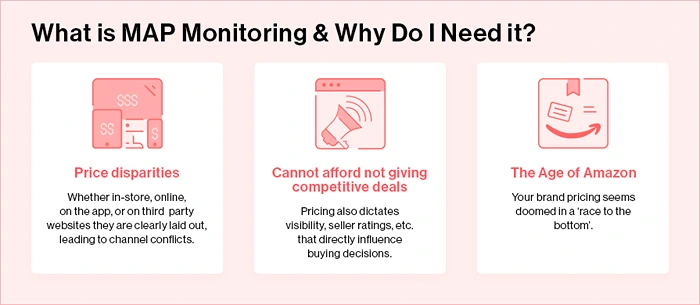
Image Source: Practical ECommerce
The internet broke down sales barriers, but it also invited chaos. Anyone can list your product, often without your blessing, and slap any price they want on it. Here’s why that keeps brand managers awake at night:
- The Race to Rock Bottom: One rogue seller slashes prices. Others follow. Suddenly, your premium product looks like bargain-bin material. Customers start wondering, “Is this legit? Why pay full price?” It’s a direct hit to your brand’s prestige. A 2023 Global Brand Counterfeiting Report highlighted a scary trend: online sales of counterfeit and pirated goods might hit $1.9 trillion by 2025. That’s a lot of unauthorized activity muddying the waters.
- Your Trusted Retailers Get Burned: Your authorized partners invest in staff, stores, marketing, and real customer service. When an unknown website undercuts them using your product, it feels like betrayal. They might ditch your brand, cut orders, or just complain loudly. That trust you built? It erodes fast.
- Profit Margins Vanish: When Minimum Advertised Price (MAP) policies get ignored, everyone loses. Your margins shrink. Your retailers’ margins shrink. Funding innovation or better marketing gets harder.
Flying blind online isn’t an option. Spotting violations by accident means the damage is already done.
Ecommerce Map Monitoring: Your Digital Watchtower (Simplified)

So, what’s the nuts and bolts? Ecommerce map monitoring is essentially your automated lookout system. It constantly scans the vast online marketplace for your products, checking two critical things:
- The Price: Is it at or above your set MAP? Or is someone diving below it?
- The Seller: Is this retailer on your approved list? Or is it an unauthorized seller popping up where it shouldn’t?
Specialized MAP compliance software does the heavy lifting. It crawls thousands of sites – Amazon, eBay, Walmart, niche stores, even social marketplaces – hunting for your product SKUs or UPCs. When it spots a listing, it grabs the price and seller name, checks them against your rules, and screams (politely, via alerts) if something’s wrong. This isn’t a weekly audit. It’s live, 24/7 surveillance.
How the Tech Actually Works
Sure, you could try checking prices manually. Open 50 browser tabs, refresh constantly, compare lists… sounds exhausting, right? For any brand with more than a few products, it’s impossible. That’s where MAP compliance software becomes your best friend. Here’s the simple breakdown:

- The Digital Bloodhounds (Crawlers): Tiny programs scour the web, visiting targeted sites, hunting specifically for your product codes. They’re fast and relentless.
- The Data Snatchers: When they find your product, they grab key info:
- The exact price shown (the crucial bit!).
- Who’s selling it (vital for unauthorized seller tracking).
- Is it actually in stock?
- When was the listing last updated?
- Making Sense of the Mess (Normalization): Sellers describe the same product wildly differently. “$99.99,” “Ninety-Nine Dollars,” “99.99 USD.” The software translates this into a standard number for fair comparison. It also matches seller names to your authorized list, even if they use slight variations.
- The Rule Enforcer: This is the brains. You feed it your MAP policy – Product X must be advertised at $Y minimum. It compares every found price against this rule. It also cross-references sellers: “Authorized? Yes/No.”
- Your Early Warning System (Alerts & Proof): Violation found? Price alerts hit your inbox or dashboard instantly. Crucially, it delivers proof: a screenshot, the exact violation details, seller name, timestamp, and a direct link. No more guessing. It also builds reports showing trends – who keeps violating, which products are targeted, how compliance improves over time.
This automation handles the internet’s scale and speed. It turns noise into actionable intel.
Beyond Busting Bad Guys: Real Perks of MAP Monitoring
Catching violators feels great, but the benefits run deeper:
- Guarding Your Brand’s Reputation: Consistent pricing stops your product looking cheap. Customers associate your name with quality and fair value, not constant discounting. This is gold for premium brands.
- Keeping Your Retailers Happy (and Loyal): When partners see you actively enforcing MAP and hunting down unauthorized sellers, they feel supported. They know you’ve got their back against price-cheating competitors. This builds serious loyalty. Ever wonder why retailers pick certain brands? A Retail Industry Leaders Association (RILA) survey found that consistent MAP enforcement is a major factor.
- Protecting Profits (Yours and Theirs): Stopping price erosion keeps margins healthy for everyone playing fair. That means more money for you and your retailers to reinvest and grow.
- Spotting Fakes and Unauthorized Sellers: Unauthorized seller tracking is huge. Finding sellers you never approved is step one to stopping them. Often, these sellers source products through shady channels – maybe diverted stock, maybe counterfeits. Finding them early is key.
- Seeing Your Market Clearly: Ecommerce map monitoring is a powerful spyglass. You see:
- What prices your authorized sellers actually use (even if compliant).
- How competitors price similar items.
- Where your products sell best (and where violations cluster).
- Pricing trends over time.
- Who’s really selling your stuff online (the good, the bad, the ugly).
- Saving Your Team’s Sanity: Free your legal, sales, and brand teams from endless, soul-crushing manual searches. Let them focus on strategy and partnerships. The time saved by MAP compliance software often pays for itself.
Getting Started: Your MAP Monitoring Game Plan
Ready to rein in the chaos? Here’s a practical roadmap:
- Craft a Rock-Solid MAP Policy: This is your rulebook. Be crystal clear. What counts as the “advertised price”? (Is it the cart price? Pre-shipping?). What happens if someone breaks the rules? (Warnings? Suspension?). Get legal advice – rules like the US Colgate Doctrine matter. Put it in writing. Share it widely.
- Know Your Team: Build the Authorized List: You can’t spot unauthorized sellers if you don’t know who’s legit. Keep a meticulously updated list of every approved retailer, including their official storefront names on big marketplaces.
- Pick Your Software Wisely: Not all MAP compliance software is equal. Ask:
- Where does it scan? (Coverage matters – Amazon, eBay, global sites?).
- How accurate and fast is it? (False alarms waste time).
- Can I customize price alerts? (Get notified only for what matters).
- How good are the reports? (Need trends, evidence, easy sharing).
- Is it easy for my team to use? (Sales, legal, brand protection all need access).
- Can it grow with us? (Scalability is key).
- What’s the real cost? (Per SKU? Monthly fee?).
- Set Up Your Tech: Give the software your product list (SKUs, MAP prices) and authorized sellers. Work with the vendor to set your specific rules and alerts. Decide who gets notified and how.
- Plan Your Enforcement Moves: What happens when an alert pings? Who:
- Verifies it’s a real violation (not a glitch)?
- Saves the evidence (software helps, but have a system)?
- Takes action? (Warning authorized sellers? C&D letters to rogues? Reporting to Amazon?).
Be consistent and timely. Slow responses encourage more violations.
- Review, Learn, Adapt: Don’t just set and forget. Regularly check your software’s reports. Spot patterns: Are certain products always targeted? Is eBay a hotspot? Are new unauthorized sellers popping up weekly? Use these insights to tighten your policy, adjust monitoring, or investigate supply chain leaks.
Seeing It Work: A MAP Monitoring Win
Imagine “Summit Peak Outfitters” (SPO), makers of top-tier hiking boots. Their authorized retailers complain: online prices are tanking, and customers question quality.
- The Discovery: SPO turns on ecommerce map monitoring. Within days:
- Their flagship boot is 25% under MAP on multiple Amazon pages and obscure sites.
- Dozens of sellers are flagged as unauthorized sellers.
- The Crackdown: Alerts trigger action:
- Cease-and-desist letters fly to unauthorized sellers.
- Amazon Brand Registry gets violation reports with proof.
- Monitoring data shows many rogues near a specific distributor. An audit reveals a leak – excess stock sold to liquidators.
- The Win: Within weeks:
- Unauthorized listings vanish or correct prices.
- The distributor leak is plugged.
- Authorized retailers report sales bumps and thank SPO.
- Online prices stabilize, restoring brand value.
- SPO stays vigilant with ongoing monitoring.
This is ecommerce map monitoring in action: turning frustration into control.
Picking Your Software Partner: Must-Have Features
Choosing tools? Demand these:
- Wide Net Scanning: Covers Amazon, eBay, Walmart, Target, and niche sites relevant to you. Global reach is often crucial.
- Spot-On Accuracy: Must find your products and grab the real price reliably, even on messy pages. High accuracy prevents false alarms.
- Lightning-Fast Alerts: Get price alerts and unauthorized seller tracking notices ASAP via email, dashboard, or tools like Slack. Speed limits damage.
- Smart Reports: Go beyond alerts. See compliance trends, repeat offenders, violation hotspots, and seller activity over time. Custom reports are a bonus.
- Easy-to-Use Hub: The dashboard shouldn’t need a manual. Your team needs quick access to alerts, evidence, and reports.
- Grows With You: Handles your SKU count today and tomorrow.
Found a Violator? Your Action Checklist
Got an alert? Don’t panic. Have a clear process:
- Double-Check: Is the violation still live? Is it definitely your product? Is the seller correctly ID’d? Rule out glitches or legit sales.
- Grab Proof: Use the software’s evidence (screenshot, link). Log details for each seller violation – build a history.
- Reach Out (Strategically):
- Authorized Seller Slip-Up? A friendly but firm reminder usually works. “Hey Partner, spotted your listing for X at $Y. Our MAP is $Z. Can you adjust by [date]? Here’s the link…” Track it.
- Unauthorized Seller? Start with a formal Cease & Desist letter. State your trademark rights. Demand an immediate stop. Send certified mail/email. Keep copies.
- Report to the Marketplace: Use Amazon Brand Registry, eBay VeRO, Walmart Brand Portal. Submit the evidence captured by your ecommerce map monitoring tool. Be persistent.
- Escalate if Needed: For repeat offenders ignoring warnings, lawyer up. Options: stern legal letters, lawsuits (trademark infringement), or injunctions.
- Find the Source (Unauthorized Sellers): How’d they get your product? Distributor leak? Arbitrage? Fakes? Your monitoring data (seller locations, patterns) can offer clues.
Be Consistent: Enforce the rules fairly against everyone. Playing favorites undermines your whole policy. Track actions in your MAP compliance software.
What’s Next? Staying Ahead in Ecommerce MAP Monitoring
The online sales world never stops evolving. Here’s where ecommerce map monitoring is headed:
- Smarter AI: Tools will better spot violations hidden in complex deals (“Buy 1, Get 50% off 2nd!”) or auto-adjusting prices. AI will also improve spotting fakes by analyzing product images.
- New Battlefields: Monitoring must expand to TikTok Shop, Instagram Shopping, Pinterest – anywhere sneaky sellers pop up.
- Going Global: Selling internationally? Monitoring needs to cover regional giants like Mercado Libre, Rakuten, AliExpress, and respect local pricing laws.
- Deeper Leak Detection: Linking monitoring data directly to supply chain systems will help brands find and plug leaks faster.
- Marketplaces Step Up (Hopefully): Pressure might push platforms like Amazon to offer better native tools for fighting MAP violations and unauthorized sellers.
Choosing adaptable MAP compliance software and staying informed is key for long-term defense.
Why Monitoring Isn’t Just Security, It’s Survival
Ecommerce map monitoring, powered by smart MAP compliance software, is your essential shield. It transforms an overwhelming mess into a manageable defense. It gives you the eyes to see threats across the entire digital shelf and the proof to act decisively.
Setting up a serious monitoring program – clear policy, right tech, consistent follow-through – delivers real wins. You protect your brand’s premium feel, keep your retail partners strong, safeguard profits, find supply chain leaks, and gain unbeatable market insights.
Stop letting online pricing feel like the wild west. Take control with ecommerce map monitoring. Try 42Signals to see such a service in action today.
Frequently Asked Questions
What does MAP mean in business?
In business, MAP stands for Minimum Advertised Price. It refers to the lowest price a retailer is allowed to publicly advertise a product for sale, as set by the manufacturer or brand owner. While retailers can often sell the product at any price in private or in-store, they are restricted from advertising it below the MAP threshold in ads, websites, or digital listings.
The purpose of MAP policies is to:
- Protect brand value and avoid price wars that can devalue a product
- Ensure fair competition among retailers by keeping advertising prices consistent
- Support smaller retailers who might not be able to match deep discounting by larger competitors
MAP agreements are common in industries like electronics, fashion, cosmetics, and sporting goods, where brand image and pricing consistency matter.
It’s important to note that MAP policies regulate advertised prices, not necessarily the final sale price at checkout.
How does MAP monitoring work?
MAP monitoring is the process of tracking and enforcing compliance with a brand’s Minimum Advertised Price (MAP) policy across various sales channels—especially online marketplaces and retail websites. The goal is to ensure that retailers do not advertise a product below the agreed-upon minimum price, which could undermine brand value and cause unfair pricing competition.
Here’s how MAP monitoring typically works:
1. Price Tracking Across Channels
Brands or manufacturers use automated tools or software to scan e-commerce platforms, search engines, and retailer websites for advertised prices. These tools check for violations 24/7 and can cover:
- Product pages
- Google Shopping ads
- Email promotions
- Social media listings
- Marketplaces like Amazon, Walmart, eBay
2. Identification of Violations
When a retailer advertises a product below the MAP, the system flags it as a violation. The software records the evidence, including screenshots, URLs, and timestamps.
3. Reporting & Alerts
The brand or compliance team receives real-time alerts and detailed reports showing which sellers violated the MAP policy, what prices were listed, and how frequently the violations occurred.
4. Enforcement Actions
Based on the findings, the brand can take steps such as:
- Sending a warning or cease-and-desist notice to the retailer
- Temporarily suspending supply or pricing privileges
- Ending the partnership for repeated violations
Some advanced platforms also integrate with seller contact databases, making it easier to follow up or escalate actions.