
** TL;DR ** If you’re still tracking competitor prices manually through spreadsheets and periodic website checks, you are likely costing your business significant sales and profit. This outdated method is slow, prone to human error, and keeps you constantly reacting to competitor promotions instead of proactively competing. The consequences include shrinking profit margins from poorly timed price matches, lost Amazon Buy Box wins, and your team wasting valuable time on data entry instead of strategy. Ultimately, replacing manual price tracking with automated price checking software is essential to eliminate these inefficiencies, protect your revenue, and compete effectively in today’s fast-paced e-commerce environment.
Let’s be honest. As a manager or business owner, you wear a dozen hats. You are focused on marketing, customer service, and inventory. In the middle of all this, tracking your competitors’ prices can feel like a necessary but tedious chore. So, you probably have a system. Maybe it is a dedicated team member who spends hours each week clicking through competitor sites. Perhaps it is a complex spreadsheet where you manually log prices every few days not using a price checking software.
It feels organized. It feels controlled. But what if this very process, this manual price tracking, is the silent culprit behind dwindling sales and shrinking profit margins?
The e-commerce world moves at lightning speed. A competitor can change their price or launch a flash sale in seconds. Relying on a manual process to keep up is like using a paper map in the age of GPS. It might eventually get you there, but you will have taken wrong turns, hit dead ends, and missed the fastest route countless times.
Why Price Checking Software is Crucial to Sales

Image Source: Competera
1. Your Team is Buried in Data Entry, Not Data Analysis
This is often the most visible symptom. How many hours per week does your staff spend copying and pasting numbers from a website into a spreadsheet? This time adds up quickly. What starts as a quick 30-minute task can balloon into a multi-hour ordeal when you track dozens of products across multiple competitors and marketplaces like Amazon.
The real cost is not just the hours spent. It is the opportunity cost. The employee doing this repetitive work could be focused on high-value tasks like analyzing sales trends, developing new marketing campaigns, or improving customer service. Instead, they are stuck in a cycle of data collection. This is a classic example of operational inefficiency. You are using human potential for a task that technology can handle infinitely faster and more accurately.
This manual process turns your team into data collectors when they should be data strategists. The goal is not to have a perfect list of prices. The goal is to understand what those prices mean for your business and to act on them. Manual tracking makes the first part so labour-intensive that the second, more critical part often gets neglected. By the time the data is entered, the market may have already changed again.
2. You’re Always a Step Behind on Competitor Promotions
Flash sales, holiday discounts, and limited-time offers are the weapons of choice in modern e commerce. Competitors use these tactics to grab attention and steal market share. With a manual tracking system, you are almost always reacting to these moves instead of anticipating or immediately responding to them.
Imagine this. A major competitor launches a “24-Hour Flash Sale” on a key product you both sell. You are manually tracking their prices, but your next check is not scheduled until tomorrow afternoon. By the time you discover the sale, it is almost over. They have already captured a significant number of sales that could have been yours. You are left in a reactive pricing position, forced to decide whether to slash your own price after the fact, often hurting your profit margins for no gain.
This delay is inevitable with manual checks. You cannot have someone watching competitor sites 24/7. Sophisticated price checking software, however, can monitor these changes in real time. It alerts you the moment a key competitor launches a promotion, allowing you to make an informed decision instantly. In the race for sales, being a day late is the same as being last.
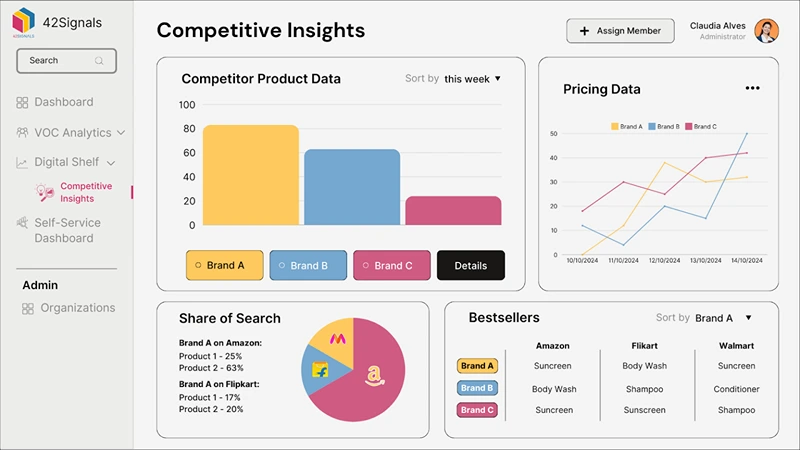
Competitor analysis dashboard by 42Signals
3. You Keep Finding Errors in Your Pricing Data Without a Price Checking Software
Human error is an inescapable fact of life. Even your most diligent employee can transpose numbers, misread a price, or copy data into the wrong spreadsheet cell. A single typo can have significant consequences. For instance, if you mistakenly log a competitor’s price as $50 instead of $55, you might set your price too low, unnecessarily sacrificing your profit margins. Conversely, if you log $55 as $50, you might set your price too high, making you uncompetitive and leading to lost sales.
These errors compound over time. An incorrect data point can skew your entire understanding of the market rate for a product. You might base weeks of pricing strategy on flawed information. This not only impacts immediate sales but can also lead to poor long-term strategic decisions about which products to promote or even continue to stock.
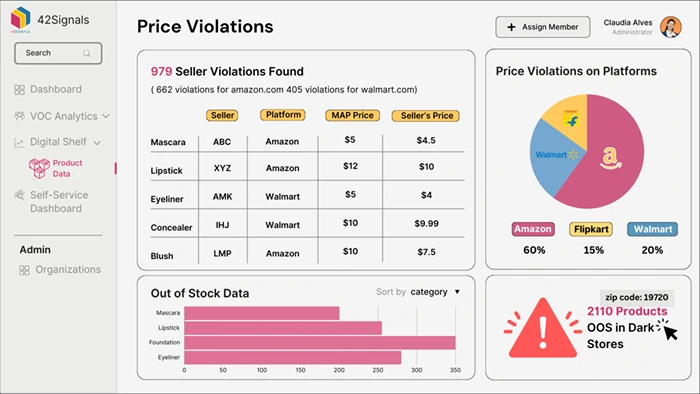
Price violations data by 42Signals
Automation virtually eliminates this risk. A reliable price checking software pulls data directly from the source, ensuring accuracy and consistency. It removes the risk of fatigue-induced mistakes, giving you the confidence that your pricing decisions are based on a foundation of clean, reliable data.
4. Your Profit Margins Are Shrinking and You Don’t Know Why
This is the financial red flag that ties all the previous points together. You review your quarterly reports and see that your overall revenue might be steady, but your net profit is down. You are selling, but you are making less on each sale. There is a good chance your manual price tracking process is a key contributor.
Here is how it happens. Because your data is delayed or occasionally incorrect (as we discussed in points 2 and 3), you are often forced into a “race to the bottom.” You see a competitor’s lower price and, in a panic, you match or beat it. However, you lack the context.

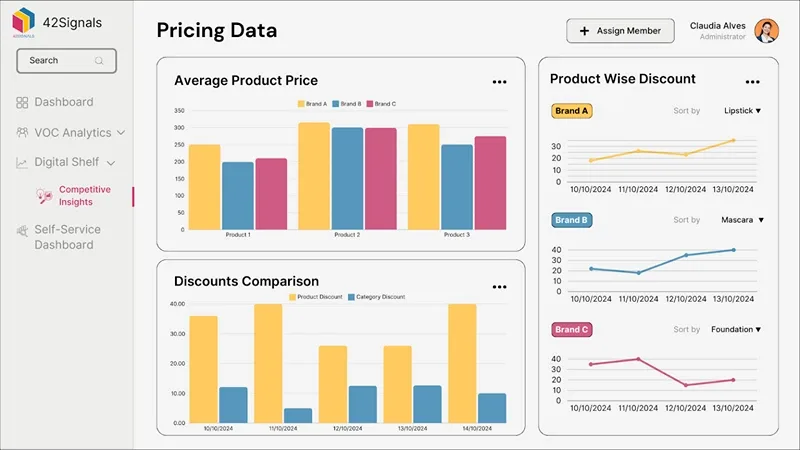
Inventory data by 42Signals
- Was it a short-term promotion?
- Did they clear out old inventory?
- Are they selling a different bundle?
Without this context, you are blindly reacting. This reactive pricing erodes your margins. Furthermore, the operational inefficiency of paying an employee to manually track prices is a direct, ongoing cost that further eats into your bottom line. A study by MIT Sloan Management Review highlighted that data-driven organizations are 5% more productive and 6% more profitable than their competitors. Relying on manual data collection prevents you from being a data-driven organization.
5. You’re Consistently Losing the Amazon Buy Box
For Amazon sellers, this sign is the most direct and painful. The Amazon Buy Box is the white panel on the right side of a product detail page where customers can begin the purchasing process. Statistics show that over 80% of Amazon sales go to the seller who wins the Buy Box. It is not an exaggeration to say that if you are not in the Buy Box, you are virtually invisible on Amazon.
Amazon’s algorithm awards the Buy Box based on a complex mix of factors, but price and availability are two of the most critical. If your manual checks are too infrequent, your price might be uncompetitive for hours, causing you to lose the Buy Box. Even a small price difference can be enough for the algorithm to favor a competitor.
Winning and keeping the Buy Box requires constant, real-time price optimization. It is a battle fought in seconds, not hours. Manual tracking simply cannot compete. The right price checking software does not just monitor prices. It can integrate with your repricing strategy to help you compete aggressively for the Buy Box while protecting your minimum profit margins, ensuring you stay in the fight for those crucial sales.
The Way Forward: From Manual Tracking to a Price Checking Software
If any of these five signs feel familiar, it is not a sign of failure. It is a sign that your business is growing and your old processes are no longer sufficient. The market has evolved, and your tools need to evolve with it. The solution is to replace your manual, error-prone, and slow process with an automated, accurate, and fast one.
This is where intelligent price checking software becomes your most powerful ally. It is not just about automating a task. It is about fundamentally upgrading your competitive capability. The right software acts as a 24/7 sentinel for your business, monitoring competitor promotions and market shifts with perfect accuracy. It frees your team from data entry and empowers them with actionable insights.
You gain the ability to move from a position of reaction to a position of control. Instead of wondering why your sales are down, you will have the data to understand market dynamics. Instead of guessing on pricing, you can set intelligent, rules-based strategies that protect your profit margins while keeping you competitive. You can stop losing the Amazon Buy Box and start winning it more consistently.
Key Takeaways: Transforming Your Pricing Strategy with a Price Checking Software
- Manual tracking is a hidden cost. The hours your team spends on data entry represent a significant operational inefficiency and opportunity cost, diverting talent from strategic work that could grow the business.
- Speed is revenue. In e-commerce, being slow to react to competitor promotions means directly losing sales. Automated price checking software provides the real-time alerts needed to move from a reactive to a proactive stance.
- Human error has a direct bottom-line impact. Mistakes in manual data entry lead to incorrect pricing decisions, which can either erode your profit margins or make you uncompetitive, resulting in lost sales.
- Profit erosion is a major symptom. Shrinking profit margins are often a direct consequence of delayed, inaccurate data forcing you into reactive price cuts and the ongoing labor cost of manual tracking.
- Winning the Amazon Buy Box requires automation. Since the vast majority of Amazon sales go to the Buy Box winner, consistent victory is impossible with manual checks. It requires the constant, real-time optimization that only specialized software can provide.
Reclaim Your Time, Your Data, and Your Sales
Manual price tracking is more than just an inconvenience. It is a significant business risk that leads to operational inefficiency, human error, and a reactive pricing stance. The consequences are real and measurable: lost sales, shrinking profit margins, and a frustrated team.
The transition to an automated system is not just a technological upgrade. It is a strategic decision to prioritize growth over busywork. It is a commitment to using data for intelligent decision-making rather than just for record-keeping. By embracing a sophisticated approach to price monitoring, you stop being a spectator in the market and start being a proactive, savvy competitor.
Your time, your team’s talent, and your sales are too valuable to lose to an outdated process. It is time to close the spreadsheets and open the door to a smarter way of working.
Use 42Signals’ automated price tracking and monitoring services to never miss out on a price fluctuation again.
Frequently Asked Questions
1. What is the best app for checking prices?
The best app for checking prices depends on your use case — personal shopping vs. business-level price monitoring.
For individual shoppers: Google Shopping offers real-time product listings from multiple online stores with price comparisons.
Honey and CamelCamelCamel are popular for tracking price drops and historical pricing on Amazon.
ShopSavvy allows barcode scanning to compare in-store and online prices quickly.
For businesses and brands: 42Signals is an excellent option for enterprise-level price intelligence. It tracks competitor pricing, promotions, and stock availability across multiple marketplaces in real time.
2. What is the best software for price comparison?
For professional price comparison, dedicated price intelligence platforms are more effective than simple consumer apps.
42Signals stands out for retail and e-commerce pricing because it offers:
Automated competitor price tracking across geographies
MAP (Minimum Advertised Price) compliance monitoring
Price change alerts and reporting dashboards
Historical trend analysis for pricing strategy.
Other notable options include Prisync and Price2Spy, but 42Signals is more suited for brands seeking real-time market visibility rather than just snapshots.
3. How can I track the price of an item?
You can track prices in a few simple ways:
Use browser extensions or apps like Honey or CamelCamelCamel to get alerts when the price drops.
Set Google price alerts by clicking “Track Price” on product pages in Google Shopping.
Use dedicated price tracking software if you’re monitoring multiple SKUs or competitors.
Leverage automation tools that scrape product data at regular intervals and notify you when there’s a change.
For business use, 42Signals lets you monitor price changes in real time, create custom reports, and even trigger alerts based on specific pricing thresholds.
4. What is a price monitoring system?
A price monitoring system is a software or automated process used to track and record price changes across online and offline channels. It’s especially useful for retailers, brands, and e-commerce platforms that need to stay competitive.
Core functions include:
Collecting pricing data from competitor websites or marketplaces.
Detecting changes in price, discounts, or promotions.
Sending alerts or generating reports to support pricing decisions.
Tracking MAP compliance and price wars.
Providing insights for dynamic pricing strategies.
For example, a brand selling electronics can use a price monitoring system to detect when a competitor drops the price on a similar product and adjust their pricing strategy accordingly.