

A MAP violation occurs the moment a retailer or seller advertises a product below the Minimum Advertised Price a brand has set. Individually they look minor, but MAP violations accumulate fast: a single advertised price below MAP pressures every other seller to follow, and the brand loses control of how its products are presented to the market.
This page focuses squarely on what a MAP violation is, what counts as one, the kinds of MAP violations brands run into, and how the violation is detected, escalated and resolved. Whether you’re a brand looking to identify violations or a retailer trying to understand the rules better, this guide gives you a clear, practical reference.
For the related topics, see our dedicated guides: understanding MAP pricing, MAP monitoring, how to enforce MAP pricing, and MAP pricing vs MSRP.
New to MAP itself? Start with our complete guide to MAP pricing and how MAP policies work, then return here for the violation detail.
What Is a MAP Violation?
What Constitutes a MAP Violation?
A MAP violation is any instance where a product is advertised at a price lower than the minimum the brand has set. The key word is advertised: MAP governs the price shown publicly, not the final price a customer pays at checkout. MAP violations occur whenever a product is advertised at a price lower than the set minimum. This can happen across a variety of platforms, including:
- Online marketplaces (e.g., Amazon, eBay)
- Retailer websites
- Social media promotions
- Print ads
- Email campaigns
While some MAP violations are deliberate, others may result from confusion over the policy or technological errors. Regardless of intent, these violations disrupt the competitive environment and can have wide-reaching impacts on brand value.
Common Examples of MAP Violations
Some examples of MAP violations include:
- Online price listings below MAP: A retailer lists a product on their website for less than the agreed MAP.
- Coupon code abuse: A retailer offers a discount that brings the advertised price below MAP when a coupon is applied.
- Email marketing violations: Sending email promotions that advertise prices below the MAP threshold.
- “In Cart” pricing: Displaying the MAP price on the product page, but reducing the price once the product is added to the shopping cart.
- Marketplace violations: Offering products below MAP on third-party platforms like Amazon, eBay, or Walmart.
The MAP Violation Lifecycle: From Detection to Resolution
Understanding the full lifecycle of a MAP violation is essential for building a predictable, scalable enforcement process. When every member of your team understands the workflow—and every step is documented and measured—you transform reactive chaos into proactive control.
Here is the complete violation lifecycle, designed to be implemented as your standard operating procedure.
DETECT → VERIFY → DOCUMENT → NOTIFY → ESCALATE → PENALIZE → RESOLVE
Stage 1: Detect – Finding Violations Before They Spread
What Happens:
Detection is the continuous monitoring of all sales channels—marketplaces, retailer websites, social media, and search ads—to identify prices advertised below your MAP threshold. In 2026, this is never done manually. Automated software crawls millions of listings daily, flagging potential violations in real time.
Who Owns It:
- Primary: MAP monitoring software (automated)
- Secondary: Channel ops team reviews automated alerts
What Evidence Is Required:
- The listed price displayed publicly
- The MAP threshold for that specific SKU
- The URL where the violation occurred
- Date and timestamp of detection
- Seller/retailer name and identifier
SLA (Service Level Agreement):
- Detection Frequency: Continuous (24/7/365)
- Alert Generation: Within 1 hour of listing update
- False Positive Triage: Within 24 hours of alert
Key Question to Ask Your Software Vendor:
“Do you monitor every SKU continuously, or do you sample? What’s your detection latency from listing update to alert?”
Stage 2: Verify – Confirming the Violation Is Real
What Happens:
Not every alert is a true violation. Verification is the critical step where you confirm that the detected price actually breaches MAP and that the alert isn’t a false positive caused by:
- Currency conversion errors
- Out-of-stock pricing anomalies
- Bundled products vs. individual items
- International sites vs. domestic markets
- Membership-only pricing that isn’t public
Who Owns It:
- Primary: Channel ops or MAP coordinator
- Secondary: Automated verification rules (if configured)
What Evidence Is Required:
- Confirmation that the product is an exact SKU match (not a variant, bundle, or different model)
- Verification that the price is publicly visible without login/special access
- Check for promotional exceptions (holiday windows, clearance events)
- Screenshot capture with timestamp and URL
SLA:
- Complete verification within 24 hours of alert
- Auto-verify rules can reduce this to minutes
Common Verification Pitfalls to Avoid:
- Assuming all alerts are valid without checking context
- Failing to distinguish between authorized and unauthorized sellers
- Missing “add to cart” pricing tricks where MAP is displayed but price drops at checkout
Stage 3: Document – Building an Ironclad Case
What Happens:
Documentation is where you transform a detected violation into undeniable, actionable evidence. This step is critical because:
- Retailers will challenge your claims
- Legal action may require proof
- You need records for repeat offender tracking
- Platform takedowns (Amazon, eBay) require evidence packages
Who Owns It:
- Primary: MAP software (automated evidence capture)
- Secondary: Legal team reviews for high-risk cases
What Evidence Is Required:
- Timestamped screenshot showing the full page (URL visible, price clear, date/time stamp)
- SKU/UPC/GTIN match confirmation
- Seller information (store name, seller ID, contact if available)
- MAP policy reference (showing the required minimum)
- Historical record of prior violations by this seller (if any)
SLA:
- Evidence package auto-generated within 1 hour of verification
- Archived and immutable (cannot be altered)
Best Practice:
Use software that captures screenshots automatically at the moment of detection. Listings change quickly, and a violation that existed at 10:00 AM may be “fixed” by 2:00 PM—if you didn’t capture it, you can’t prove it happened.
Stage 4: Notify – Communicating the Violation
What Happens:
Notification is the first direct contact with the violating seller. The goal is to:
- Inform them of the violation
- Provide clear evidence
- Request correction within a specific timeframe
- Document their response (or lack thereof)
Who Owns It:
- Primary: Automated notification system (first strike)
- Secondary: Channel manager (for Tier 1 partners)
What Evidence Is Required:
- The evidence package from Stage 3
- A clear, pre-written notification template
- Tracking of when notification was sent and to whom
SLA:
- First notification sent within 24-48 hours of verification
- Tier 1 partners may receive same-day personal outreach
Notification Best Practices:
- Be professional, not accusatory (assume good intent initially)
- Include clear instructions for correction
- Set a specific deadline (usually 48-72 hours)
- CC internal compliance file for tracking
Stage 5: Escalate – Increasing Pressure When Needed
What Happens:
If the violation is not corrected within the specified timeframe, or if this is a repeat offense, escalation is required. Escalation can take several forms:
- Final warning with shorter deadline
- Involvement of legal team
- Notice to platform (Amazon, eBay) for takedown
- Notification to distributor (if seller sourced through unauthorized channel)
Who Owns It:
- Primary: Channel ops manager or MAP coordinator
- Secondary: Legal counsel (for serious or repeated violations)
What Evidence Is Required:
- Full documentation of prior notification
- Proof that violation persists
- Seller’s response (if any)
- Internal notes on escalation rationale
SLA:
- Escalate within 24 hours of missed correction deadline
- Legal review within 48 hours for serious cases
Escalation Options by Seller Tier:
| Tier | First Escalation | Second Escalation | Final Escalation |
| Tier 1 (Strategic) | Personal call from channel manager | VP-level conversation | Partnership review |
| Tier 2 (Authorized) | Final warning with 24-hour deadline | 30-day supply hold | Termination |
| Tier 3 (Long-tail) | Immediate supply hold | Termination | N/A |
| Tier 4-5 (Unauthorized) | Cease-and-desist | Takedown notice | Legal action |
Stage 6: Penalize – Applying Consequences
What Happens:
When a seller refuses to comply after clear notification and escalation, penalties must be applied consistently. This is not punitive—it’s protective. Without meaningful consequences, your MAP policy is just a suggestion.
Who Owns It:
- Primary: Channel ops or sales leadership
- Secondary: Legal (for termination or legal action)
Available Penalties (in escalating order):
- Written warning (first offense, minor)
- Co-op advertising fund suspension (for partners who receive marketing support)
- Supply hold (temporary suspension of new orders)
- Product allocation reduction (less inventory during allocations)
- Termination of authorized status (permanent)
- Legal action (for counterfeit or severe gray market cases)
SLA:
- Penalty applied within 48 hours of failed escalation
- Termination requires legal review (allow 5-7 business days)
Critical Principle:
Apply penalties consistently. If you penalize one retailer but not another for the same violation, you create legal exposure and destroy trust with compliant partners.
Stage 7: Resolve – Closing the Loop
What Happens:
Resolution is the final step where the violation is confirmed corrected, and the case is closed. However, “closed” doesn’t mean forgotten. Resolution includes:
- Final verification that price is now compliant
- Documentation of outcome
- Updating seller history for future reference
- Internal debrief (if pattern emerges)
Who Owns It:
- Primary: MAP coordinator
- Secondary: Software (automated re-check)
What Evidence Is Required:
- Updated screenshot showing compliant pricing
- Date/time of resolution
- Note on any penalties applied
- Seller tier update (if behavior changed)
SLA:
- Final verification within 24 hours of reported fix
- Case closed and archived within 48 hours
False Positive Handling: The Gap Most Competitors Miss
One of the most overlooked aspects of MAP enforcement is how to handle false positives—alerts that look like violations but aren’t. Poor false positive management leads to:
- Wasted team time chasing non-issues
- Damaged retailer relationships (accusing someone who did nothing wrong)
- Alert fatigue (your team starts ignoring notifications)
Common Sources of False Positives:
| Source | Description | How to Handle |
| Currency Mismatch | International site shows price in different currency that appears lower when converted incorrectly | Verify against correct exchange rate; set currency-specific MAPs |
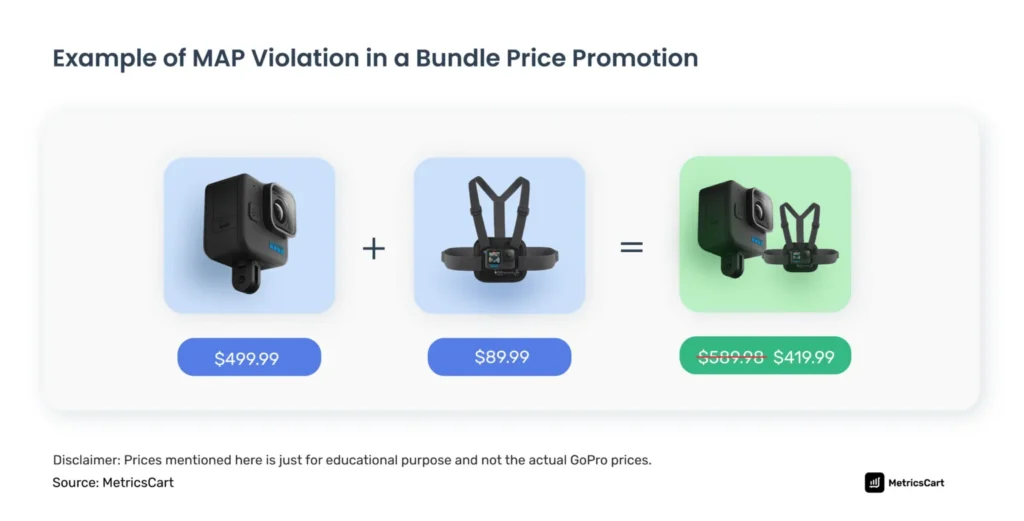
| Bundled Products | Product sold with accessories or other items at combined price | Policy should explicitly address bundles; if allowed, note exception |
| Outlet/Clearance Sections | Separate site section for discontinued or refurbished items | Policy should specify if MAP applies to all inventory or only current |
| Membership Pricing | Price visible only after login (Costco, Sam’s Club) | Most MAP policies apply to public advertising only; member pricing often excluded |
| Variant Confusion | Different model/size/color with different MAP | Ensure SKU-level matching; don’t compare across variants |
| Geotargeted Pricing | Regional pricing variations | Set region-specific MAPs or note exceptions |
| Sold-Out Listings | Old prices cached on sold-out items | Ignore; focus on active, in-stock listings |
False Positive Protocol:
- Auto-flag potential false positives based on rules
- Review within 24 hours by trained analyst
- Document the reason it’s a false positive
- Adjust monitoring rules to prevent future occurrences
- No notification sent to retailer (preserve relationship)
Pro Tip: Train your team to assume good intent initially. A quick verification check before sending an angry email saves relationships and credibility.
How do MAP Violations Affect E-Commerce Brands and Retailers?
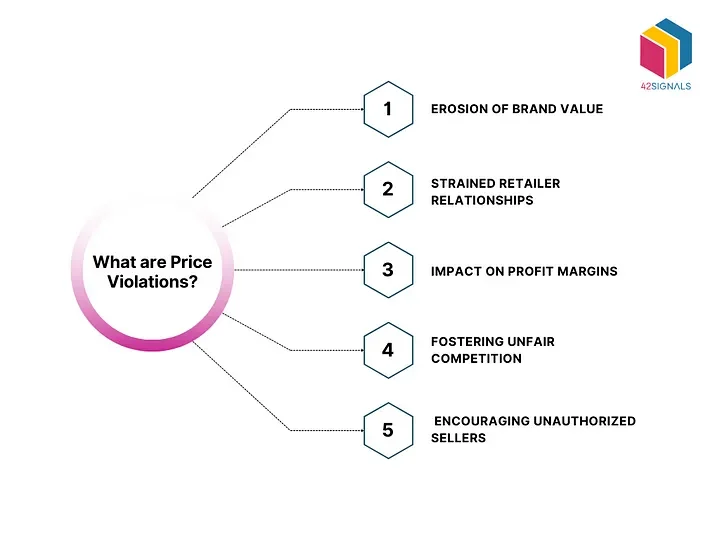
MAP violations can have several negative effects on both brands and retailers:
- Erosion of brand value: When a brand’s products are consistently advertised below MAP, it can lead to a perception that the brand’s value has diminished.
- Loss of retailer trust: Retailers who follow MAP policies can become frustrated when they see competitors undercutting them without consequence, leading to strained relationships with the brand.
- Downward pricing pressure: MAP violations can spark price wars, driving prices lower and forcing other retailers to follow suit, even if it harms profitability.
- Impact on pricing strategies: Brands that rely on premium pricing models may struggle to maintain those models when MAP violations occur frequently, forcing them to re-evaluate their pricing strategies.
For how violations ripple through pricing strategy in depth, see the MAP pricing guide.
For tools, detection patterns and competitor monitoring, see the MAP monitoring complete guide.
For the full enforcement playbook — strike framework, penalties and legal guardrails — see how to enforce MAP pricing.
MAP Violations on Different E-Commerce Platforms
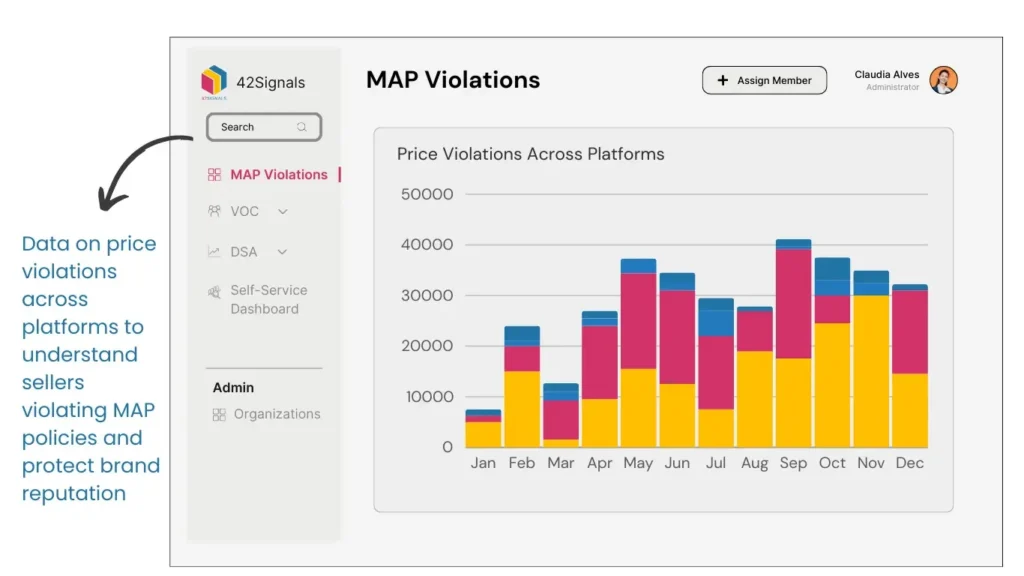
1. Amazon MAP Violations
Amazon is one of the largest and most complex marketplaces when it comes to MAP enforcement. Given its scale and the number of third-party sellers, it is difficult for brands to maintain consistent pricing. Unauthorized sellers and price undercutting are rampant, making MAP violations on Amazon a significant issue.
Overview of Amazon’s MAP Policies
Amazon itself does not enforce MAP policies on behalf of brands. Instead, it provides tools through its Brand Registry program that allow brands to monitor and report MAP violations. Amazon prioritizes providing consumers with the best possible price, so it is up to the brand to enforce MAP compliance.
Common Amazon MAP Violations include…
- Third-party sellers offering products below MAP.
- “In Cart” pricing that lowers the advertised price below MAP thresholds.
- Unauthorized sellers list the product without following MAP policies.
Since Amazon operates on a global scale, enforcing MAP policies across different regions and sellers can be particularly challenging.
Strategies to Address Amazon MAP Violations
To address MAP violations on Amazon, brands can:
- Enroll in Amazon’s Brand Registry to gain greater control over product listings.
- Use third-party MAP monitoring tools to track violations in real time.
- Work with Amazon MAP violation attorneys to navigate legal complexities and take action against chronic violators.
- Submit formal reports to Amazon against unauthorized sellers or violators.
Here are a few other stories on how big brands like HP and Boehringer Ingelheim combated MAP Violations.
2. HP MAP Violations
Hewlett-Packard (HP) is another brand that has faced challenges with MAP violations, particularly in the tech and electronics sector. HP has implemented strict MAP policies to maintain its product’s premium status, but frequent violations occur, especially on online marketplaces.
HP uses a combination of monitoring tools and legal enforcement to address these issues, but challenges persist due to the volume of sellers involved.
3. Boehringer Ingelheim MAP Violations
Boehringer Ingelheim, a pharmaceutical company, has also struggled with MAP enforcement in the health and wellness sector. Due to the nature of the pharmaceutical and health product industry, maintaining consistent pricing is crucial for ensuring product trust and integrity.
However, widespread violations on online platforms and through third-party sellers have prompted the company to implement stricter compliance and enforcement measures.
For prevention strategies and a tools comparison, see the MAP monitoring guide and MAP enforcement guide.
Key Takeaways
Managing and preventing Minimum Advertised Price (MAP) violations is crucial for preserving a brand’s value, ensuring fair competition, and maintaining strong relationships with retailers.
Key points to remember include:
- Importance of MAP Policies: MAP policies protect brands from price erosion and ensure a level playing field across retail channels. By preventing price undercutting, these policies help preserve brand integrity and maintain profitability for both the brand and its authorized retailers.
- Challenges in Enforcement: The increasing complexity of multi-channel retailing, the presence of unauthorized sellers, and global market differences make enforcing MAP policies difficult. Brands face significant challenges in consistently applying MAP policies, especially on third-party marketplaces like Amazon.
- Tools and Strategies for Compliance: Automated tools like price monitoring software, marketplace monitoring platforms, and legal enforcement services are essential for detecting and addressing MAP violations. Proactively using these eCommerce analytics tools, combined with strong communication and incentivizing retailer compliance, can significantly reduce violations.
- Case Studies and Lessons Learned: Real-world examples from brands like Apple, Sony, and Nike show that rigorous enforcement, clear communication, and consistent policy application lead to successful MAP compliance. Lessons from brands that struggled with MAP violations highlight the importance of proactive monitoring and legal safeguards.
- Future Trends: The use of AI and machine learning is transforming how brands detect MAP violations, while omnichannel retailing adds new complexities to enforcement. As e-commerce grows, brands will need to adapt to evolving regulations and consumer behaviors to stay competitive and compliant.
Conclusion
Preventing and managing MAP violations is a continuous process that requires vigilance, collaboration, and technological support. Brands must take a proactive approach by clearly communicating MAP policies, investing in automated price monitoring solutions, and consistently enforcing these policies across all sales channels.
By doing so, they not only protect their pricing strategy but also reinforce their relationships with retail partners.
To ensure long-term success, brands should focus on fostering trust and transparency with their retail networks, offering incentives for compliance, and utilizing the latest tools and services to stay ahead of potential violations.If you are curious to see how prompt detection of MAP violations can help your brand, schedule a demo with our experts.
Frequently Asked Questions
What is a MAP violation?
A MAP violation occurs when a retailer or seller advertises a product at a price below the Minimum Advertised Price the brand has established. The violation is triggered by the advertised price — the price publicly shown on a product listing, in an email, on social media, or in any other advertising medium — not the final price paid at checkout. MAP violations can be deliberate, where a seller intentionally undercuts to win sales, or unintentional, caused by outdated pricing data, automated repricing errors, or coupon configurations. Regardless of intent, any advertised price below the set minimum constitutes a map violation and can trigger enforcement action under the brand’s policy.
What are the most common types of MAP violations?
The most common map violations brands encounter fall into five categories:
Listed price violations: A product page on a retailer website or marketplace shows a price below MAP outright — the most straightforward type and the easiest for automated tools to detect.
“Add to cart” pricing: The advertised page price appears MAP-compliant, but the price drops when the item is added to the cart. This is intentional circumvention and requires cart-level monitoring to catch.
Coupon and promotional code abuse: A retailer issues a coupon or discount code that, when applied, brings the effective advertised price below MAP. Email promotions and on-page coupon badges are common vectors.
Marketplace violations: Third-party sellers on Amazon, eBay, Walmart, and other platforms list products below MAP, often without a signed reseller agreement. These are the hardest to enforce because the seller may have no direct relationship with the brand.
Bundle pricing loopholes: A seller bundles the product with a low-value item and prices the bundle in a way that implies a below-MAP price for the primary product. If the MAP policy does not explicitly address bundles, this is a grey area that many rogue sellers exploit.
How do brands monitor and identify MAP violations?
Brands identify map violations primarily through automated price monitoring software that crawls retail websites, marketplaces, and search ads continuously, flagging any listing that falls below the MAP threshold for that SKU. Modern tools monitor multiple channels simultaneously — Amazon, eBay, Walmart, Google Shopping, brand.com, and even social media promotions — and generate alerts within minutes of a violation appearing. For brands relying on manual monitoring, violations are typically caught through periodic spot checks, competitor tips, or complaints from compliant retailers who notice undercutting. Manual methods are too slow and too narrow to provide reliable coverage; most brands managing more than a few dozen SKUs across more than two platforms require automated map violation monitoring to maintain any meaningful compliance rate.
How do brands enforce MAP violations?
MAP violation enforcement follows a structured escalation ladder:
Detect and verify: Automated software flags the potential violation; a team member or automated rule confirms it is a true violation and not a false positive.
Document: Timestamped screenshots and SKU-level evidence are captured automatically, building an enforcement file.
Notify: A formal warning is sent to the seller with the evidence, the specific price discrepancy, and a correction deadline (typically 48–72 hours).
Escalate: If the violation persists past the deadline, escalation moves to supply holds, co-op fund suspension, or, for unauthorized sellers, a takedown notice filed with the marketplace.
Penalise and resolve: Consequences are applied consistently across all violators regardless of seller tier. Enforcement consistency is what gives a MAP policy its deterrent effect.
Enforcement must be unilateral — applied identically to all sellers — to remain legally defensible.
What software is used to monitor and track MAP violations?
MAP violation software typically provides continuous price crawling across online marketplaces and retail sites, automated screenshot capture at the moment of detection, SKU-level alert generation, seller identification, and case management for the enforcement workflow. Key features to evaluate when selecting a map violation tool include: real-time or near-real-time detection speed, coverage of all channels where your products are sold (not just Amazon), cart-level price monitoring for add-to-cart violations, evidence packaging that produces timestamped screenshots, and workflow automation that handles first-strike notifications without manual intervention. 42Signals provides MAP monitoring and enforcement automation across major ecommerce platforms — see how it works at the link below.
What is the best way to handle MAP violations at scale across multiple marketplaces?
Handling map violations at scale requires three things working together: automated detection that runs continuously without manual input, a tiered enforcement workflow that routes violations to the right response path based on seller type and violation severity, and centralised case management that tracks every violation from detection to resolution. For brands with hundreds of SKUs across Amazon, eBay, Walmart, and direct retail sites, the key operational principle is triage: not every map violation warrants the same response. Strategic retail partners with a signed agreement get personal outreach; long-tail marketplace sellers get automated cease-and-desist notices; unauthorized rogue sellers get platform takedown requests. Platforms that integrate detection, evidence capture, automated notification, and escalation tracking in one system eliminate the manual coordination cost that makes large-scale enforcement unmanageable.