

** TL;DR ** Review analysis is the systematic process of mining customer reviews and feedback for actionable insights, moving beyond star ratings to understand the “why” behind customer sentiment. By using both manual reading and automated tools for sentiment analysis, e-commerce businesses can transform raw opinions into a strategic roadmap for improving products, refining marketing with authentic customer language, proactively managing their reputation, and outperforming competitors. Ultimately, treating this continuous cycle of listening, analyzing, and acting as a core business habit turns customer voices into a powerful driver for informed decision-making and sustainable growth.
Imagine walking into a physical store where every customer’s thought, complaint, praise, and suggestion is written on a note and pasted to the wall. Overwhelming? Perhaps. But it would also be the most valuable resource in that store for understanding what you are doing right and what needs fixing. In the world of e-commerce, this wall of notes exists. It is your collection of product reviews and customer feedback.
For many online businesses, reviews are often seen as a simple metric, a star rating to showcase. But this view misses the immense potential locked within that text. Every review is a direct conversation with your market. Review analysis is the process of systematically listening to that conversation at scale. It is about moving beyond the star rating to understand the “why” behind it.
What is Review Analysis? More Than Reading the Reviews
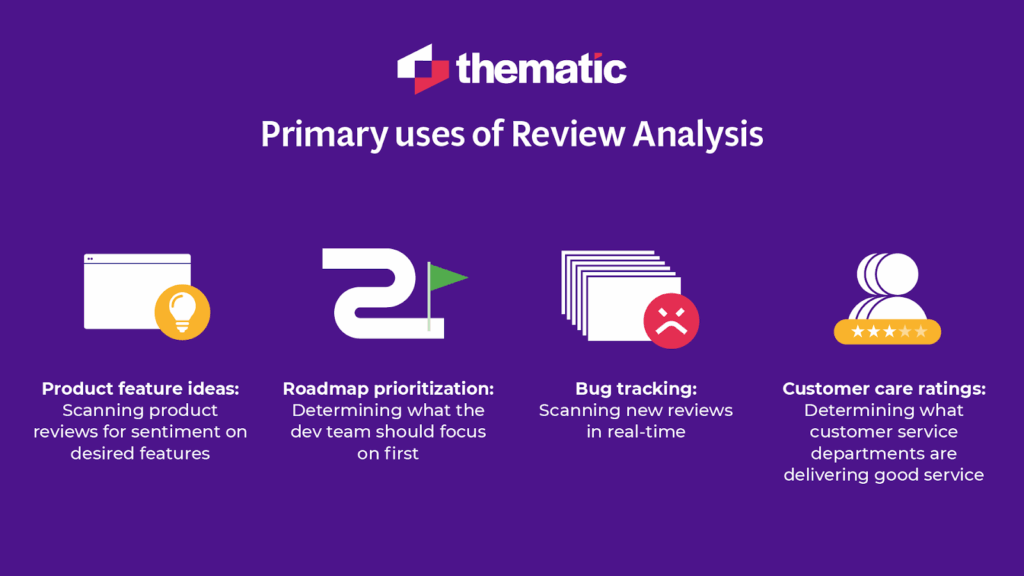
Image Source: Thematic
At its core, review analysis is the systematic examination of customer reviews to extract meaningful patterns, sentiments, and actionable insights. It is the bridge between qualitative human opinion and quantitative business data.
Think of it this way: a product has a 4.2-star average. That is a useful data point. But review analysis digs deeper.
It asks:
- What specific features are people praising in their 5-star reviews?
- Are the 3-star reviews consistently mentioning a confusing instruction manual?
- Is there a sudden spike in comments about shipping delays from a specific region?
This process transforms scattered opinions into a clear narrative about your product’s performance, your brand’s perception, and your customers’ experience.
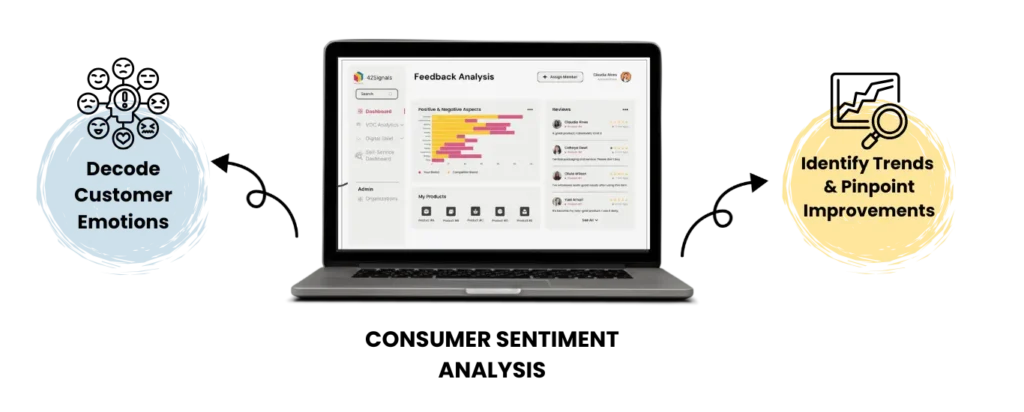
This work often involves a technique called customer sentiment analysis, which uses technology to automatically determine the emotional tone behind the text. Is the review positive, negative, or neutral? By applying sentiment analysis to your review corpus, you can quickly gauge overall customer happiness and identify emerging issues before they escalate. It is a foundational part of modern review management.
The Tangible Business Benefits of Analyzing Reviews
You might think your product team knows your product best, or that your marketing team understands your customer. But true, unbiased insight comes from the people who have spent their own money on your offering. Ignoring this free flow of intelligence is a significant missed opportunity. Here is what a dedicated review analysis practice can deliver.
First, it directly fuels product improvement and innovation. Customers are brilliant at identifying pain points and dreaming up useful features. A pattern of feedback about a product’s durability or a desired accessory is a clear roadmap for your R&D team.
For instance, a study by the Spiegel Research Center found that nearly 95% of shoppers read reviews before making a purchase, and they are looking for specifics. Your product reviews are that specific wishlist and bug report, delivered directly.
Second, it supercharges your marketing and sales efforts. Authentic phrases from positive reviews become your most powerful ad copy. Identifying the most loved features allows you to highlight them in product descriptions and ads. Furthermore, addressing common criticisms proactively in your marketing content can reduce pre-purchase hesitation.
Third, it is essential for reputation and review management. A single negative review is not a crisis; a pattern of negative reviews about the same issue is. Review monitoring through analysis helps you spot these trends early, allowing you to address the root cause and respond publicly to show you are listening. This proactive care can actually boost credibility. Harvard Business Review research suggests that winning back a customer who made a complaint can increase their loyalty.
Finally, it provides a competitive intelligence goldmine. Analyzing your competitors’ reviews shows you where they are falling short, revealing gaps in the market you can exploit, and highlighting strengths you need to match.
Gathering the Raw Material: Sourcing Reviews for Effective Analysis
You cannot analyze what you do not collect. Effective review analysis begins with a strategy for gathering feedback from every possible channel. Your goal is to create a complete, centralized picture of the customer voice.
The most obvious source is your own website and product pages. Ensure leaving a review is a simple, intuitive process. But do not stop there. Third-party marketplaces like Amazon, eBay, or specialized platforms are where many customers feel most comfortable leaving candid feedback. Review monitoring must extend to these external sites.
Social media platforms and direct customer support channels (like emails or chat logs) are also treasure troves of implicit feedback. A tweet complaining about a difficulty assembling your product is a review, even if it is not in a formal review section. Tools that centralize this data are crucial for customer feedback analysis that leaves no insight behind.
Remember, the volume and diversity of your data source will directly impact the quality of your insights. Encourage reviews politely, make the process easy, and cast a wide net.
The How-To: Manual Methods and Powerful Tools for Analysis
So you have thousands of reviews. Now what? There are two main approaches to review analysis: manual and automated.
For small businesses just starting, a manual read-through can be insightful. Look for common words, recurring compliments, and repeated frustrations. Group similar comments together to identify themes. This hands-on approach builds a genuine feel for your customer’s voice.
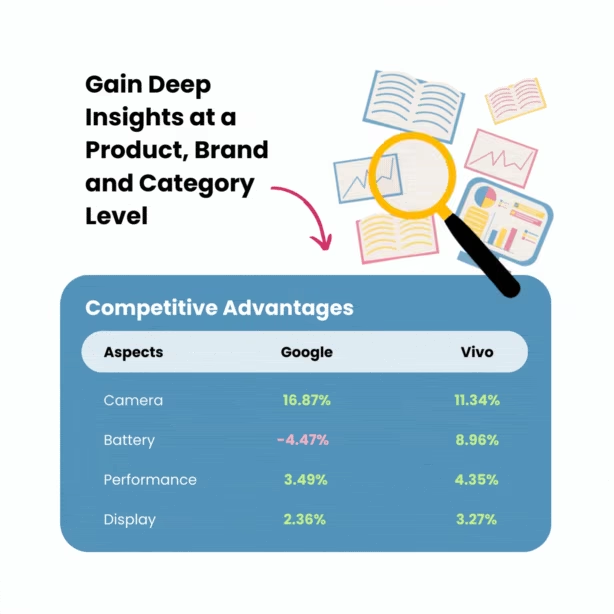
However, as volume grows, manual analysis becomes impossible. This is where product review analytics software and tools powered by Artificial Intelligence (AI) come in. These tools automate the heavy lifting of customer sentiment analysis. They can scan thousands of reviews in minutes, categorizing them by sentiment, topic, product feature, and more.
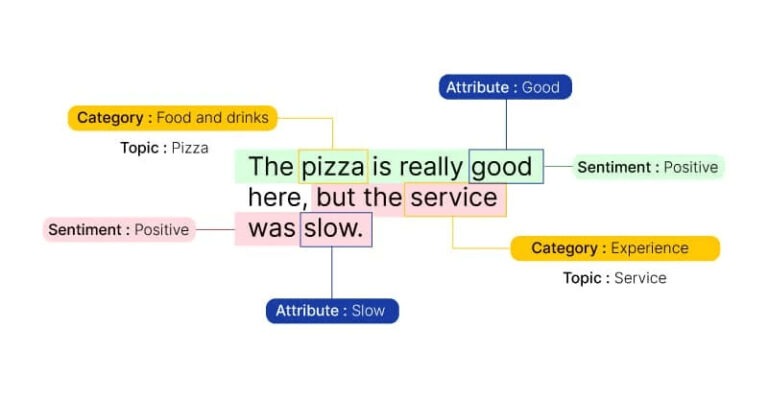
These platforms typically work by using Natural Language Processing (NLP) to understand language contextually. They do not just flag positive or negative words; they understand that “this product is sick!” is likely positive, while “the battery life is sickeningly short” is negative. They can automatically tag reviews mentioning “shipping,” “packaging,” “ease of use,” or “customer service,” allowing you to see at a glance what topics are driving sentiment.
Investing in a good review management platform that includes analytics is often the logical step for growing e-commerce businesses. It turns an overwhelming task into a manageable, daily reporting function.
Decoding Emotions: The Critical Role of Sentiment Analysis
Customer sentiment analysis is the engine that powers scalable review analysis. It is the process of computationally identifying and categorizing opinions expressed in text to determine the writer’s attitude. In simpler terms, is the customer happy, angry, or indifferent?
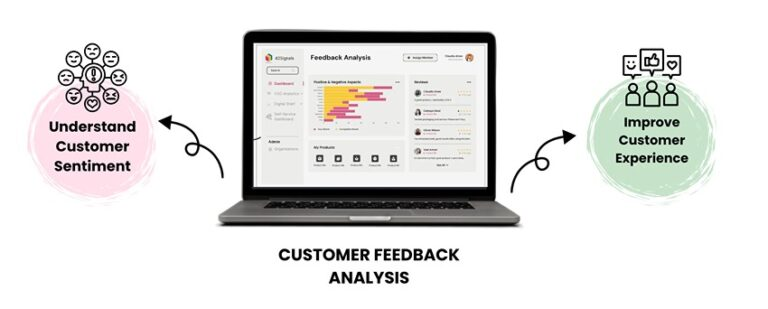
Image Source: 42Signals’ Customer Feedback Analysis
Sentiment is usually scored on a spectrum (positive, neutral, negative) or a numeric scale. This allows you to track changes over time.
- Did the sentiment on your flagship product drop after a new batch was shipped?
- Did a change to your checkout process lead to a positive sentiment spike in reviews mentioning “shipping”?
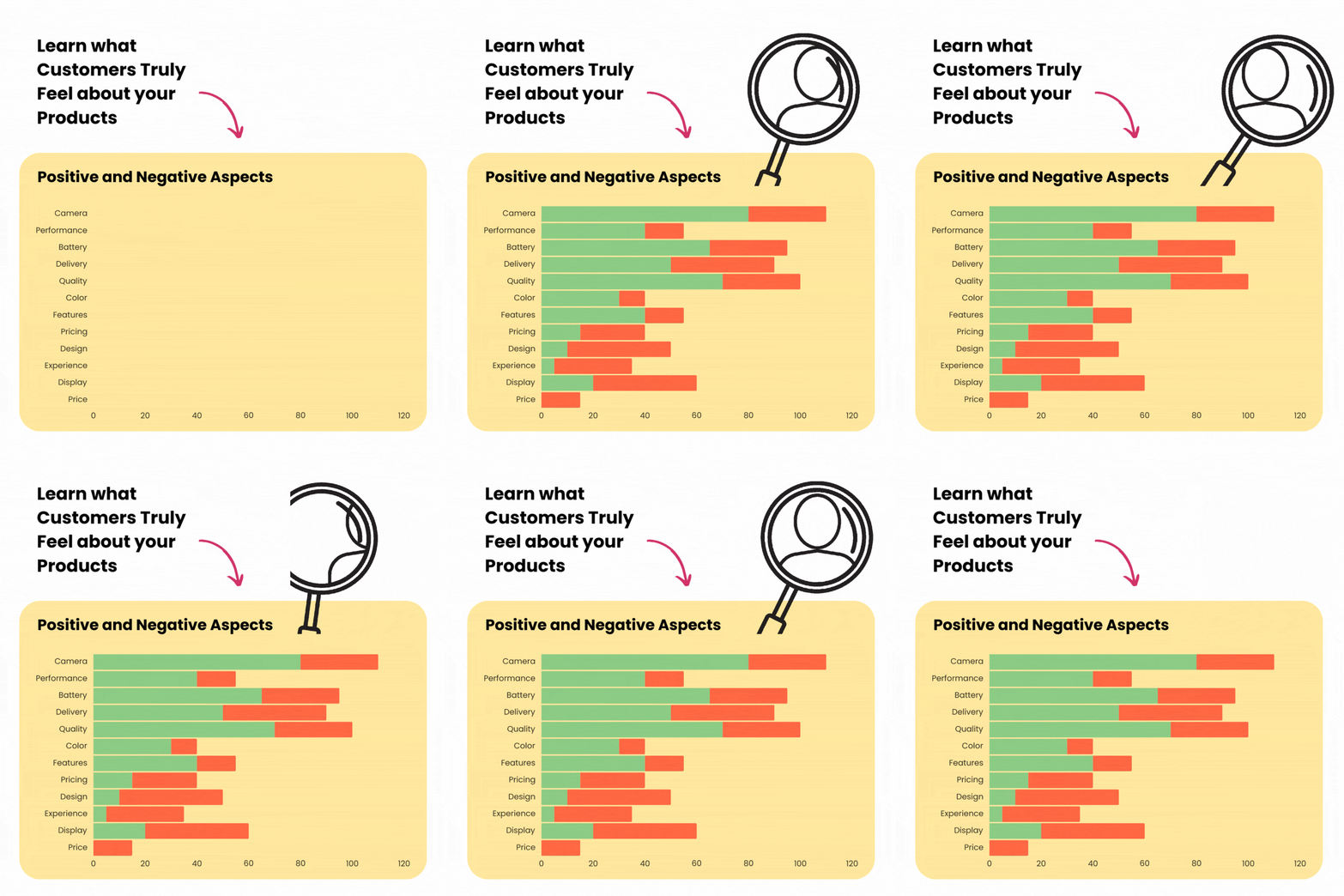
Understanding review sentiment is about more than just a score. It is about correlating sentiment with specific topics.
For example, you might find that sentiment is overwhelmingly positive around “product quality” but sharply negative around “delivery time.” This precise insight tells you exactly where to allocate resources. Your product is great, but your logistics partner may be failing you. This level of clarity is what makes sentiment analysis indispensable.
From Data to Action: Turning Analysis Insights into Strategy
Collecting data and generating pretty sentiment charts is only valuable if it leads to action. The final and most important step of review analysis is closing the loop. Here is how to translate insights into tangible business improvements.
For product teams, create a recurring report that highlights the top-requested features and most common complaints. Use direct quotes from reviews in your product development meetings. This evidence-based approach ensures you are building what customers actually want.
For your marketing department, provide a list of powerful, authentic customer phrases. They can use these in ad headlines, website testimonials, and social media posts. Additionally, if analysis reveals a common misconception about your product, marketing can create content to directly address it.
For customer service and operations, alert them to emerging issues immediately. If review monitoring picks up a new pattern of complaints about a defective component, operations can pause shipments and investigate the supply chain. Customer service can be armed with scripts to address the issue proactively for customers who make contact.

Image Source: Response Scribe
Finally, engage directly on the review platforms. Thank customers for positive reviews, especially detailed ones. For negative reviews, respond professionally, apologize for the shortfall, and if possible, explain how their feedback is being used to make improvements. This public-facing action shows all potential customers that you are committed to listening and evolving.
Building a Culture of Listening: Making Review Analysis a Habit
Effective review analysis is not a one-time project. It is an ongoing cycle of listening, understanding, acting, and improving. To truly benefit, it must become embedded in your company’s culture.
Schedule regular meetings, perhaps weekly or monthly, dedicated to reviewing the latest customer feedback analysis reports. Involve team members from different departments. Share powerful customer quotes company-wide to remind everyone who they are serving. Celebrate when a change made based on review data leads to a measurable improvement in sentiment or sales.
This cultural shift turns customers from passive buyers into active collaborators in your business’s journey. Their feedback becomes the most valued input in your strategic planning.
Your Competitive Advantage is Hiding in Plain Sight
In the crowded and competitive world of e-commerce, advantages are hard to come by. Yet, most businesses are sitting on an untapped goldmine. Review analysis is the process of refining that raw ore into pure strategic gold. It is the systematic, intelligent practice of listening at scale.
By embracing product review analytics and customer sentiment analysis, you move from guessing what your market wants to knowing it. You stop fearing negative feedback and start leveraging it as a free consultancy service. You transform review management from a defensive chore into an offensive growth engine.
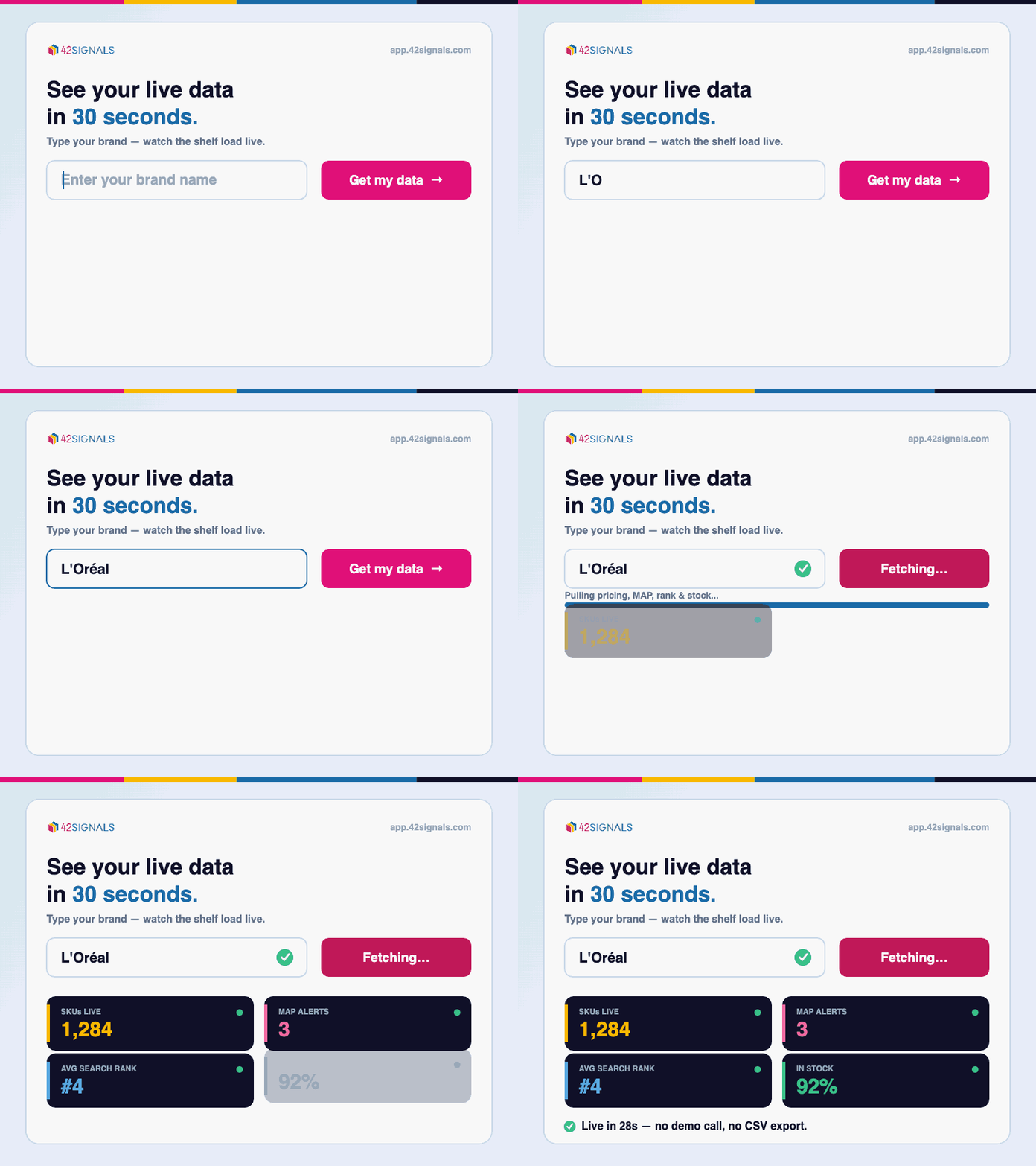
Start today with voice of customer analytics. Get in touch with us for a personalised demo for your brand to understand what customers are saying about your product or even what competitors’ customers say about their products.
Frequently Asked Questions
1. How to write an analysis review?
An analysis review is a structured summary of what the data reveals, why it matters, and what actions should follow. To write one effectively:
Start with the purpose — Explain what you analyzed and why.
Describe the data — Mention where it came from, how much data you used, and the timeframe.
Explain your method — Outline how you processed or categorized the data.
Present your findings — Highlight key patterns, trends, or problems you discovered.
Use evidence — Support insights with metrics, quotes, charts, or examples.
Interpret what it means — Connect insights to real business impact.
Give recommendations — Suggest what the team should do next based on the results.
A good analysis review is objective, clear, and actionable, not just a summary of numbers.
2. What are the 7 steps to analysis?
While frameworks vary, most analytical processes follow these seven core steps:
Define the question – Clarify what you’re trying to understand or solve.
Collect data – Gather relevant information from all sources.
Clean the data – Remove errors, duplicates, and irrelevant entries.
Organize and categorize – Sort data into themes, metrics, or groups.
Analyze the patterns – Identify trends, correlations, and key findings.
Interpret results – Explain what the findings mean for the business or situation.
Recommend actions – Provide clear next steps based on the insights.
This structure ensures the analysis is logical, thorough, and useful.
3. What is customer review analysis?
Customer review analysis is the process of examining customer feedback — written reviews, star ratings, comments, and sentiments — to understand how people perceive a product or service.
It helps businesses answer questions like:
What do customers like most?
What complaints appear repeatedly?
What issues impact ratings or returns?
Which features or experiences need improvement?
Customer review analysis is widely used for product development, customer experience improvements, pricing decisions, and competitive benchmarking.
4. How to analyze review data?
To analyze review data effectively, follow these steps:
Step 1: Collect the reviews
Gather reviews from all relevant platforms (Amazon, Google, e-commerce sites, apps, social media).
Step 2: Clean the dataset
Remove spam, fake reviews, repeated entries, and irrelevant text.
Step 3: Categorize the feedback
Group reviews based on themes such as:
Product quality
Delivery experience
Pricing
Customer service
Packaging
Step 4: Identify sentiment
Assess whether each review is positive, neutral, or negative — manually or using sentiment analysis tools like 42Signals, Google NLP, or internal AI models.
Step 5: Find recurring patterns
Look for repeated words, common complaints, top praise points, and issues that appear frequently.
Step 6: Quantify the insights
Use metrics such as:
Average rating
Sentiment score
Share of negative comments
Frequency of specific issues
Step 7: Turn insights into actions
Translate your findings into recommendations for product improvements, communication adjustments, policy changes, or customer support training.