

** TL;DR ** Effective MAP compliance enforcement is a critical strategic process that moves beyond simply having a policy to actively ensuring all retailers adhere to your Minimum Advertised Price. It requires a foundation of a clear, legally sound policy, followed by continuous MAP monitoring to detect violations—a task best handled by automated software to ensure comprehensive, real-time coverage. The enforcement itself must be executed through a consistent, documented protocol of warnings and escalating consequences applied uniformly to all partners to maintain credibility and avoid legal pitfalls related to antitrust laws. Ultimately, integrating technology for MAP compliance software enforcement transforms this function from a reactive burden into a proactive system that protects brand equity, retailer relationships, and profit margins.
MAP compliance enforcement is the systematic process of monitoring the advertised prices of products across retail channels and ensuring adherence to a unilaterally set Minimum Advertised Price. It is a critical function of brand management and channel marketing.
A precise understanding of the policy’s scope is paramount. A MAP policy governs the advertised price—the price displayed in product listings, digital advertisements, email promotions, and printed circulars. It explicitly does not dictate the final selling price at the point of sale.
Retailers maintain the autonomy to complete the actual transaction at any price they choose. This distinction is not semantic; it is the very foundation of the policy’s legal defensibility.
The legal framework surrounding manufacturer-led pricing is complex and primarily governed by antitrust laws, such as the Sherman Antitrust Act. Practices like resale price maintenance (RPM), which involves coercing agreements on actual sales prices, are subject to intense legal scrutiny and can be deemed per se violations. In contrast, a unilaterally imposed and consistently enforced MAP policy is typically evaluated under the “rule of reason,” which balances the pro-competitive benefits of the policy against any potential anti-competitive effects. Therefore, the execution of MAP compliance enforcement must be meticulously designed to avoid any perception of collusion or agreement.
The Legal Architecture of MAP Compliance Enforcement: Antitrust Principles and Risk Mitigation

Image Source: Wiser
Navigating the intersection of commercial strategy and legal compliance requires a prudent approach. The primary objective is to mitigate any risk of perceived resale price maintenance while legitimately protecting brand interests.
To ensure enforcement activities remain within safe harbors, the following principles are non-negotiable:
- Unilateral Policy Formation and Communication: The MAP policy must be created and implemented by the manufacturer alone. It should be communicated to retailers as a non-negotiable condition of doing business, not as an invitation to negotiate or discuss pricing strategies.
- Absolute Consistency in Application: Enforcement actions must be applied uniformly across all retail partners without discrimination. Favoritism or selective enforcement can be construed as an anti-competitive practice and undermines the policy’s legitimacy.
- Transparency and Documentation: The policy terms must be clear, unambiguous, and easily accessible. Most importantly, every step of the enforcement process must be thoroughly documented, from the initial identification of a violation to all subsequent communications and actions.
It is strongly advised that legal counsel with expertise in antitrust law review both the MAP policy and the proposed enforcement protocol. This guidance is for informational purposes and should not be construed as legal advice.
Ready to Take the Next Step?
See how our solutions can help you achieve your goals and drive measurable results.
Phase 1: Constructing an Enforceable MAP Policy Framework

The cornerstone of effective enforcement is an impeccably drafted policy. A vague or incomplete policy creates ambiguity, making consistent enforcement impossible. While a generic MAP policy template can provide a starting point, it must be customized to reflect the specific nuances of your product portfolio and distribution model.
An ironclad MAP policy should explicitly delineate the following elements:
- Scope of Coverage: Specify whether the policy applies to the entire product catalog or only to designated products and SKU numbers.
- Policy Duration and Amendments: State the effective date and any expiration date. Outline the process for making future amendments to the policy or pricing, including adequate notice periods to retailers.
- Pricing Specifications: Clearly list the Minimum Advertised Price for each covered product or product category. This information is best managed through a dynamically updated document or portal.
- Definition of Advertisement: Provide an exhaustive definition of what constitutes an advertisement, encompassing company websites, third-party marketplaces (e.g., Amazon, Walmart.com), search engine shopping results, social media ads, email campaigns, and physical print media.
- Stated Consequences for Non-Compliance: Outline a precise, progressive disciplinary procedure. A typical sequence includes a first warning, a second and final warning, suspension of cooperative advertising funds or other benefits, and ultimately, termination of the business relationship.
- Exclusions and Allowances: Define any permissible exceptions, such as specific annual sales events (e.g., Black Friday), member-only sales, or bundled product promotions.
This document serves as the rulebook. Its clarity directly correlates to the defensibility of your enforcement actions.
Phase 2: Achieving Comprehensive Market Visibility through MAP Compliance Enforcement
The second phase involves the continuous and systematic surveillance of the market to identify policy violations. Given the vastness of the digital commerce ecosystem, manual MAP monitoring is an exercise in futility. It is resource-prohibitive, prone to human error, and incapable of providing real-time intelligence.
The proliferation of online sellers and marketplaces means your products can be listed on thousands of web pages. Identifying a violation manually requires knowing where to look and constantly revisiting those pages. This approach is inherently reactive and inefficient.
This is where technology becomes a strategic imperative. Automated MAP compliance software enforcement platforms are engineered to solve this exact challenge. These sophisticated systems utilize web crawlers to scan a curated list of URLs, marketplaces, and search engine results around the clock. They instantly detect and flag any advertised price that breaches your predetermined MAP thresholds.
According to a analysis by industry experts, brands that leverage automated monitoring software identify pricing violations significantly faster—often within minutes—compared to those relying on manual methods, which can take days or weeks. This rapid detection is critical for minimizing the market impact of a low price and demonstrating vigilant enforcement to your retail network.
Phase 3: Executing a Disciplined Enforcement Protocol
Upon identification of a violation, a pre-defined, consistent enforcement sequence must be initiated. Adherence to a strict protocol ensures fairness and eliminates emotional or arbitrary decision-making.
Step 1: Evidence Capture and Verification
Prior to any communication, secure incontrovertible proof of the violation. Advanced MAP monitoring solutions automatically capture time-stamped screenshots and URLs, creating an immutable audit trail. This step verifies that the finding is accurate and not a parsing error by the software.
Step 2: Initial Notification
The first contact with the non-compliant retailer should be formal and assume the violation was unintentional. The communication, typically an email, should state the specific product, the observed advertised price, the mandated MAP, and the policy clause that has been breached. It must politely request price correction within a specified timeframe, usually 24 to 48 hours.
Step 3: Secondary Communication and Escalation
If the violation persists beyond the initial grace period, a second, more firm communication is required. This message should be escalated to a higher-level manager within the retailer’s organization and should reiterate the violation while explicitly referencing the next stage of consequences as outlined in the policy document.
Step 4: Implementation of Sanctions with MAP Compliance Enforcement
Should the retailer remain non-compliant, you must follow through with the sanctions detailed in your policy. This demonstrates credibility and resolve. Actions may include the temporary suspension of marketing allowances, volume-based discounts, or access to new product launches. In cases of repeated and wilful violation, the final sanction may involve ceasing all shipments and terminating the partnership.
Phase 4: Integrating Advanced Technology for Scalable MAP Compliance Enforcement
To manage this process at scale across hundreds of products and retailers, investment in a dedicated technological platform is not just advantageous; it is essential. Modern MAP compliance software enforcement solutions provide far more than basic monitoring.
A comprehensive platform, such as the analytics suite offered by 42Signals, delivers a centralized command center for all enforcement activities. Key capabilities include:
- Automated, Continuous Surveillance: Monitoring across a global network of e-commerce sites and marketplaces.
- Real-Time Alert Systems: Instant notifications via email or dashboard alerts upon violation detection.
- Integrated Evidence Management: Automated archiving of violation proof for easy retrieval and reporting.
- Communication Workflow Tools: Features to track and manage all enforcement communications from a single interface, ensuring no step is missed.
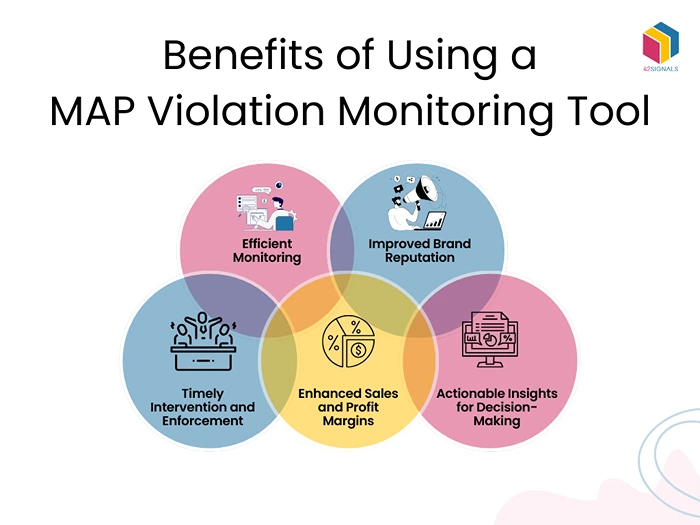
- Performance Analytics and Reporting: Dashboards that provide insights into compliance rates over time, identify chronic offenders, and measure the ROI of your enforcement program by correlating compliance with margin protection.
Leveraging these tools transforms MAP compliance enforcement from a labor-intensive, reactive task into a strategic, data-driven business process.
Ready to Take the Next Step?
See how our solutions can help you achieve your goals and drive measurable results.
Addressing Complex Enforcement Scenarios: Unauthorized Sellers and Repeat Offenders
A robust enforcement program must account for challenging scenarios. Two common challenges are unauthorized sellers and chronically non-compliant authorized partners.
For repeat offenders within your authorized network, your pre-defined escalation protocol is your guide. Consistency is paramount. Applying consequences uniformly signals to all partners that the policy is immutable. Failure to act against a high-volume retailer undermines the policy’s authority with all other partners.
Unauthorized sellers present a distinct challenge, as there is no direct commercial relationship to leverage. Mitigation strategies require a different toolkit:
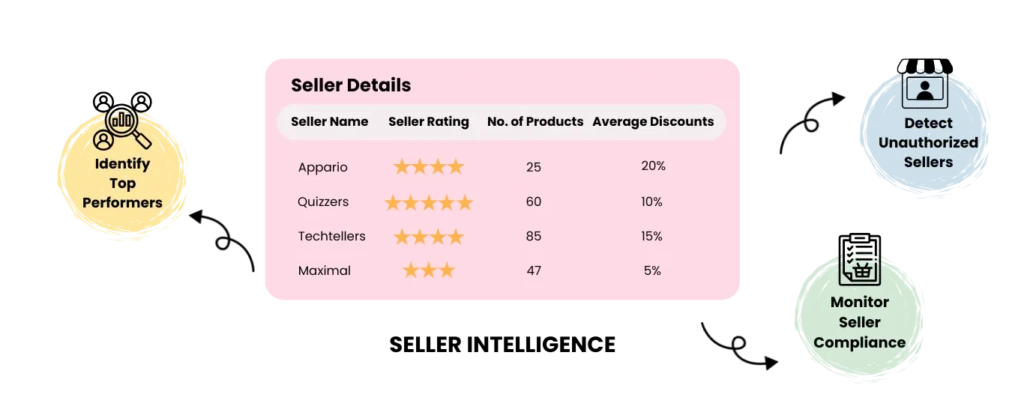
- Intellectual Property Enforcement: If the seller is using copyrighted images or trademarked text without permission, formal takedown notices under the Digital Millennium Copyright Act (DMCA) or through marketplace IP complaint systems can be effective.
- Investigation of Supply Chain Leakage: Unauthorized sellers often acquire product through excess inventory from distributors or authorized retailers. Conducting an audit of your distribution chain can help identify and plug the source of leakage.
- Marketplace Reporting: While more difficult, some marketplaces may act on reports of unauthorized sales, especially if coupled with IP infringement claims.
Elevating MAP Compliance Enforcement to a Strategic Brand Function
Effective MAP compliance enforcement is a strategic imperative that directly safeguards revenue, brand equity, and channel health. It transcends a simple reactive process and establishes a foundation of pricing integrity upon which sustainable growth is built.
A systematic approach—comprising a legally sound policy, continuous monitoring, a disciplined communication protocol, and the strategic application of technology—empowers brands to transition from passive observers to authoritative stewards of their market value. In an era of intense online competition, a proactively enforced MAP policy is not a constraint on retailers but a protection for all stakeholders invested in the long-term health of the brand.
For organizations seeking to implement a rigorous, scalable, and efficient enforcement program, leveraging advanced technology is the critical differentiator.
To discover how data-driven MAP monitoring and enforcement analytics can fortify your brand’s market position, we invite you to explore the enterprise-grade solutions provided by 42Signals.
Our platform is designed to deliver the clarity, control, and confidence required to execute your enforcement strategy with precision.
Frequently Asked Questions
1. What is a compliance MAP?
A compliance MAP refers to how strictly a brand or manufacturer monitors and enforces its Minimum Advertised Price (MAP) policy across its sales channels. The goal is to ensure that authorized retailers do not advertise products below a specified minimum price, preserving brand value and fair competition.
MAP compliance typically involves:
Tracking advertised prices across marketplaces (like Amazon, Walmart, etc.).
Sending warning notices to violators.
Restricting supply or suspending partnerships if violations persist.
Brands use MAP compliance tools to automate this process and ensure consistent pricing visibility online.
2. What does MAP mean in purchasing?
In a purchasing or procurement context, MAP still stands for Minimum Advertised Price, but the focus is on the terms set by the manufacturer for how low a product can be publicly priced—not sold. Retailers can often sell below the MAP, but they cannot promote or list the product at a lower price than agreed.
For purchasing teams, respecting MAP is critical to maintaining supplier relationships and avoiding being flagged or penalized by the brand.
3. What are MAP rules?
MAP rules are the guidelines set by a manufacturer or brand that dictate the lowest price a reseller can publicly advertise a product. These rules typically include:
The specific price floor per SKU or product category.
The advertising channels covered (e.g., online listings, digital ads, flyers).
Penalties for violations (warnings, supply cuts, legal action).
Exceptions (e.g., private promotions, in-cart discounts).
MAP rules do not regulate the actual sale price; they control only the advertised price. Retailers can sell at any price but must advertise at or above the MAP.
4. What does MAP stand for in retail?
In retail, MAP stands for Minimum Advertised Price. It’s a pricing policy used by manufacturers to prevent retailers from undercutting the value of a product by advertising it at deep discounts.
Retailers must agree to this policy to remain authorized sellers. MAP helps:
Maintain a level playing field among retailers.
Protect brand reputation.
Avoid “race to the bottom” pricing wars, especially in e-commerce.
MAP is particularly common in industries like electronics, outdoor gear, beauty, and luxury products.