


** TL;DR ** For complete strategic agility and sustainable growth, businesses must integrate both the Voice of Customer (VOC) and the Voice of Market (VOM). VOC provides immediate, tactical insights through brand-specific customer feedback analysis (surveys, reviews) essential for retention and optimizing existing products; however, relying on it alone creates a strategy gap by only allowing optimization of the past. VOM, conversely, provides a future-oriented trend radar by tracking broad market signals (competitor actions, macro trends, technological shifts), which identifies white space and predicts disruption. The true power lies in synergy: using voice of customer insights to validate and prioritize opportunities spotted by the VOM, ensuring innovation is focused on both what customers need now and where the entire market is headed next.
Staying ahead of today’s market means listening. But are you listening to the right conversations? Are you hearing the brand-specific feedback from your existing clientele, or are you tracking the larger, market-wide signals that hint at tectonic shifts in your industry?
The truth is, for a complete strategic picture, you need both. We’ll unpack the essential relationship between the Voice of Customer (VOC) and the Voice of Market (VOM). We’ll show you exactly why integrating both is about sustainable growth and strategic agility.
The Crucial Distinction: Understanding Market Signals and Customer Feedback Analysis
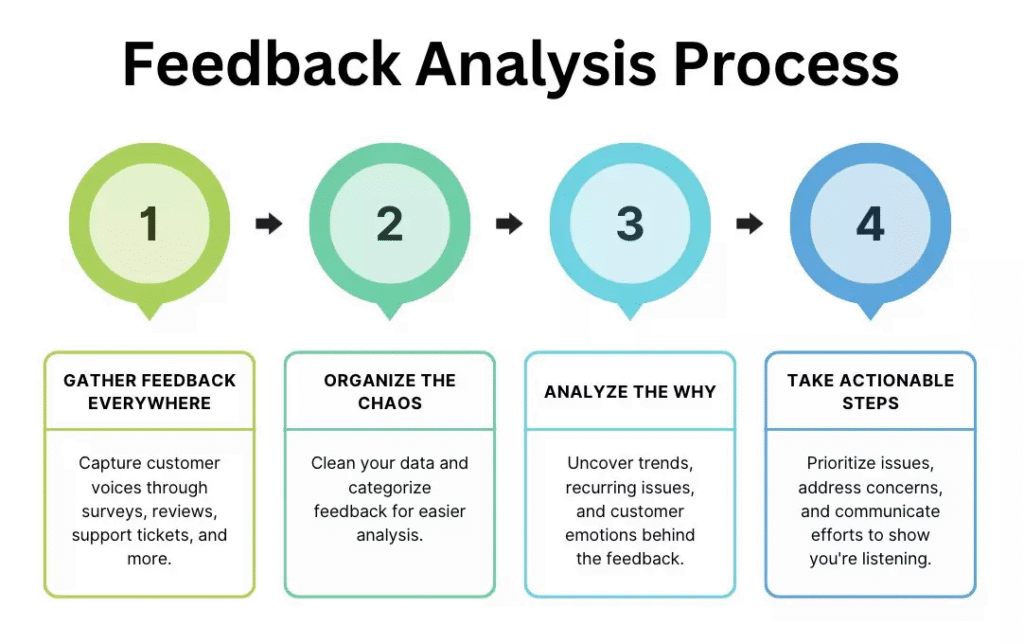
Image Source: Solutions Hub
Before we dive into why you need both, let’s clarify the difference. These two voices are often mistakenly conflated, but they serve fundamentally different purposes in your intelligence gathering. Think of them as two distinct types of radar: one focused on immediate surroundings and the other scanning the distant horizon.
What is the Voice of Customer? Getting Brand-Specific Feedback
The Voice of Customer (VOC) is the aggregation of everything your existing or potential customers say, feel, or think specifically about your brand, products, services, or interactions. It is internal, focused, and deeply personal to your company’s performance.
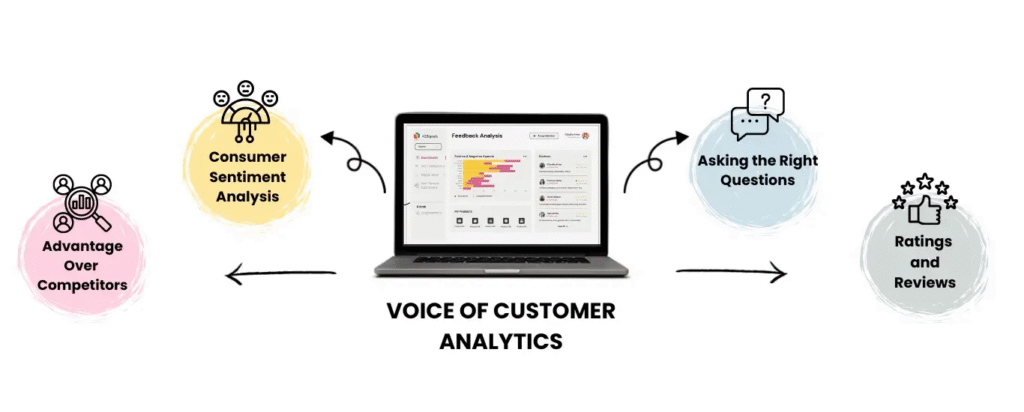
When you engage in customer feedback analysis, you are scrutinizing data points like:
- Direct Feedback: Responses from surveys, one-on-one interviews, and dedicated feedback forms.
- Indirect Feedback: Data from customer support interactions (chat transcripts, call recordings), product reviews, and social media mentions specifically targeting your brand.
- Inferred Feedback: Behavioral data like purchase history, usage patterns, and click-through rates on your website.
Voice of Customer analytics are invaluable for immediate, tactical improvements. They tell you exactly where your product is frustrating users, where your service is failing, or what features are most loved. This stream of information is essential for improving customer retention and increasing the lifetime value of your current user base.
What is the Voice of Market? Tracking Market-Wide Signals
The Voice of Market (VOM), on the other hand, is the expansive view. It represents the broader, market-wide signals, trends, needs, and conversations happening across the entire industry or demographic, regardless of your brand. VOM is external, diffuse, and future-oriented.
The sources for tracking these market signals include:
- Macro Trends: Economic shifts, technological advancements, and regulatory changes impacting the entire industry.
- Competitor Analysis: What your rivals are launching, how they are positioning themselves, and the public’s general sentiment toward them.
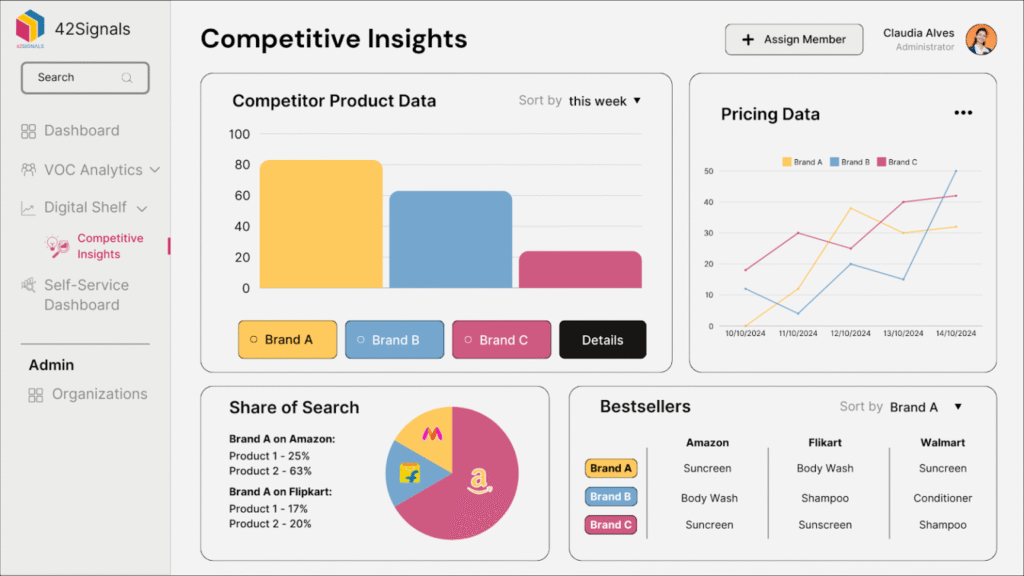
- Industry Conversations: Discussions on forums, trade publications, and professional networks about pain points, unmet needs, and emerging technologies that no one is currently solving well.
- Demographic Shifts: Changes in consumer behavior, purchasing power, and platform preferences across the target audience.
These market signals provide a powerful trend radar. They alert you to emerging opportunities or looming threats that are bigger than your brand alone. If a new technology is rapidly changing consumer expectations, the VOM will pick up that scent long before your direct VOC surveys reflect it.
The Strategy Gap: Why Voice of Customer Data Alone Isn’t Enough
Many businesses become highly proficient at collecting voice of customer insights and assume they have a complete picture. After all, if your customers are happy, what else matters? This mindset creates a dangerous strategy gap.
Relying solely on brand-specific feedback only allows you to optimize the past. Your customers can only give feedback on the products and services you already offer. They are rarely pioneers. As Henry Ford is often quoted, “If I had asked people what they wanted, they would have said faster horses.”
The Blind Spot of Optimization
When you focus only on voice of customer analytics, you risk falling into the trap of incrementalism. You might spend years making your existing product 10% better—smoother UI, faster load times, slightly improved customer service. These are all good things, but they won’t prepare you for a disruptive competitor who enters the market with a fundamentally different solution driven by an ignored market signal.
The VOM is where you find the unarticulated needs—the problems so frustrating or so new that people haven’t yet framed them as a request for your product development team. Tracking consumer sentiment across the wider industry space helps you spot these inflection points.
The Power of Synergy: Integrating Voice of Market and Voice of Customer
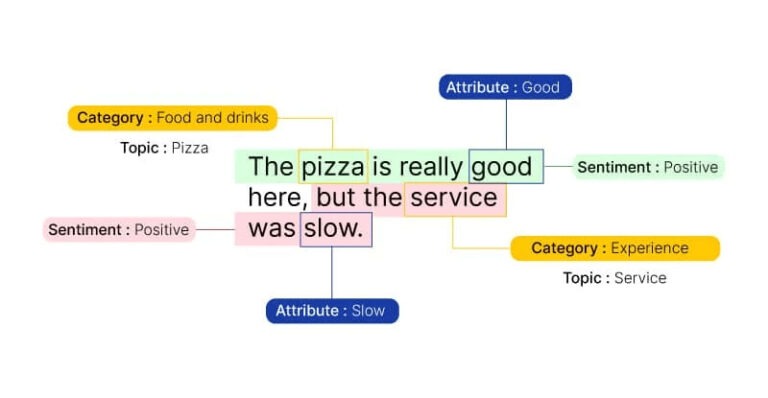
The truly strategic advantage comes from integrating both data streams. When you overlay deep voice of customer insights onto the broad landscape of market signals, you gain predictive power. This synergy allows you to anticipate where your industry is headed and position your brand accordingly.
1. Validating and Prioritizing Innovation
A strong market signal might suggest a massive opportunity, perhaps a shift toward sustainable packaging or a new demand for hyper-personalized digital experiences. However, acting on a market signal without internal validation is risky.
- VOM Identifies the Opportunity: A trend radar spots that 70% of industry discussions revolve around the difficulty of integrating legacy systems with new cloud solutions (a clear market signal).
- VOC Validates the Priority: Your voice of customer analytics shows that 65% of your high-value customers who churned cited “integration complexity” as a major pain point.
The synergy is clear: the market is moving, and your customers are confirming that this specific problem is hurting your brand directly. This combined intelligence makes innovation prioritization a much simpler, data-backed decision.
2. Identifying White Space and Unmet Needs
This is where you find new opportunities for growth. Customer feedback analysis is excellent for finding product defects; the VOM is excellent for finding entirely new markets or product categories.
Imagine your VOC data shows customers are highly satisfied with your current fitness tracking app. Everything is working well. But your VOM analysis, using a detailed signal taxonomy, starts picking up market signals about a surging public interest in “mental wellness tracking” and “sleep health metrics,” driven by overall changes in consumer sentiment regarding health.
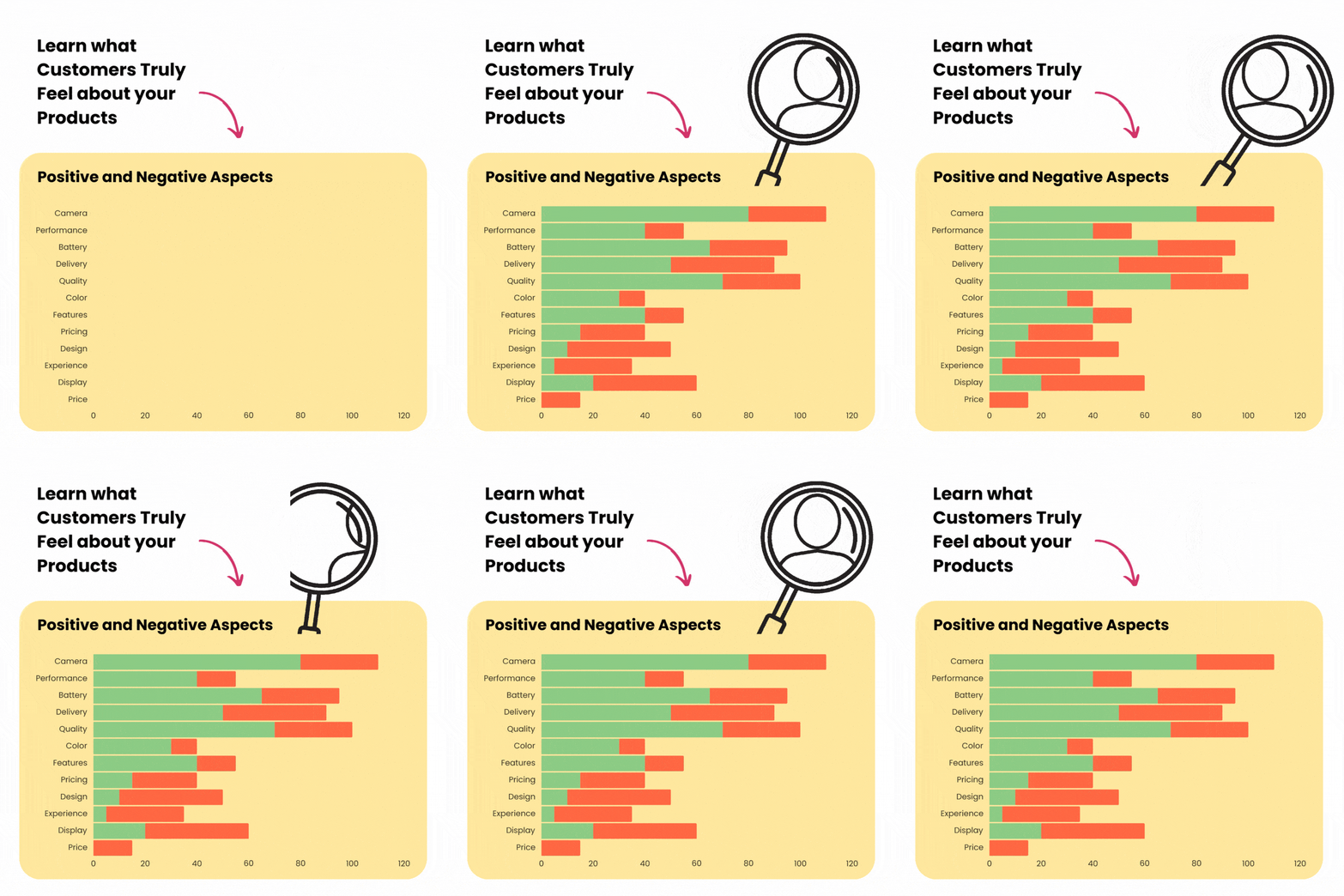
You realize that while your customers love your fitness product, the market is quickly moving toward a more holistic view of health. You haven’t captured these new demands in your product roadmap, nor are your current customers even asking you for it, yet. This integrated view points directly to a white space: a new product line focusing on mental and sleep health.
3. Mitigating Risk and Predicting Disruption
Disruption rarely comes from within your existing customer base. It comes from the fringes of the market. Companies that failed to adapt to digital photography or streaming video didn’t fail because their existing customers suddenly complained. They failed because they missed the market signals indicating shifts in technology and delivery models.
By continually scanning the VOM, your team effectively deploys a trend radar that identifies potential threats. If the VOM suggests a new, lower-cost technology is emerging that could make your premium offering obsolete, you need to react before your VOC surveys show a drop in sales. Combining this VOM threat with voice of customer insights about price sensitivity helps you formulate a defensive strategy—perhaps launching a more budget-friendly line or doubling down on unique features that the new technology can’t replicate.
Building Your Signal Taxonomy: Structuring Market Intelligence
To effectively track the Voice of Market, you can’t just passively read the news. You need a structured approach—a signal taxonomy—to categorize and prioritize the complex web of information coming in. This system helps translate amorphous market chatter into actionable intelligence.
A robust signal taxonomy often organizes market signals into key categories:
| Signal Category | Description | Impact on Strategy |
|---|---|---|
| Technological Signals | New patents, emerging platforms, adoption rates of new software, AI applications, etc. | Determines future product capabilities and obsolescence risk. |
| Regulatory/Policy Signals | New legislation (e.g., data privacy laws, environmental standards), governmental changes, trade tariffs. | Defines operational boundaries, compliance requirements, and market access. |
| Socio-Cultural Signals | Changes in lifestyle, demographic shifts, shifting values (e.g., sustainability, remote work, ethical sourcing). | Influences brand messaging, target audience definition, and product purpose. |
| Competitive Signals | New product launches by rivals, mergers/acquisitions, aggressive pricing strategies, major leadership changes. | Dictates immediate competitive response and market positioning. |
| Economic Signals | Interest rate changes, inflation, changes in consumer purchasing power, supply chain costs. | Affects pricing, cost structure, and investment decisions. |
By using this kind of structured approach, your team moves beyond vague observations and can generate quantifiable voice of customer analytics relative to specific VOM inputs. For instance, you can measure how shifts in consumer sentiment about environmental issues (Socio-Cultural Signal) impact the success rate of products flagged as “eco-friendly” in your internal customer feedback analysis.
Operationalising Both Voices: Tools and Processes to Understand Market Signals
Integrating VOM and VOC requires more than just goodwill; it demands specific tools, dedicated roles, and integrated processes. The goal is to create a seamless loop where external market signals inform internal development, and brand-specific voice of customer insights validate external assumptions.

The VOC Toolkit for Customer Feedback Analysis
Successfully gathering voice of customer insights relies on dedicated systems:
- Integrated CRM Systems: To unify all interactions (sales, support, marketing) and track behavior.
- Survey Platforms: Tools for capturing direct feedback (Net Promoter Score, Customer Satisfaction Score) at critical touchpoints.
- Review and Social Listening Tools (Brand-Specific): Monitoring platforms focused only on mentions of your brand and products to perform continuous customer feedback analysis.
The VOM Toolkit for Tracking Market Signals
Tracking market signals requires tools with a broader aperture:
- Market Intelligence Platforms: Tools designed to track competitor pricing, product features, and organizational movements.
- Wider Social Listening and News Aggregators: Platforms that scan industry news, specialized forums, and broad social media discussions for general consumer sentiment and trend-spotting (your trend radar).
- Industry Analyst Reports: Subscriptions to research firms that provide high-level, structured data on macro trends.
The Integration Process: Where the Voices Meet
The true work happens in the synthesis stage:
- Signal Mapping: Monthly or quarterly workshops where VOM analysts present key market signals (e.g., “AI integration is a top priority for B2B software”).
- VOC Validation: VOC teams then cross-reference these signals with internal voice of customer analytics. Do customers mention AI integration? Are they asking for solutions that AI could solve? This step converts abstract signals into concrete product requirements.
- Strategy Alignment: Product and marketing teams use the combined intelligence to define new product roadmaps, create targeted messaging (informed by the VOM’s understanding of competitor narratives), and forecast demand. A high-priority market signal combined with strong voice of customer insights about pricing sensitivity dictates a fast-track, value-driven launch strategy.
Achieving Natural Keyword Density
Throughout this article, we’ve focused on weaving the primary and secondary keywords naturally into the conversation. For instance, the primary keyword, market signals, has been used extensively to drive home the concept of external, broad intelligence. Secondary keywords like voice of customer insights, voice of customer analytics, consumer sentiment, and customer feedback analysis have been utilized to explain the specific mechanisms of VOC.
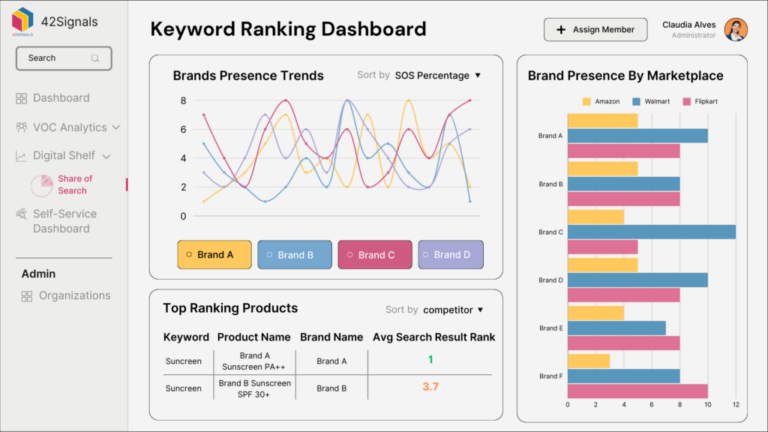
42Signals’ keyword rank tracker
The semantic keywords, trend radar and signal taxonomy, have been used to provide a structured framework for VOM analysis. This careful distribution ensures that the content is both human-readable and SEO-friendly, achieving a natural density for market signals without resorting to keyword stuffing.
The Mandate for Dual Listening Market Signals
In the end, achieving a complete strategic picture requires dual listening. The Voice of Customer helps you survive today by optimizing and retaining your existing base. The Voice of Market ensures you thrive tomorrow by identifying the shifts, threats, and opportunities that will define the next decade.
To move forward with confidence, your organization must move beyond simply collecting feedback. You must actively implement systems that track market signals, allowing you to continuously adjust your trend radar.
By pairing this expansive view with rigorous voice of customer analytics and detailed customer feedback analysis, you gain the ability to innovate where the market is going, not just where your customers have been. Ignore one voice, and you risk being outmaneuvered; embrace both, and you secure your position as a strategic leader in your industry.
Use 42Signals to understand how review data and customer sentiment can help your business learn about customer feedback.
Frequently Asked Questions
What is the meaning of customer analytics?
Customer analytics refers to the process of collecting, processing, and interpreting data about customer behavior, interactions, preferences, and motivations. The core objective is to develop a deep, actionable understanding of the customer base. This discipline moves beyond simple reporting to uncover patterns and make data-driven predictions, ultimately informing strategic decisions related to product development, marketing campaigns, customer service optimization, and overall business growth. It transforms raw customer data into valuable intelligence that helps a company acquire, retain, and maximize the lifetime value of its customers.
What are the 4 types of customer analytics?
Customer analytics is broadly categorized into four primary types, each serving a distinct purpose in providing insights:
Descriptive Analytics: This is the most fundamental type, focusing on what has happened in the past. It involves summarizing historical data to understand current customer behavior, such as calculating metrics like average order value, customer churn rates, or website traffic volume. It establishes the baseline for all other types of analysis.
Diagnostic Analytics: This type focuses on why something happened. It involves deeper analysis, often using techniques like data mining and drilling down into specific datasets, to identify the root causes behind observed customer behaviors. For example, diagnostic analytics might explain why a particular marketing campaign failed or why a specific product’s sales suddenly spiked.
Predictive Analytics: This analysis focuses on what is likely to happen in the future. Using statistical models, machine learning, and historical data, it forecasts future customer trends, such as predicting customer churn risk, identifying high-value customers, or forecasting demand for a new product.
Prescriptive Analytics: This is the most advanced form, focusing on what action should be taken to achieve a desired outcome. It provides recommendations for the best course of action by factoring in potential risks and rewards. For instance, prescriptive analytics might recommend the optimal personalized offer to send to a specific customer segment to prevent churn or maximize cross-selling.
What are the skills of customer analytics?
Effective customer analytics requires a blend of technical expertise, analytical thinking, and business acumen. Key skills include:
Data Proficiency: Strong command over databases and data warehousing, including SQL for querying and manipulating large datasets.
Statistical Modeling and Machine Learning: The ability to develop, test, and deploy statistical models (like regression analysis) and machine learning algorithms (like clustering or predictive forecasting) to identify patterns and predict future outcomes.
Programming: Proficiency in analytical programming languages such as Python or R, which are essential for cleaning data, running complex analyses, and building scalable models.
Data Visualization and Storytelling: The skill to translate complex analytical findings into clear, compelling, and actionable insights using data visualization tools (like Tableau or Power BI). Analysts must be able to communicate the “so what” of the data to non-technical stakeholders.
Business Acumen and Domain Knowledge: A deep understanding of the business model, market context, and customer lifecycle is critical to ensure that the analysis addresses relevant business problems and provides strategically valuable recommendations.
What are customer analytics tools?
Customer analytics relies on a diverse ecosystem of software tools designed to handle the various stages of data collection, processing, analysis, and visualization. These tools fall into several categories:
Customer Relationship Management (CRM) Systems: Platforms like Salesforce or HubSpot serve as the primary source for collecting and centralizing customer interaction data across sales, marketing, and service channels.
Business Intelligence (BI) and Data Visualization Tools: Software such as Tableau, Power BI, or Looker are used to transform processed data into interactive dashboards and reports, making it easier to monitor key performance indicators and share insights.
Web and Mobile Analytics Platforms: Tools like Google Analytics or Adobe Analytics track digital customer behavior, measuring website traffic, conversion funnels, and in-app usage patterns.
Data Science and Machine Learning Platforms: Environments like Python (with libraries such as Pandas and Scikit-learn) and R are used for advanced, custom modeling, enabling predictive and prescriptive analytics.
Voice of Customer (VOC) Tools: Platforms that gather and analyze direct customer feedback from surveys (e.g., Qualtrics), reviews, and social media mentions to provide deeper qualitative context to quantitative data.