
With competition intensifying and consumers becoming more price-sensitive, businesses need a strategic approach to pricing that not only attracts customers but also maximizes profitability. Enter the price matrix—a highly effective tool that organizes and optimizes product pricing based on various factors. Whether you’re running a direct-to-consumer (D2C) brand or a more traditional retail operation, developing a strong pricing matrix is crucial for sustaining profitability and remaining competitive.
This article will explain what a price matrix is, how to create one, and the five compelling reasons why you need it to elevate your retail strategy.
What is a Price Matrix?
A price matrix is a structured table or chart that organizes different price points for a product or a product line based on several factors such as:
- Product tiers
- Customer segments
- Regional demand
- Sales channels
The price matrix aims to provide a transparent and logical pricing system that allows businesses to quickly determine the best price for any given product, considering the above variables.
In essence, the price matrix helps brands offer dynamic, scalable pricing without the risk of overcomplicating their pricing structure.
For example, imagine you’re managing an eCommerce platform that sells fashion products. Using a price matrix, you could categorize your products into different tiers—such as budget, mid-range, and premium. Each tier might have distinct price points for different customer segments, locations, or sales channels. A well-thought-out price matrix aligns the price with the perceived value of the product for different audiences.
The Pricing Strategy Matrix is a valuable framework that helps businesses determine the best pricing approach by evaluating both the price and quality of their products or services. This matrix highlights four distinct pricing strategies: Skimming, Premium, Economy, and Penetration.
Each of these strategies offers different advantages and challenges. Skimming involves setting high initial prices and gradually lowering them to capture more market segments over time. Premium pricing maintains a high price point by emphasizing superior quality or brand prestige.
Economy pricing focuses on offering low-cost options to attract price-sensitive consumers, while Penetration pricing starts with low prices to quickly build market share before potentially transitioning to higher pricing. By categorizing these approaches, the Pricing Strategy Matrix enables companies to align their pricing with their business objectives and market positioning.
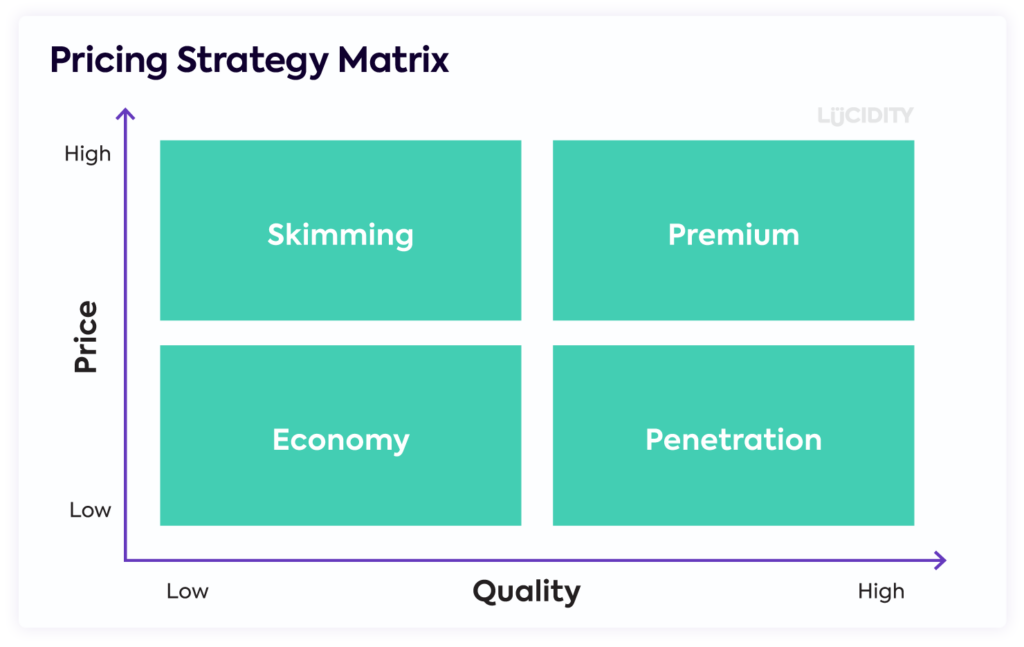
Image Source: Get Lucidity
How to Develop an Effective Price Matrix for Retail Success?
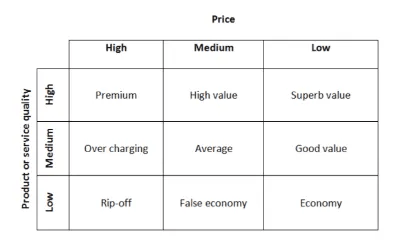
Image Source: Medium
Creating a price matrix is a detailed process that requires a deep understanding of your products, market, and customers. Below are the essential steps to create an effective price matrix for your retail or D2C brand:
1. Analyze Product Data
The first step in creating a price matrix is to analyze your product data. You need to identify key characteristics of your products, such as:
- Product categories (e.g., apparel, electronics, etc.)
- Sales volume
- Profit margins
- Cost of goods sold (COGS)
- Demand elasticity (how sensitive sales are to price changes)
Analyzing product data helps you understand which products generate the most profit and which may need price adjustments. It will also assist in organizing products into tiers based on profitability, market demand, and cost.
2. Identify Product Tiers
Next, segment your products into distinct categories or tiers based on the following attributes:
- Quality: Is the product considered a premium item, a budget option, or something in between?
- Brand positioning: Are you positioning this product as an exclusive offering or a mass-market product?
- Customer perception: How do customers perceive the value of this product relative to others in your portfolio?
By segmenting products into different tiers, you can assign a specific price range to each tier. For example:
- Budget Tier: Items with lower costs and margins, appealing to price-sensitive customers.
- Mid-Range Tier: Items that balance quality and affordability, appealing to a broad customer base.
- Premium Tier: High-end products that justify higher prices due to brand value, quality, or exclusivity.
3. Incorporate Customer Segments
Different customers have different willingness to pay. A solid pricing strategy incorporates customer segmentation into the pricing model. Some customer segments may be more price-sensitive, while others are willing to pay a premium for luxury or specialized products.
Segment your customers by demographic and psychographic criteria, such as:
- Age
- Income level
- Geographic location
- Buying behavior
Once you have a clear understanding of your customer segments, your price matrix can include distinct price points for different audiences. For instance, a D2C brand selling skincare products might charge younger consumers less while offering premium pricing for older, affluent customers.
4. Factor in Sales Channels
The channels through which products are sold should also influence your price matrix. Prices may vary depending on whether you’re selling directly to consumers through your website (D2C), via a third-party marketplace like Amazon, or in brick-and-mortar stores.
For example, you may want to offer lower prices on your own eCommerce website to incentivize direct purchases, as selling through a third-party marketplace typically involves higher fees.
5. Monitor and Adjust Based on Ecommerce Analytics
Once your price matrix is in place, monitoring its effectiveness through eCommerce analytics is critical. You should continuously analyze how price changes impact sales, profits, and customer behavior. Metrics to focus on include:
- Conversion rate: Are customers purchasing more or less at different price points?
- Average order value: How does the pricing structure affect the total amount customers spend per order?
- Customer lifetime value: Are you retaining high-value customers with your pricing strategy?
Use this data to optimize your price matrix regularly. Keep in mind that a price matrix is not static; it should evolve as market conditions, customer preferences, and competitive pressures change.
The Strategic Core: Price Lining & Architecture
A price matrix operationalizes higher-level strategies like price lining and price architecture. Price lining is the practice of selling products at a limited number of predetermined price points (e.g., $9.99, $19.99, $49.99). A matrix enforces this by grouping products into these “lines” or price brackets based on their tier and cost structure.
This creates a clear value matrix for the customer. They learn that $19.99 gets them a reliable mid-tier product, simplifying choice and building trust. The matrix cost for each product must be engineered to fit profitably into its designated price line, making cost control and product development integral to the pricing strategy.
Advanced Frameworks: The Competitive & Value Matrix
Beyond internal grids, matrices are crucial for external analysis.
- Competitive Matrix: This tool plots your products against competitors on axes like price and perceived quality/benefits. As the prompt asks to “name 3 reasons for creating a competitive matrix”:
- To identify market gaps for new products.
- To spot where you are over- or under-priced relative to the value you deliver.
- To understand competitors’ strategic positioning (economy vs. premium).
- Parallel Pricing & Middle Market Matrix: Parallel pricing is a strategy where a company intentionally sets prices very close to a key competitor, often using a matrix to automate this alignment. Middle market matrix pricing refers to the sophisticated, data-driven pricing models used by firms targeting the mid-market segment, balancing competitive pressure with sufficient margin.
Execution: Building Your Price Matrix Template
To move from concept to execution, businesses need a buildable price matrix template. Here is a foundational structure to adapt:
1. Define Your Axes (Dimensions):
- Primary Axis (Rows): Product Value Tiers. Define 3-4 tiers (Economy, Standard, Premium, Luxury) based on cost, features, and target margin.
- Secondary Axis (Columns): Key Pricing Factors. These can be: Customer Segment (B2C, B2B), Region, Sales Channel, or Order Volume.
2. Establish Your Pricing Logic & Formulas:
For each cell in the matrix, establish a formula. For example:
- Base Price: (Cost of Goods Sold + Fixed Overhead) x (1 + Target Margin%)
- Channel Adjustment: Marketplace Price = Base Price x 1.1
- Volume Discount: Price for 100+ units = Base Price x 0.9
3. Implement, Monitor, and Iterate:
Embed the matrix rules into your ERP, POS, or e-commerce platform. Use ecommerce analytics to track the performance of each cell (conversion rate, profit margin). This data allows for the price adjustment matrix to evolve, ensuring it remains competitive and profitable.
Practical Application: The Retail Price Matrix in Action
In retail, a price matrix is often a multi-dimensional grid used to set prices dynamically.
Consider a furniture retailer with a core “price-quality matrix” strategy. Their matrix for a dining chair might look like this, factoring in product tier (vertical) and sales channel (horizontal):
| Product Tier / Channel | Direct E-commerce | Marketplace (e.g., Amazon) | Brick-and-Mortar Store |
|---|---|---|---|
| Economy (Basic Materials) | $79.99 | $84.99 (includes marketplace fee) | $89.99 |
| Mid-Range (Enhanced Design) | $149.99 | $159.99 | $169.99 |
| Premium (Luxury Materials) | $299.99 | $314.99 | Not offered in-store |
This retail matrix enables swift, consistent pricing decisions. It automatically applies a 10% premium on marketplaces to cover fees and a further margin in physical stores for display and service costs. The “Premium” tier is excluded from physical stores due to space constraints, focusing online where the assortment can be infinite.
Top 5 Reasons Your Business Needs a Price Matrix
Now that you understand what a price matrix is and how to build one, let’s explore five key reasons why implementing a price matrix can significantly benefit your business.
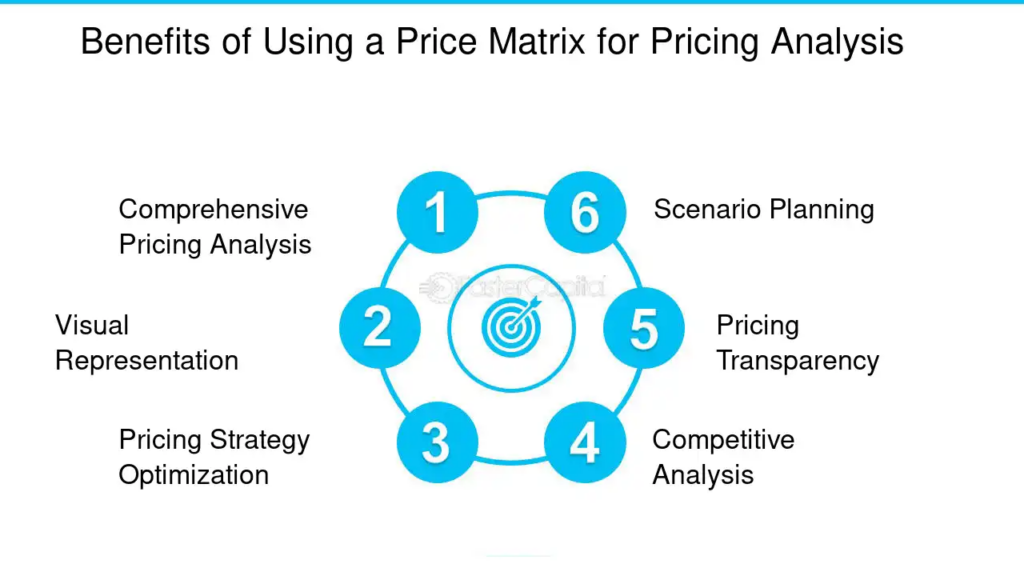
Image Source: FasterCapital
1. Improves Pricing Strategy with Better Data Insights
By creating a price matrix, you’re able to make data-driven decisions that optimize your pricing strategy. A matrix forces you to consider all variables—product tiers, customer segments, sales channels—ensuring that you’re not just pricing arbitrarily but strategically.
This organized approach helps align product prices with customer expectations and market demand. As a result, you can avoid underpricing or overpricing your products, which could either erode your profit margins or deter customers from making a purchase.
For instance, many D2C brands leverage eCommerce analytics to fine-tune their price matrix in real-time, ensuring that pricing remains competitive while maximizing revenue.
2. Simplifies Complex Pricing Models
As your product offerings grow, your pricing structure will inevitably become more complex. A price matrix simplifies these pricing models by creating a clear system that takes into account multiple variables without overwhelming your internal team or your customers.
This is particularly useful for D2C brands or companies with a wide array of products. By organizing pricing into product tiers and customer segments, you can manage complexity more effectively. This clarity not only helps your team make pricing decisions faster but also enables customers to understand the value proposition behind each price point more clearly.
3. Boosts Customer Satisfaction and Retention
Customer satisfaction often hinges on whether customers perceive the price of a product as fair and aligned with its quality. By using a price matrix, you’re able to offer more personalized pricing that resonates with different customer segments, which in turn fosters loyalty and increases customer retention.
For example, budget-conscious customers will appreciate the competitive pricing in lower-tier product categories, while premium shoppers will feel they’re getting their money’s worth in the high-end product tiers. When customers believe they’re receiving value for their purchase, they are more likely to return and become repeat buyers.
4. Helps Optimize Margins Across Multiple Channels
Selling across multiple channels, such as eCommerce platforms, third-party marketplaces, and physical stores, adds another layer of complexity to your pricing strategy. A price matrix helps optimize your margins by allowing you to adjust prices based on channel-specific costs.
For instance, selling through a third-party marketplace might incur additional fees, which you can factor into the price for that channel. Meanwhile, you can offer lower prices on your own eCommerce website to attract more direct sales, which tend to have higher profit margins. The flexibility of a price matrix allows you to stay competitive across all sales channels while maintaining profitability.
5. Enables Better Competitive Analysis
A price matrix allows you to conduct competitive analysis more effectively. By structuring your pricing in a matrix, you can easily compare your prices to competitors within each product tier and customer segment. This analysis helps you understand where your pricing sits in relation to the market and adjust accordingly to stay competitive.
For example, if you find that your mid-range products are priced higher than your closest competitor’s, you may decide to lower the price within that tier to capture more market share. Alternatively, you could choose to highlight the additional value your product offers, justifying the higher price. With a price matrix, competitive analysis becomes a structured, actionable process.
Conclusion on Price Matrix
A well-executed price matrix is a vital component of any retail or eCommerce business looking to optimize its pricing strategy. By organizing products into tiers, factoring in customer segments, and adjusting prices based on sales channels, a price matrix provides clarity and control over what can often be a chaotic and confusing process.
Not only does it simplify complex pricing models, but it also boosts customer satisfaction, optimizes profit margins, and enables more informed competitive analysis. In today’s highly competitive retail landscape, leveraging a price matrix can give your business the strategic advantage it needs to thrive.
Whether you’re a seasoned product marketer, a business owner, or a brand strategist, now is the time to implement a price matrix and start reaping its numerous benefits.At 42Signals, we help brands make smarter, data-driven pricing decisions. Whether you’re building a price matrix or refining your pricing strategy, our platform delivers the insights you need to stay competitive. Schedule a demo!
Frequently Asked Questions
Q: What is the difference between a price matrix and a pricing strategy?
A: A pricing strategy (e.g., penetration, skimming, value-based) is your high-level approach to the market. A price matrix is the tactical, operational tool that executes that strategy across hundreds or thousands of SKUs, ensuring consistent and logical pricing based on predefined rules.
Q: Can a price matrix help with ‘price lining’?
A: Absolutely. Price lining involves setting distinct price points for categories of products. A price matrix is the perfect tool to enforce this. You define the “lines” (e.g., $10, $25, $50) and use the matrix to assign each product to the correct line based on its tier, cost, and strategic role, creating a clean price architecture for customers.
Q: How does a price matrix relate to a competitive matrix?
A: They serve different but connected purposes. A competitive matrix is for external analysis, comparing your offerings to competitors. Insights from this analysis—like finding you’re overpriced in a key segment—directly inform the rules within your internal price matrix, telling you where to adjust your operational prices.
Q: Is a price matrix only for large companies with many products?
A: While it’s essential for managing complexity at scale, even small businesses benefit. A simple 2×2 matrix (e.g., Product Tier vs. Customer Type) brings discipline, prevents arbitrary discounting, and ensures you are building a logical, scalable pricing structure from the start.
Q: What’s a common mistake when first implementing a price matrix?
A: The most common error is creating a matrix that is too complex or rigid on day one. Start with 2-3 key dimensions (e.g., product category and channel). Use it, learn from the data, and then gradually add more sophistication (like regional adjustments or loyalty-tier pricing). The matrix should be a living tool.