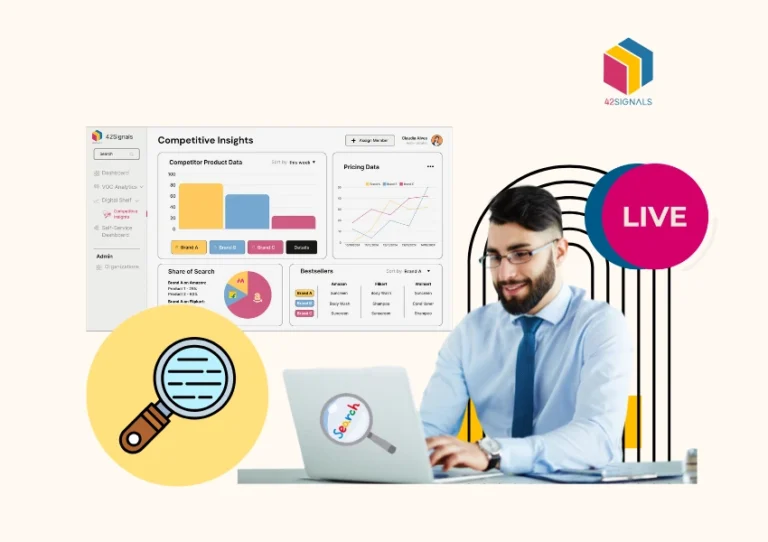


With the rise of online shopping, it has become increasingly important for brands to optimize their digital shelf presence to attract and retain customers. To do this effectively, brands must track and analyze key digital shelf metrics to gain insights into their online performance and identify areas for improvement.
In this blog, we will explore the most important metrics that every brand should track to improve their online presence and increase sales.
From product availability to customer ratings and reviews, we will equip you with the necessary information, insights, and tools you need to optimize your digital shelf and succeed in the highly competitive world of e-commerce.
So, let’s dive in and discover the key digital shelf metrics that can help take your brand to the next level!
What is a Digital Shelf?
A digital shelf is a term used to describe a virtual space where a business or e-commerce business displays and promotes its products online. It is a concept used in digital marketing to refer to the online equivalent of a physical store shelf where products are arranged for display.
In the context of e-commerce, a digital shelf refers to a website or online marketplace where products are showcased for potential customers to view and purchase. It is a digital representation of a physical retail shelf where products are displayed in an organized and attractive manner to attract and retain customers.
However, this definition only scratches the surface. The digital shelf is far more dynamic and complex than its physical counterpart. It is not a single location but a vast, interconnected ecosystem. Every touchpoint where a consumer can discover, evaluate, and purchase a product is part of the digital shelf. This includes:
- Search Engine Results Pages (SERPs): Google Shopping ads and organic product listings.
- Online Marketplaces: Like Amazon, eBay, and Walmart.com.
- Retailer Websites: Such as Target.com, BestBuy.com, or HomeDepot.com.
- Brand-Owned DTC Sites: The brand’s own e-commerce store.
- Social Commerce Platforms: Instagram Shopping, Facebook Marketplace, and TikTok Shop.
A well-organized and optimized digital shelf can help businesses increase sales, attract new customers, and improve customer engagement and loyalty which is a good segue into the various digital shelf metrics.
The Components of a Winning Digital Shelf
A product’s presence on the digital shelf is comprised of several critical components that work together to convince and convert a shopper:
- Product Content: This is the heart of the digital shelf. It goes beyond a simple title and image. It includes:
- Rich Imagery & Video: High-resolution images from multiple angles, infographics, 360-degree spins, and lifestyle videos that show the product in use.
- Detailed & Optimized Copy: Persuasive product titles, bullet-pointed feature lists, and compelling long-form descriptions that incorporate relevant keywords for search.
- Technical Specifications: Sizing charts, material composition, compatibility information, and care instructions.
- Enhanced Content: A+ Content (Amazon) or Rich Media, which includes branded modules, comparison charts, and video banners that enhance the standard product page.
- Shopper Engagement Elements: This is the interactive layer that builds trust and provides social proof.
- Ratings and Reviews: The modern equivalent of word-of-mouth. They are critical for reducing purchase anxiety and providing authentic feedback.
- Q&A Sections: Where potential customers can ask questions and get answers from other buyers or the brand itself, preemptively overcoming objections.
- Operational & Transactional Data: The backend mechanics that enable a seamless purchase.
- Pricing: Not just the list price, but any promotional pricing, coupon availability, and shipping costs.
- Availability & Inventory: Real-time stock levels to prevent selling what you don’t have.
- Promotions: Any “Buy One Get One” deals, bundle offers, or discounts displayed on the page.
- Shipping & Fulfillment: Clear information on delivery speeds, costs, and options (e.g., “Same-Day Delivery,” “Free 2-Day Shipping”).
A well-organized and optimized digital shelf can help businesses increase sales, attract new customers, and improve customer engagement and loyalty, which is a good segue into the various digital shelf metrics.
Digital Shelf Metrics Every Brand Should Track
There are several key digital shelf metrics that every brand should track to measure the effectiveness of their online presence and identify areas for improvement.
Some of these metrics include:
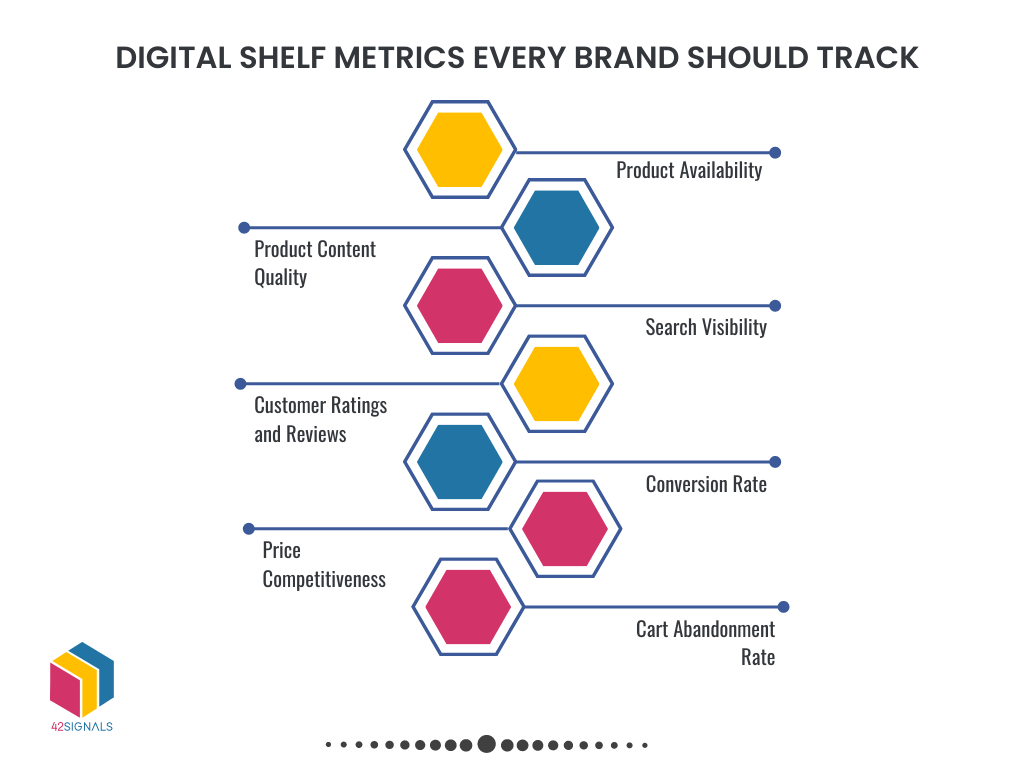
- Product Availability: Tracks the percentage of time a product is available for purchase on the digital shelf. This metric is important because out-of-stock products can lead to lost sales and customer dissatisfaction.
- Product Content Quality: This digital shelf metric measures the completeness and accuracy of product information such as titles, descriptions, images, and specifications, and is important because customers rely on this information to make purchase decisions.
- Search Visibility: Measures how easily a brand’s products can be found in online search results. Brands should track their search ranking for key product keywords to ensure their products are visible to potential customers.
- Customer Ratings and Reviews: The average rating and number of reviews for a brand’s products. Positive reviews and ratings can help increase sales, while negative reviews can have a negative impact on a brand’s reputation.
- Conversion Rate: Measure the percentage of visitors to a digital shelf who make a purchase. Brands should track this metric to identify areas for improvement in the purchase process, such as site speed, user experience, and payment options.
- Price Competitiveness: A brand’s pricing relative to their competitors. Brands should monitor these digital shelf metrics to ensure that their prices are competitive and aligned with customer expectations.
- Cart Abandonment Rate: This digital shelf metric measures the percentage of visitors who add products to their cart but don’t complete the purchase. Brands should track this metric to identify friction points in the purchase process and optimize their checkout process to reduce cart abandonment.
- Share of Search & Share of Page: Advanced metrics that analyze what percentage of top search results your brand owns for critical keywords, and how much digital “real estate” your products command on a category page compared to competitors.
By tracking these and other relevant metrics, brands can gain valuable insights into their online performance and identify opportunities to improve their online presence and increase sales.
What is Digital Shelf Analytics?
Digital shelf analytics refers to the practice of tracking and analyzing key performance metrics related to a brand’s online presence and product offerings on various digital platforms, such as e-commerce websites, online marketplaces, and social media.
It involves monitoring and analyzing data such as product availability, search visibility, customer ratings and reviews, pricing competitiveness, traffic, and conversion rates.
With this data, teams gain insights into a brand’s digital shelf performance and by doing so optimize its digital shelf presence and increase sales.
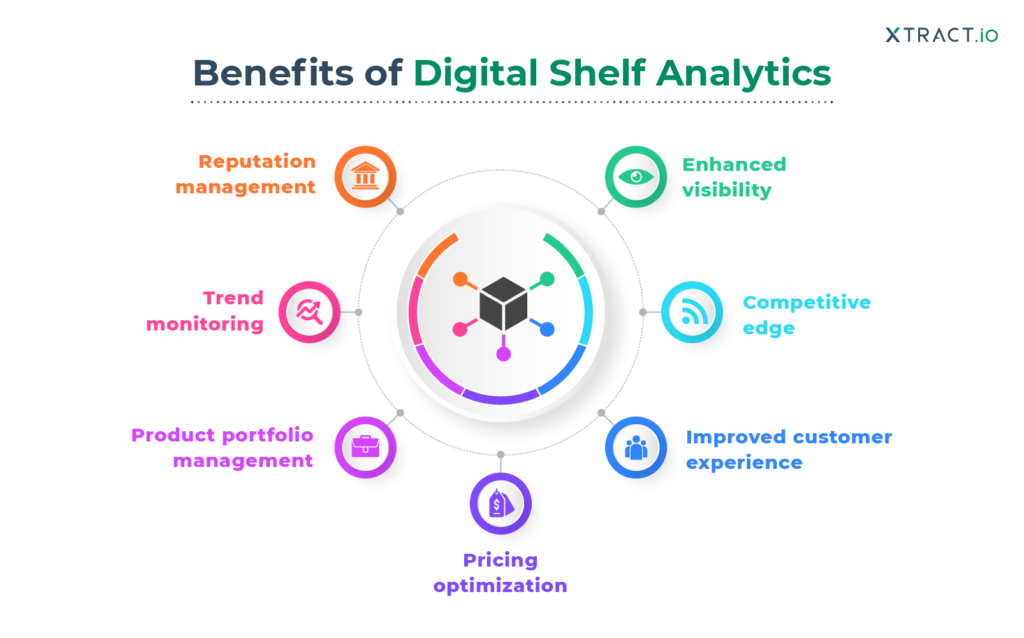
Image Source: Xtract
It is a crucial aspect of any e-commerce strategy and can provide valuable insights that help brands stay ahead in a highly competitive market.
How 42Signals Helps
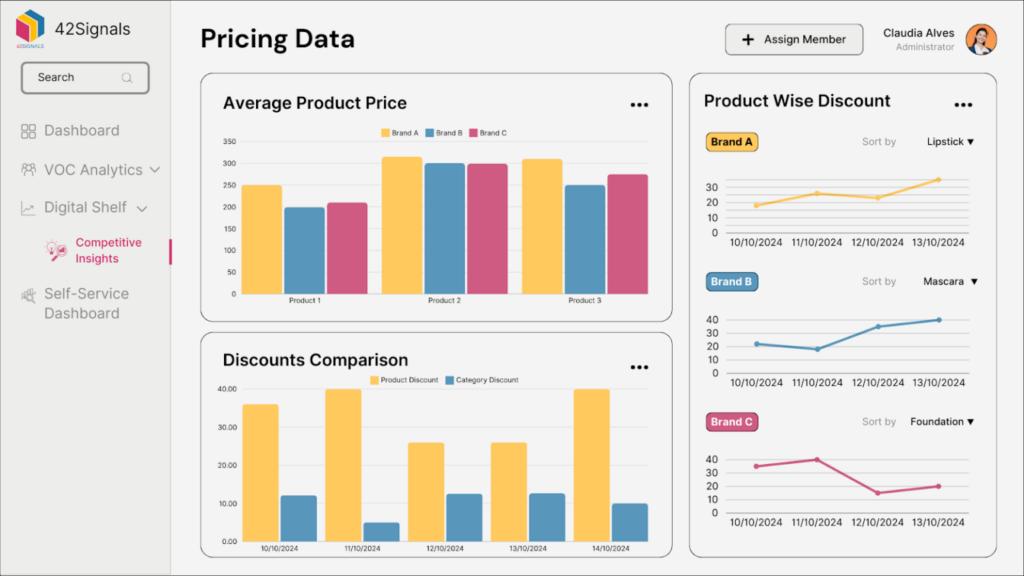
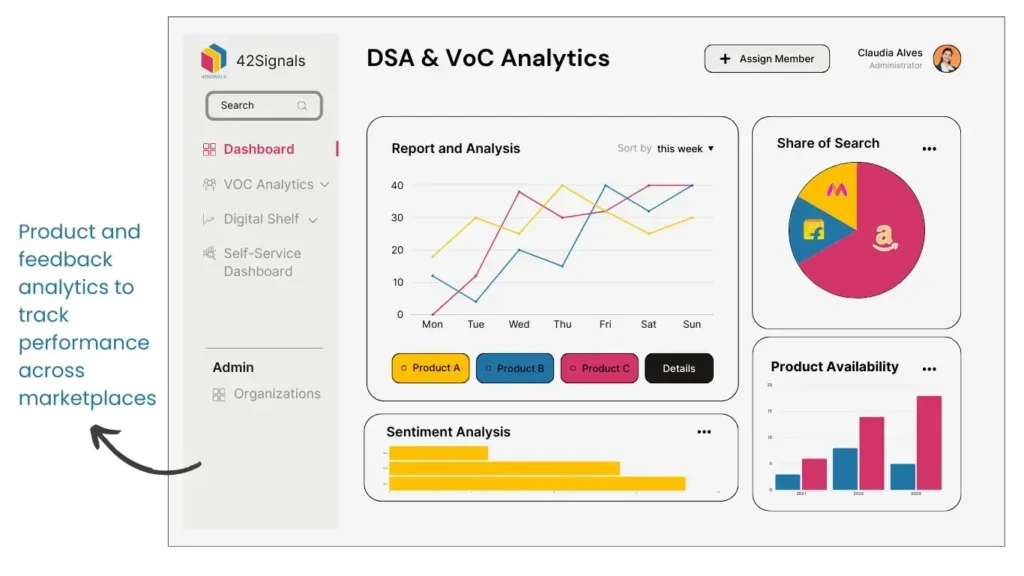
Digital shelf analytics tools like 42Signals provide brands with a range of features to help them track and analyze key digital shelf metrics, gain insights into their online performance, and take action to improve their digital shelf presence.
Here are a few ways that brands can use digital shelf analytics tools to track and analyze metrics:
Dashboard Overview: Digital shelf analytics tools typically provide a centralized dashboard overview that summarizes key metrics such as product availability, content quality, search visibility, and more across all retailers and product lines. This allows brands to quickly and easily identify areas that need attention and take action to address them from a single pane of glass.

This allows brands to quickly and easily identify areas that need attention and take action to address them.
Competitor Analysis: These tools enable brands to compare their performance to that of their competitors. This helps brands identify areas where they may be falling behind—be it in pricing, review volume, or content richness—and take steps to improve their online presence and gain a competitive edge.
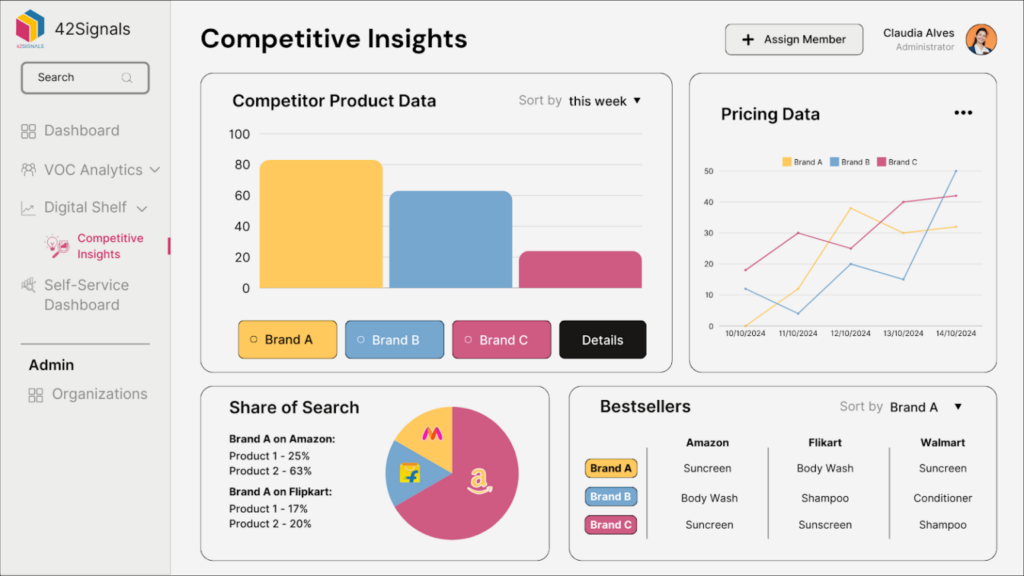
Custom Reports: Digital shelf analytics tools allow brands to create custom reports that focus on specific metrics, retailers, or product categories. This enables different teams (e.g., marketing, sales, supply chain) to gain more detailed insights into their digital shelf metrics and make data-driven decisions based on this information.
Actionable Insights: Perhaps the most important aspect of DSA tools is the ability to gain actionable insights into your digital shelf performance. With these tools, brands can identify specific areas that need attention (e.g., “Product X is out of stock on Walmart.com,” or “Your competitor’s price on Amazon is 15% lower”), prioritize their efforts, and take immediate, corrective action to improve their online presence and increase sales.
Assortment & Distribution Monitoring: Tools like 42Signals can also track where your products are being sold online, helping you identify unauthorized sellers and map your true digital distribution, which is critical for brand integrity and pricing control.
Tracking and analyzing key digital shelf metrics through DSA tools like 42Signals can provide valuable insights into a brand’s online performance. It can help identify areas for improvement and enable brands to take action and increase sales. In today’s e-commerce landscape, mastering your digital shelf is not just an advantage—it is a fundamental requirement for survival and growth.
The Future of the Digital Shelf: Beyond the Transaction
While tracking metrics and optimizing product pages are essential for current success, the digital shelf is rapidly evolving from a static display into a dynamic, personalized, and intelligent engagement platform. Understanding these future trends is crucial for brands that want to lead, not just compete.
The next generation of the digital shelf will be characterized by several key shifts:
1. Hyper-Personalization through AI and Machine Learning: The one-size-fits-all product page is becoming obsolete. Advanced algorithms will curate the digital shelf in real-time for each individual shopper. This means the imagery, copy, promotional offers, and even the recommended products will dynamically change based on a user’s browsing history, purchase behavior, demographic data, and even real-time intent. Your product’s presentation will be uniquely tailored to maximize its appeal for every single visitor.
2. The Rise of Voice and Visual Search: As smart speakers and image recognition technology proliferate, how consumers “browse” the digital shelf is changing. Optimizing for voice search means focusing on natural language and long-tail keyword phrases (e.g., “best organic dog food for large breeds with sensitive stomachs”). For visual search, it means having high-quality, distinctive imagery that can be easily identified by platforms like Google Lens or Pinterest Lens. The digital shelf of the future must be discoverable without a traditional text-based query.
3. Frictionless Commerce through Social and Augmented Reality (AR): The lines between discovery, inspiration, and purchase are blurring. Social commerce platforms are turning entire social feeds into digital shelves. Furthermore, Augmented Reality (AR) is transforming the product page itself. Imagine virtually “placing” a piece of furniture in your living room or “trying on” a shade of lipstick through your phone’s camera. These immersive experiences, integrated directly onto the digital shelf, drastically reduce purchase uncertainty and elevate the online shopping experience, bridging the final gap between digital browsing and physical confidence.
4. Sustainability and Ethical Transparency as a Core Shelf Component: Modern consumers increasingly make purchase decisions based on a brand’s values. The digital shelf is becoming the primary venue for communicating this. Future-facing brands will use their product pages to highlight sustainability metrics—such as carbon footprint, recycled material composition, or ethical sourcing certifications—with the same prominence they give to features and price. This transparency will become a non-negotiable element of product content, directly influencing conversion and loyalty.
5. The Synchronized Ecosystem: Unifying Online and Offline: The future digital shelf will not exist in a vacuum. It will be fully synchronized with physical retail through technologies like QR codes, NFC tags, and in-store interactive kiosks. A customer might scan a QR code on a physical shelf tag to access enhanced digital content, check inventory at home, or read reviews before making an in-store purchase. This creates a seamless, “phygital” customer journey where the digital and physical shelves are two sides of the same coin.
Frequently Asked Questions
What are the components of the digital shelf?
The digital shelf encompasses every touchpoint where consumers interact with a brand’s products online.
It’s akin to a virtual aisle where shoppers browse and make purchasing decisions. Here are the key components of the digital shelf:
- Product Information and Content: The foundation of the digital shelf, including product descriptions, specifications, pricing, and availability.
- Primary and Secondary Images: Hero images and other visuals that help shoppers visualize the product from different angles.
- Pricing: Easily accessible pricing information.
- Reviews and Ratings: Influential in consumer decision-making and one of the important digital shelf metrics.
- Search Results, Ads, and Product Pages: Everywhere your product can be found through a screen.
- Social Media Accounts and Mobile Apps: Additional channels for engagement.
What is the share of a digital shelf?
The share of the shelf is a KPI that measures the volume and visibility of a brand’s products on retail shelves compared to competitors within a category. In the digital context, it refers to how much digital real estate a brand occupies on e-commerce websites.
Brands rely on visual diagrams called planograms to compute their share of shelf percentage.
What is digital shelf optimization?
Digital shelf optimization (DSO) is the art of crafting and enhancing a brand’s presence on e-commerce websites. It ensures that products are visible, compelling, and easy to find and purchase.
Just as websites are optimized for search engines, brands must optimize their product listings for the algorithms powering e-commerce platforms.
How do you measure share of shelf?
To measure share of shelf, consider the following methods:
- Product Facings: Count how many times a specific item is visible from the front of the shelf. These facings indicate prominence.
- Linear Shelf Space: Measure the linear space occupied by a brand’s products on the shelf.
- Planograms vs. Realograms: Planograms represent the visual layout, while realograms show the actual placement in a store.