


** TL;DR ** To truly understand and improve your brand’s online success, look beyond sales figures and focus on four critical metrics that measure your digital shelf performance: Share of Search (your brand’s visibility in customer searches), Out-of-Stock Rate (lost sales due to inventory gaps), MAP Compliance (adherence to pricing policies to protect brand value), and First Page Visibility (your products’ discoverability in search results). Together, these indicators provide a proactive diagnostic dashboard that reveals the health of your online presence, explains the drivers behind sales trends, and guides strategic optimization for sustainable growth across retail platforms.
While sales figures provide a critical summary of commercial outcomes, they represent a historical account rather than a diagnostic tool. An exclusive focus on revenue and units sold offers limited insight into the health and potential of your online brand presence. To cultivate sustainable growth, brands must monitor the leading indicators that directly influence purchase decisions on the digital shelf. This requires shifting from a retrospective view to a proactive analysis of the factors governing online visibility, availability, and brand integrity. Digital shelf performance transcends final sales data.
It encompasses the totality of the customer experience across retailer sites like Amazon, Walmart, and Target, from discovery to the point of purchase. A sophisticated analytics strategy examines the elements that either facilitate or obstruct the path to conversion. The following four metrics provide the foundational framework for this analysis, offering actionable intelligence to optimize your brand’s presence, protect its value, and predict future performance.
The Limitations of a Sales-Only Perspective in Digital Shelf Performance
Sales data is unequivocally vital as a key performance indicator, yet it functions primarily as a lagging measure. It confirms outcomes but does not explain the conditions that produced them. Relying solely on this data is akin to managing a retail store by only reviewing daily cash register totals without ever walking the sales floor. You remain unaware of empty shelves, incorrect price tags, or competitors’ promotional displays that directly siphon potential customers.

Image Source: Thunder Bit
A robust digital shelf performance strategy employs leading indicators that act as both a diagnostic and a predictive compass. These metrics illuminate the “why” behind sales trends, allowing brands to intervene before revenue is impacted. According to research by McKinsey, organizations leveraging advanced analytics in commercial operations can improve their marketing ROI by 15-20%. The strategic implication is clear: optimizing the digital shelf environment is a prerequisite for maximizing sales efficiency.
Metric 1: Share of Search – Gauging Mindshare and Demand
Share of Search measures the percentage of category-related search queries that include your brand or product name within a given marketplace. It serves as a powerful proxy for brand health and a leading indicator of market share, reflecting top-of-funnel demand and consumer awareness.

Strategic Importance
This metric quantifies your brand’s mindshare within a specific product category. A growing Share of Search suggests increasing brand relevance and consideration, which typically precedes market share gains.
Conversely, a decline signals eroding visibility, potentially due to competitive pressures, diminished marketing impact, or shifting consumer preferences. It moves the analysis upstream from the point of purchase to the critical moment of intent formation, providing time to adjust strategies.
Optimization Framework
Improving Share of Search requires a dual focus on content optimization and demand generation. Ensure product listings are comprehensively optimized for both branded keywords and high-volume, non-branded category terms. Concurrently, align external marketing efforts—including content marketing, social media, and influencer partnerships—to drive branded search volume.
This integrated approach ensures that increased awareness translates directly into measurable search behavior on retailer platforms, strengthening your overall share of search position.
Metric 2: Out-of-Stock Rate – Quantifying Lost Opportunity
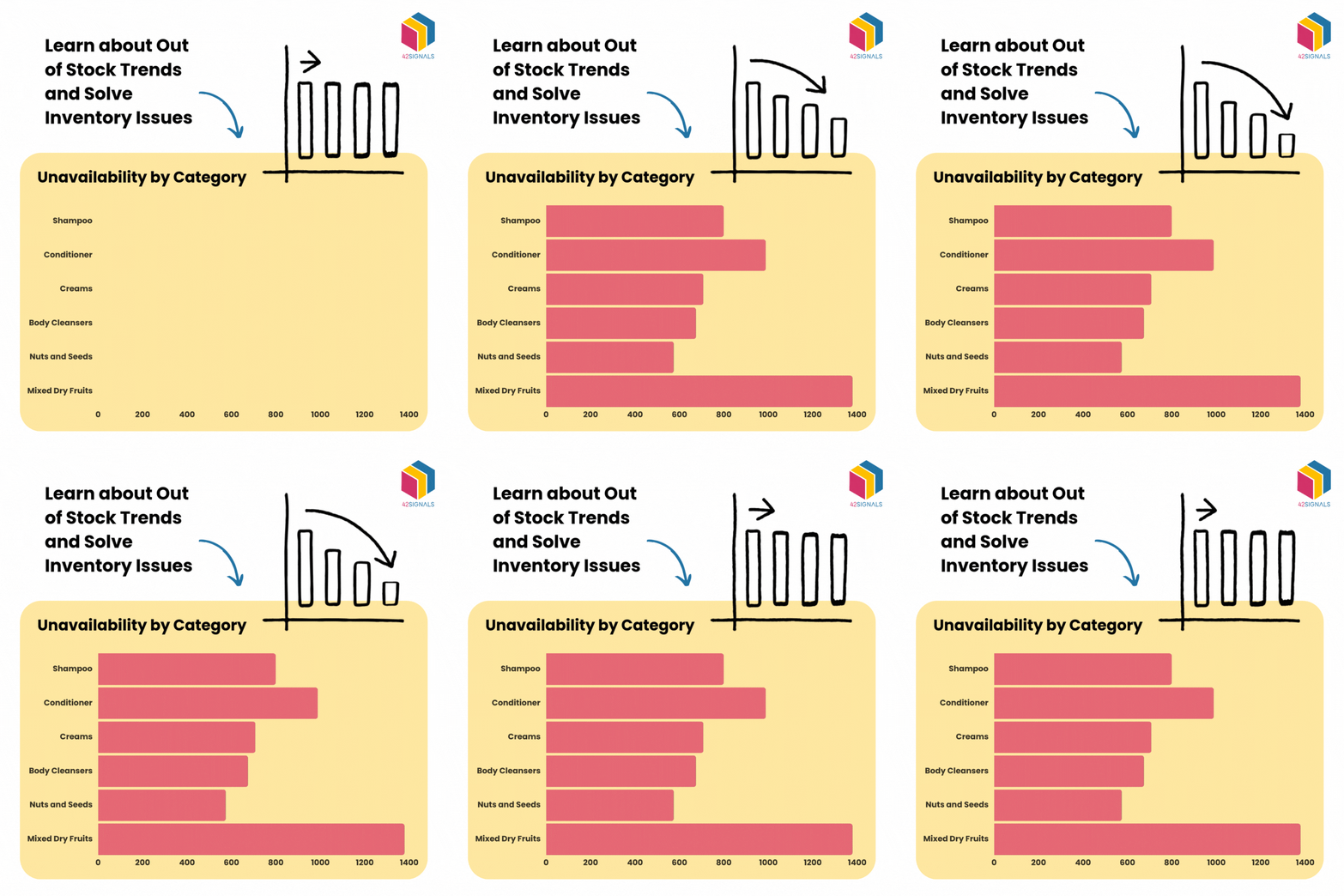
The Out-of-Stock Rate represents the percentage of time a product is listed as unavailable for purchase on a retailer’s site. It directly measures lost revenue opportunity and signifies a critical failure in supply chain and inventory management relative to demand.
The Compound Cost of Stockouts
An out-of-stock situation imposes immediate and long-term costs. The immediate loss of the sale is often transferred to a competitor. From a longer-term perspective, frequent stockouts erode consumer trust, damage brand reliability, and can trigger algorithmic penalties on retailer sites, resulting in decreased visibility.
A report by the IHL Group estimates that global retailers lose over $1 trillion annually due to inventory distortion, which includes out-of-stocks. For brand manufacturers, this directly undermines marketing investments and hard-won search placement.
Management and Mitigation
Proactive inventory management is essential for product availability. Brands should implement online retail analytics tools that provide real-time visibility into stock levels across all digital channels. Establish automated low-inventory alerts and develop responsive replenishment protocols.
Collaborating closely with retailers on shared data and forecasts can further enhance accuracy. Treating inventory availability as a key component of digital shelf performance ensures that marketing and visibility investments are not wasted at the final moment of truth.
Metric 3: MAP Compliance – Preserving Brand Equity and Channel Health in Digital Shelf Performance
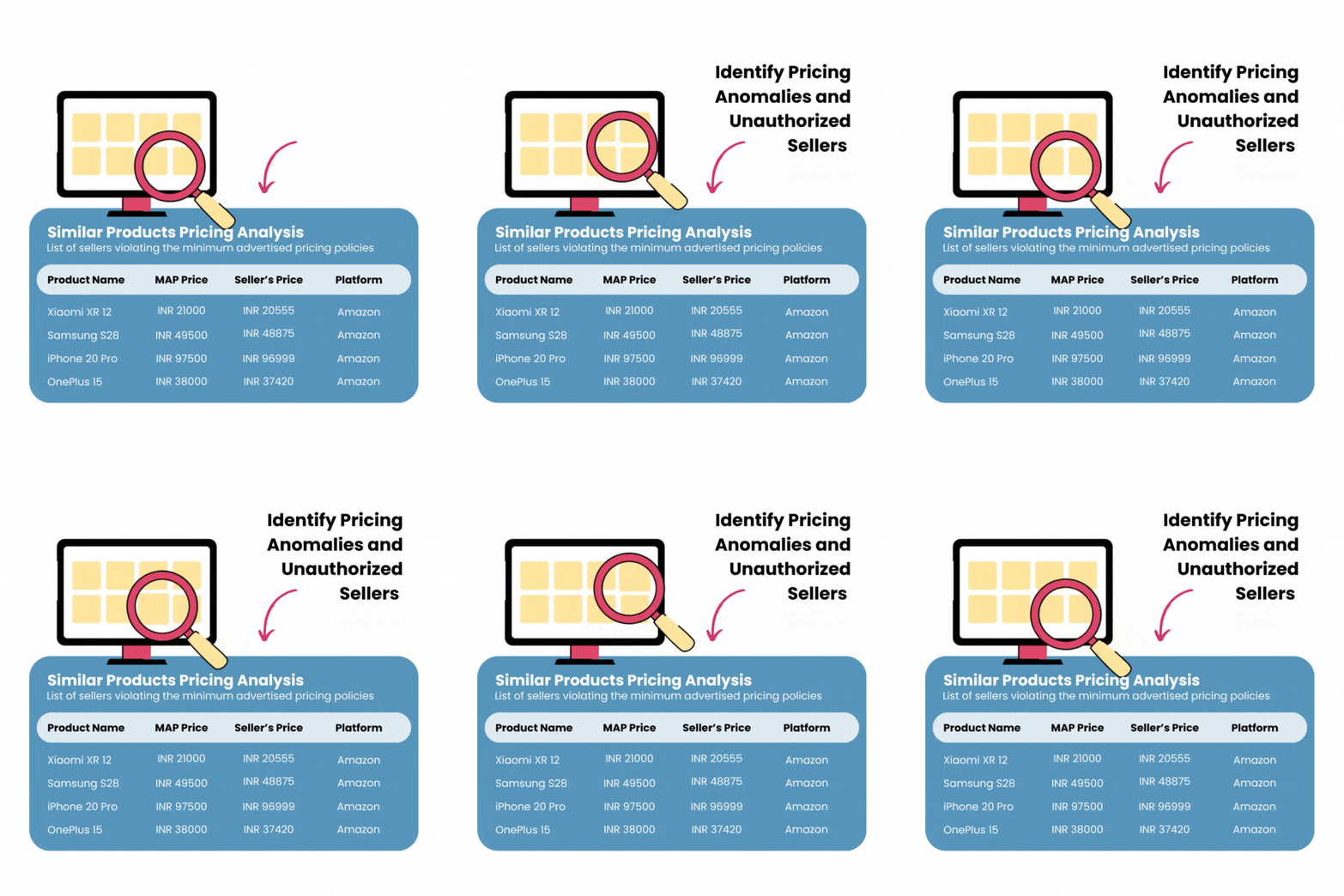
Minimum Advertised Price (MAP) compliance monitoring tracks adherence to agreed-upon pricing policies across your online distribution network. MAP violations threaten brand equity, erode retailer margins, and create channel conflict, destabilizing the market for your products.
Consequences of Price Erosion
Unchecked MAP violations initiate a downward pricing spiral. Authorized retailers, facing unfair competition from discounters, may withdraw promotional support or discontinue carrying the brand.
For consumers, inconsistent pricing fosters perceptions of lower quality or brand dilution. This environment of price chaos makes coherent brand storytelling impossible and damages relationships with valued retail partners, ultimately impairing long-term digital shelf performance.
Enforcement as a Strategic Function
Effective governance requires systematic monitoring and consistent enforcement. Utilize retail benchmarking software to continuously scan the digital landscape for pricing anomalies.
A formal enforcement policy should be clearly communicated to all distributors, outlining progressive steps from notification to potential suspension of supply. Vigilant MAP enforcement is not punitive; it is a protective measure that ensures all channel partners can maintain healthy margins, thereby incentivizing their investment in selling and promoting your products.
Metric 4: First Page Visibility – Securing Critical Discoverability

Image Source: Amazon.com
First Page Visibility measures the frequency with which your products appear on the first page of search results for their targeted keywords on a retailer’s platform. In digital commerce, this visibility is a fundamental determinant of consideration and conversion.
The Imperative of Prominent Placement
Consumer behavior data consistently shows that a dominant majority of clicks are captured by products listed on the first search results page, with visibility decreasing precipitously thereafter. First page visibility is therefore a non-negotiable objective for driving traffic.
A product may have superior features and excellent content, but without prominent placement, it remains effectively invisible to the majority of shoppers.
Driving Improved Search Rank
Achieving first-page placement is a multidisciplinary effort. It begins with meticulous, platform-specific keyword research and the strategic integration of those terms into product content. Completing every attribute field, utilizing high-quality visual assets, and actively generating positive customer reviews are all table stakes.
Furthermore, since sales velocity is a key ranking factor on many platforms, strategies to drive external traffic can create a positive feedback loop. Regularly tracking these visibility metrics provides a clear performance baseline and identifies optimization opportunities for individual products and across the portfolio.
Digital Shelf Metrics Framework: The Complete Reference Table
Understanding what to measure is only half the battle. You also need to know what “good” looks like, who owns improvement, and how often to track. This framework, which can also be used for competitor price intelligence, provides that clarity.
| Metric | Definition | “Good” Threshold | “Bad” Threshold | Owner (RACI) | Measurement Frequency |
| Share of Search | Percentage of category searches that include your brand/product | Top 3 in category; >15% share | Outside top 5; declining >10% MoM | Marketing / Brand Manager | Weekly (trend), Monthly (share) |
| Out-of-Stock Rate | Percentage of time SKU is unavailable | <2% of days per month | >5% of days per month | Supply Chain / Ops Manager | Daily (alerts), Weekly (trend) |
| MAP Compliance | Percentage of authorized sellers adhering to MAP | >95% of listings compliant | <85% compliance; repeat offenders | Channel Ops / Legal | Daily (alerts), Weekly (violations) |
| First Page Visibility | Percentage of target keywords where product ranks page 1 | >80% for priority keywords | <50% for priority keywords | Category / SEO Manager | Weekly (rank), Monthly (share) |
| Content Score | Completeness and quality of product content (titles, images, descriptions) | >90% content completeness | <70% completeness | Category / Merchandising | Weekly (audit), Monthly (score) |
| Buy Box % | Percentage of time your product wins the Buy Box (Amazon/Walmart) | >90% for priority SKUs | <70%; trending down | Ecommerce Ops / Pricing | Daily, Weekly trend |
| Ratings Velocity | Rate of new reviews per week/month | Growing >10% MoM; category leader | Flat or declining; lower than competitors | Customer Experience / Marketing | Weekly, Monthly |
| Search Rank | Position for target keywords across platforms | Top 3 for core terms; page 1 for category | Below page 3 for key terms | SEO / Category Manager | Weekly (core), Monthly (long-tail) |
RACI Owner Definitions
| Role | Responsibility |
| Marketing / Brand Manager | Owns brand visibility, Share of Search, demand generation, content strategy |
| Supply Chain / Ops Manager | Owns inventory availability, fulfillment, out-of-stock prevention |
| Channel Ops / Legal | Owns retailer relationships, MAP policy, enforcement actions |
| Category / Merchandising | Owns product content, assortment, listing optimization |
| SEO / Ecommerce Manager | Owns search rank, keyword strategy, first page visibility |
| Customer Experience | Owns review generation, ratings, customer feedback response |
| Ecommerce Ops / Pricing | Owns Buy Box management, competitive pricing, repricing rules |
Weekly Operating Cadence: The Digital Shelf Review Rhythm
A consistent operating cadence transforms metrics from passive reports into active management tools. Here’s how to structure your week.
Monday: Kickoff & Alert Triage (30 minutes)
Focus: Rapid response to urgent issues that emerged over the weekend
| Review Item | What to Look For | Trigger for Action |
| Stockout Alerts | SKUs that went OOS since Friday | Immediate expedite; assess impact |
| MAP Violations | New unauthorized sellers or price drops | Send warning notices; escalate repeat offenders |
| Buy Box Loss | SKUs where you lost Buy Box | Investigate cause; decide repricing response |
| Critical Rank Drops | Top 10 SKUs with rank drop >10 positions | Audit listing; check competitor activity |
Outcome: Assign owners for urgent actions; log issues for weekly review
Tuesday: Search Visibility Review (1 hour)
Focus: Deep dive on Share of Search, First Page Visibility, and Search Rank
| Review Item | What to Look For | Trigger for Action |
| Share of Search Trends | Changes vs. previous week/month; competitor movements | Investigate cause; adjust content or marketing |
| First Page Visibility % | % of target keywords on page 1 | Identify gaps; prioritize optimization |
| Keyword Rank Changes | Top 20 keywords—winners and losers | Double down on winners; diagnose losers |
| Competitor Rank Moves | Competitors gaining on your key terms | Audit their listings; consider response |
Outcome: Optimization priorities for the week; content updates assigned
Wednesday: Content & Experience Review (1 hour)
Focus: Product content quality, ratings, and customer feedback
| Review Item | What to Look For | Trigger for Action |
| Content Score | Completeness gaps; low-scoring SKUs | Assign content updates; prioritize high-volume SKUs |
| Ratings Velocity | New review rate; total reviews vs. competitors | Plan review generation campaign |
| Sentiment Trends | Emerging complaints or praise themes | Inform product, marketing, or CX |
| Image Quality | Missing or low-quality images | Prioritize reshooting or uploads |
Outcome: Content improvement plan; review generation initiatives
Thursday: Supply & Compliance Review (1 hour)
Focus: Inventory health and pricing policy enforcement
| Review Item | What to Look For | Trigger for Action |
| OOS Rate by SKU | SKUs with recurring stockouts | Root cause analysis; forecast review |
| Low Inventory Alerts | SKUs below 2 weeks supply | Expedite reorders; consider price adjustments |
| MAP Compliance Rate | % compliant vs. target | Escalate repeat violators; audit enforcement actions |
| Unauthorized Sellers | New unauthorized listings | Send cease-and-desist; trace source |
Outcome: Supply chain actions; enforcement updates
Friday: Leadership Summary & Next Week Planning (30 minutes)
Focus: Weekly summary, cross-functional alignment, next week priorities
| Review Item | What to Look For | Action |
| Key Metrics Dashboard | Performance vs. targets; week-over-week trends | Identify wins and areas needing focus |
| Action Items Status | Open vs. completed actions | Close completed; reprioritize open |
| Next Week Priorities | Top 3-5 initiatives | Align teams; assign owners |
| Executive Summary | 1-page recap of performance | Share with leadership |
Outcome: Weekly summary; aligned priorities
Five Metric Playbooks: What to Do When Digital Shelf Performance Drops
When a key metric declines, the worst response is panic. The best response is systematic diagnosis and targeted action. Here are playbooks for the five most critical digital shelf metrics.
Playbook 1: Content Score Drop
Symptom: Content completeness score falls below 80% or drops >10% week-over-week
Immediate Triage (24 hours)
| Step | Action | Owner |
| 1 | Identify which SKUs or categories drove the drop | Category Manager |
| 2 | Check if new products were added without complete content | Merchandising |
| 3 | Verify if platform requirements changed (e.g., new image specs) | Ecommerce Ops |
Root Cause Analysis (48 hours)
| Potential Cause | How to Diagnose |
| New product launch | Audit recent additions against completeness checklist |
| Platform change | Review retailer content requirements updates |
| Data feed failure | Check integration between your system and retailer |
| Manual entry error | Review recent content updates; identify patterns |
Remediation Actions
| Scenario | Action | Timeline |
| New products incomplete | Prioritize top-volume SKUs; complete within 7 days | 1-2 weeks |
| Platform change | Update all SKUs to new requirements | 1-2 weeks |
| Data feed issue | Fix integration; re-sync | 24-48 hours |
| Manual errors | Audit and correct; implement checklist | 1 week |
Prevention
- Implement automated content validation before publishing
- Maintain content completeness dashboard with weekly alerts
- Train team on platform requirements changes
Playbook 2: Availability Drop (Out-of-Stock Rate Spikes)
Symptom: OOS rate exceeds 5% or increases >3% week-over-week
Immediate Triage (24 hours)
| Step | Action | Owner |
| 1 | Identify which SKUs are OOS and for how long | Supply Chain |
| 2 | Check if OOS is platform-specific or across all channels | Ecommerce Ops |
| 3 | Verify if forecast missed or supply chain broke | Demand Planning |
Root Cause Analysis (48 hours)
| Potential Cause | How to Diagnose |
| Demand spike | Compare sales vs. forecast; check promotional impact |
| Supplier issue | Review purchase orders; contact supplier |
| Logistics delay | Track shipment status; check carrier performance |
| Forecasting error | Review forecast model inputs; check seasonality |
| Platform listing issue | Check if product is suppressed (content, compliance) |
Remediation Actions
| Scenario | Action | Timeline |
| Demand spike | Expedite reorder; consider price increase to slow velocity | 24-72 hours |
| Supplier issue | Source alternative; expedite; communicate to sales | 1-2 weeks |
| Logistics delay | Split shipments; air freight if critical | 3-7 days |
| Forecasting error | Adjust models; increase safety stock | 1 week |
| Listing suppression | Fix content/compliance issue; request reinstatement | 24-72 hours |
Prevention
- Set automated low-inventory alerts at 2 weeks supply
- Maintain safety stock for top 20% SKUs
- Review forecast weekly with sales and marketing
Playbook 3: Buy Box % Drop
Symptom: Buy Box ownership drops below 80% or declines >10% week-over-week
Immediate Triage (24 hours)
| Step | Action | Owner |
| 1 | Identify which SKUs lost Buy Box | Ecommerce Ops |
| 2 | Determine who won Buy Box (competitor, other seller) | Pricing Analyst |
| 3 | Check price gap between you and winner | Pricing Analyst |
Root Cause Analysis (48 hours)
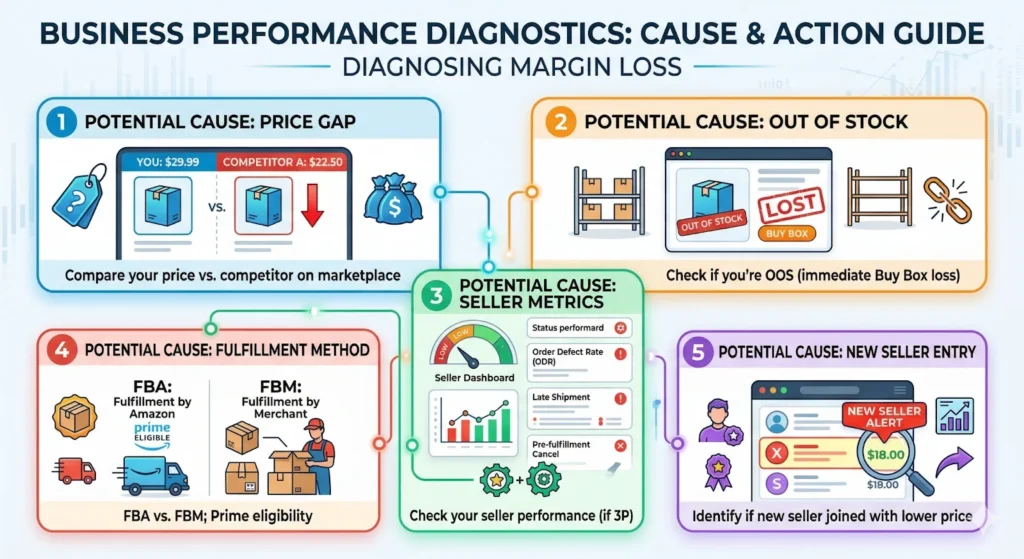
Remediation Actions
| Scenario | Action | Timeline |
| Price gap | Match competitor within margin tolerance | 4-24 hours |
| Out of stock | Expedite restock; prioritize this SKU | 24-72 hours |
| Seller metrics | Address performance issues; improve ratings | 1-2 weeks |
| Fulfillment disadvantage | Consider switching to FBA or improved shipping | 1-2 weeks |
| New seller | Investigate source; enforce MAP; compete on service | 24-72 hours |
Prevention
- Set automated price monitoring with Buy Box alerts
- Maintain FBA/Fulfilled inventory for top SKUs
- Monitor seller metrics dashboard weekly
Playbook 4: Search Rank Drop
Symptom: Priority keyword rank drops >10 positions or below page 3
Immediate Triage (24 hours)
| Step | Action | Owner |
| 1 | Identify which keywords and SKUs dropped | SEO Manager |
| 2 | Check if drop is platform-specific or across all | Ecommerce Ops |
| 3 | Verify if competitor launched new product or promotion | Category Manager |
Root Cause Analysis (48 hours)
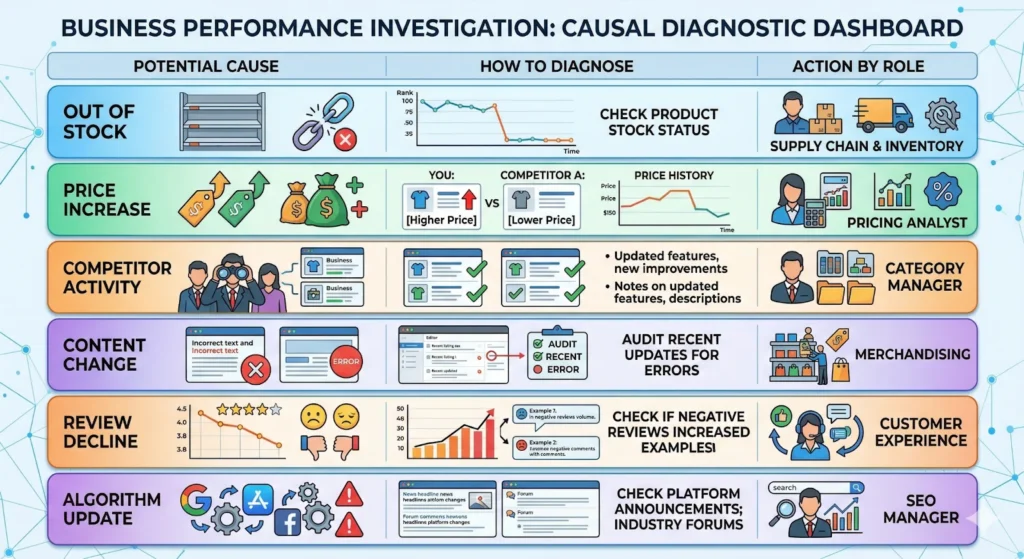
Remediation Actions
| Scenario | Action | Timeline |
| Out of stock | Restock ASAP; rank recovers with availability | 24-72 hours |
| Price gap | Adjust price if margin allows | 24 hours |
| Competitor improved | Audit their listing; upgrade yours | 1-2 weeks |
| Content error | Fix titles, bullets, images | 24-48 hours |
| Negative reviews | Address customer issues; generate new positive reviews | 1-4 weeks |
| Algorithm change | Adapt to new ranking factors; test changes | 1-4 weeks |
Prevention
- Monitor rank weekly with automated tools
- Maintain content freshness with quarterly audits
- Keep 90%+ content completeness score
Playbook 5: Ratings Velocity Drop
Symptom: New review rate declines >20% MoM or below category average
Immediate Triage (24 hours)
| Step | Action | Owner |
| 1 | Identify which SKUs have declining review velocity | Customer Experience |
| 2 | Check if sales volume for those SKUs also declined | Category Manager |
| 3 | Verify if competitor review rates increased | Marketing |
Root Cause Analysis (48 hours)
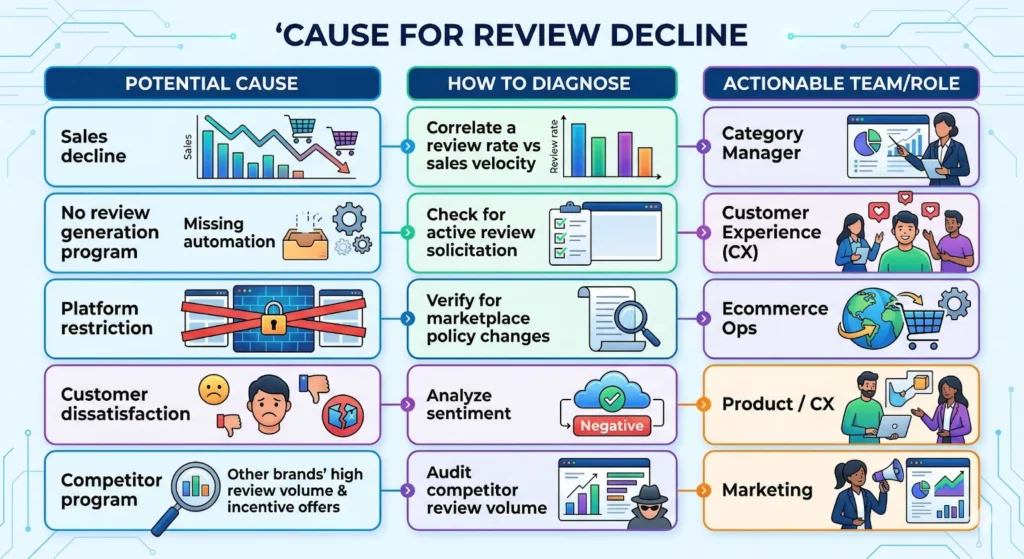
Remediation Actions
| Scenario | Action | Timeline |
| Sales decline | Address root cause (availability, rank, price) | 1-4 weeks |
| No review program | Implement post-purchase review solicitation | 1-2 weeks |
| Platform restriction | Adapt to new rules; focus on allowable channels | 1 week |
| Quality issues | Address product issues; respond to negative reviews | 1-4 weeks |
| Competitor program | Benchmark and improve your incentives | 2-4 weeks |
Prevention
- Implement automated review solicitation
- Set weekly review count targets by SKU
- Monitor review velocity as leading indicator
The Digital Shelf Operating System: Metrics, Cadence, and Playbooks as One Framework
The metrics framework, weekly cadence for inventory forecasting, and playbooks form a complete operating system for digital shelf management:
| Component | Purpose | Output |
| Metrics Framework | Defines what to measure and targets | Dashboard, accountability |
| Weekly Cadence | Creates consistent review rhythm | Rapid response, trend awareness |
| Playbooks | Enables systematic action | Faster resolution, fewer mistakes |
When implemented together, they transform digital shelf management from reactive firefighting to proactive optimization.
Building an Integrated Digital Shelf Performance Dashboard
The true power of these metrics is realized not in isolation, but through their integration. They form a interconnected framework for holistic brand management on the digital shelf. Share of Search drives potential demand; First Page Visibility captures that demand; MAP Compliance preserves the brand’s value proposition; and inventory availability secures the conversion. A weakness in any single metric can diminish the effectiveness of the others.
To operationalize this framework, implement a centralized online retail analytics platform that aggregates data across these four areas. This unified dashboard moves the organization from reactive reporting to proactive brand stewardship.
Establish regular cross-functional reviews to assess performance against retail benchmarking data and competitive sets.
Key Takeaways
- Move Beyond Lagging Indicators: Sales data alone is a historical report; to drive future growth, you must analyze the leading indicators that directly influence purchasing decisions on the digital shelf.
- Measure Share of Search: This metric acts as a leading indicator of market share, quantifying brand demand and mindshare by tracking how often your brand appears in category-related search queries.
- Minimize Out-of-Stock Rate: Treat inventory availability as a critical component of performance, as stockouts result in immediate lost sales, long-term brand damage, and algorithmic penalties on retailer sites.
- Enforce MAP Compliance: Vigilant monitoring and enforcement of Minimum Advertised Price policies are essential to protect brand equity, ensure retailer profitability, and maintain healthy channel partnerships.
- Prioritize First Page Visibility: Secure discoverability by optimizing for prominent search placement, as the vast majority of e-commerce conversions are captured by products listed on the first page of results.
- Adopt an Integrated View: These four metrics form an interconnected diagnostic dashboard. A holistic, data-driven approach to these areas enables proactive brand management and sustainable competitive advantage online.
Conclusion on the Importance of Digital Shelf Performance
Transitioning to a metric-driven approach centered on digital shelf performance represents a strategic evolution in e-commerce management. It replaces a narrow focus on historical outcomes with a comprehensive system for diagnosing health, predicting trends, and guiding investment.
By mastering Share of Search, Out-of-Stock Rate, MAP Compliance, and First Page Visibility, brands gain the actionable intelligence needed to optimize their online presence, protect their equity, and build a resilient, high-growth digital business. The future belongs to brands that understand not just what they sold, but how effectively they are presented and managed within the digital ecosystems where commerce now happens.

Try 42Signals today to understand your digital shelf analytics and how this data can impact your business.
Frequently Asked Questions
1. What is digital shelf performance?
Digital shelf performance refers to how well a product competes, converts, and stays visible across online marketplaces and retail platforms. It looks at the signals that influence a shopper’s decision before they click “buy,” such as:
Search ranking
Content accuracy and completeness
Pricing competitiveness
Stock availability
Customer reviews and ratings
Buy Box ownership
Competitor positioning
When these elements perform well, the product becomes easier to find, more appealing to shoppers, and more likely to drive sales. Poor digital shelf performance typically results in lost visibility, lost market share, and lower conversions.
2. What is digital shelf optimization?
Digital shelf optimization is the ongoing process of improving how products appear and compete online. It involves adjusting product content, pricing, availability, and promotional strategies to maximize visibility and conversion.
Effective optimization includes:
Updating product images, titles, bullets, and SEO-rich descriptions
Ensuring consistent pricing across channels
Monitoring stock to prevent availability gaps
Managing reviews and improving sentiment
Tracking competitor listings and responding quickly
Testing and improving content variations
Optimization is not a one-time task. Online platforms change continuously, so brands must fine-tune their digital shelf daily to stay competitive.
3. What does digital shelf mean?
The digital shelf is the online equivalent of a physical store shelf. It represents the space where products appear on e-commerce websites, marketplaces, retailer apps, and search results.
Everything a consumer sees before purchasing—content, images, price, shipping details, reviews—makes up the digital shelf.
Unlike a physical shelf, the digital shelf is shaped by:
Search algorithms
Advertising
Competitor behavior
Availability
Content quality
Pricing dynamics
A strong digital shelf presence ensures products remain discoverable and competitive in crowded online environments.
4. What is digital shelf excellence?
Digital shelf excellence is the highest level of performance a brand can achieve across online retail channels. It means a brand consistently dominates search results, maintains pricing strength, delivers high-quality content, owns the Buy Box, and keeps products in stock.
Digital shelf excellence typically includes:
High search rank for priority keywords
Best-in-class product content and imagery
Strong review scores with continuous feedback management
Perfect availability and supply chain consistency
Competitive pricing supported by real-time analytics
Fast reaction to competitor moves
Compliance with retailer standards
Brands that achieve digital shelf excellence build trust, outperform competitors, and capture disproportionate market share.