

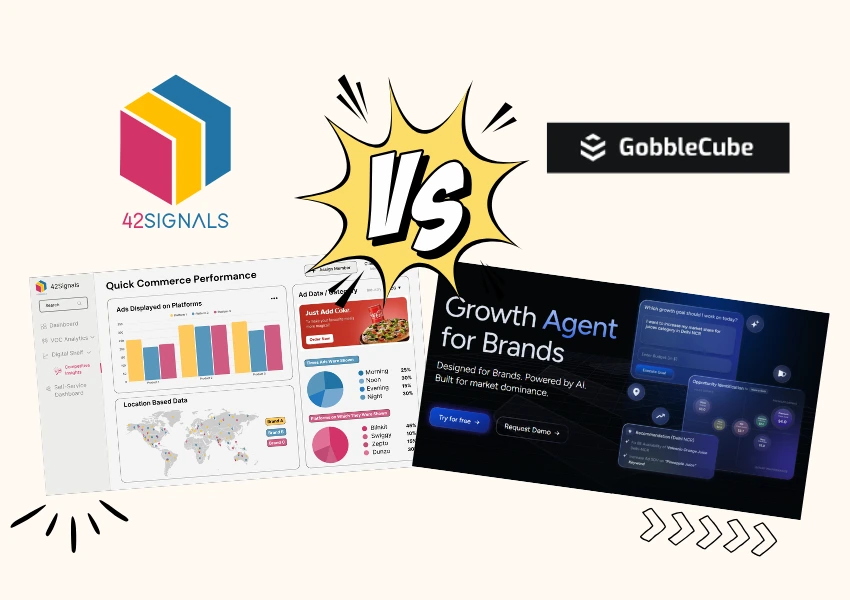
** TL;DR ** When choosing between GobbleCube and 42Signals, the decision hinges on a fundamental trade-off: strategic breadth versus tactical agility. 42Signals is the powerhouse for global, comprehensive analytics, offering deep historical data integration across countless marketplaces—ideal for large enterprises needing a stable, unified view for long-term planning and high-level reporting. In contrast, GobbleCube is the specialist for speed and surgical precision, excelling in near real-time data—particularly for quick commerce—with granular insights into share-of-search, MAP violations, and inventory, all designed to fuel immediate, automated actions for brands in fast-moving, competitive niches. Essentially, 42Signals provides the authoritative map for a wide-scale campaign, while GobbleCube delivers the live radar and precision tools for winning daily battles. Your choice depends on whether your priority is overarching strategic oversight or rapid, tactical execution.
Are you drowning in data but starving for insights? In today’s lightning-fast world of online shopping, knowing exactly what’s happening across multiple e-commerce platforms isn’t just nice—it’s the only way to survive and thrive. Choosing the right data analytics partner can feel like navigating a maze. Two big players often come up in the conversation: 42Signals and GobbleCube.
This article is designed to be your quick guide, helping you compare these two powerhouses so you can confidently pick the right tool for your e-commerce business. We’ll break down what makes each platform unique, focusing on how they handle everything from basic e-commerce analytics to deep dives into marketplace data and the hyper-speed world of quick commerce insights. Let’s get started on finding the perfect fit for your needs.
Understanding the E-commerce Data Landscape with Gobblecube and 42Signals
Before we dive into the specific features of 42Signals and GobbleCube, it’s crucial to understand why having a specialized data partner is non-negotiable.

Image Source: Gobblecube Website
The Challenge of Modern E-commerce Analytics
Gone are the days when tracking sales on a single website was enough. Now, your customers are everywhere: Amazon, Walmart, regional marketplaces, and the rapidly growing sector of quick commerce apps delivering groceries in minutes. This fragmentation creates a data nightmare.
You need a platform that can aggregate, clean, and interpret this sprawling information. The core need is simple: a single, accurate view of your performance, your competitors’ moves, and market trends. This is where specialized tools like GobbleCube and 42Signals step in, transforming raw data into actionable strategies. Without this, you’re essentially flying blind in a very crowded sky.
Beyond Basic Sales: What Good Data Analysis Delivers
Effective e-commerce data analysis goes far beyond “how much did we sell?” It’s about answering the high-impact questions:
- Why did my competitor’s product suddenly jump in ranking? This is an area where strong competitor analytics provides the answers, allowing you to react swiftly to changes in market dynamics.
- What percentage of customers are seeing my product versus my competitor’s when searching for a specific term? This metric is the share of search, and tracking it accurately tells you if your product visibility is gaining or losing ground against the competition.
- Are our products being sold below the Minimum Advertised Price (MAP) on any platform? Tools focused on map violations are essential for monitoring this to protect your brand’s pricing integrity and reputation in the digital space.
- Which keywords are driving the most organic traffic, and where are we losing ground? This is addressed by effective keyword analysis, which helps you fine-tune your product titles and descriptions for maximum impact.
Both 42Signals and GobbleCube promise to deliver these answers, but they approach the task with different strengths. The choice depends entirely on your specific focus—are you more concerned with broad market trends or granular, minute-by-minute quick commerce insights?
Deep Dive into 42Signals: Strengths and Focus

42Signals has established itself as a robust platform, often favored by larger enterprises looking for comprehensive, global e-commerce analytics. Their strength typically lies in breadth and deep integration capabilities.
Comprehensive E-commerce Analytics Reporting
One of 42Signals’ primary benefits is its ability to stitch together massive datasets from numerous global marketplaces. They are generally known for their detailed reporting features, which can be highly customizable.
For instance, a brand operating across ten different countries or marketplaces like Amazon and eBay can use 42Signals to consolidate all sales, inventory, and advertising performance into a single dashboard. This comprehensive view saves immense time and resources that would otherwise be spent manually combining spreadsheets. The complexity and breadth of this reporting make it highly valued by global teams who need a consistent overview.
Focusing on Marketplace Data Integrity
Data cleanliness is paramount, and 42Signals often places a strong emphasis on data integrity. They ensure that the marketplace data you receive is scrubbed of common errors and inconsistencies, providing a reliable foundation for critical business decisions. If you are a brand that needs to confidently report market share of search to stakeholders based on meticulously sourced data, 42Signals’ focus on integrity will be a key differentiator. They aim to reduce the noise and deliver a signal you can trust, which is crucial when making multi-million dollar decisions.

Competitor Analytics and Historical Trend Mapping
When it comes to understanding the competitive environment, 42Signals offers strong tools for competitor analytics. Their platform allows users to track pricing changes, stock levels, and promotional activities of direct rivals over extended periods. This historical mapping is vital for strategic planning.
For example, by analyzing six months of competitor pricing data, a brand can identify patterns—such as pre-holiday price drops—and use this information to create a more effective, proactive pricing strategy for the next cycle. This long-view approach is essential for stable, sustained growth in large markets.
Key Takeaway for 42Signals
42Signals excels at providing a broad, reliable, and deeply integrated view of global e-commerce analytics. It’s a strong fit for established brands requiring high-level data aggregation and historical competitive tracking across multiple geographies. Their focus is on strategic stability and comprehensive coverage.
In-Depth Look at GobbleCube: The Nimble Challenger
GobbleCube appeals to brands that require faster, more focused, and highly granular data, especially in the fastest-moving sectors of e-commerce. Its reputation is built on agility, specialized insights, and a powerful suite of tools designed for real-time action. The rise of new retail models has amplified the need for a partner like GobbleCube.
Specialized Quick Commerce Insights
The rapid rise of instant delivery services demands a level of data granularity that standard platforms miss. GobbleCube has carved out a niche with Gobbs Edge, which provides cross-platform insights on pricing, visibility, and availability in real-time. This allows brands to see what’s truly driving or dragging sales. For CPG companies in the quick commerce space, this is invaluable—knowing not just sales volume, but pinpointing which dark store is running low right now or if a competitor is dominating a key search term on delivery apps.
Granular Share of Search and Visibility
GobbleCube is frequently cited for its highly granular reporting on share of search and keyword analysis, powered by Gobbs Edge. It tracks keyword-level Share of Voice (SOV), showing exact search positions to optimize listings and ad spend. This specificity enables surgical optimization.
Taking it a step further, Gobbs Boost transforms these insights into action with AI-powered ad automation. It runs goal-based campaigns that auto-adapt to stock levels, competition, and performance in real-time. Using digital shelf-powered rulesets (like availability and rank), it provides keyword opportunity insights and enables granular, hyperlocal campaign management to maximize Return on Ad Spend (RoAS).
Addressing MAP Violations, Pricing Volatility and Inventory
Pricing is a constant battle, and unauthorized sellers can erode brand equity. Gobbs Edge offers high-frequency monitoring to identify unauthorized sellers and MAP violations, giving brands a clear view of where their pricing strategy is undermined across diverse channels. This aggressive, real-time monitoring is integrated into its core marketplace data offering.
For quick commerce, inventory visibility is critical. Gobbs Flow addresses this by tracking the entire availability lifecycle—from company depot to dark store—to spot gaps fast. Its superpowers include reacting faster to stockouts, AI-smart purchase order (PO) planning based on cross-platform demand, and forecast-led production planning. This prevents lost sales and powers efficient growth.
Beyond reaction, GobbleCube empowers proactive strategy with Gobbs Discover. This tool spots micro-category growth trends, white space, and pricing gaps. It provides competition-level insights at a hyperlocal level to preempt moves, supercharges New Product Development (NPD) with real-time insights, and even uses AI-powered demand signals to optimize offline distribution strategy.
The GobbleCube Approach: Data Frequency and Actionability
GobbleCube’s philosophy is centered on high-frequency data collection and turning insights into immediate actions through an integrated product suite:
- Gobbs Edge: The core analytics engine for real-time insights.
- Gobbs Boost: The AI-driven execution engine for advertising.
- Gobbs Flow: The supply chain nerve center for inventory.
- Gobbs Discover: The strategic intelligence engine for growth.
This ecosystem is engineered for businesses in competitive, fast-moving categories where every minute counts. It provides the near real-time data and automated execution necessary for quick pivots and tactical victories.
Key Takeaway for GobbleCube
GobbleCube stands out not just for its specialization in quick commerce and granular data, but for providing a connected system that spans insight, advertising, inventory, and strategy. It’s ideal for brands that prioritize immediate, highly detailed insights and require the tools to act on them instantly in competitive, fast-paced categories. If your focus is rapid response and operational agility, GobbleCube’s integrated ecosystem is a formidable choice.
Feature Comparison: 42Signals vs. GobbleCube
To help you visualize the core differences, here is a breakdown of how the two platforms generally approach key areas of e-commerce analytics. Note the strong focus on specialized data like quick commerce insights from GobbleCube:
Image Source: 42Signals’ price alerts
| Feature Category | 42Signals Approach | GobbleCube Approach |
|---|---|---|
| Core Focus | Broad global e-commerce analytics and multi-market aggregation. | Granular, high-frequency marketplace data, specializing in quick commerce insights. |
| Data Frequency | Generally strong historical data and daily/hourly reporting. | Often focuses on near real-time data capture, particularly for high-volatility areas. The core strength of GobbleCube is rapid updates. |
| Competitor Analytics | Strong historical trend tracking, broad competitive set analysis. | Deep-dive into specific keyword and search result positions, focusing on immediate threat assessment. |
| Share of Search | Comprehensive view across large marketplaces. | Highly granular, position-level tracking, crucial for precise keyword analysis and tactical changes. |
| MAP Violations | Standard monitoring and reporting features. | High-frequency monitoring, quick detection, and detailed evidence collection, reflecting the priority GobbleCube places on pricing integrity. |
| Quick Commerce | May offer basic integration or aggregated reporting. | Dedicated, specialized data pipelines for granular quick commerce insights and dark store performance. |
| Target User | Global brands, large enterprises, teams focused on long-term strategy. | CPG brands, fast-moving consumer goods (FMCG), and teams focused on rapid tactical execution, often choosing GobbleCube for immediacy. |
Deciding Your Priority: Strategy vs. Agility
When choosing between 42Signals and GobbleCube, the decision ultimately boils down to your strategic priorities. Are you playing a long game across many markets (Strategy), or are you fighting minute-to-minute battles in high-velocity sectors (Agility)?
Strategy: The 42Signals Fit
If your organization fits the profile below, 42Signals is likely the better choice:
- Global Scale is Primary: You operate in multiple countries or marketplaces and need a single, unified view of your performance across all of them. The ability to aggregate marketplace data seamlessly across diverse regions is more important than minute-by-minute detail.
- Historical Trend Analysis: Your planning cycles are quarterly or annually, and you rely heavily on analyzing year-over-year or month-over-month trends in competitor analytics to set pricing and marketing budgets. 42Signals provides the deep history needed for this.
- Broad Data Integrity: You need a highly vetted, consistent stream of e-commerce analytics that can be easily plugged into existing Business Intelligence (BI) tools. The robustness of the 42Signals platform supports large-scale data warehousing efforts.
Agility: The GobbleCube Fit
If the following points describe your e-commerce challenge, then GobbleCube should be your preferred partner:
- Quick Commerce is a Growth Driver: Your business relies significantly on sales from instant delivery apps. You need specific, high-frequency quick commerce insights to manage inventory and visibility in these channels. This is where GobbleCube truly shines.
- Search Optimization is Critical: You need surgical precision in keyword analysis and share of search tracking to dominate specific search terms on key marketplaces. You must know exactly when and why your ranking drops so you can adjust your strategy instantly.
- MAP and Pricing Control: You are struggling with rampant map violations and need a tool that can aggressively and rapidly monitor unauthorized pricing to protect your brand integrity. The vigilance of GobbleCube in this area is a significant advantage for brand protection.
For a brand selling highly perishable or trendy items, where stock-outs or a sudden competitor promotion can cripple a week’s revenue, the speed and specialization of GobbleCube are often indispensable. They provide the necessary visibility to maintain a competitive edge.
Human-Centric Data: Beyond the Algorithm
No matter which platform you choose—42Signals or GobbleCube—it is crucial to remember that data is only valuable when it informs human decisions. Both platforms offer sophisticated algorithms, but the conversational tone of this guide is a reminder that simple interpretation is best.
Turning Marketplace Data into Simple Actions
A common mistake is treating marketplace data like an endless report. The best data partners help you cut through the noise.
- Example 1: The GobbleCube Scenario: You receive an alert from GobbleCube detailing a 15% drop in your share of search for “premium dog food” on a major marketplace. The data points specifically to a new product launched by a competitor. Action: Your human decision is simple: immediately review the competitor’s listing, adjust your title tags for better relevance using the keyword analysis provided, and increase your ad spend on a secondary, high-converting keyword. GobbleCube provides the bullet; you pull the trigger for a rapid tactical change.
- Example 2: The 42Signals Scenario: 42Signals reveals that your Average Order Value (AOV) in Europe is 20% lower than in North America, a pattern identified in the broader e-commerce analytics report. Action: The human team investigates the discrepancy, identifying that European customers are not seeing the same “bundle and save” promotions that are successful in North America. The action is a high-level strategic rollout of a new promotional structure, demonstrating the platform’s value for long-term planning.
The difference isn’t in the quality of the data, but in the speed and level of the necessary action. GobbleCube often drives tactical, immediate actions based on real-time marketplace data, while 42Signals often drives strategic, large-scale initiatives.
The Cost of Insights: Investment vs. Expense
We cannot provide exact pricing, as both 42Signals and GobbleCube use custom models based on the volume of data you need to process—the number of SKUs, competitors tracked, and marketplaces monitored. However, we can discuss the relative cost philosophy.
Typically, platforms that offer broad enterprise solutions, like 42Signals, often come with a higher barrier to entry and require longer-term commitments, reflecting the complexity of integrating their comprehensive e-commerce analytics tools across a large organization. This investment covers wide geographical and product scope.
GobbleCube, with its specialized focus, might offer more modular pricing, allowing brands to pay specifically for the high-frequency quick commerce insights or detailed map violations tracking they need, without necessarily buying into a full, multi-country reporting suite. While its specialized data is inherently valuable and not cheap, you may find a better fit for a focused budget if your main concern is high-velocity segments.
Due Diligence: Asking the Right Questions

When talking to the sales teams at 42Signals and GobbleCube, make sure you ask these key questions to determine which platform provides the best e-commerce analytics for your business model:
| Question Area | Question for 42Signals | Question for GobbleCube |
|---|---|---|
| Data Coverage | How seamlessly can you integrate e-commerce analytics across seven different national Amazon sites and our internal ERP system? We need to ensure complete global coverage. | What is the frequency of data collection for quick commerce insights on Instacart, and what level of detail do you provide for stock-outs by dark store location? The granularity of GobbleCube data is key here. |
| Competitor Analytics | Can we track non-branded share of search for an entire product category (e.g., “protein bars”) across all monitored marketplaces? We need broad competitive views. | How quickly can your platform identify and alert us to a new map violations instance, and what historical data do you retain on the seller? The speed of GobbleCube alerts is critical for brand protection. |
| API & Integration | Describe the complexity of mapping your marketplace data fields to our existing internal data dictionary. We need clean data flow for our data science team. | How easy is it for our internal pricing tool to ingest your real-time keyword analysis data via API for dynamic bidding? We rely on GobbleCube for rapid, automated pricing adjustments. |
| Specialization | Beyond sales, what depth of consumer behavior segmentation do you offer within your e-commerce analytics dashboard? | How do your quick commerce insights specifically differentiate from standard marketplace reporting in terms of predicting demand shifts? |
The Right Partner for Your E-commerce Success
Choosing your e-commerce analytics partner is a major commitment. Both 42Signals and GobbleCube are leaders in the field, providing exceptional marketplace data and the tools necessary for modern competitor analytics. The best choice depends on where you need to exert the most force.
If your business is defined by global scale, complex cross-platform aggregation, and a focus on long-term historical analysis, 42Signals offers the comprehensive stability you need. They are built for strategic oversight and reliable e-commerce analytics.
If your business is defined by the need for speed, surgical precision in keyword analysis, defending against map violations, and a critical dependence on quick commerce insights, then GobbleCube is likely the more specialized, agile partner to help you win today’s battles. The high-frequency data from GobbleCube empowers rapid, tactical execution.
Remember, the goal is not just to collect data, but to gain leverage. Whether you choose the breadth of 42Signals or the focus of GobbleCube, ensure the platform’s strengths align with the specific challenges and growth opportunities facing your brand right now. Making an informed choice now will determine how fast and how far you can scale in the future. The partnership you choose for your marketplace data will define your market intelligence.
If you would like to see 42Signals’ capabilities, schedule a demo with us today.
Source Note: All statistics and data points referenced (e.g., specific market percentages, timeframes for data alerts) are illustrative examples used to demonstrate the functionality and focus of each platform and do not represent actual, verified performance metrics or features of the companies named. For actual performance data, users should consult the official sources for 42Signals and GobbleCube. The general trends and focus areas described are based on common industry knowledge of the e-commerce data landscape and the different needs of global versus agile businesses.
Frequently Asked Questions
1. What is ecommerce data?
Ecommerce data is the information generated from online buying and selling activities. It captures how customers interact with digital stores and how products perform across platforms.
Common types of ecommerce data include:
Product prices and discounts
Sales volume and revenue
Customer behavior (clicks, searches, carts, conversions)
Inventory levels and stock movement
Reviews, ratings, and sentiment
Traffic sources and campaign performance
Businesses use ecommerce data to improve pricing, optimize product pages, forecast demand, and enhance customer experience.
2. What are the 4 types of e-commerce?
The four primary types of e-commerce are defined by who is buying and selling:
B2C (Business to Consumer)Businesses sell directly to individual customers. Example: Online fashion or electronics stores.
B2B (Business to Business)Businesses sell products or services to other businesses. Example: Wholesale platforms or SaaS tools.
C2C (Consumer to Consumer)Individuals sell to other individuals using a marketplace. Example: Resale or peer-to-peer platforms.
C2B (Consumer to Business)Individuals offer products or services to companies. Example: Freelancers selling services to brands.
Each model has different pricing, logistics, and customer acquisition strategies
3. What is the e-commerce sales data in India?
India’s e-commerce market is one of the fastest-growing globally. Online retail sales in India are estimated in the hundreds of billions of dollars in annual gross merchandise value, driven by:
Rising smartphone and internet penetration
Growth of digital payments
Expansion into Tier-2 and Tier-3 cities
Strong adoption of online grocery, fashion, and electronics
Rather than a single fixed number, e-commerce sales data in India is best viewed as a rapidly expanding trend, with consistent double-digit growth year over year across categories.
4. What exactly is ecommerce?
Ecommerce is the buying and selling of goods or services over the internet. It includes everything from browsing products online to placing orders, making digital payments, and receiving deliveries.
Ecommerce covers:
Online retail stores
Marketplaces
Mobile commerce apps
Subscription services
Digital products and services
At its core, ecommerce removes the need for physical store visits and allows businesses to reach customers anytime, anywhere.