
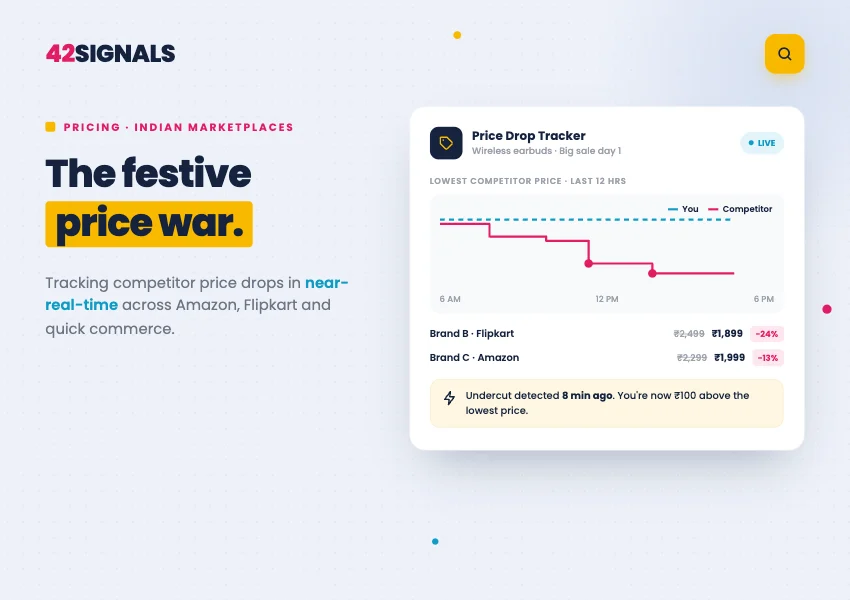
Why the Festive Price War Is Won With Context, Not Speed
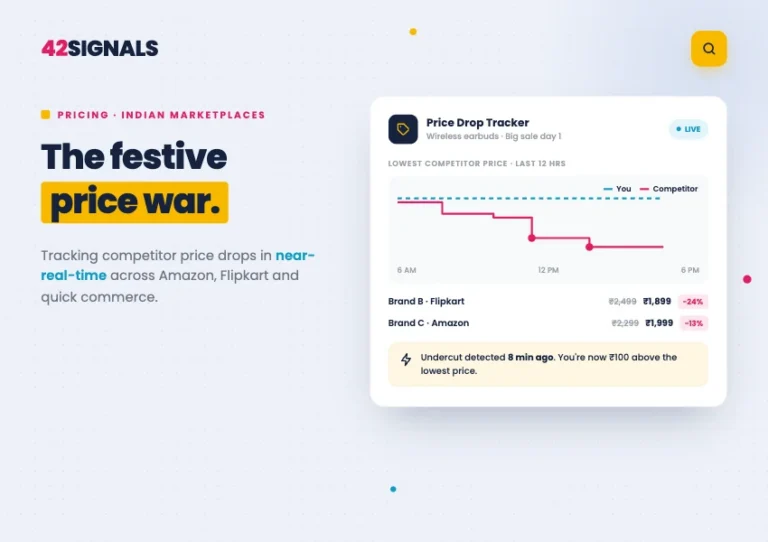
Most brands lose margin during festive sales the same way: someone sees a competitor’s price drop, has no idea whether it’s a 48-hour flash promotion or a sustained repositioning, and matches it. The competitor’s promotion ends on Thursday. The brand’s price stays down until January, because raising it feels like admitting weakness. That sequence repeats across categories every year, and it is not a speed problem. Reacting faster to a price you don’t understand just means losing margin sooner.
A festive price war is won by the brand that can tell the difference between a drop worth responding to and a drop worth ignoring and can tell it within hours rather than at the next weekly review. That requires four things most teams don’t have during peak: visibility of the full landed price, context on competitor stock position, knowledge of who is funding the discount, and pre-agreed rules about when to act. This guide covers how discount cascades start, what to monitor across Amazon, Flipkart, and quick commerce, how to read a competitor price drop correctly, and how to build repricing rules that protect margin when everyone around you is cutting.
How a Festive Price War Actually Starts
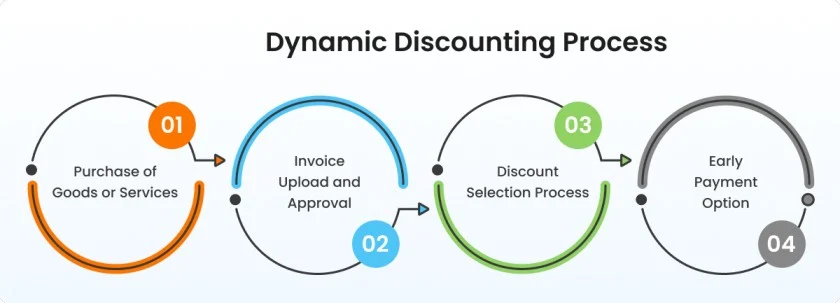
Image Source: High Radius
Price wars rarely begin with a strategic decision. They begin with a cascade.
Stage one: a platform-funded promotion. A marketplace applies its own discount or coupon to a competitor’s listing. The brand may not have chosen this, and may not even be funding it.
Stage two: automated repricers react. Rule-based repricing tools across the category detect the new lowest price and adjust. Nobody has made a decision yet; software has.
Stage three: humans panic. Brand managers see their price position deteriorating on a dashboard, escalate, and approve cuts to match.
Stage four: the floor resets. By the time the original platform promotion ends, category price expectations have moved. Shoppers who were conditioned by three days of deep discounting don’t return to the old price point, and neither does the category.
The critical insight is that stages two and three are where the damage happens, and both are avoidable. A brand that understands in stage one that the initiating discount was platform-funded and temporary can sit out the cascade entirely.
The Four Price Signals You Actually Need
Tracking list price alone is why most competitor price intelligence produces bad decisions.
List price is the number on the search results page. It is the least informative of the four, because it’s the one most easily manipulated by promotional mechanics layered on top.
Landed price is what the shopper actually pays at checkout, after shipping, platform coupons, and any applicable offers. This is what competes. A competitor with a higher list price and a 10% instant bank discount may be materially cheaper than you.
Bank and card offers are a defining feature of Indian festive sales. Both major platforms have historically run instant discounts of around 10% with partner banks, with per-transaction caps and sometimes minimum cart values. These move effective price substantially and are invisible if you’re only scraping list price.
Who funds the discount is the signal that determines whether a price is sustainable. A platform-funded promotion ends when the platform decides. A seller-funded discount reflects that seller’s margin tolerance and tells you something about how long they can hold it.
Any monitoring system that captures only the first of these will generate alerts that lead to margin loss.
Reading a Competitor Price Drop Correctly
A drop is not a signal until you know three things about it.
Their Stock Position
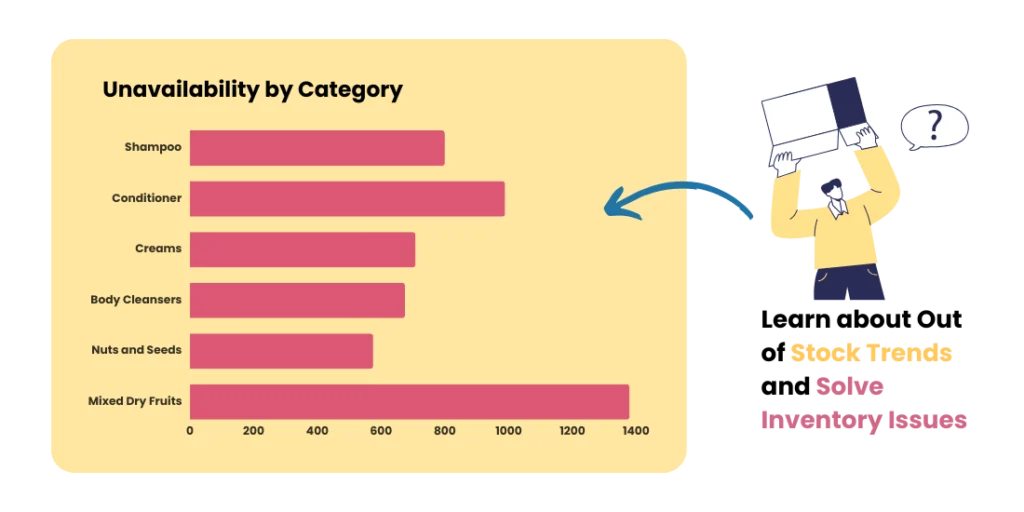
A competitor cutting price with limited inventory remaining is not a threat; they will be unavailable within a day or two, and their demand will redistribute to whoever is still visible. Matching them costs you margin on volume you were going to capture anyway when they sold out.
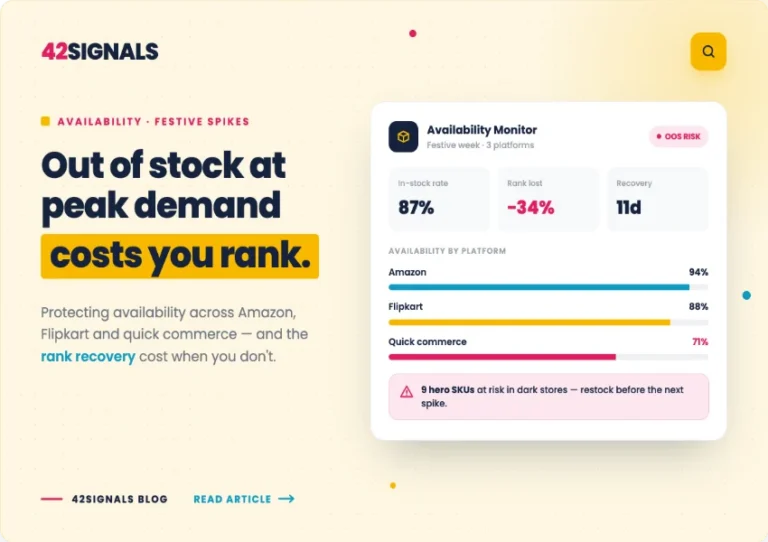
This is the single highest-value piece of context in a festive price war, and it is invisible in pricing data alone. It requires availability monitoring alongside price monitoring, which is why the two should never be separate systems. Our guide to digital shelf availability covers the tracking approach, and the deeper mechanics of stockouts at peak are in our article on stock availability during sale windows.
The Duration Pattern
Has this competitor run the same promotion, at the same depth, in the same week, in previous years? Historical price data turns an alarming drop into a predictable event. Brands with two or three festive seasons of competitor price history can recognise a recurring flash promotion on sight.
Without history, every drop looks like a strategic move. With it, most turn out to be scheduled.
The Funding Source
Platform-funded discounts end on the platform’s schedule. Seller-funded discounts are constrained by the seller’s margin. Distinguishing between them tells you whether you’re looking at a temporary distortion or a genuine competitive repositioning.
Platform Dynamics: Amazon, Flipkart and Quick Commerce
The same competitor behaves differently across platforms, and your monitoring needs to reflect that.
Amazon
Amazon’s Buy Box logic weights landed price heavily, so shipping and delivery speed compete alongside item price. Losing the Buy Box is a sharper penalty than a rank slip. It removes you from the default purchase path entirely.
Amazon also monitors pricing across the web, which means a price on your own site or another marketplace can affect your position here. Price parity is a structural requirement, not a channel strategy choice.
Flipkart
Flipkart’s search weights direct catalogue matching more heavily, and its festive promotional mechanics exchange bonuses, platform coupons, Plus and Black member pricing layer more visibly on top of list price. Effective price modelling matters more here precisely because the stack of mechanics is deeper.
Quick Commerce: Blinkit, Zepto and Instamart
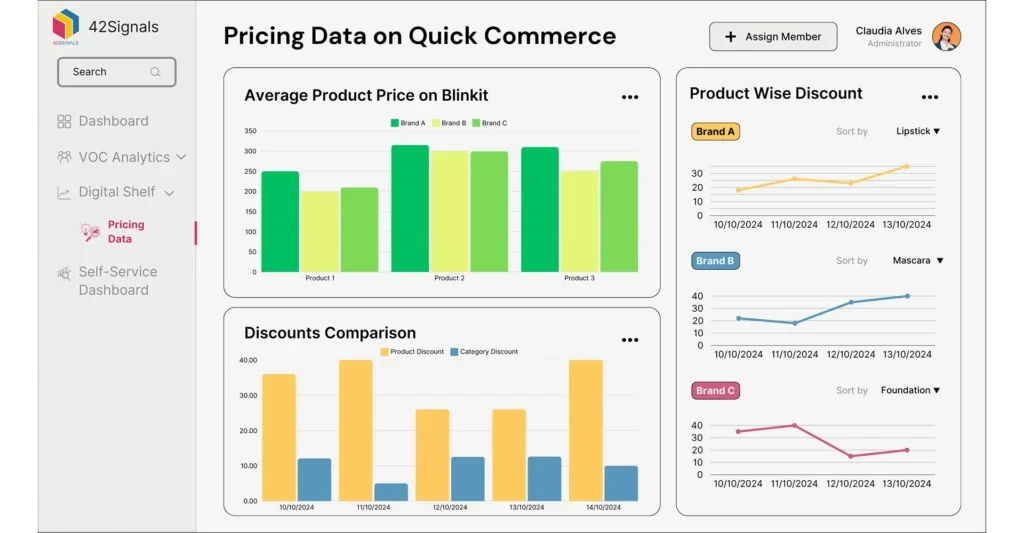
Image Source: Pricing data on quick commerce on platforms like Blinkit, Zepto, Swiggy Instamart
Three differences change the monitoring requirement entirely.
Prices vary by location. A competitor’s price in one pincode may differ from another. National price monitoring on platforms like Blinkit produces an average that describes no actual shopper’s experience.
Promotional windows are shorter. Quick commerce festive demand concentrates around specific occasions. Dhanteras evening, Diwali morning and promotions run in hours rather than days. A daily price check misses most of what happens.
The shelf is tiny. With three or four products visible above the fold, a price-driven position loss is disappearance rather than demotion.
This is why quick commerce price monitoring has to be pincode-level and high-frequency, or it isn’t monitoring at all.
Price Parity and Listing Suppression
The failure mode that catches multichannel brands during a festive price war is not losing on price. It’s being removed for pricing inconsistency.
When your price differs materially across Amazon, Flipkart, quick commerce, and your own DTC site, platforms can and do suppress listings. You don’t lose the Buy Box; the listing stops appearing. Advertising continues spending against a product nobody can find.
During a festive window, this happens more often, because promotional mechanics applied unevenly across channels create parity gaps that nobody intended. A platform-applied coupon on one marketplace can put you out of parity on another without anyone on your team changing a price.
The defence is monitoring effective price across every channel simultaneously, not managing each channel independently.
MAP, Unauthorised Sellers, and the Indian Legal Position
Festive windows are when unauthorised sellers and grey-market inventory surface most aggressively, because deep platform discounting gives cover for listings that undercut authorised partners.
The commercial problem is real: unauthorised discounting distorts your competitive read, damages authorised partner relationships, and can trigger the cascade described earlier. But the enforcement response in India requires more care than the US-style MAP playbook many global brands import.
Under Section 3(4)(e) of India’s Competition Act, 2002, resale price maintenance is a recognised vertical restraint. India applies a rule-of-reason standard rather than a per se prohibition an RPM arrangement is void only where it causes or is likely to cause an Appreciable Adverse Effect on Competition. Restraints on minimum resale price are the concern; maximum resale price does not raise the same issue, and an agreement that explicitly permits lower prices falls outside the restriction. Market share has been decisive in how the Competition Commission of India has assessed these cases.
The cautionary precedent is instructive. In August 2021, the CCI imposed a ₹200 crore penalty on Maruti Suzuki over a Discount Control Policy that amounted to RPM. Notably, the enforcement apparatus itself, the use of mystery shopping agencies to monitor dealer discounting, and the imposition of penalties on dealers who breached it. was central to the finding. For a fuller treatment, see this analysis of resale price maintenance under Indian competition law.
The practical distinction for brands: observing and monitoring prices across the market is an information activity. Imposing and enforcing minimum resale prices on distributors through agreement and penalty is a different activity with regulatory exposure, particularly for brands with meaningful market share.
Most of the commercial value brands seek from MAP programmes, knowing who is discounting, where, by how much, and whether they are authorised, comes from the monitoring, not the enforcement. That distinction is worth discussing with counsel before your festive enforcement plan is set. Our guide to MAP violation monitoring covers the visibility side.
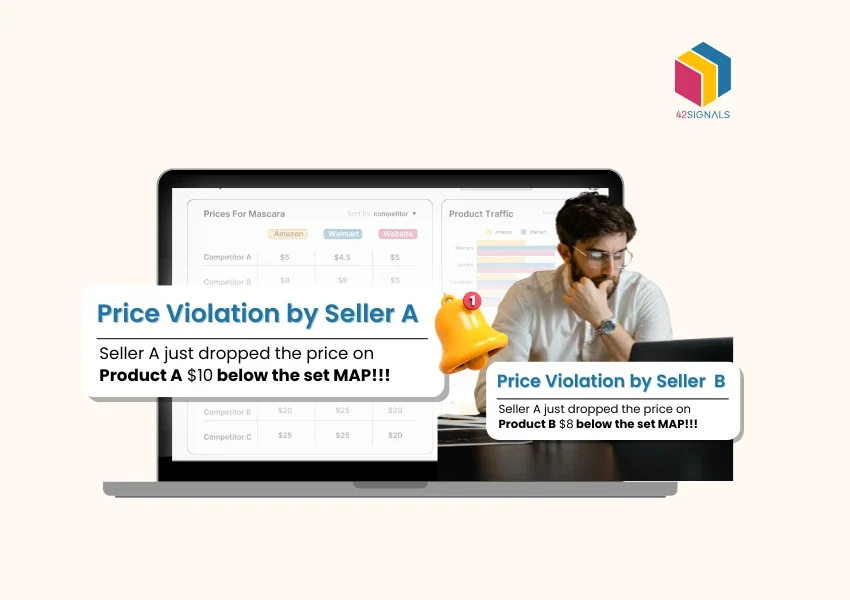
Building Near-Real-Time Price Monitoring
“Real time” is a marketing term. What matters is whether your detection interval is shorter than the window in which a competitor’s price change costs you money.
Set frequency by category volatility, not by preference. Electronics and fashion during a festive window may need hourly checks. Slower-moving categories may be fine with several checks daily. Quick commerce needs higher frequency than either, because promotional windows are measured in hours.
Capture landed price, not list price. Shipping, coupons, bank offers, and member pricing all need to be in the dataset or your comparisons are wrong.
Monitor at the granularity where prices actually vary. For quick commerce, that means pincode level. A national average obscures exactly the variation you need to act on.
Pair price data with availability data. As covered above, a competitor’s stock position determines whether their price drop matters. Separate systems produce decisions made without the most important context.
Retain history. Recognising a recurring promotion requires last year’s data. This is the cheapest competitive advantage available, and it only accrues if you started collecting before you needed it.
Alert on thresholds, not on every change. During a festive price war, every competitor changes price constantly. An alerting system without thresholds trains your team to ignore alerts within two days.
42Signals tracks competitor pricing, promotions, and availability at pincode level across Amazon, Flipkart, Blinkit, Zepto, and Instamart with the historical depth to tell a recurring promotion from a real repositioning.
Repricing Rules That Protect Margin
Decisions made calmly in September beat decisions made at 11pm on day three.
Write the margin floor per SKU before the window opens. Not a target, a floor, below which the answer is no regardless of what a competitor does. Having it in writing is what prevents the escalation call from becoming a negotiation.
Define the response threshold. A workable rule: respond only if a tracked competitor’s landed price falls more than a defined percentage below yours and holds for a defined period, and they have sufficient stock to sustain it. Any one condition failing means no action.
Tier your catalogue. Key value items, the SKUs shoppers actively price-compare, need tight competitiveness. The long tail has far more pricing latitude than most teams assume, and treating every SKU as a battleground guarantees losing margin on products nobody was comparing.
Decide the promotional calendar, not just the price. Both platforms run festive sales in waves. Which SKUs discount in the opening burst, which hold for the mid-window refresh, and which stay protected through to Diwali. Brands that discount everything on day one have nothing left for the waves that often convert better.
Pre-agree who can override. During a festive price war, someone will want to break the rules. Decide in advance who has that authority and what evidence they need.
The Daily War Room Cadence
A workable rhythm during the window, in priority order:
Competitor availability first. Who has gone out of stock, and where? This is both a bid-increase opportunity and the context that determines whether their price still matters.
Landed price movement second. Not list price. Filter to changes crossing your response threshold.
Your own parity status third. Check for gaps that could trigger suppression, including ones created by platform-applied promotions you didn’t authorise.
Unauthorised seller activity fourth. New listings and discounting on your own SKUs.
Share of search, fifth. Position movement on priority terms, which shows competitive impact before sales data does. Understanding whether you actually gained ground requires comparing against the category rather than your own prior period and identifying which terms rivals gained on is a competitor keyword gap analysis exercise.
Winning the Festive Price War Without Racing to the Bottom
The brands that come out of a festive window with margin intact are rarely the ones who held price the hardest. They are the ones who know which drops to ignore.
That knowledge is specific and assembled in advance: landed price rather than list price, competitor stock position alongside competitor pricing, historical patterns that identify a recurring promotion, and written rules agreed before anyone was under pressure.
Without those, a festive price war is a reflex. Someone sees a number, escalates, and the category floor resets for everyone, including the competitor who started it, who often didn’t intend to start anything.
The compounding advantage is historical. A brand entering its third festive season with competitor price history can recognise most promotional patterns on sight, which means responding to the few that are genuinely new. That advantage only exists if the data collection started before it was needed, which makes the weeks before a sale, not the days during it, the period that determines how the price war goes.
42Signals gives pricing and category teams real-time competitor price, promotion, and availability data across every Indian marketplace and quick commerce platform.
Frequently Asked Questions About the Festive Price War
How often should I check competitor prices during a festive sale?
Frequently enough that your detection interval is shorter than the window in which a price change costs you money. In fast-moving categories like electronics and fashion during a festive window, that often means hourly. Quick commerce needs higher frequency still, because promotional windows there run in hours and prices vary by pincode. Daily checks, which are adequate outside peak, miss most of what happens during a sale.
Should I always match a competitor’s price drop during a festive sale?
No, and matching reflexively is the most common source of festive margin loss. Before responding, establish three things: whether the competitor has enough stock to sustain the price, whether the drop matches a recurring promotional pattern from previous years, and whether the discount is platform-funded or seller-funded. A competitor running low on inventory will be unavailable shortly, and their demand will redistribute to you anyway.
What is the difference between list price and landed price?
List price is the figure shown on the search results page. Landed price is what the shopper actually pays at checkout after shipping, platform coupons, bank and card offers, and member pricing. Landed price is what competes, and the gap between the two can be substantial during Indian festive sales where instant bank discounts of around 10% are common. Monitoring list price alone produces comparisons that are simply wrong.
Is MAP enforcement legal in India?
Indian competition law treats this differently from many other jurisdictions, and the answer requires legal advice on your specific arrangements. Under Section 3(4)(e) of the Competition Act, 2002, resale price maintenance is assessed under a rule-of-reason standard rather than prohibited outright, it is void only where it causes or is likely to cause an Appreciable Adverse Effect on Competition. The CCI penalised Maruti Suzuki ₹200 crore in 2021 over a discount control policy, where the monitoring-and-penalty enforcement mechanism was central to the finding. Monitoring market prices is an information activity; imposing and enforcing minimum resale prices on distributors is a different one with regulatory exposure. Take qualified counsel.
Why did my listing disappear during the festive sale?
Price parity is a common cause. Platforms monitor pricing across channels and can suppress listings priced materially above the same item elsewhere; the listing stops appearing rather than simply losing position. During festive windows, this happens more often, because promotional mechanics applied unevenly across channels create parity gaps nobody intended. Check effective price across every channel, not just the one where the listing vanished.
How do bank offers affect competitor price comparisons?
Substantially. Indian festive sales have historically featured instant discounts of around 10% with partner bank cards, usually with per-transaction caps and sometimes minimum cart values. A competitor with a higher list price plus an active bank offer can be cheaper at checkout than you are. Any competitive price comparison that excludes these mechanics will systematically misread your position.
How do I stop a festive price war from destroying category margin?
Mostly by not participating in the cascade. Write margin floors per SKU before the window opens, define a response threshold that requires multiple conditions to be met before you act, tier your catalogue so only genuinely price-compared SKUs get aggressive treatment, and plan your discount ladder across the full multi-wave sale rather than spending it on day one. The cascade is usually triggered by automated repricers and reactive humans responding to a temporary platform-funded promotion, recognising that early is what keeps you out of it.