
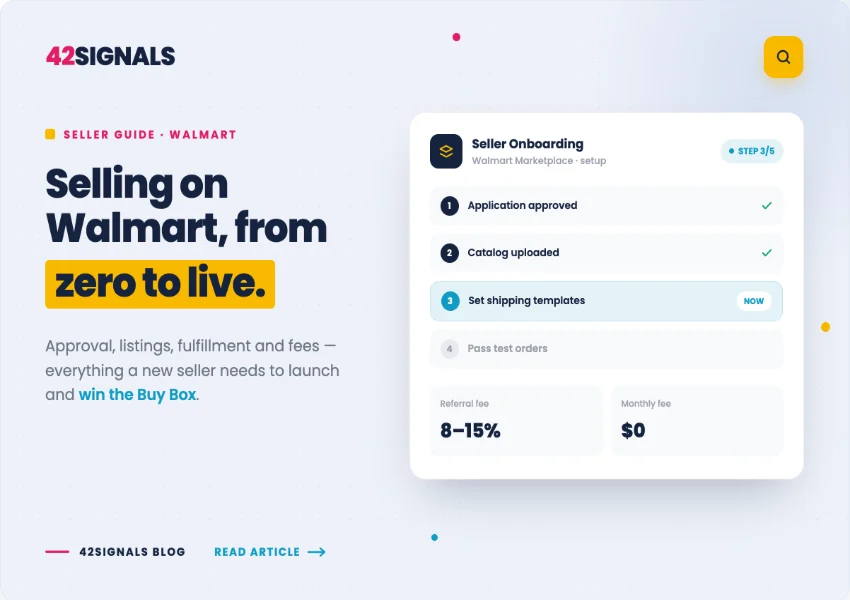
What It Takes to Become a Walmart Marketplace Seller
Walmart Marketplace is not Amazon with a different logo, and the sellers who treat it that way struggle. The single most important structural difference: Walmart’s application is selective. Where Amazon offers effectively open registration, Walmart screens applicants and expects a documented history of ecommerce success before approving you. That gate is a barrier when you’re applying and an advantage once you’re through, because it holds competitive density well below Amazon’s. The economics differ too.
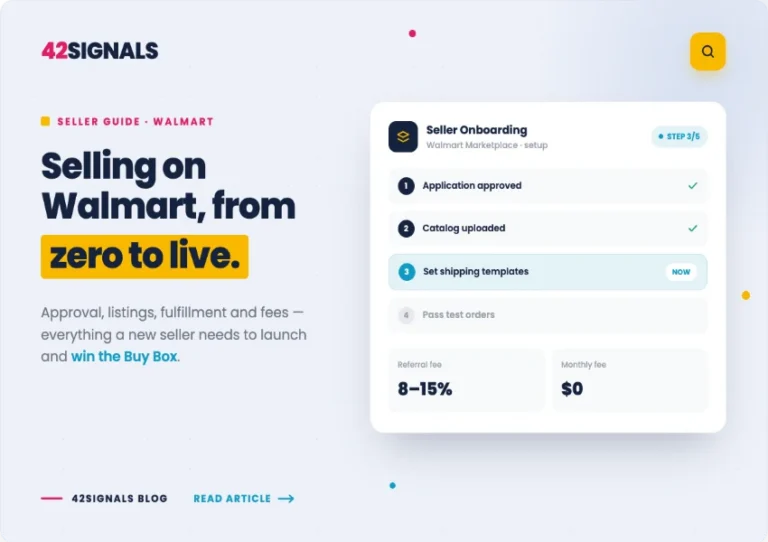
There’s no monthly subscription; signing up is free, and you pay a referral fee on each item sold. This guide covers the eligibility requirements, the application process, the full fee structure, how to choose between fulfillment models, what actually drives visibility on Walmart’s search, and how to measure your performance once you’re live. If you’re already selling on Amazon and evaluating Walmart as a second channel, the sections on Buy Box competition and cross-channel measurement are where the differences matter most.
Why Become a Walmart Marketplace Seller?

Lower Competitive Density
Because approval is selective, categories that are saturated on Amazon are frequently far thinner on Walmart. Fewer sellers competing for the same search terms means cheaper advertising and a realistic path to organic visibility for products that would be buried elsewhere.
This advantage erodes as more sellers are approved. It is a timing argument, not a permanent structural one, which is the case for moving early rather than perfecting your Amazon operation first.
No Subscription Cost
There is no monthly fee and no listing fee. You pay a referral fee per completed sale. For a seller testing a new channel, this removes the fixed-cost risk entirely: an unsuccessful Walmart experiment costs you setup time rather than a recurring subscription.
New-Seller Incentives
Walmart currently runs a New-Seller Savings program offering tiered referral fee discounts — reported on Walmart’s own program page as 20% off base referral fees for the first $50K in GMV, 30% between $50K and $500K, and 40% above $500K, up to a $72,000 cap — plus credits toward WFS fulfilment, search engine marketing, and Walmart Connect advertising (source: Walmart New-Seller Savings).
The Reason That Doesn’t Hold Up
“Walmart is easier than Amazon” is not true and gets new sellers into trouble. The application is harder, the content requirements are stricter, and the Buy Box logic is less forgiving on price. Walmart is less crowded, which is a different claim.
Walmart Marketplace Seller Requirements
Walmart publishes its requirements directly, and they’re worth reading in full before you apply. According to Walmart’s official onboarding documentation, you need:
- A copy of a personal ID
- A Business Tax ID or Business License Number — an SSN is not accepted
- Your business entity classification
- Supporting documents verifying your business name and address
- A history of marketplace or ecommerce success
- Products carrying GTIN/UPC GS1 Company Prefix Numbers
The SSN Exclusion
Sole proprietors operating under a personal Social Security Number cannot register. You need a formally registered business entity with a Tax ID. If you don’t have one, that’s the first step, and it’s not a same-week fix.
The Ecommerce History Requirement
This is the genuinely selective element. Walmart wants evidence you’ve sold successfully elsewhere — an established Amazon or eBay account, or a functioning ecommerce site with real order volume.
Practical implication: applying with no trading history is likely to fail. If you’re pre-launch, build sales elsewhere first and apply once you have performance to point to. Applicants who present a strong, verifiable business profile move through materially faster.
GS1-Issued GTINs
Your products need legitimate GTIN/UPC codes with a GS1 Company Prefix. Resold or recycled barcodes bought cheaply from third-party sellers are a common rejection cause and a common source of listing suppression later. Buy them from GS1 directly.
The Application Process
The sequence runs: eligibility → application → onboarding → listings → fulfilment → performance.
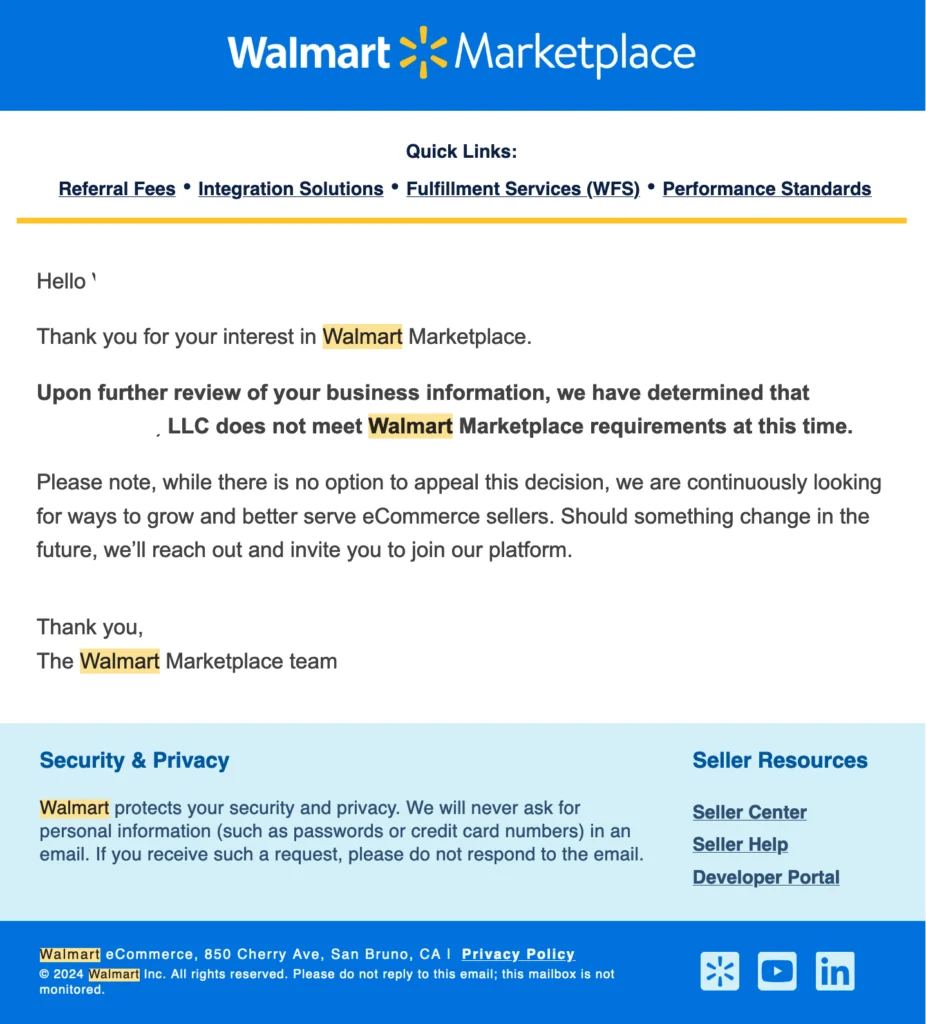
Image Source: Bellavix
Assemble your documentation before you start rather than mid-form. Applications stall most often on missing paperwork, not on rejection.
During onboarding you’ll complete your Seller Profile, agree to the Retailer Agreement, set up payments, configure shipping settings and tax details, and complete item setup. Walmart requires you to publish and test items before your store goes live — you cannot skip to selling.
One detail worth planning around: your shipping configuration directly affects your search visibility later, because delivery speed is a ranking and Buy Box input. Setting this up carelessly at onboarding creates drag that’s tedious to unwind.
If you sell your own brand, apply for brand owner or authorised reseller privileges through Seller Center under Growth → Brand Manager, uploading a letter of authorisation or equivalent evidence of your relationship to the brand. This matters more than it appears — it’s the mechanism that gives you standing when unauthorised sellers appear on your listings, which connects directly to MAP violation monitoring and authorised reseller management.
Understanding the Fee Structure
Referral Fees
The core cost. Referral fees are category-specific and deducted from each completed sale before payout. Walmart also offers reduced referral fees on select low-priced items, accessible through Seller Center under Pricing → Incentives. Worth checking if you carry lower-ASP products, as it’s not applied automatically.
Walmart Fulfillment Services
WFS is optional. If you use it, you pay a fulfillment fee based on weight and dimensions plus a storage fee based on cubic volume and duration. Run your own catalogue through Walmart’s WFS Cost Estimator before committing. Fulfilment economics vary enormously by product dimensions, and category-average figures are close to meaningless for a specific SKU.
What You Don’t Pay
No setup fee, no monthly subscription, no listing fee. For sellers accustomed to Amazon’s Professional plan subscription, this materially changes the maths on testing a new channel with a narrow catalogue.
Choosing Your Fulfillment Model
Walmart Fulfillment Services
WFS automatically satisfies Walmart’s delivery speed expectations, which feeds directly into search placement and Buy Box eligibility. It also handles returns processing and customer service for fulfilled orders.
Walmart positions WFS as the fastest route to Pro Seller status, precisely because it meets shipping speed requirements without you having to engineer them.
Self-Fulfilment
You avoid WFS fees and retain inventory control, but you own the delivery speed problem. Walmart’s search and Buy Box logic favour fast, reliable delivery, so a self-fulfilment seller with three-day handling competes at a structural disadvantage against a WFS listing.
Self-fulfilment works well for sellers with existing fast logistics, oversized items where WFS economics break down, or products with handling requirements WFS doesn’t accommodate.
The Hybrid Approach
Many established sellers run WFS on high-velocity SKUs where delivery speed drives conversion, and self-fulfil the long tail where storage fees would erode margin on slow-moving inventory. This requires accurate velocity data by SKU, which is the sort of thing worth establishing before you commit inventory rather than after.
Building Listings That Actually Rank

Walmart scores listing completeness explicitly and surfaces it to you. Missing attributes, short descriptions, single images, and absent rich media all suppress visibility in a way that’s more mechanical than Amazon’s.
Practical priorities:
Complete every attribute field, including ones that seem optional. Walmart uses structured attributes for filtering, and an incomplete listing is invisible to filtered browsing regardless of keyword relevance.
Multiple high-quality images, following Walmart’s specifications. Image count correlates with both ranking and conversion.
Write the title to Walmart’s format, not Amazon’s. The conventions differ, and importing Amazon titles wholesale produces titles that read badly and rank poorly.
Keyword research specific to Walmart. Search behaviour is not identical across marketplaces; the terms that convert on Amazon are a starting hypothesis, not an answer. A structured competitor keyword gap analysis applied to Walmart specifically will surface terms your Amazon data won’t.
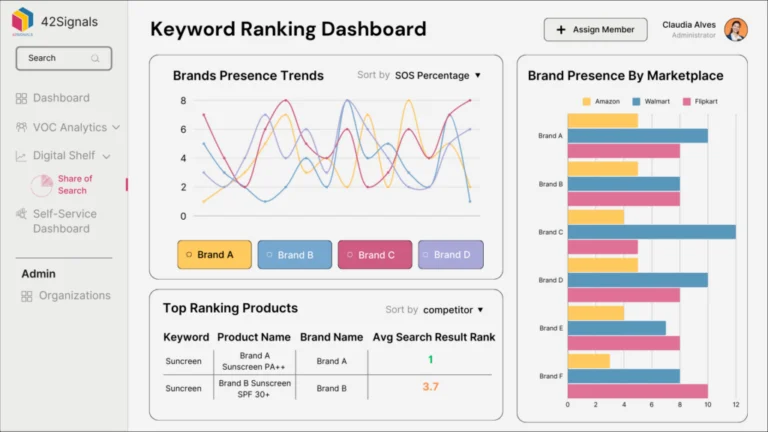
The broader point: in a marketplace where competitive density is lower, content quality is a larger share of what separates you from the seller ranked below. That advantage disappears if you bulk-port listings from another channel without adaptation.
Winning the Buy Box
Walmart’s Buy Box logic is stricter on price than Amazon’s, and this catches multichannel sellers.
Walmart actively monitors pricing across the web and can suppress listings priced significantly higher than the same item elsewhere. A seller running different prices across Amazon, their own DTC site, and Walmart can find their Walmart listing suppressed entirely, not losing the Buy Box, but removed from view.
Three consequences.
Price parity is a compliance requirement, not a strategy choice. Set explicit parity rules across every channel and monitor them continuously.
Landed cost is what competes. Buy Box logic weighs the total customer cost, so shipping charges and delivery speed matter alongside item price. Winning on landed cost rather than list price is the durable position.
Manual price monitoring doesn’t scale past a small catalogue. Once you’re managing hundreds of SKUs across several channels, parity violations happen faster than a person can find them, which is where automated ecommerce price tracking stops being optional.
The Pro Seller Badge
Walmart’s Pro Seller program rewards consistent, high-performing sellers with a visible badge, faster payouts, referral fee discounts, and improved search placement. Qualification depends on sustained order defect performance, on-time delivery, and catalogue quality — which is why WFS shortens the path.
Measuring Performance Beyond Seller Center

Three gaps matter as you scale.
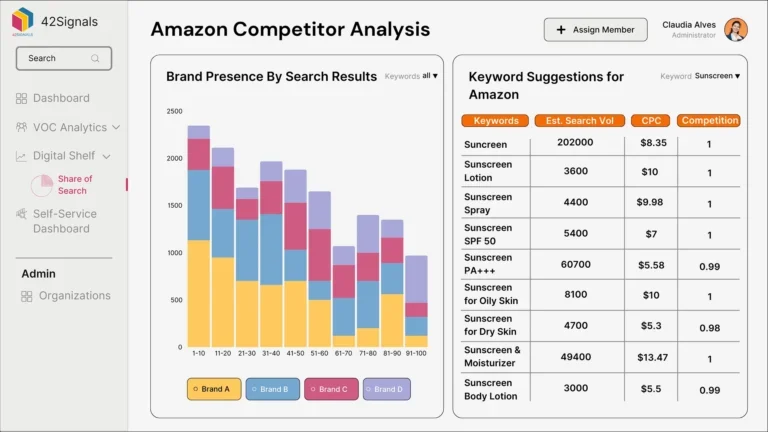
Competitive position on your keywords. Your dashboard shows your rankings, not that a competitor entered your primary category term last month and has been climbing since. Tracking share of voice against competitors is a separate exercise from tracking your own rank.
Availability and suppression. A suppressed listing, an out-of-stock SKU, or a price-parity violation removes you from the shelf while your advertising continues running. Catching this in a weekly report is expensive; the mechanics are the same problem covered in our guide to digital shelf availability.
Category share versus account growth. Your Walmart sales can grow while your category share falls, if the category grows faster. That’s a market share tracking question that no marketplace’s own reporting answers, and it’s the number that predicts next year rather than describing last quarter.
42Signals tracks share of voice, pricing compliance, competitor placements, and availability across marketplaces, so you can compare Walmart and Amazon performance on the same terms.
Common Mistakes New Sellers Make
Applying without trading history. The ecommerce success requirement is real. Build elsewhere first.
Bulk-porting Amazon listings. Different title conventions, different attribute schemas, different search behaviour. Ported listings underperform.
Ignoring price parity. The fastest route to listing suppression, and the one multichannel sellers hit most often.
Underestimating delivery speed. Slow handling suppresses visibility regardless of listing quality or price.
Using cheap third-party barcodes. GS1-issued GTINs are a requirement, and non-compliant codes surface as problems later rather than at setup.
Treating Walmart advertising as a separate silo. Walmart Connect campaigns perform against the same shelf your organic listings compete on. Bidding aggressively on terms where you already rank organically pays for traffic you had — the same dynamic covered in our guide to Amazon Sponsored Products and pricing ROI.
Your First 90 Days as a Walmart Marketplace Seller
Weeks 1–4 go to getting approved and set up properly — complete documentation, correct GTINs, full attribute population, and a shipping configuration that supports competitive delivery speed. Rushing this stage creates problems that take months to unwind.
Weeks 5–8 are for establishing baselines. Track your organic visibility, your competitors’ positions, and your price parity across channels before you start spending on advertising. Without a pre-period, you’ll have nothing to measure lift against and no way to tell whether early sales came from your ads or from the channel simply being new to you.
Weeks 9–12 are where you scale what’s working — pushing high-velocity SKUs into WFS, expanding advertising on terms where your organic visibility is weakest rather than strongest, and building toward Pro Seller qualification.
Becoming a Walmart Marketplace seller is a lower-risk channel test than most, because there’s no subscription cost and the incentive programs offset early fees. The risk isn’t financial. It’s opportunity cost — building a second channel badly, then concluding the channel doesn’t work when what didn’t work was the setup.
Do the listing quality properly, hold price parity, and measure your position on the shelf rather than only your own sales. The competitive density advantage that makes Walmart attractive right now won’t last indefinitely, and the sellers establishing organic positions today are the ones who keep them as the marketplace fills.
42Signals gives multichannel sellers a single view of pricing, availability, and competitive position across Walmart, Amazon, and every other channel you sell through.
Frequently Asked Questions About Selling on Walmart Marketplace
How much does it cost to become a Walmart Marketplace seller?
There is no setup fee, monthly subscription, or listing fee. Signing up is free, and you pay a referral fee on each completed sale, deducted before payout. Referral fees vary by category. If you use Walmart Fulfillment Services, you also pay fulfilment and storage fees based on your product’s weight, dimensions, and storage duration. Check Walmart’s current fee schedule in Seller Center, as rates change.
How long does Walmart Marketplace approval take?
It varies with the completeness of your application. Applicants with full documentation and a verifiable history of ecommerce success move through faster; incomplete paperwork is the most common cause of delay. Assembling everything before you begin — business Tax ID, entity classification, address verification, and evidence of marketplace performance — is the single biggest factor you control.
Can I sell on Walmart Marketplace without a business license?
No. Walmart requires a Business Tax ID or Business License Number and explicitly does not accept a Social Security Number. Sole proprietors trading under a personal SSN need to register a business entity first. You’ll also need documentation verifying your business name and address.
Is Walmart Marketplace easier than Amazon?
Less crowded, but not easier. The application is selective where Amazon’s is effectively open; content requirements are stricter, and Walmart’s Buy Box logic is less forgiving on price listings priced well above the same item elsewhere can be suppressed entirely. The advantage is lower competitive density in many categories, which makes organic visibility and advertising cheaper to obtain.
Do I need Walmart Fulfillment Services to succeed?
No, but WFS automatically meets Walmart’s delivery speed expectations, which feed into search placement and Buy Box eligibility, and Walmart positions it as the fastest route to Pro Seller status. Self-fulfilment works if you already have fast, reliable logistics or sell items where WFS economics don’t work. Many established sellers run a hybrid — WFS on high-velocity SKUs, self-fulfilment on the long tail.
Why is my Walmart listing not showing up?
The most common causes are price parity violations, incomplete listing content, and unavailability. Walmart monitors pricing across the web and can suppress listings priced significantly above the same item elsewhere. Incomplete attributes remove you from filtered browsing regardless of keyword relevance. Check parity, listing completeness score, and stock status before assuming a ranking problem.
Should I sell on both Walmart and Amazon?
For most established sellers, yes — the channels reach overlapping but distinct audiences and Walmart’s lower competitive density often produces better advertising efficiency. The requirement is operational: price parity must hold across both, inventory needs syncing to prevent overselling, and performance should be measured with the same instrument on both channels so the comparison means something.