
Why Grocery Ecommerce Trends Matter More Than Category Growth
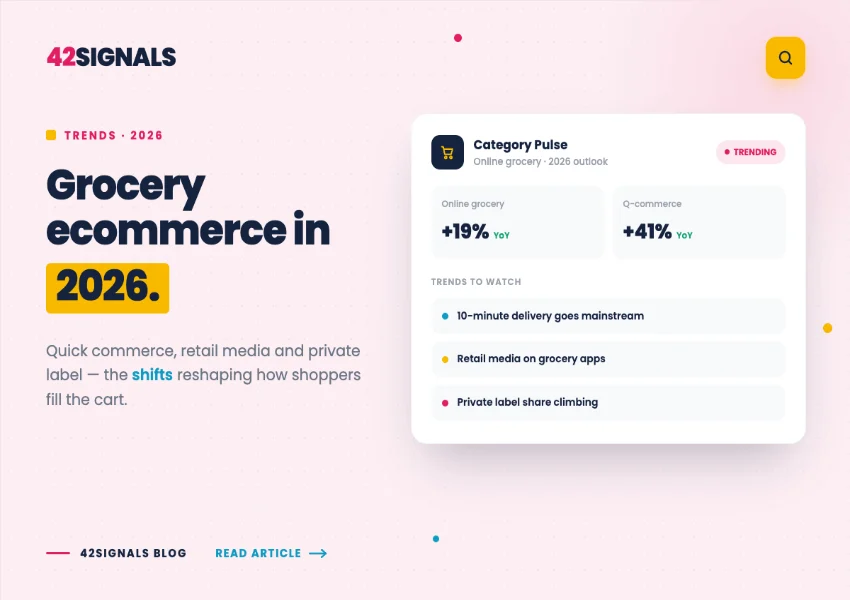
Total grocery spending is growing slowly. Online grocery is growing at roughly twenty times the rate of in-store, and it is absorbing almost all of the category’s net new dollars. FMI and Nielsen project online grocery to grow at an 11.6% compound annual rate from 2026 to 2028, against 0.6% for in-store lifting online’s share of total grocery spending from 18% in 2024 to 25.5% by 2028 (source: FMI/Nielsen, Digital Engagement Transforms Grocery Shopping 2026). Ecommerce accounted for roughly three-quarters of total grocery dollar growth last year. For a brand, that means your category can look flat while the shelf underneath it is reorganising completely. The grocery ecommerce trends that matter aren’t about whether online grows that’s settled. They’re about where the volume is concentrating, how fast fulfillment has to be, and who controls visibility on the shelf you’re competing for. This article covers seven shifts and what each one requires you to track.
The Baseline: Where Online Grocery Actually Stands
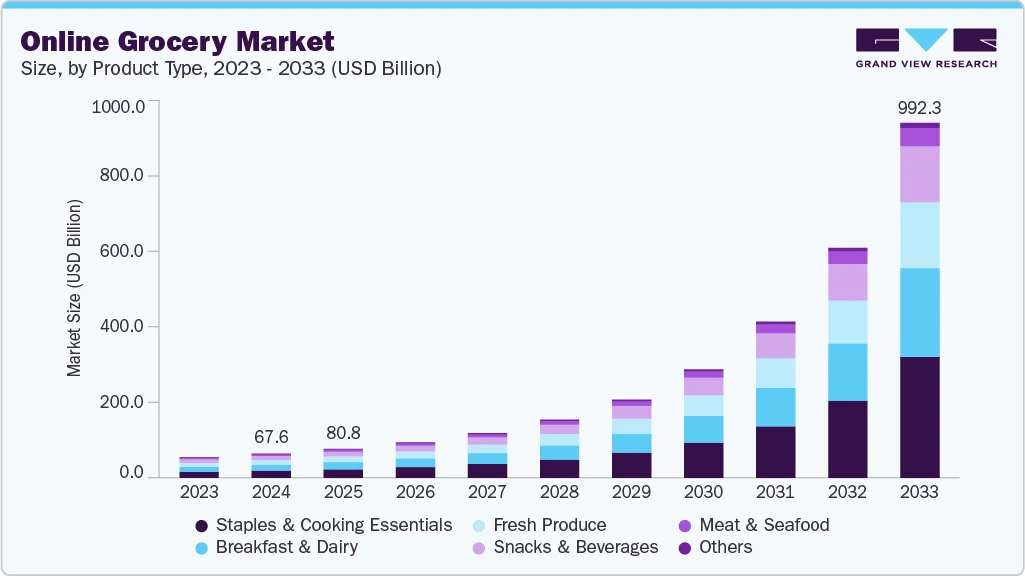
Image Source: Grand View Research
US online grocery sales have grown more than 20% year over year for six consecutive quarters through Q1 2026, according to Brick Meets Click, the standard tracker for the category. Online’s share of total grocery spending reached 19% at the close of 2025, a 430 basis point increase against December 2024.
A caution worth carrying into any trends discussion: global online grocery market-size estimates vary by more than double between research firms, depending on methodology and category definitions. Treat single global figures sceptically, and prefer trackers that publish their method.
What is not in dispute is direction and speed. The category has moved from a convenience channel to the primary procurement method for high-value households, and the competitive dynamics have changed with it.
Trend 1: Speed Has Become the Category
The single clearest signal in current grocery ecommerce trends is that delivery speed, not price or assortment, is now the primary competitive axis.
Brick Meets Click estimates same-day purchases accounted for roughly 80% of delivery orders in Q1 2026, and more than 30% of ship-to-home orders across all retail formats. Their assessment is that ultra-fast delivery is eroding the need for quick trips to the physical store entirely.
The escalation has been rapid. Amazon expanded fresh grocery availability within its same-day network, introduced fulfillment in three hours or less in March 2026, and launched delivery in 30 minutes or less in some areas through Amazon Now in May. Walmart reported store-fulfilled delivery growing 50% in its most recent quarter.
What this changes for brands: speed is fulfilled locally, which means your availability is now a store-level or dark-store-level question rather than a national one. A SKU with healthy national inventory can be unavailable in exactly the metros generating your demand and every ad impression served there is spend that cannot convert.
Trend 2: Quick Commerce Is Rewriting the Shelf
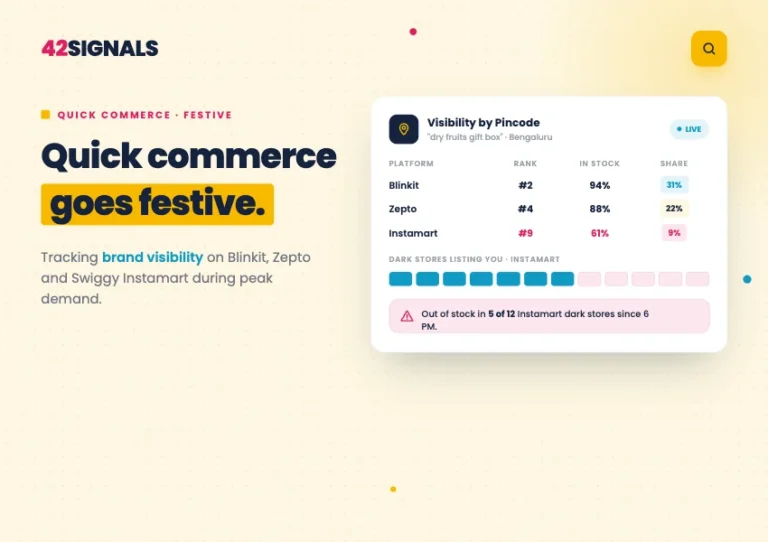
Nowhere is this more advanced than India, where Blinkit, Zepto, and Swiggy Instamart have built the world’s most mature instant-grocery ecosystem. Instant delivery is projected as the fastest-growing fulfilment model globally, and India is where the operating model was proven at scale.
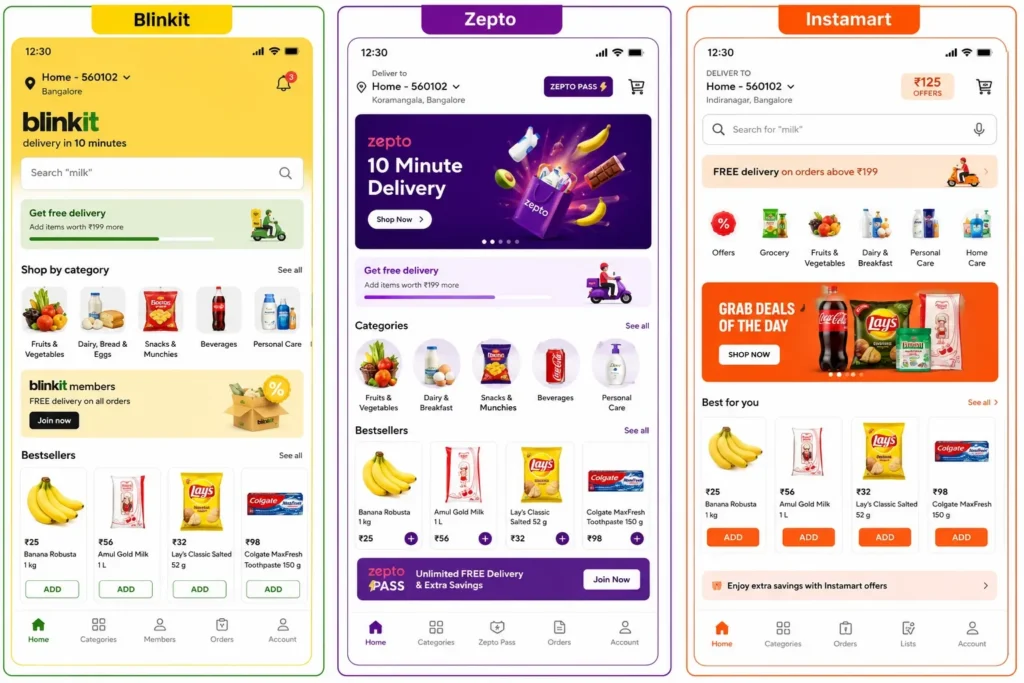
Image Source: Confetti Design
Three structural differences make quick commerce a distinct competitive environment rather than faster ecommerce.
The shelf is tiny. A quick commerce search returns three or four products above the fold. Paid placement is frequently the only route to visibility, not an enhancement to organic ranking.
Assortment is curated and constrained. Dark stores hold a fraction of a supermarket’s SKU count, so getting listed is a genuine gate. Losing a listing is losing the market in that catchment.
Inventory is hyperlocal. Stock sits in dark stores serving small catchments, so availability varies within a single city — often within a few kilometres. National fill-rate reporting is close to useless here.
The practical consequence is that quick commerce requires pincode-level monitoring as a condition of competing, not a refinement. Our guide to digital shelf availability covers the mechanics, and the broader framework sits in our digital shelf analytics guide.
Trend 3: Retail Media Became the Profit Engine
Grocery runs on thin net margins. Retail media carries software-like margins on traffic and data the retailer already owns — which is why every grocer with meaningful digital traffic has built an advertising business.
Kroger reported that its ecommerce business, including its retail media network, turned profitable ahead of schedule. Target’s Roundel and Walmart Connect are both growing considerably faster than their parent retailers’ merchandise sales.
What this changes for brands: a growing share of visible placement on grocery sites is bought rather than earned, and the retailer selling you the media is also the one reporting whether it worked. Attributed sales are not incremental sales — a brand already ranking well organically will show excellent reported ROAS on terms it was already converting.
The counterweight is comparing paid share of voice against organic share of voice on the same terms. If paid share climbs while organic falls, media spend is masking a listing problem rather than solving one.
Trend 4: Fresh Moved Online
Fresh and perishable categories were the last holdout, on the assumption shoppers wouldn’t trust someone else to pick their produce. That assumption has weakened considerably as cold-chain reliability improved and substitution policies matured.
The commercial implication runs beyond fresh itself. Fresh drives trip frequency. A household that buys produce online weekly is a household buying its centre-store basket online too, which pulls packaged goods volume into digital channels faster than packaged-goods marketing alone would.
For brands in ambient and packaged categories, this means digital share is growing for reasons that have nothing to do with your category’s own digital maturity.
Trend 5: The Digital Shelf Is Now Hyperlocal
Traditional grocery ecommerce reporting is national or regional. Fulfilment has become local store-based for same-day, dark-store-based for quick commerce. The gap between how you measure and how shoppers actually experience your brand widens every quarter.
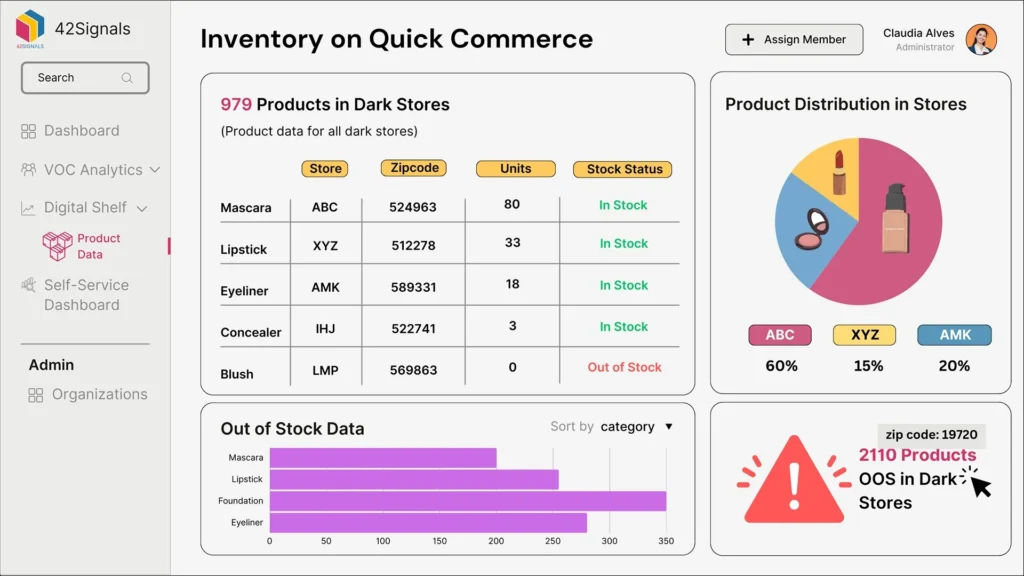
Three things now vary by location in ways national data hides:
Availability. Your fill rate is a distribution of local outcomes, not a single number. The average conceals both your problem markets and your opportunities.
Price and promotion. Localised pricing and store-level promotions mean your competitive position differs by catchment.
Search results. Platforms surface what they can deliver to that shopper. Your rank is location-dependent, so a national rank report describes an average nobody experiences.
The opportunity buried in this: when a competitor goes out of stock in a catchment where you’re well stocked, demand redistributes to whoever remains visible. That’s the highest-value moment to increase bids — and it is invisible in your own campaign data, because it’s a fact about someone else’s shelf.
Trend 6: Discovery Is Moving to AI and Agents
Product discovery is increasingly mediated — by retailer recommendation engines, by reorder prompts, and now by AI assistants that filter rather than browse.
The mechanic matters. An agent doesn’t scan a category page and get drawn to your packaging. It starts with everything in the category and eliminates: wrong price, poor availability, thin data, weak reviews. If you’re filtered out early, the shopper never learns you existed.
That places unusual weight on structured product data quality. Vague, brand-led descriptions that work on a shelf edge perform badly when the reader is a machine matching attributes. Specific, complete, accurate attribute data is becoming a distribution requirement rather than a content nicety.
For a fuller treatment of how this reshapes brand visibility, see our guide to agentic commerce and AI shopping agents.
Trend 7: Private Label and Subscription Lock-In
Two retailer strategies that squeeze branded manufacturers from opposite directions.
Private label has moved beyond value tiers into premium and specialty positioning, backed by the retailer’s own data on which attributes shoppers search for. When the retailer controlling search results also sells a competing product, the competitive dynamic is not neutral.
Subscription memberships — Walmart+, Target Circle 360, and equivalents — lock households into a single retailer’s ecosystem. A subscriber’s basket concentrates, which raises the cost of losing a listing at that retailer and lowers your ability to reach that household elsewhere.
Together these mean retailer relationships matter more, not less, as the channel digitises. Losing distribution at a subscription-heavy retailer costs more than the volume it directly represents.
What These Grocery Ecommerce Trends Require You to Track
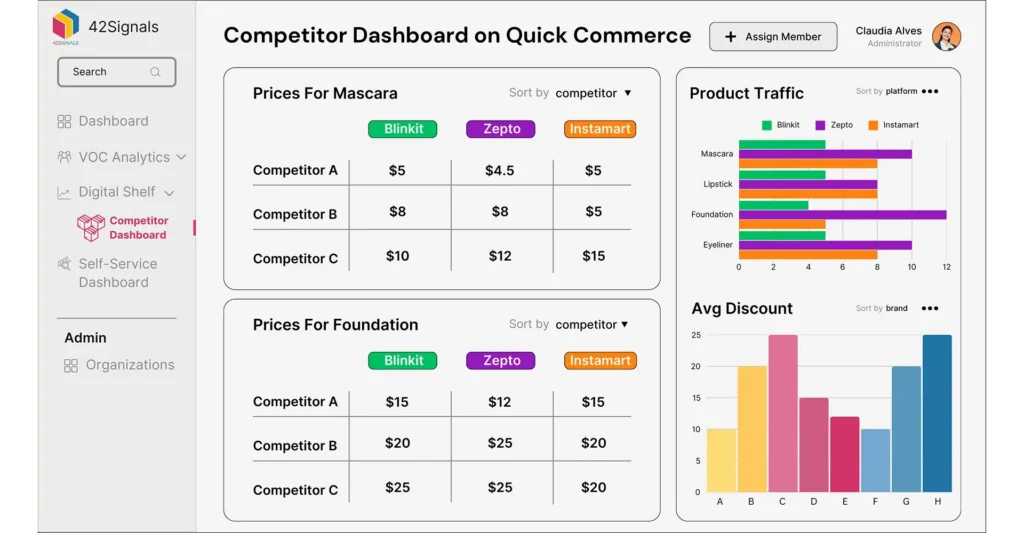
Five things, ordered by how frequently they’re missed.
Availability at fulfilment granularity. Store level for same-day, pincode or dark-store level for quick commerce platforms like Blinkit. National rates hide the variation that determines whether your media spend converts.
Share of search, organic and paid separated. What proportion of visible results you own on priority terms, and how much you bought versus earned. Track the ratio, not just the total.
Competitor assortment changes. A rival expanding from three SKUs to eight in your subcategory is a shelf-share move that appears in your sales data months later. New quick commerce listings are the earliest signal available.
Price and promotional position by location. Localised pricing means your competitive standing differs by catchment, and unauthorised discounting distorts every downstream pricing decision which makes MAP violation monitoring part of competitive tracking rather than a separate compliance task.
Category share, not account performance. Sales can grow at every retailer while your category share falls, if the category grew faster. That’s a market share tracking question no retailer’s reporting answers.
42Signals tracks availability, pricing, share of search, and competitor assortment across Blinkit, Zepto, Instamart, Amazon, and Flipkart at pincode level, where grocery is actually fulfilled.
How to Act on Grocery Ecommerce Trends in Your Own Categories
Weekly: availability by location on top SKUs, price and promotional changes across your tracked competitor set, and share of search movement on priority terms. These change faster than a monthly review can catch.
Monthly: assortment changes and new entrants in your quick commerce categories, review velocity and sentiment shifts, and retail media performance compared against your independent share-of-voice data rather than against itself.
Quarterly: category share against the full category, and a genuine review of who your competitors are. On platforms where new sellers and private-label SKUs appear continuously, the competitive set changes faster than most brands update their tracked list.
The comparison across platforms only works if you measure them with the same instrument. Our comparison of competitor analysis tools covers the platforms that handle multi-marketplace monitoring, and a structured competitor keyword gap analysis surfaces the terms rivals win that you aren’t bidding on at all.
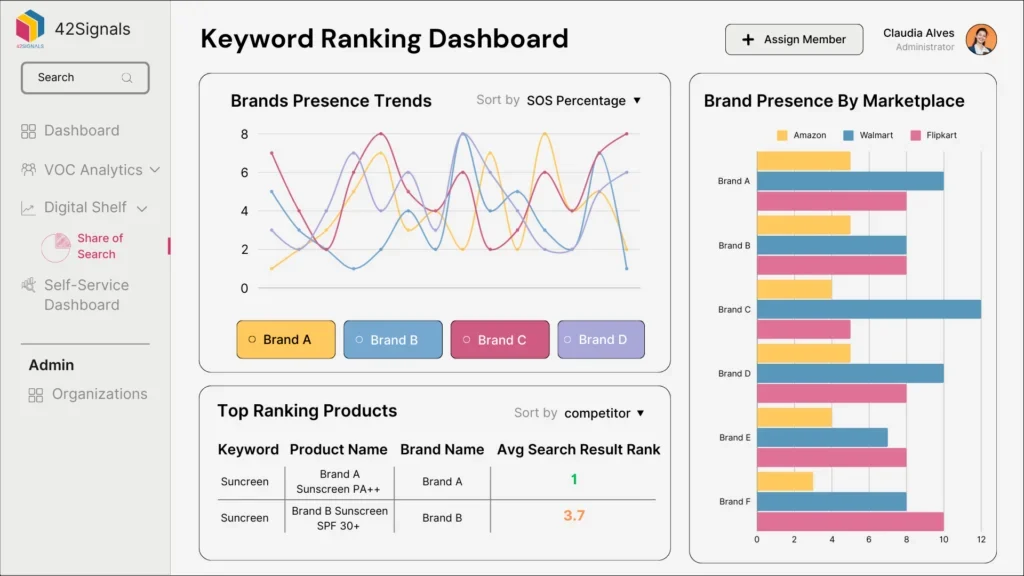
Turning Grocery Ecommerce Trends Into Category Share
The grocery ecommerce trends worth acting on share one characteristic: they move the decision point closer to the shopper’s location and further from your national plan.
Speed is fulfilled from a store or dark store near the buyer. Quick commerce assortment is decided catchment by catchment. Search results are filtered by what can actually be delivered to that address. Retail media places bought inventory above earned inventory on a shelf that already varies by geography.
Every one of those shifts widens the gap between what national reporting tells you and what shoppers experience. A brand can hold strong national distribution, healthy total availability, and rising ecommerce sales while steadily losing the specific catchments where its category is growing fastest — and not see it until a quarterly review.
The brands gaining share in digital grocery aren’t the ones with the best read on macro trends. They’re the ones measuring at the granularity the channel actually operates at: availability where it’s fulfilled, share of voice where shoppers search, and category share against the whole category rather than their own account.
Online grocery will keep taking the category’s growth. Whether it takes it to you depends on whether you can see the shelf clearly enough to compete for it.
42Signals gives FMCG brands pincode-level visibility across quick commerce and marketplace platforms availability, pricing, share of voice, and competitor assortment in one view.
Frequently Asked Questions About Grocery Ecommerce Trends
How fast is online grocery growing?
US online grocery has grown more than 20% year over year for six consecutive quarters through Q1 2026, according to Brick Meets Click. FMI and Nielsen project an 11.6% compound annual growth rate from 2026 to 2028, compared with 0.6% for in-store — taking online from 18% of total grocery spending in 2024 to a projected 25.5% by 2028. Ecommerce accounted for roughly three-quarters of total grocery dollar growth last year.
What is the biggest trend in grocery ecommerce right now?
Fulfilment speed. Same-day accounted for around 80% of delivery orders in Q1 2026, and retailers are competing on windows measured in minutes rather than days. Because speed is fulfilled locally — from stores or dark stores — it makes availability a store-level rather than national question, which is the change that most often breaks existing brand measurement.
How is quick commerce different from regular online grocery?
Three ways. The visible shelf is far smaller, often three or four products above the fold, so paid placement is frequently the only route to visibility. Assortment is heavily curated because dark stores hold a fraction of a supermarket’s SKU count. And inventory is hyperlocal, varying within a single city, which makes pincode-level tracking a requirement rather than a refinement. India’s quick commerce market is the most developed globally.
Why is retail media growing so fast in grocery?
Grocery operates on thin net margins, while retail media monetises traffic and first-party data the retailer already owns at much higher margin. Several grocers now report their digital businesses turning profitable largely on the strength of advertising. For brands, the consequence is that more of the visible shelf is bought rather than earned — and the retailer reporting your performance is also the one selling you the placement.
What should FMCG brands track in online grocery?
Availability at the granularity fulfilment actually happens — store or pincode level, not national. Share of search with organic and paid separated. Competitor assortment changes, which lead sales data by months. Price and promotional position by location. And category share measured against the whole category rather than your own account growth, since sales can rise at every retailer while your share falls.
Is national availability data good enough for grocery ecommerce?
No, and this is the most common measurement gap. Same-day delivery fulfils from local stores and quick commerce from dark stores serving small catchments, so a SKU showing healthy national inventory can be unavailable in the metros driving most of your demand. Any advertising running against those locations is spend that cannot convert, and national reporting will not surface it.
How do AI shopping agents affect grocery brands?
Agents filter rather than browse — they start with the full category and eliminate options on price, availability, data quality, and reviews. A brand filtered out early is never seen by the shopper at all. This places unusual weight on complete, specific, accurate product attribute data, since vague brand-led copy that works on a shelf edge performs poorly when the reader is matching structured attributes.