
Sephora vs Ulta: What the Scoreboard Actually Says
The question assumes a single race. There isn’t one.
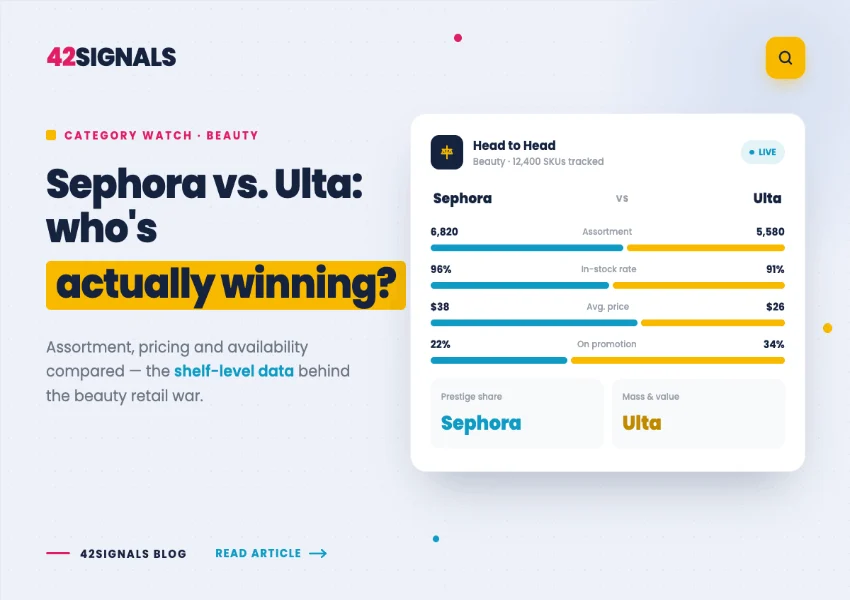
Ulta Beauty reported net sales of $12.4 billion for fiscal 2025, up 9.7% year over year, with fourth-quarter sales rising 11.8% to $3.9 billion and comparable sales up 5.8% (source: Ulta Q4 FY2025 results via WWD). Sephora doesn’t report separately, it sits inside LVMH’s Selective Retailing division, which posted 5% organic growth in the first half of 2026, driven primarily by Sephora, with market share gains in several countries (source: LVMH H1 2026 results). Both are growing. Both claim share gains. And the comparison that matters commercially isn’t which one is larger — it’s that they’re winning different customers, in different categories, through different distribution, and neither one’s reporting tells a brand where it is actually performing. This article compares the two on the dimensions that decide outcomes: business model, loyalty economics, distribution reach, and the competitor both are quietly losing ground to. If you’re a brand selling into both, the final sections cover what the rivalry means for your assortment, pricing, and measurement.
Sephora vs Ulta: Two Fundamentally Different Business Models
The strategic difference isn’t aesthetic. It’s structural, and it determines which brands thrive at each.
Image Source: Ulike
Ulta: The Mass-to-Prestige Continuum
Ulta’s defining mechanism is range. A shopper can put a $7 drugstore mascara and a $70 prestige serum in the same basket, book a salon appointment, and earn loyalty points across all of it.
That continuum lets Ulta serve a wide income spectrum without fragmenting into separate brands — and it produces a basket structure Sephora structurally cannot match. Every Ulta store also carries a full-service salon covering hair, skin, and brow services. Services are a minor revenue line directly, but they drive repeat foot traffic and lift attach rates: a customer in for a haircut is considerably more likely to buy a product in the same visit.
Category mix skews to cosmetics at roughly 43%, with skincare near 20%, haircare around 16%, and fragrance plus salon making up the balance (source: Business Model Analyst — verify against Ulta’s own filings before publishing).
Sephora: Curated Prestige and Price Integrity
Sephora runs the opposite play. It protects prestige positioning and price integrity rather than spanning price tiers, competing on exclusive brand curation, advisor-led service, and launch access. LVMH has repeatedly attributed Sephora’s brick-and-mortar growth specifically to that exclusive curation strategy.
The tradeoff is deliberate. Sephora forgoes the mass end of the basket to remain the retailer where prestige launches happen first — which is why emerging prestige and indie brands still treat a Sephora placement as a category credential in a way an Ulta placement doesn’t quite replicate.
Why This Matters for Brand Selection
The models are selected for different brands. A mass or masstige brand has a route to scale at Ulta that barely exists at Sephora. A prestige-positioned brand risks diluting its equity in Ulta’s mass adjacency while gaining reach it can’t get elsewhere.
Neither answer is universally right. But it’s an assortment decision, not a distribution decision, and brands that treat both retailers as interchangeable shelf space tend to underperform at one of them.
The Numbers Behind the Sephora vs Ulta Comparison
The honest answer to “who’s bigger” is that the disclosure makes a clean comparison impossible.
What Ulta Discloses
Ulta reports as a standalone public company, so the data is unusually clean: $12.4 billion in fiscal 2025 net sales, 9.7% growth, and guidance for 6–7% net sales growth in fiscal 2026 — a deliberate deceleration (source: Ulta Q4 FY2025 earnings). Management also stated it took share in makeup, with positive comps in both mass and prestige makeup.
The fiscal 2026 guidance is the interesting number. A company guiding to 6–7% after delivering 9.7% is signalling that the current growth rate isn’t the run rate.
What Sephora Doesn’t
LVMH doesn’t break out Sephora. It reports Selective Retailing, which also contains DFS travel retail — a business with entirely different dynamics. Selective Retailing grew 5% organically in H1 2026 with margin improvement, and LVMH attributed that primarily to Sephora.
Meanwhile LVMH’s Perfumes & Cosmetics division — the brand-manufacturing side, not the retailer — was flat organically. The retailer is outperforming the brands it sits alongside inside the same group, which is a quietly significant detail about where value is accruing in beauty.
The Comparison Nobody Can Make Cleanly
Anyone claiming a precise Sephora vs Ulta market share split is estimating. One company reports segment-level organic growth percentages inside a division containing an unrelated business; the other reports full financials. The comparison is directional at best.
What can be said with confidence: both are gaining share, both are decelerating from post-pandemic peaks, and the US beauty and fragrance store category overall is forecast to reach roughly $69.3 billion in 2026 with about 3.3% growth (source: IBISWorld US beauty stores industry analysis) — slower than either retailer’s own growth, which is what share gain looks like arithmetically.
Loyalty Is the Real Battleground
This is where the Sephora vs Ulta contest is genuinely close, and where both have built something difficult to dislodge.
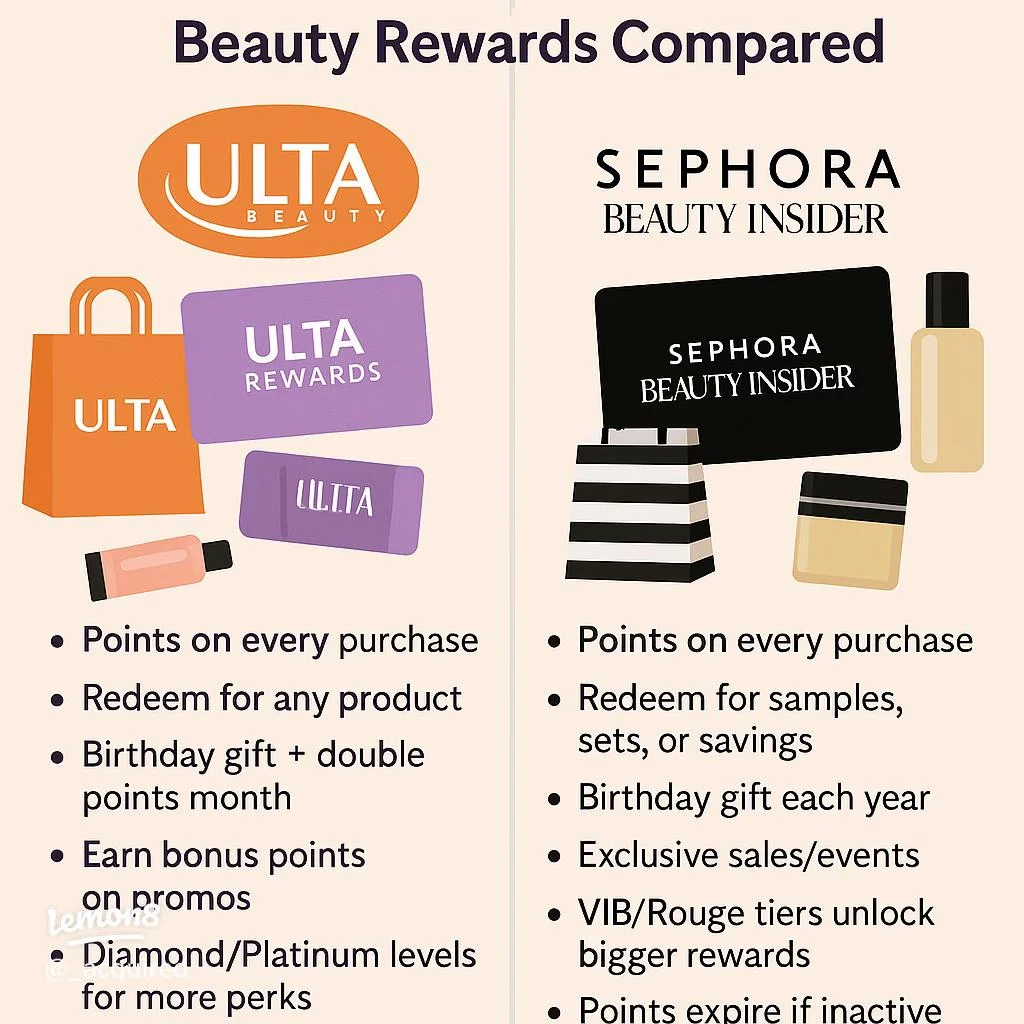
Image Source: Lemon 8
Ulta Beauty Rewards counts roughly 44 million active members generating more than 95% of net sales. Sephora’s Beauty Insider sits at approximately 46 million members (sources: Ulta investor materials; Built In company profile — verify Sephora figure against a primary source).
The membership numbers are close enough to be a wash. The economics underneath them are not.
Ulta’s program follows a pronounced concentration pattern — the top 20% of members drive roughly 80% of revenue, a split Ulta’s own marketing leadership has confirmed publicly. That’s why the Platinum and Diamond tiers get early access to events like the 21 Days of Beauty sale, richer point multipliers, and personalized offers. Ulta concentrates retention spend where the revenue actually is, and gives everyone else a visible ladder.
The transferable point for brands: a loyalty program’s real output isn’t discounts. It’s first-party purchase data and a ranked list of the retailer’s most valuable customers. Both retailers convert that into personalised marketing, sharper inventory decisions, and — critically — retail media inventory they sell back to brands. Understanding how that data asset gets monetised is worth reading alongside our guide to retail media networks.
Distribution: Kohl’s vs Target
Both retailers made the same strategic bet, borrowing someone else’s footprint, and both bets are now large enough to matter.
Sephora at Kohl’s launched in 2021 and has expanded past 1,100 locations, with the partnership expected to surpass $2 billion in annual sales (sources: Glossy; Built In). It puts Sephora into off-mall, suburban, more value-oriented locations — precisely the geography where Ulta was historically unchallenged.
Ulta’s counter is a partnership placing mini-shops in over 800 Target locations, extending discovery into a mass retailer with far higher trip frequency than any beauty specialist.
The strategic read: Sephora is buying suburban reach it didn’t have, and Ulta is buying trip frequency it can’t generate alone. Sephora is also expanding internationally — including UK and Scottish store openings — while Ulta remains substantially a North American business, though its Space NK acquisition marks a move beyond that.
For brands, the practical consequence is that shelf presence at either retailer now means several different store formats with different assortment depth, different demographics, and different fill rates. A Sephora at Kohl’s shop-in-shop is not a Sephora flagship, and performance data averaged across both tells you very little. This is the same store-level variation problem we cover in our guide to digital shelf availability.

The Competitor Neither Side Wants to Discuss
US prestige beauty grew 2% to $16 billion in the first half of 2025. Mass merchant beauty grew 4% to $34.6 billion over the same period (source: Circana, via Yahoo Finance). The mass channel is more than twice the size and growing at twice the rate.
Amazon, meanwhile, has taken durable ownership of replenishment — the unglamorous, high-margin business of shoppers reordering the same shampoo or mascara without browsing. Neither specialist has replicated that, and neither has fully countered it. What Amazon still struggles to replicate is discovery and the try-before-you-buy service environment, which is precisely why both retailers keep investing in experiential retail and services.
So the honest competitive picture is a three-way contest where the specialists fight over discovery while mass and marketplace channels absorb repeat purchase. A brand optimising only for its Sephora vs Ulta performance is optimising for the part of the market growing slowest.
If your category has meaningful replenishment behaviour, monitoring your marketplace position matters as much as your specialty retail placement — which is where Amazon keyword rank tracking and Amazon BSR monitoring become part of the same conversation rather than a separate one.
What the Sephora vs Ulta Rivalry Means If You’re a Beauty Brand
Assortment Has to Diverge
Running identical assortment into both retailers wastes the structural difference between them. Ulta’s continuum rewards accessible price points and range; Sephora’s model rewards exclusives and launch cadence. Retailer-exclusive SKUs and staggered launch timing are standard practice among brands performing well in both, precisely because they stop the two accounts cannibalising each other.
Price Integrity Gets Harder, Not Easier
Two specialty retailers, plus Kohl’s and Target shop-in-shops, plus marketplace listings, plus your own DTC channel, is five or more price-visible surfaces. Sephora in particular protects price integrity as a positioning choice — which makes an unauthorised discount visible on a marketplace a direct problem in your retailer relationship, not just a margin issue.

Systematic MAP violation monitoring stops being a compliance function and becomes account management.
Both Retailers Now Sell You Media
Both monetise their loyalty data through advertising, and both report your campaign performance using their own attribution. That’s the standard structural conflict in retail media: the seller of the media is also the auditor of the result. Attributed sales are not incremental sales, and a brand already holding strong organic placement will see excellent reported ROAS on terms it was converting anyway.
How to Measure Your Own Performance Across Both
Retailer-reported data will tell you how you performed inside that retailer. It will not tell you whether you’re winning the category.
Three things need to be measured independently.
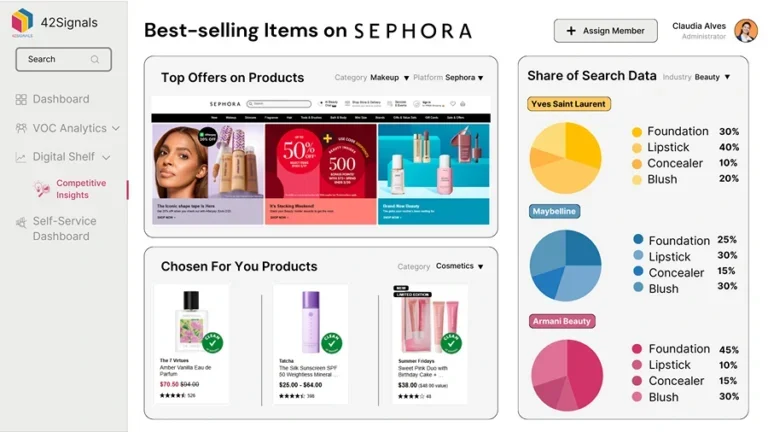
Share of voice by retailer, organic and paid separately. What proportion of visible placements do you own on your priority search terms at each retailer, and how much of that is bought versus earned? If paid share climbs while organic share falls, media spend is masking a listing or assortment problem rather than solving one.
Availability at store and format level. National in-stock rates hide the variation that matters. A SKU can be well stocked in Sephora flagships and unreliable in Kohl’s shop-in-shops, and your campaigns will keep spending against both.
42Signals gives beauty brands an independent view of the shelf — organic and paid share of voice, competitor placements, pricing compliance, and store-level availability across every retailer you sell through.
So Who Is Actually Winning?
On disclosed financials, Ulta has the clearer case: $12.4 billion in fiscal 2025 with near-double-digit growth, stated share gains in makeup, and a loyalty base generating over 95% of sales. It’s the larger disclosed North American specialty beauty business.
On trajectory and geography, Sephora has arguments Ulta doesn’t. It’s gaining share across multiple countries, expanding internationally while Ulta remains largely North American, outperforming the manufacturing brands inside its own parent group, and its Kohl’s footprint is now attacking Ulta’s historic suburban advantage directly.
On the loyalty question, it’s close to a draw on membership scale, with different monetisation logic underneath.
The more useful conclusion is that the Sephora vs Ulta framing is too narrow. Both are growing faster than the category, which means both are taking share — from department stores, from drug chains, from each other at the margins. Meanwhile the mass channel is twice the size and growing twice as fast, and marketplace channels own replenishment.
Ulta is winning the accessible-to-prestige continuum and the services-driven trip. Sephora is winning prestige discovery, launch prestige, and international expansion. Neither is winning replenishment, and that’s the category where the volume actually sits.
Sephora vs Ulta: The Verdict for Brand Teams
If you sell beauty, the answer to “who’s winning” is less actionable than the answer to “where am I winning, and how would I know?”
Both retailers will show you a dashboard suggesting your investment with them is working. Neither will show you your position relative to competitors on the same shelf, whether your availability held in every store format, whether your paid placements defended positions you already owned organically, or whether your category share moved at all.
The brands performing consistently across both accounts do three things. They differentiate assortment to suit two genuinely different business models rather than shipping identical ranges. They enforce price integrity across every visible surface, because at a retailer that positions on price integrity this is a relationship issue rather than a margin one. And they maintain independent measurement — share of voice, availability, and category share — so that a strong quarter reported by a retailer can be verified rather than assumed.
The Sephora vs Ulta rivalry will keep producing headlines. The brands that benefit from it are the ones measuring their own position in it accurately.
42Signals tracks share of voice, pricing compliance, competitor placements, and store-level availability across marketplaces and retail partners the independent baseline retailer reporting doesn’t provide.
Frequently Asked Questions About Sephora vs Ulta
Is Sephora or Ulta bigger?
Ulta is the larger disclosed North American specialty beauty retailer, reporting $12.4 billion in fiscal 2025 net sales. A direct comparison isn’t possible, because Sephora doesn’t report separately — it sits within LVMH’s Selective Retailing division alongside DFS travel retail, so only segment-level organic growth percentages are published. Globally, Sephora operates across more than 30 countries, while Ulta remains substantially North American.
What is the main difference between Sephora and Ulta?
Assortment strategy. Ulta spans mass to prestige, letting a shopper buy drugstore and luxury products in one basket, and every store includes a full-service salon. Sephora concentrates on curated prestige with exclusive brand launches and advisor-led service, deliberately forgoing the mass end of the range to protect its prestige positioning.
Which loyalty program is better, Beauty Insider or Ulta Beauty Rewards?
They’re structured for different behaviour. Ulta Beauty Rewards has roughly 44 million active members and a tiered system that rewards concentrated spend — the top 20% of members drive about 80% of revenue. Sephora’s Beauty Insider is comparable in scale at approximately 46 million members and weights toward exclusive access, launches, and events. Heavy, broad-basket shoppers generally extract more from Ulta’s points structure; prestige-focused shoppers get more from Beauty Insider’s access benefits.
Should a beauty brand sell at Sephora or Ulta?
It depends on positioning rather than on which retailer is performing better. Mass and masstige brands have a route to scale at Ulta that barely exists at Sephora. Prestige and emerging indie brands often find a Sephora placement functions as a category credential. Many brands sell into both with deliberately differentiated assortment and staggered launch timing, which prevents the two accounts competing for the same purchase.
Who is winning the beauty retail war?
Both are taking share from department stores and drug chains, and both are growing faster than the overall US beauty store category. Ulta leads on disclosed revenue and North American footprint; Sephora is gaining share across more countries and expanding internationally. The larger shift is that mass merchant beauty is roughly twice the size of prestige and growing faster, while marketplace channels have absorbed most replenishment purchasing — so the specialists are competing hardest in the segment growing slowest.
How do beauty brands track performance across both retailers?
Retailer-supplied reporting covers performance inside that retailer only. Independent tracking needs three components: share of voice by retailer with organic and paid separated, availability measured at store and format level rather than nationally, and category share measured against the whole category rather than the account. Without those, a brand can grow at both retailers while losing category position and not detect it.
Does Sephora at Kohl’s affect Ulta?
Directly. The partnership has expanded past 1,100 locations and is expected to exceed $2 billion in annual sales, placing Sephora in off-mall suburban locations where Ulta was historically unchallenged. Ulta’s counter is mini-shops in over 800 Target stores, which trades on trip frequency rather than suburban reach. Both partnerships mean brands now face several distinct store formats per retailer, with different assortment depth and fill rates in each.