
Why Quick Commerce Brand Visibility Is a Different Problem
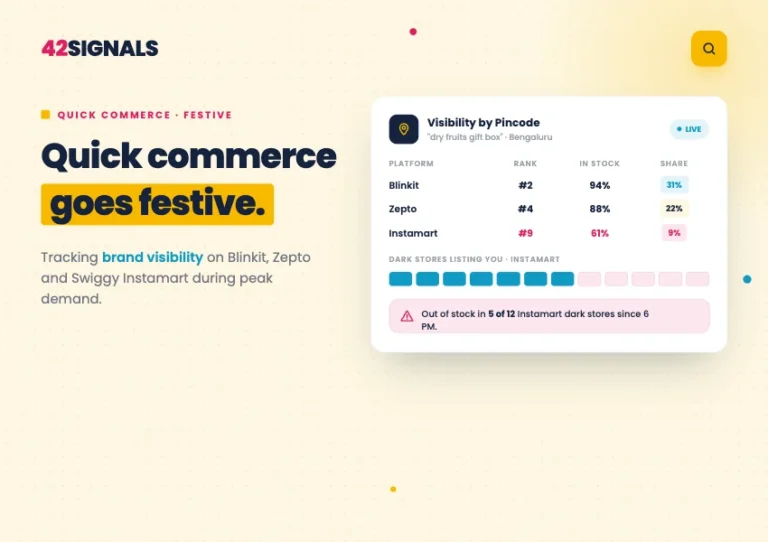
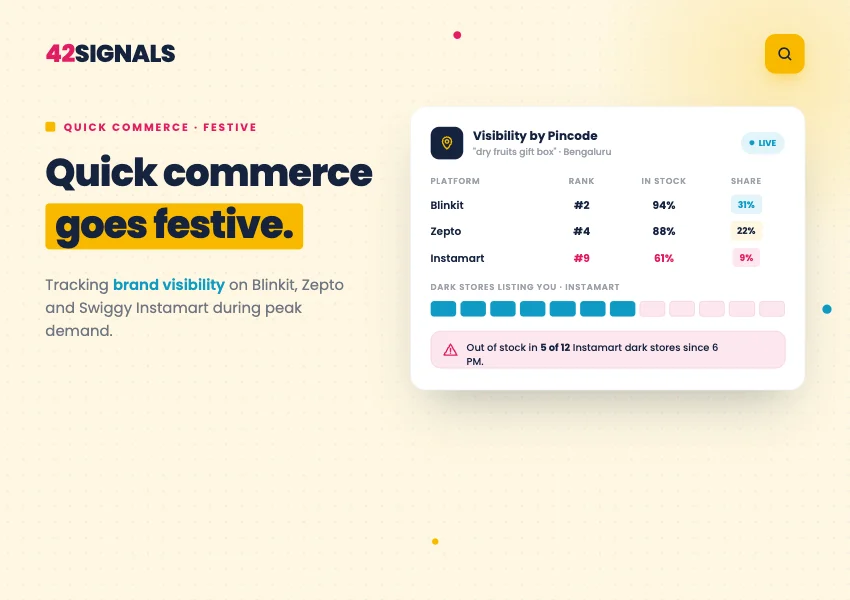
A brand can hold 90% national availability on Blinkit and be invisible in the three Bengaluru pincodes generating a third of its category demand. That sentence describes the entire measurement problem. Quick commerce does not work like a marketplace with faster shipping. Inventory sits in dark stores serving catchments of a few kilometres, assortment is decided store by store, and the visible shelf is three or four products deep. National fill-rate reporting — the number most FMCG teams actually look at — describes an experience no individual shopper has. During a festive window, when demand concentrates into specific occasions and specific catchments, that measurement gap becomes expensive rather than merely imprecise. A stockout on Dhanteras evening in a high-demand pincode is not recoverable by restocking the next morning. The occasion has passed. This guide covers what quick commerce brand visibility actually requires you to measure, how the platform landscape changed in 2026, why the festive dynamics differ from Amazon and Flipkart, and what a workable monitoring cadence looks like.
The 2026 Landscape: Six Players, Not Three
Image Source: Inc 42
Most brand tracking still covers Blinkit, Zepto and Swiggy Instamart. That is no longer the full competitive set.
Blinkit, now operating under Eternal Limited, leads on scale. Market share estimates from Datum Intelligence cited by Reuters put it around 46–48% at the start of 2026, with Swiggy Instamart and Zepto each somewhere in the 20–25% range, though these figures blend GMV and order-volume share from secondary trackers and should be read as “roughly half, quarter, quarter” rather than a precise table.
On physical infrastructure, a geocoded mapping of platform APIs in March 2026 counted 4,081 operational dark stores across the three incumbents, Blinkit 1,954, Zepto 1,089, Instamart 1,038, with Blinkit holding close to half the national dark store footprint and operating in many smaller cities where the others have no presence. Other sources report higher counts for the same period, which is why ranges are more honest than point figures here.
The two developments that change brand planning:
Flipkart Minutes and Amazon Now have entered at scale. Reports through 2026 describe Flipkart Minutes adding roughly 100 dark stores a month, and Amazon Now expanding toward and past 1,000 dark stores. Two well-capitalised entrants with existing customer bases and existing brand relationships change the negotiating dynamic and the tracking requirement.
The economics are tightening. Instamart reported dark store capacity utilisation around 40% in early 2026. Zepto, which filed to list publicly, reported substantial FY26 advertising revenue alongside its order growth — a signal that retail media is becoming a core part of platform economics rather than a side business.
For brands, the practical consequence is that tracking three platforms now covers materially less of the category than it did eighteen months ago.
Why the Quick Commerce Shelf Breaks Normal Measurement
Three structural features make this environment different from Amazon or Flipkart.
The Shelf Is Three Products Deep
A quick commerce search returns three or four products above the fold. There is no page two in any meaningful sense — shoppers ordering in a hurry do not scroll.
This changes what visibility means. On Amazon, slipping from position 4 to position 8 is a demotion. On Blinkit, it disappeared. Quick commerce brand visibility is closer to binary than to a ranking curve, which is why paid placement is frequently the only route to being seen rather than an enhancement to organic position.
Availability Varies Within a City
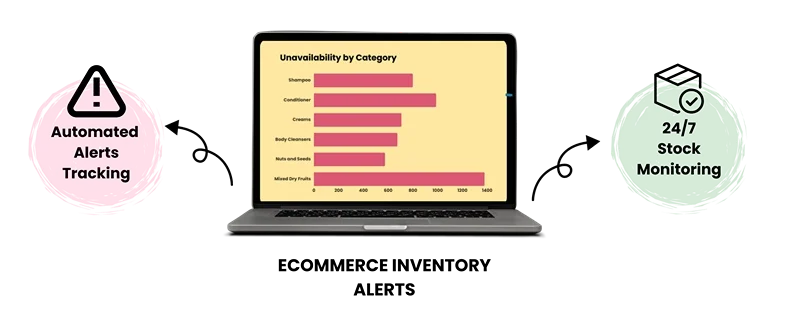
Dark stores serve catchments of a few kilometres. Inventory allocation across them is a platform decision, made independently of your national stock position.
The result: your product can be fully available in North Bengaluru and unavailable five kilometres south. Both facts are true simultaneously, and a national availability figure averages them into a number that is accurate and useless.
Pincode-level tracking is therefore not a refinement of quick commerce measurement. It is the minimum viable unit of measurement, and anything coarser produces decisions made on averages that describe nobody.
Assortment Is a Gate, Not a Given
Dark stores hold a fraction of a supermarket’s SKU count. Getting listed is a genuine commercial gate, and delisting from a catchment removes you from that market entirely rather than pushing you down a page.
Assortment gaps are also the earliest available competitive signal. A rival expanding from two SKUs to six in your subcategory across a city’s dark stores is a shelf-share move that will appear in your sales data months later — if you are not watching assortment, you find out last.
What Quick Commerce Brand Visibility Actually Requires You to Track
Five measures, in rough order of how often they are missed.
1. Availability at Pincode and Dark Store Level
The foundation. Everything else is unreliable without it, because a share of search reading taken where you are out of stock measures nothing useful.
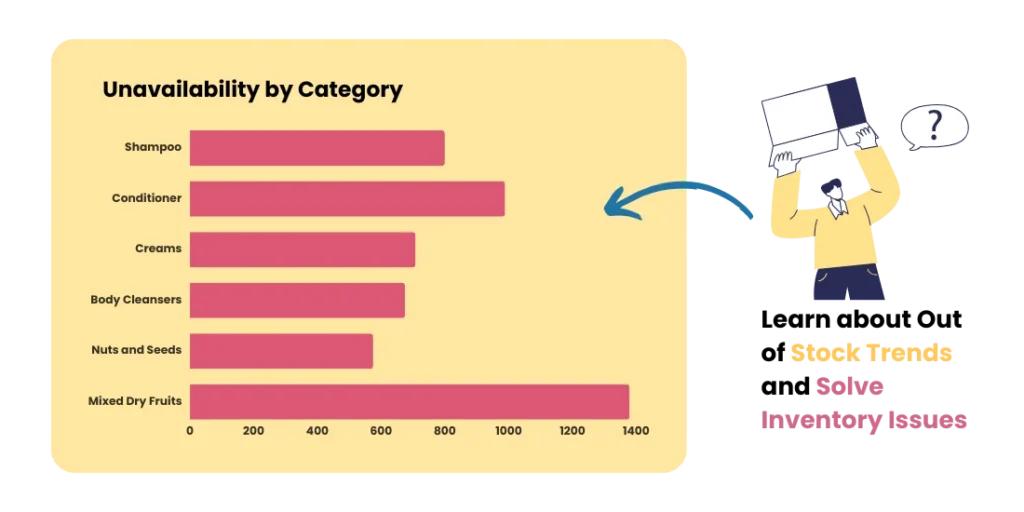
Track fill rate by SKU by catchment, and track it often enough to catch intra-day gaps. The broader mechanics of how stockouts damage position are covered in our guide to stock availability during sale windows.
2. Share of Search by Catchment
What proportion of the visible results you occupy for your category terms — measured at a result depth that reflects the platform. Given three or four visible products, top-5 or even top-3 is the only depth that means anything here.
Separate organic from sponsored placements, for the reasons set out in our guide to how to measure share of search. In quick commerce, this split matters more than elsewhere, because high sponsored density on a three-product shelf means a brand with strong paid share and zero organic share is one budget decision away from disappearing.
3. Assortment Gaps
Which of your SKUs are listed in which catchments, and which competitor SKUs are listed where yours are not? This is where distribution strategy and visibility strategy converge, and it is the metric most likely to be missing from a brand’s dashboard entirely.
4. Price and Promotion by Location
Prices and offers vary by catchment. A national price check produces an average that misrepresents your competitive position in specific markets.
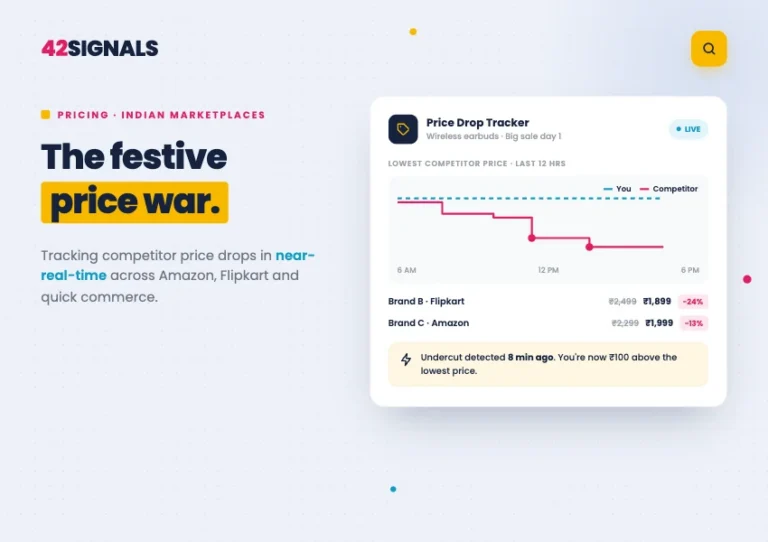
During festive windows, this compounds, because promotional windows on quick commerce run in hours rather than days. Our guide to the festive price war covers the reading discipline — particularly why a competitor’s price drop means something different depending on their stock position.
5. Competitor Dark Store Presence
Where your competitors are listed, and you are not, and where their availability is failing. A rival out of stock in a catchment where you are well stocked is the highest-value moment to increase bids; demand redistributes to whoever remains visible, and on a three-product shelf, that redistribution is concentrated.
Festive Dynamics: Why Quick Commerce Peaks Differently
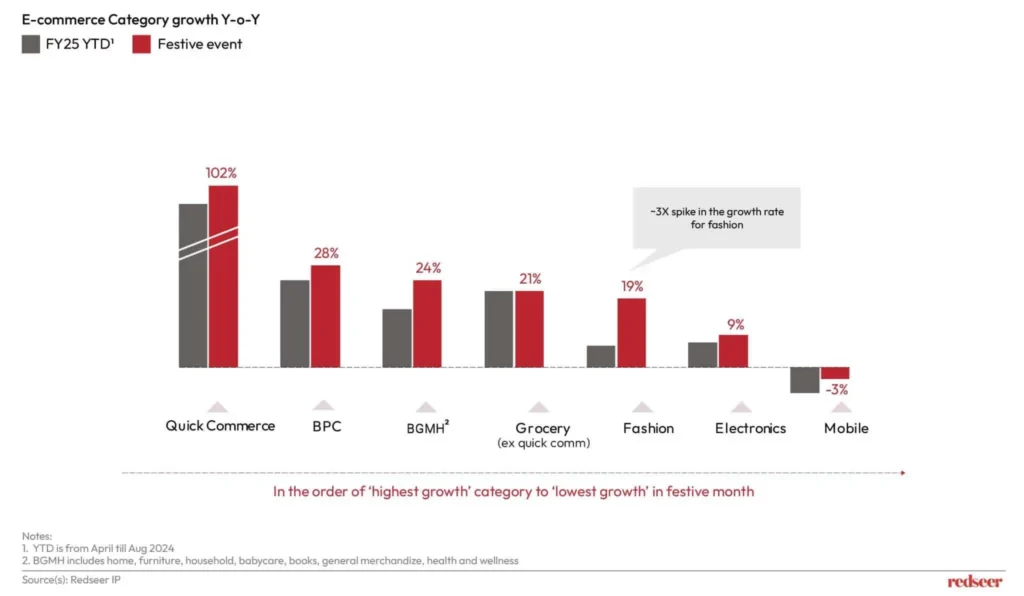
Image Source: Redseer
Amazon and Flipkart festive demand builds across days and waves. Quick commerce festive demand behaves differently in three ways.
Occasion spikes, not sale windows. Demand concentrates around Dhanteras, Diwali eve, and specific gifting and preparation moments — often resolving within hours. The relevant planning unit is the occasion, not the sale period.
Catchment concentration. Festive demand skews geographically in ways that differ from baseline demand. The catchments that matter most during Diwali are not necessarily your strongest markets in July.
No recovery window. A stockout on Amazon during a ten-day sale costs you part of the window. A stockout in a high-demand catchment on Dhanteras evening costs the occasion entirely.
The operational implication is that festive quick commerce planning needs occasion-level demand modelling by catchment, higher-frequency monitoring than any other channel, and pre-agreed replenishment escalation — because by the time a weekly report surfaces the problem, the occasion is over.
Add the festive checklist cta here
The Retail Media Layer
Advertising has become a core part of quick commerce platform economics, not a peripheral revenue line. Zepto’s disclosed FY26 advertising revenue, reported alongside its public listing preparation, illustrates the scale this has reached.
For brands, three consequences follow.
Paid placement is often the entry ticket. On a three-product shelf, organic visibility is achievable but fragile. Most brands in competitive FMCG categories are buying at least some of their quick commerce brand visibility.
Reporting is less mature than Amazon’s. Placement transparency, attribution logic, and search-term-level reporting vary between platforms and change without much notice. Building your own view of where ads served, and against what availability, is not optional.
The attribution problem is the same as everywhere else. The platform selling you the media also reports whether it worked, and attributed sales are not incremental sales. Comparing your paid share of search against your organic share on the same terms is the only way to see how much you are paying for demand you already had.
The “10-Minute Delivery” Messaging Question
One regulatory development worth knowing about before it appears in your creative brief.
Reuters reported in January 2026 that India’s government instructed Blinkit, Zepto and Swiggy to stop promoting grocery delivery as a “10-minute” service, following concerns about rider safety and pay practices. Separately, a major body representing retail distributors asked the competition regulator to investigate the platforms over alleged predatory pricing.
For brands, the practical reading is that speed-of-delivery claims are a platform-level regulatory question, and brand messaging that leans on “10-minute” framing carries reputational risk that the underlying convenience proposition does not. The consumer behaviour driving quick commerce growth is unchanged; the language used to describe it is under scrutiny.
This is also a reminder that quick commerce operates in a less settled regulatory environment than established marketplaces, and that brands with meaningful dependence on the channel should be tracking policy developments alongside performance.
Building a Monitoring Cadence
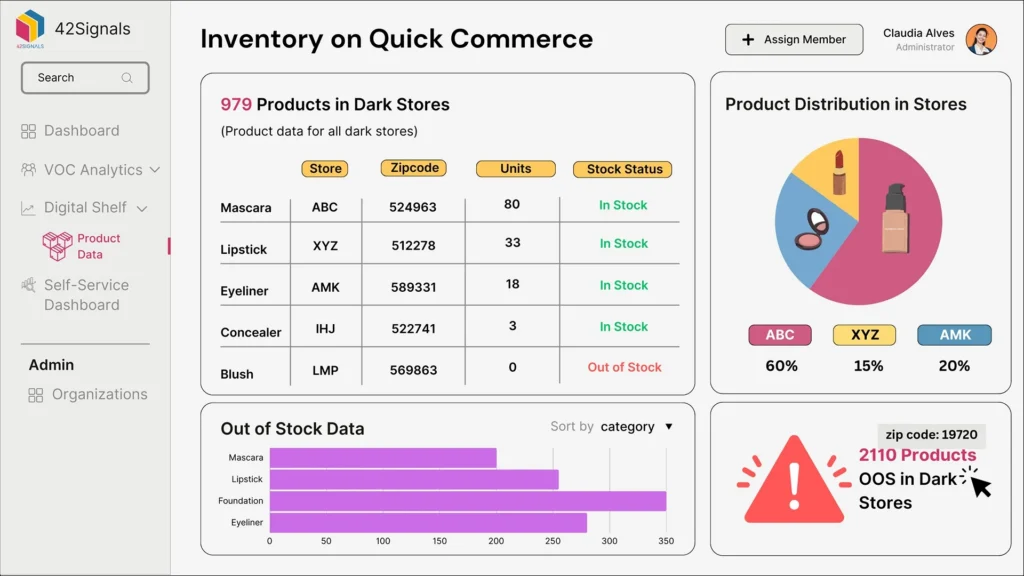
Frequency should match how fast the environment changes, which on quick commerce, is faster than anywhere else in Indian retail.
Multiple times daily during festive occasions: fill rate on priority SKUs in priority catchments. Hours matter here in a way they do not on Amazon.
Daily during festive windows: full catchment availability, share of search on category terms, competitor availability and price, and new competitor listings.
Weekly outside peak: assortment coverage by catchment, competitor SKU additions, and organic-versus-paid share trend.
Monthly: catchment-level performance review — which catchments are you winning, which are you absent from, and does your distribution effort match where category demand actually concentrates.
Post-festive: reconstruct every stockout by catchment and occasion, and quantify what it cost. This dataset is what justifies next year’s inventory and distribution investment, and almost nobody builds it.
Learn more about what data can be tracked with 42Signals by going through our Zepto data use case.
42Signals tracks availability, pricing, assortment, and share of search at pincode level across Blinkit, Zepto, Swiggy Instamart, and the newer quick commerce entrants.
Turning Quick Commerce Brand Visibility Into Category Share
The uncomfortable thing about quick commerce is that most brands are making distribution and media decisions on data that cannot support them.
National availability figures average across catchments where the truth is opposite. Platform-reported campaign performance describes attributed rather than incremental outcomes. Assortment coverage often isn’t tracked at all, despite being the gate that determines whether any of the rest matters. And the competitive set most brands monitor covers three platforms in a market that now has six.
None of that is a reason to under-invest in the channel. Quick commerce is growing faster than any other route to the Indian consumer, and for FMCG categories it is increasingly where replenishment demand is captured. It is a reason to measure it at the granularity it actually operates at.
The brands gaining share here are not the ones spending most on placement. They are the ones who know which catchments matter for their category, whether they are actually available in those catchments, and whether the visibility they are buying is extending organic position or substituting for it.
That is a measurement problem before it is a merchandising one and on a shelf three products deep, the cost of not knowing is that you simply aren’t there.
42Signals gives FMCG brand and category teams pincode-level visibility across every major quick commerce platform, availability, assortment, pricing, and share of search in one view.
Frequently Asked Questions About Quick Commerce Brand Visibility
Why does my product show as available nationally but out of stock on Blinkit or Zepto?
Because quick commerce inventory sits in dark stores serving catchments of a few kilometres, and platforms allocate stock across those stores independently of your national position. Your product can be fully available in one part of a city and unavailable five kilometres away. National fill-rate reporting averages those outcomes into a figure that is accurate and operationally useless — which is why pincode-level tracking is the minimum viable measurement unit on these platforms.
How many dark stores do Blinkit, Zepto and Swiggy Instamart operate?
Counts vary between sources and change monthly. A geocoded mapping of platform APIs in March 2026 counted 4,081 dark stores across the three incumbents, with Blinkit holding close to half the national footprint and Zepto and Instamart roughly tied behind it. Other sources report materially higher counts for the same period. Treat any specific figure as a snapshot from one methodology rather than a settled number, and note that Flipkart Minutes and Amazon Now have since added significant capacity.
Who leads the Indian quick commerce market?
Blinkit, operating under Eternal Limited, leads on both scale and market share. Estimates from Datum Intelligence cited by Reuters put it around 46–48% at the start of 2026, with Swiggy Instamart and Zepto each somewhere in the 20–25% range. These figures blend GMV share and order-volume share from secondary trackers, so they are better read as “roughly half, quarter, quarter” than as a precise ranking. Flipkart Minutes and Amazon Now have both entered at scale since.
Should brands advertise on quick commerce platforms?
Usually yes, because with only three or four products visible above the fold, paid placement is frequently the only reliable route to visibility rather than an enhancement to organic position. The prerequisite is confirmed availability in the catchments where ads will serve — advertising into a pincode where you are out of stock is spend that cannot convert. Platform reporting is also less mature than Amazon’s, so building an independent view of placement and availability matters more here.
How is festive demand different in quick commerce?
It concentrates into occasions rather than sale windows. Demand spikes around Dhanteras, Diwali eve, and similar moments, often resolving within hours rather than days, and it skews geographically in ways that differ from baseline demand. Critically, there is no recovery window — a stockout in a high-demand catchment on Dhanteras evening costs the occasion entirely, because restocking the next morning arrives after the demand has gone.
What should FMCG brands track on Blinkit, Zepto and Instamart?
Five things: availability by SKU by catchment, share of search at a result depth reflecting the three-or-four-product shelf, assortment coverage showing which SKUs are listed where, price and promotion by location, and competitor presence, including where rivals are listed that you are not. Assortment is the one most often missing entirely, despite being the gate that determines whether the others matter.
Is it still accurate to describe quick commerce as 10-minute delivery?
Reuters reported in January 2026 that India’s government instructed Blinkit, Zepto and Swiggy to stop promoting grocery delivery using “10-minute” framing, following concerns about rider safety and pay practices. The underlying convenience proposition and the consumer behaviour driving category growth are unchanged, but brands should be cautious about building messaging around specific delivery-time claims, since this is an active regulatory question at the platform level.