
What This Article Covers on Amazon Sponsored Products
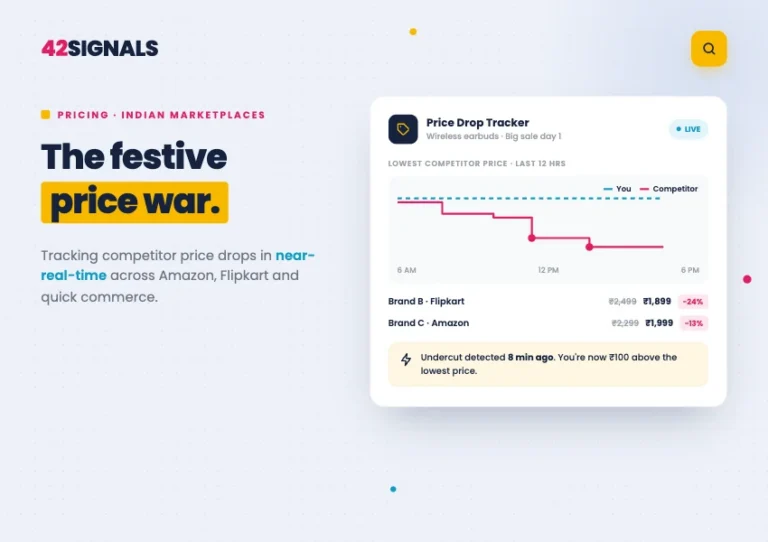
Amazon Sponsored Products is the most widely used ad format on the marketplace, and most brands treat it as a bidding problem. It isn’t. It’s a pricing problem wearing a bidding costume. You can win the auction, hold the top slot, and still lose money — because a shopper who clicks your ad and sees a price 15% above the listing next to it doesn’t convert. You paid for the click anyway. This guide covers how Sponsored Products actually works, why competitor pricing is the single biggest lever on your return on ad spend, and how brands use real-time price intelligence to decide when to bid harder, when to pull back, and when to raise prices instead of dropping them.
What Are Amazon Sponsored Products?
Sponsored Products are cost-per-click ads that promote individual product listings inside Amazon search results and on product detail pages. They look almost identical to organic results — the only visual difference is a small “Sponsored” label — which is precisely why they work.
They are the entry point for most brands running paid media on Amazon, and they typically account for the majority of marketplace ad spend for consumer brands.
The Three Main Amazon Ad Formats
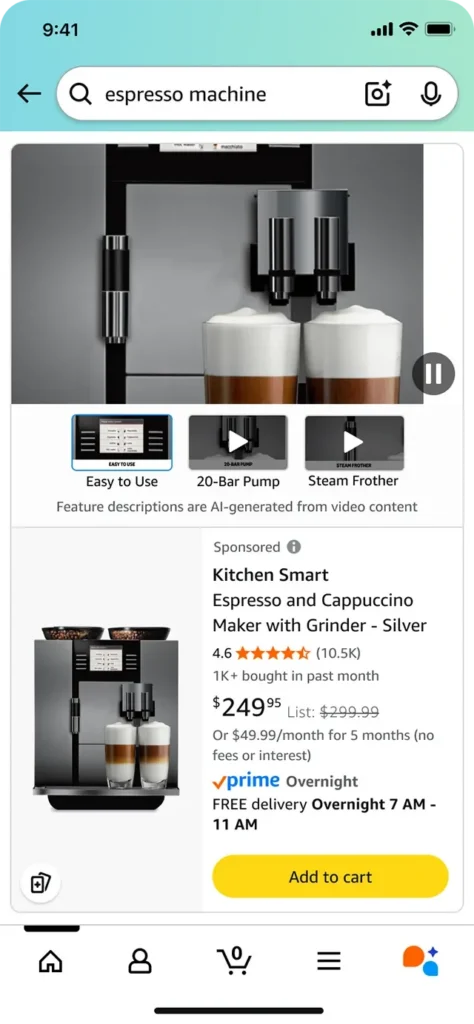
Image source: Amazon Ads
Understanding where Sponsored Products sits helps clarify what it can and can’t do for you.
Sponsored Products promote a single ASIN. They appear in search results and on competitor detail pages. Best for driving direct conversions on individual products.
Sponsored Brands promote your brand as a whole — usually a banner with your logo, a custom headline, and three products. They appear at the top of search results. Best for category-level visibility and brand recall.
Sponsored Display retargets shoppers who viewed your product or similar products, both on and off Amazon. Best for recapturing consideration-stage shoppers.
This article focuses on Sponsored Products because it is the format most directly affected by your pricing position.
How the Auction Actually Works
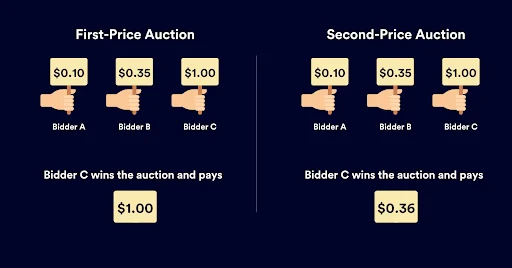
Image source: Topsort
Amazon runs a second-price auction. You set a maximum bid, and if you win, you pay slightly more than the next-highest bid rather than your full bid amount.
But bid amount alone doesn’t decide the winner. Amazon weighs your bid against a relevance and performance score that factors in your listing’s historical conversion rate, click-through rate, and keyword relevance. A listing that converts well can win placements over a higher bidder that converts poorly.
This is the mechanism that makes pricing a bidding issue. Your conversion rate is not a fixed property of your listing — it moves with your price relative to whatever else is on the page. When a competitor undercuts you, your conversion rate falls, your relevance score follows, and you end up paying more per click for worse placement. The auction penalises you twice for the same price gap.
Automatic vs Manual Targeting
Automatic campaigns let Amazon match your ad to search terms based on its own understanding of your listing. Useful for discovery — they surface keywords you hadn’t considered.
Manual campaigns let you choose exact keywords, phrase matches, or product targets. Useful for control and efficiency once you know which terms convert.
Most mature brands run both: automatic campaigns as a keyword research engine, feeding proven terms into tightly managed manual campaigns. If you’re mapping which terms your competitors own that you don’t, a competitor keyword gap analysis is the faster route than waiting for automatic campaigns to surface them.
Why Your Sponsored Products ROI Depends on Your Price
Here is the sequence that quietly drains ad budgets:
- A competitor drops their price by 20% at 9am.
- Your ads keep running at the same bid.
- Shoppers click your ad, land on your listing, compare, and leave.
- Your conversion rate falls through the afternoon.
- Amazon’s algorithm reads the lower conversion rate as reduced relevance.
- Your cost-per-click rises and your placement slips.
- You see it in your weekly report on Monday.
By then you’ve spent five days of budget on clicks that were never going to convert.
The fix isn’t more aggressive bidding. It’s knowing about step one when it happens. Real-time price monitoring means you find out at 9:05am, not the following Monday, and you get to choose your response while it still matters.
That response might be to match the price. It might be to pause the campaign for 48 hours. It might be to do nothing — which brings us to the part most brands get wrong.
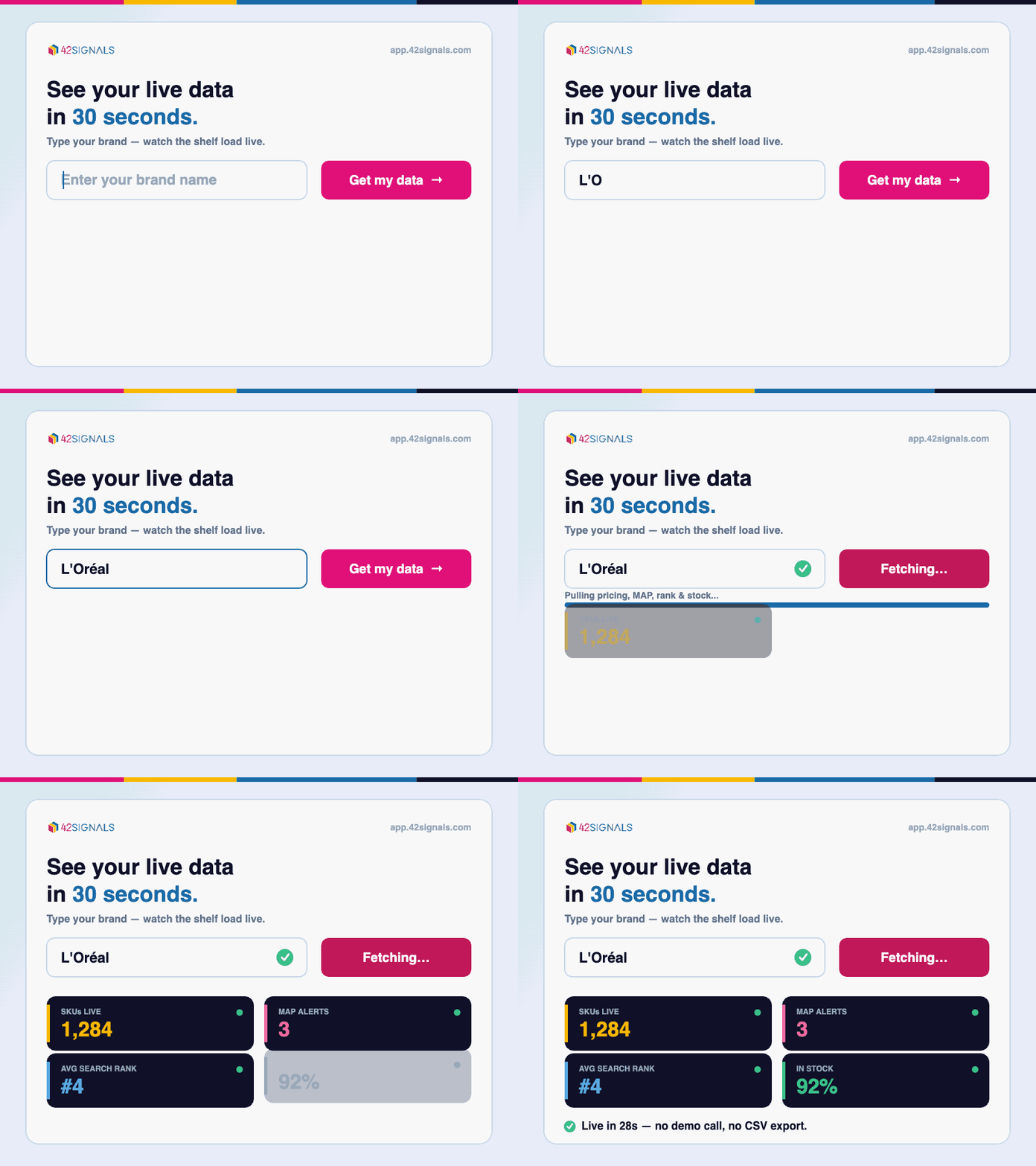
42Signals tracks competitor prices, promotions, and stock levels in real time across Amazon and 50+ marketplaces, so your Sponsored Products bids stay aligned with what shoppers actually see.
How Real-Time Visibility Protects Your Margins
Protecting margin is not the same as matching every price you see. It’s mostly the discipline of not matching — and having enough context to know which drops are worth a response.
Context Turns a Price Drop Into a Decision
A competitor cuts their price by 15%. Without context, that’s an alarm. With context, it’s a data point that resolves into one of several very different situations:
- They have five units left. They’ll be out of stock by tomorrow. Hold your price and pick up the demand.
- It’s a three-day flash promotion. Wait it out. A permanent cut in response to a temporary promotion is how price wars start.
- Their shipping cost went up. The landed price a shopper actually pays may be unchanged, or worse than yours.
- It’s a sustained repositioning. This one is worth responding to.
Only the last case justifies a price change. The other three justify holding — and each is invisible if all you’re tracking is the number on the search results page.
Landed Price, Not List Price
Shoppers compare what they pay at checkout, not what appears in the search grid. A competitor showing a lower list price while charging for shipping, or bundling a smaller quantity, may be more expensive in practice.
If your monitoring captures list price, shipping, quantity, and any active promotion, you can hold a nominally higher price with confidence — and defend that decision internally when someone asks why you’re not matching.
MAP Enforcement as a Margin Lever

Image Source: IP Secure
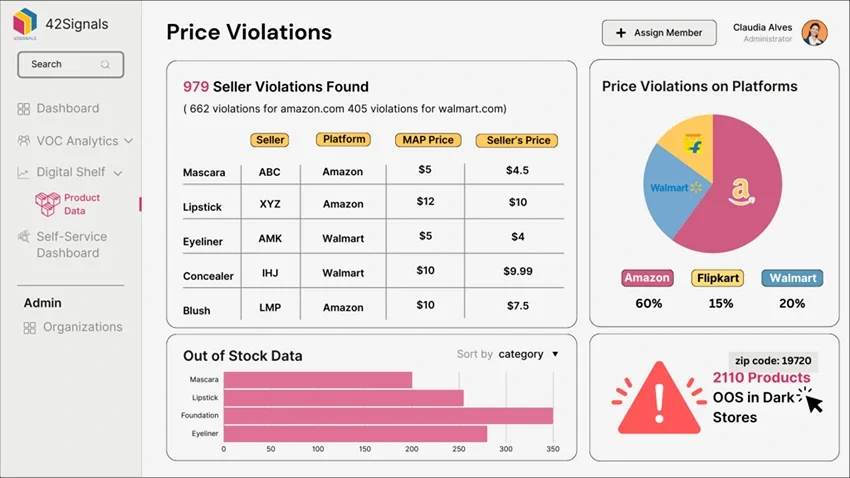
Unauthorised sellers discounting below your Minimum Advertised Price distort every pricing decision downstream. Your own analysis reads the market as more aggressive than it is, and you respond to a price that shouldn’t exist.
42Signals customer data indicates that brands running systematic MAP violation monitoring reduce annual margin leakage by five to eight percent.
Automated MAP violation monitoring with timestamped screenshot evidence gives your enforcement team what it needs to act — and gives your pricing team a clean baseline to work from.
Reading the Full Competitive Picture
Price is the headline signal. It isn’t the only one that moves your ad performance.
Availability
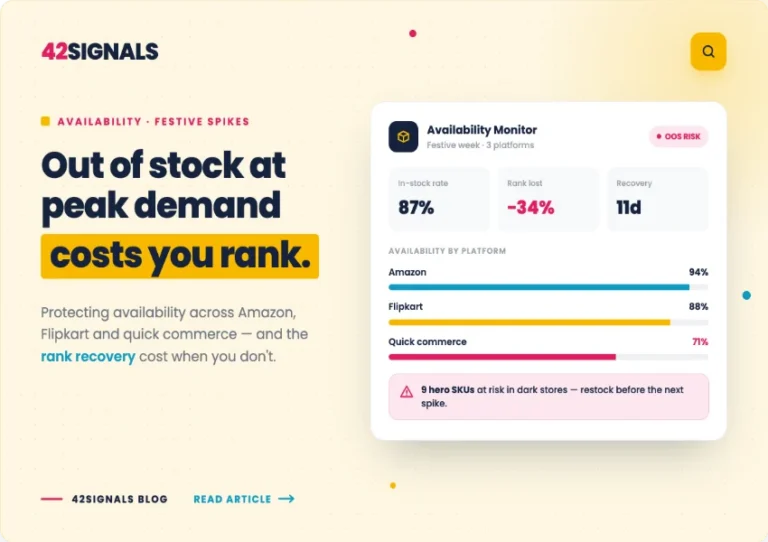
If your Sponsored Products campaigns perform well in one city and poorly in another, the cause is often not your creative or your bid. It’s that a competitor is out of stock in the first market and fully stocked in the second.
This matters more in quick commerce, where inventory is held at dark-store level and availability varies across a single city. Pincode-level tracking is the only way to see it. The relationship between stockouts and search visibility is covered in more depth in our guide to digital shelf availability.
Promotion Type
A buy-one-get-one offer, a percentage discount, a coupon clip, and a Lightning Deal all reduce effective price — but they demand different responses. Knowing the mechanic your competitor used lets you counter without touching your list price.
Review Velocity and Sentiment
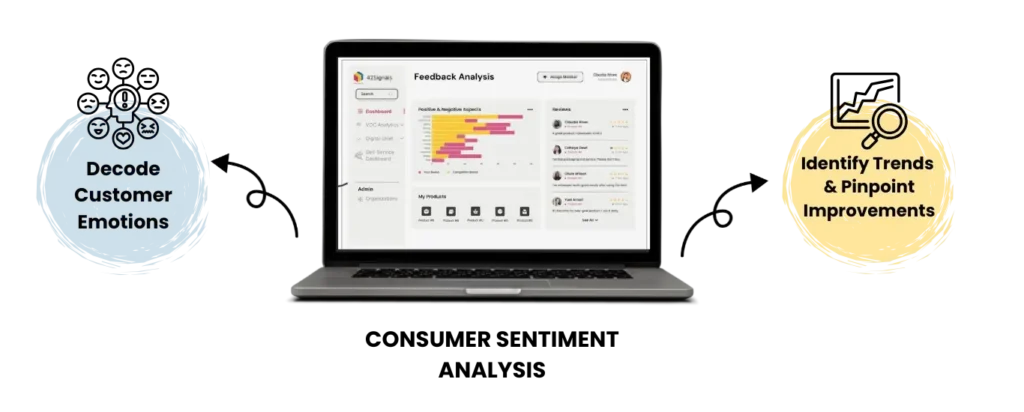
Conversion rate is a function of price and trust. A competitor with a lower price but a wave of recent one-star reviews about delivery damage is not the threat their price suggests. Tracking review sentiment alongside pricing tells you whether a price gap will actually cost you the sale.
Rank Position
Your Best Seller Rank moves with sales velocity, which moves with price and ad spend together. Watching BSR alongside your pricing decisions shows you whether a discount actually bought volume or just gave away margin.
Benchmarking: Knowing Where You Sit
Benchmarking is comparing your position against the category, not against a single rival. It answers a question that individual price checks can’t: are you a premium brand, a value brand, or drifting between the two without deciding?
That answer should drive your Sponsored Products strategy. A premium-positioned brand bidding aggressively on price-comparison keywords is buying clicks from shoppers who were never going to buy.
Two things make benchmarking useful rather than academic:
Frequency. A quarterly pricing review catches drift after it’s already cost you. A daily view of your position against the category average and category low catches it while a small correction still works.
Key value item identification. A subset of your catalogue drives most of your traffic and most of your price comparisons. These are the SKUs where competitiveness is non-negotiable and where your ad spend should concentrate. The rest of the catalogue has more pricing latitude than most teams assume.
The Defensive ROI: Money You Don’t Lose
Defensive return is harder to put in a board deck than a revenue increase, and it’s usually larger.
Avoiding Reactive Discounting
The most expensive pricing decisions are made under time pressure with incomplete information. A manager sees a competitor’s price, has no visibility into whether it’s temporary, and cuts to match. The competitor’s promotion ends three days later. Your price stays down because raising it feels like a signal of weakness.
Real-time data with historical context removes the pressure. You can see that this competitor has run the same three-day promotion monthly for the past six months and respond accordingly — which is to say, not at all.
Catching Your Own Errors
Pricing errors happen. A decimal misplaced in a bulk upload, a repricing rule that misfires, a promotion that stacks with another promotion.
When this happens on a SKU with active Sponsored Products campaigns, the ads amplify the damage — you’re paying to drive traffic to a listing that loses money on every order. Alerting on your own price anomalies, not just competitors’, means the gap between the error and the fix is minutes rather than a full day of Prime-time traffic.
The Offensive Play: Bidding Into Competitor Stockouts
The clearest opportunity in marketplace advertising is a competitor going out of stock on a high-demand SKU.
When a major rival’s listing goes unavailable, their demand doesn’t disappear — it redistributes to whoever is visible. If you find out within the hour, you can:
- Increase bids on the keywords they were winning, while competition for those placements is thin
- Hold or raise your price, since you’re now one of fewer available options
- Capture the review velocity and rank momentum that comes with the volume spike
If you find out next week, someone else already did all three.
The same logic applies to white space in the market — price points nobody is serving, or subcategories where the incumbents have poor ratings. These are the openings that competitive intelligence surfaces and manual spot-checking misses. Our comparison of competitor analysis tools for ecommerce covers how different platforms handle this.

42Signals alerts your team when a competitor’s stock drops or their price shifts. so you can move your Sponsored Products bids while the opportunity is still open. Request a demo.
How Automation Changes the Operating Model
The argument for automating price collection isn’t only speed. It’s what your team does with the hours it gets back.
An analyst spending most of the week gathering data produces very little analysis. The same analyst with the data already assembled spends the week deciding what to do about it. That’s a different job, and it’s the one you hired them for.
Illustrative example — a mid-size brand managing roughly 500 SKUs across three marketplaces:
| Activity | Manual process | Automated process | Time recovered |
| Price and stock collection | ~40 hrs/week | Continuous, no manual time | ~40 hrs |
| Analysis and interpretation | ~15 hrs/week | ~2 hrs/week | ~13 hrs |
| Execution and repricing | ~10 hrs/week | ~1 hr/week | ~9 hrs |
Figures are illustrative and will vary by catalogue size, marketplace count, and tracking depth.
The second-order benefit is consistency. Manual collection produces gaps — the week someone was on leave, the marketplace nobody remembered to check. Those gaps are exactly where the expensive surprises live.
Four Steps to Implementing Price Intelligence
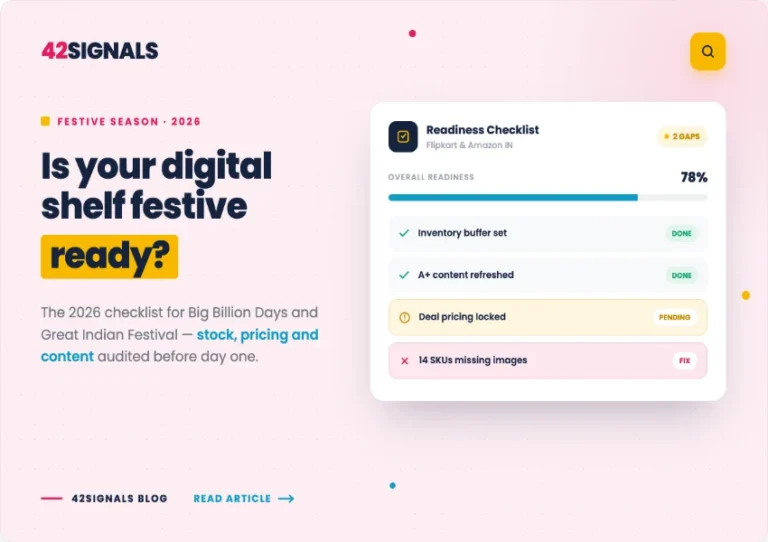
1. Start with your key value items, not your full catalogue. Identify the roughly 20% of SKUs driving 80% of revenue and the majority of price comparisons. Track those first. A narrow deployment that produces action beats a comprehensive one that produces a dashboard nobody opens.
2. Write your response rules before you have the data. Decide in advance what triggers a response and what doesn’t. For example: if a tracked competitor’s price drops more than 8% and holds for 72 hours, review; below that threshold, no action. Rules written in advance prevent panic decisions made in the moment.
3. Connect the data to your advertising workflow. Price intelligence that lives in a separate dashboard from your campaign management is intelligence you’ll act on late. The value comes from the connection — competitor goes out of stock, bids increase; competitor undercuts you significantly, spend pauses on that ASIN.
4. Review and tighten quarterly. Track which alerts led to action and which were noise. Thresholds set at launch are almost always wrong. Tighten the rules that fire too often, loosen the ones that miss real movements.
Where This Is Heading for ECommerce Brands on Amazon
Marketplace pricing is moving toward prediction rather than reaction. Models that flag a likely competitor stockout before it happens, or anticipate a promotional cycle from historical patterns, are already in use — and the gap between brands that have them and brands that don’t is widening.
The constraint is not the technology. It’s the decision framework around it. A system that automatically raises bids on competitor stockouts is only as good as the boundaries you set: how high, on which SKUs, at what margin floor. Those are judgement calls, and they stay human.
The brands getting value from automation are the ones that decided what they wanted first and then automated toward it. The ones that bought the tool hoping it would supply the strategy are still exporting spreadsheets.
Bringing Pricing and Advertising Together
Sponsored Products performance is not a bidding problem solved in the campaign manager. It’s the visible output of your pricing position, your availability, and your competitive standing — all of which move faster than a weekly reporting cycle can capture.
The brands making their ad spend work harder aren’t bidding more. They’re bidding with better information: they know when a competitor’s discount is temporary, when a stockout has opened a window, and when their own price has drifted out of the consideration set. That’s the difference between spending on Amazon and investing in it.
42Signals gives brand managers real-time pricing, availability, and MAP intelligence across Amazon, Flipkart, and quick commerce platforms — the context that makes Sponsored Products spend profitable rather than just busy. Start a free trial.
Frequently Asked Questions
How does price intelligence affect my Amazon Sponsored Products spend?
Your ads convert based on how your price compares to whatever else appears on the page. When you’re priced above the visible alternatives, you still pay for clicks but convert fewer of them — and Amazon’s algorithm reads that lower conversion rate as reduced relevance, raising your cost-per-click over time. Real-time price data lets you adjust your price or pause the campaign before that cycle starts.
Can price intelligence tools monitor MAP violations?
Yes. Most competitor price intelligence platforms include MAP monitoring, tracking listings across marketplaces and third-party sites and alerting you when a seller advertises below your authorised price. Look for tools that capture timestamped screenshot evidence, since enforcement generally requires proof rather than a data export.
Is real-time pricing data necessary for smaller brands?
Arguably more so. Smaller brands have less budget to absorb wasted ad spend and fewer SKUs to spread risk across, so a single misjudged pricing response costs proportionally more. The tracked catalogue is also smaller, which usually makes monitoring more affordable than brands expect.
Which products should I track first?
Start with key value items — the SKUs that drive most of your revenue and that shoppers are most likely to price-compare. These deliver the clearest impact on both margin and Sponsored Products performance. Expand to the long tail once your response rules are working reliably.
What’s the difference between offensive and defensive pricing ROI?
Defensive ROI is margin you protect by not making avoidable decisions — declining to match a temporary discount, catching a pricing error before it runs all day. Offensive ROI is revenue you capture by moving faster than competitors — bidding into their stockouts, holding price when they run low, filling a price point nobody is serving. Most brands measure only the second and undercount the value they’re getting.
Should I pause Sponsored Products campaigns when a competitor undercuts me?
Not automatically. Pause when the price gap is large enough to materially hurt conversion and the competitor’s position looks sustained. If they’re running a short promotion or are close to a stockout, pausing hands them visibility you’ll have to buy back at a higher cost once they’re gone. The decision depends on context, which is the argument for having the context available in the first place.