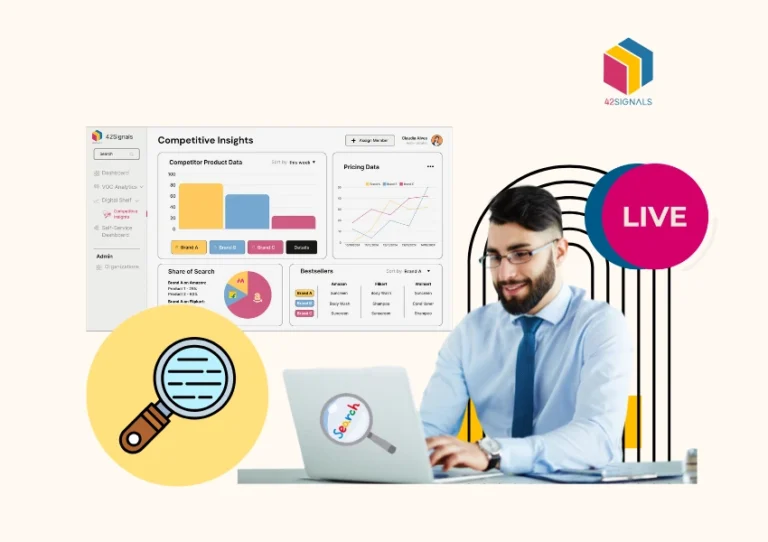

A digital shelf is where your products sit online: on your website, online marketplaces, or even quick commerce platforms. Think of it as a shelf where all your products are displayed, and similar to a physical shop, how you arrange your products can affect your sales. Because consumers can look at thousands of products from different online marketplaces, brands have to work hard to showcase their items visibly. This will help customers find them and drive sales for the brands. This guide explains how to effectively create a digital shelf strategy with the help of 42Signals’ digital shelf analytics and competitor monitoring for pricing and product optimization.

Image Source: Seller App
What is a Digital Shelf Strategy?
A digital shelf strategy focuses on all product elements and factors that impact a customer’s purchase decision. This involves having attractive listings, competitive prices, and making sure customers can easily find it. Furthermore, it includes watching competitors, studying customers, and making the right choices based on data.
With the development of online marketplaces, quick commerce, and dark stores, the digital shelf for brands has never been constructed so complexly. Brands that do not will have low visibility, market share, and revenue, as brands need to adapt to this new norm.
Step 1: Understand Your Digital Shelf Ecosystem
To the optimization of your digital shelf, you must also analyze where your products are sold and how they are displayed. The following are the necessary components:
• Online Marketplaces: Websites such as Amazon, Walmart, and eBay.
• Quick Commerce Platforms: Services such as Instacart, Zepto, Blinkit, DoorDash, and GoPuff that bring products to your door within minutes.
• Dark Stores: Micro warehouses that serve exclusively online orders.
• Your Own Website: Your brand’s D2C website.
All of these mediums are distinct from one another; therefore, your approach should also be different.
Step 2: Conduct Competitor Analysis to Identify Market Trends
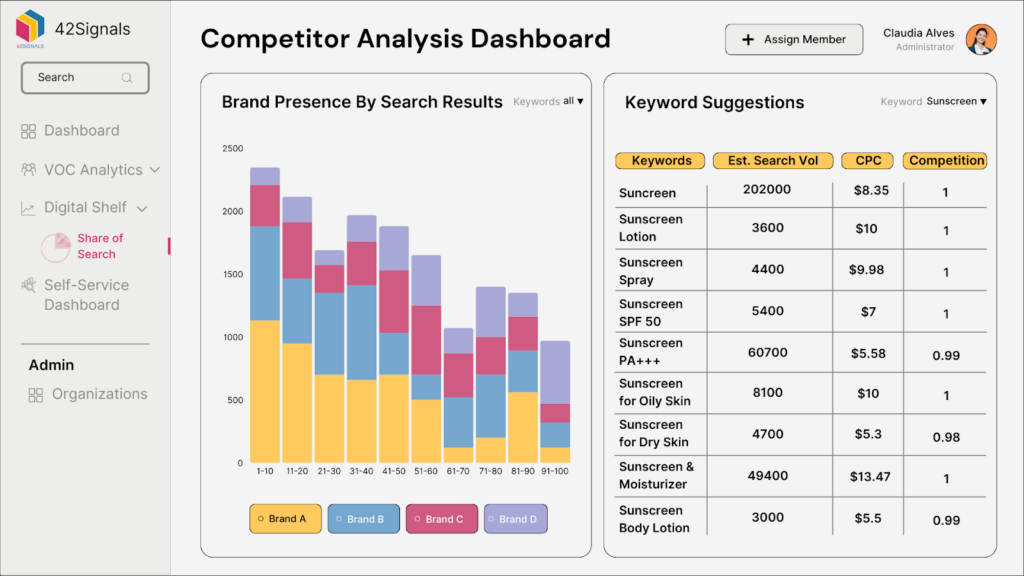
Your competitors are just a click away on the digital shelf. To stay ahead, you need to know what they’re doing—and how you can do it better.
With 42Signals’ competitor analysis dashboard, you can easily:
- Compare Product Listings: Review how your product details outdo competitors in regards to titles, images, descriptions, and even marketing of the products.
- Compare Prices: Are your competition’s prices affecting your sales? Is there a competitor selling similar items at a higher amount?
- Track Promotions: What types of competitors advertising their products are offering low prices or selected items as packages?
You can monitor your competition and see where your brand may stand out and gain a larger portion of the market with digital shelf strategy.
Example: If my product has a stockout frequently and my competitor’s product does, you will be able to shift the share of your competitor’s stockout products with in-stock products and competitive prices.
Step 3: Digital Shelf Analytics
As digital shelf analytics allows businesses to gain insights into how their digital products are performing, it is a critical factor in any organization’s digital shelf strategy. With 42Signals you can easily do the following:
- Track Product Visibility and Share of Search: Are your products ranking for the most relevant and high-volume keywords? Your “share of search”—how often you appear in search results—is a leading indicator of your future market share.
- Monitor Content Quality Score: Systematically audit the completeness and quality of your product content. Does your content answer all customer questions? Is it optimized for both algorithms and human readers?
- Analyze Customer Review Sentiment: Go beyond the star rating. Use sentiment analysis to understand the “why” behind reviews. Are there recurring complaints about product durability, sizing, or delivery? This is direct feedback for your product and marketing teams.
To improve your business, you can identify gaps in your strategy by continuously revisiting these metrics.
Step 4: Optimize Pricing with Pricing Analytics

Pricing is among the most important aspects that affect decisions to buy. With pricing analytics, and digital shelf strategy you can:
Track Competitor Price Changes in Real-Time: Immediately see when a competitor launches a promotion or adjusts their pricing strategy.
Identify Value Gaps and Opportunities: Determine if your products are priced appropriately for the value they deliver compared to the competition. This allows for strategic premium pricing or value-based positioning.
Automate Pricing Rules for Agility: Implement rule-based repricing to protect your competitive position. For example, automatically match a competitor’s price on key items or maintain a specific price differential.
It’s important to note that selling the cheapest goods is not the coveted approach, balancing sales and profits is the most favorable technique.
How 42Signals Helps:
- Real-time price monitoring – Tracks competitor price changes.
- Pricing analytics dashboards – Provides insights into pricing trends and opportunities.
- MAP (Minimum Advertised Price) violation tracking – Ensures retailers comply with pricing agreements.
Example: If a competitor suddenly drops their price by 15% during a 6-hour flash sale, your system can alert you, allowing you to authorize a targeted, strategic discount for the same period to maintain competitiveness, rather than being blindsided by a drop in conversions.
Step 5: Enhance Product Listings for Maximum Impact
Your product listings represent your brand on the digital shelf, so take time to optimize them for impact.
Invest in High-Resolution Imagery and Video: Use multiple angles, infographics, and “in-situ” photos showing the product in use. Video demonstrations are incredibly effective at reducing purchase hesitation.
Craft Compelling, Keyword-Rich Descriptions: Write for humans first, but structure content with the keywords your customers use to search. Highlight key features, but more importantly, emphasize the benefits and problems your product solves.
Showcase Social Proof Prominently: Feature positive customer reviews, ratings, and user-generated content directly in your imagery and descriptions. This builds immense credibility.
42Signals’ digital shelf strategy tools can help you A/B test different versions of your listings to see what resonates most with your audience based on consumer sentiments.
Step 6: Monitor and Adapt in Real-Time
Strategies will always need to adapt over time, and so should the digital shelf. Some of the KPIs to track would be:
- Oversee Important Data: Make sure to check things like click-through rates (CTR), conversion rates, and average order value (AOV).
- Fulfill Trends: That new product or adjusted pricing from your competitor will not go unnoticed, thanks to you!
- Adjust Your Strategy: Use the information you gather to change your approach and get ahead of your competitors.
Step 7: Make Use of Dark Stores and Quick Commerce
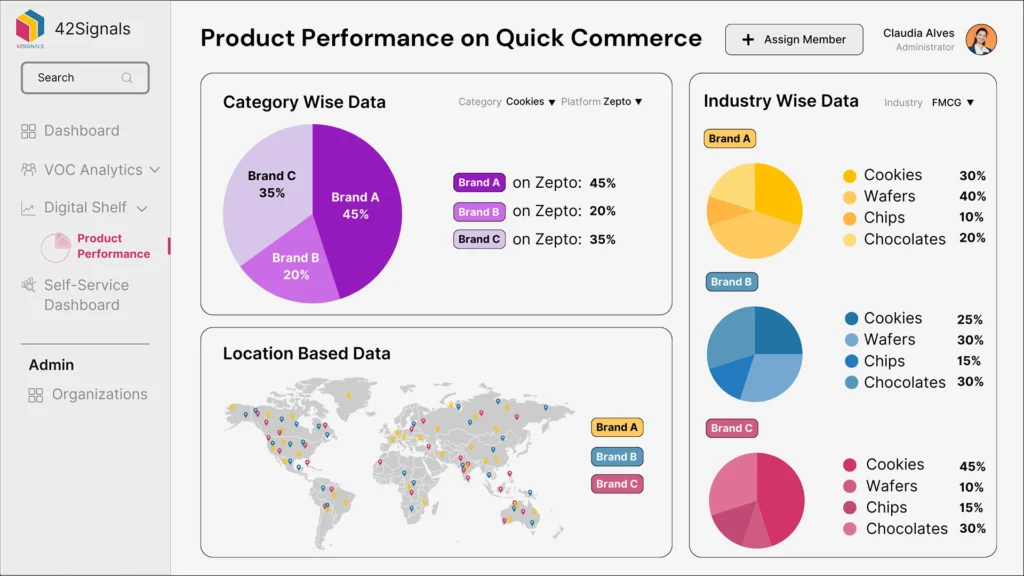
The emergence of quick commerce and dark stores has enabled brands to reach clients in record time. This is how to leverage these trends:
• Optimize for Speed: Make sure your products are listed on quick commerce platforms and can be delivered in a matter of minutes.
• Streamline Inventory Management: Predict demand with the data from 42Signals to keep your shelves stocked.
• Focus on Localization: Adjust your product and marketing to specific areas like regions or even neighborhoods.
How 42Signals Helps:
Monitors stock levels across distributed fulfillment centers to prevent lost sales from out-of-stocks.
Analyzes localized search and purchase data to predict demand in specific geographic areas.
Provides insights that allow for optimized inventory allocation, ensuring products are available where and when customers want them, within minutes.
Step 8: Track How Well Your Digital Shelf Strategy Has Worked
It is very important to see how well your strategies worked or if any adjustments would have to be made in how you do things now. Some of the key performance indicators (KPIs) you can keep track of are as follows:
Sales Growth and Revenue: Are your strategic optimizations translating into increased sales and revenue across channels?
Market Share: Are you gaining ground against your core competitors over time?
Digital Share of Shelf: Have you increased your visibility and the number of digital facings for your products?
Customer Satisfaction Metrics: Are your review ratings improving? Is sentiment becoming more positive?
All of these metrics can help you understand what is helping you, what is dragging you back, and where you can try to get better.
The Subscription Economy: Building Recurring Revenue
The subscription model has exploded beyond streaming services and software. From curated meal kits and beauty boxes to replenishable household goods and even clothing rentals, consumers are embracing the convenience and predictability of subscriptions.
For e-commerce businesses, this model represents a powerful shift from one-time transactions to building long-term customer relationships and predictable recurring revenue. In 2025, we will see a maturation of this trend, with brands focusing on personalization and flexibility. Successful subscription services will use data analytics to tailor boxes to individual preferences, offer multiple tier options (e.g., basic, premium, family-size), and make it easy for customers to skip a month or cancel without friction. The goal is to create a service so valuable and seamless that churn is minimized and customer lifetime value is maximized.
Hyper-Personalization: The End of the One-Size-Fits-All Experience
Modern consumers expect online experiences to be tailored specifically to them. Hyper-personalization uses AI and machine learning to move beyond simply using a customer’s first name in an email. It involves creating a unique shopping journey for each individual based on their real-time behavior, purchase history, browsing patterns, and even demographic data.
In 2025, personalization will be table stakes. This includes:
- AI-Powered Product Recommendations: Dynamic “customers also bought” and “recommended for you” sections that are incredibly accurate.
- Personalized Landing Pages: When a logged-in user visits the homepage, it transforms to highlight their favorite categories, new items in their size, or items left in their cart.
- Tailored Promotions: Offering a discount on a product a customer has viewed multiple times but not purchased.
- Individualized Content: Sending tutorial videos or blog posts related to a product a customer recently bought.
Brands that fail to deliver these relevant, one-to-one experiences will be perceived as impersonal and outdated, losing ground to competitors who make every customer feel uniquely understood.
B2B E-Commerce: The Digital Transformation of Wholesale
The digital shelf strategy revolution is not limited to B2C. Business-to-business (B2B) e-commerce is undergoing a massive transformation, accelerated by the expectations of a new generation of B2B buyers who demand the same ease, transparency, and speed they experience as consumers.
In 2025, B2B platforms will need to offer:
- Self-Service Portals: Allowing businesses to place orders, track shipments, and manage their accounts 24/7 without needing to speak to a sales representative.
- Customized Pricing and Catalogs: Displaying pre-negotiated contract prices and curated product assortments specific to each business client.
- Streamlined Reordering: “Quick order” lists and the ability to reorder past purchases with a single click.
- Integration with Procurement Systems: Seamless connectivity with a client’s internal ERP or procurement software to automate purchasing workflows.
This shift empowers B2B buyers, reduces operational costs for sellers, and opens up new, scalable revenue channels for brands that invest in a robust digital B2B presence.
Conclusion
Developing an effective digital shelf that enhances marketing efforts to meet target conversions can in fact be very complicated, but knowing how to do it means you should have a lot of the correct resources.
With 42Signals’ digital shelf analytics, competitor analysis dashboard, and pricing analytics, you will be able to figure out the most optimal settings for your product listing and successfully beat the competitors in sales volume.Schedule a demo and check out how we can help you enhance your digital shelf!
Frequently Asked Questions on Digital Shelf Strategy
1. What is digital shelf strategy?
A digital shelf strategy is a structured plan that helps brands maximize their visibility, performance, and sales across online marketplaces, retailer sites, and e-commerce platforms. Just like physical shelves in a store, the digital shelf determines how a product is displayed, ranked, and discovered by shoppers.
A strong strategy focuses on:
- Optimizing product content such as titles, descriptions, and images
- Monitoring pricing and availability to stay competitive
- Boosting search performance within e-commerce platforms
- Analyzing consumer behavior to refine listings and promotions
- Managing channel performance across multiple platforms.
When executed well, it helps products appear in top search results, attract more clicks, and drive higher conversion rates.
2. What is digital strategy in trading?
In the context of trading, a digital strategy refers to the use of technology, data, and online platforms to streamline buying and selling activities. It includes:
- Automating transactions through e-commerce platforms or APIs
- Using real-time data analytics to make informed pricing or investment decisions
- Applying AI or algorithmic trading for speed and precision
- Enhancing customer experience with digital tools and personalization.
This approach reduces operational friction, increases market reach, and allows companies to adapt quickly to market shifts.
3. What does a digital shelf manager do?
A digital shelf manager oversees how a company’s products appear and perform online. Their responsibilities typically include:
- Ensuring accurate and engaging product listings
- Monitoring pricing, promotions, and stock levels across different marketplaces
- Tracking competitors and identifying gaps or opportunities
- Working with marketing, sales, and supply chain teams to improve visibility
- Using digital shelf analytics tools to generate insights and drive action.
Their goal is to maximize visibility, improve conversion rates, and maintain brand consistency across platforms.
4. What is digital shelf analytics?
Digital shelf analytics is the process of collecting, measuring, and analyzing data related to how products appear on digital shelves. This includes visibility in search results, content quality, price fluctuations, stock availability, and customer engagement signals such as ratings and reviews.
Brands use digital shelf analytics to:
- Identify underperforming products or listings
- Track competitor activity in real time
- Ensure compliance with pricing and promotional policies
- Optimize content for better rankings and conversions.
A well-implemented analytics framework helps brands make data-driven decisions to maintain a competitive edge in crowded marketplaces.