

Trump tariffs 2025 aren’t just political theater anymore. They’re a very real storm cloud gathering over the entire US e-commerce world. Think higher prices, scrambled supply chains, and some seriously tough choices for anyone selling (or buying) stuff online.
How the Trump Tariffs 2025 Actually Work

Image Source: Feedvisor
Imagine you’re importing 100 hand-painted mugs from Portugal for your Etsy store. The US government slaps a 15% US import tariff on ceramic tableware. That means you pay Uncle Sam 15% of the value of those mugs the second they hit customs. Not the Portuguese artist. Not the shipping company. You.
Why would they do this? Officially? “Protecting American potters!” or “Fighting unfair trade!” Sometimes it’s pure political leverage. Remember the first China trade war under Trump? Overnight, tariffs on $200+ billion worth of Chinese goods rocketed from single digits to 25%. Think electronics, machinery, textiles, furniture – the backbone of online retail. The fallout was instant: price hikes, chaos in warehouses, and frantic emails to suppliers in the dead of night.
Here’s the kicker for e-commerce: We’re insanely reliant on imports. That cool gadget drop-shipped from Shenzhen? The trendy dress shipped directly from a Dhaka factory? Are the spare parts for your coffee maker ordered on Amazon? Odds are high they crossed an ocean… and dodged a big tariff bullet so far. A 2025 wave changes everything. Sellers get stuck holding the bag – absorb the tax and bleed profit, hike prices and scare customers, or embark on a global supplier scavenger hunt. None is are good option.
Prices Are Going Up. Let’s Stop Pretending Otherwise.
Sugarcoating helps nobody. If significant Trump tariffs 2025 land, ecommerce inflation isn’t a “maybe.” It’s a “when.” Here’s the brutal math, step-by-step:
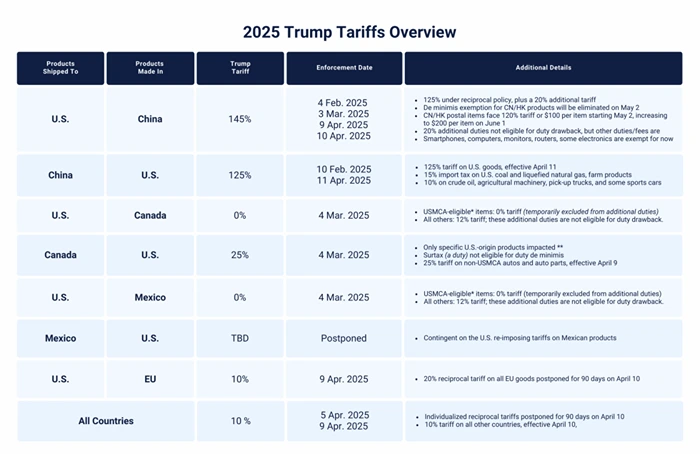
Image Source: Passport Global
- The Direct Punch to the Gut:
- Sarah runs “CozyHome Candles,” sourcing unique jars from a family glassblower in China. Jar cost: $5.00 each.
- New 25% trump tariffs? That’s an extra $1.25 per jar at customs.
- Sarah sells the candle for $24.99. Her current profit margin is thin – maybe $4 per candle after all costs.
- Her Choice: Swallow the $1.25 (slashing her profit by 31%) OR raise the price to $26.24. Most small businesses like Sarah’s cannot absorb that hit long-term. Guess what happens? You pay more. Simple. Painful.
- The Slow, Suffocating Squeeze:
- Big players like Target.com or Wayfair might use their buying power to absorb costs initially. They’ll tout “holding the line for customers!”
- But investors demand profits. Quarter after quarter of tariff pain? They will raise prices. Quietly. Incrementally. Blaming “broader market conditions.”
- Remember the Peterson Institute for International Economics study? They calculated Trump’s earlier tariffs cost US importers and consumers over $50 billion annually by end-2019. That’s not monopoly money. That’s real trump inflation hitting Main Street.
- The Hidden Web of Cost Hikes (The Domino Effect):
- Tariffs rarely hit just finished products. They hit components and raw materials, too.
- Example: That “Assembled in Mexico” flat-screen TV? The high-def display panel inside likely came from… China. A 25% tariff on that panel jacks up the TV factory’s cost before assembly even starts.
- Result? The “Made in Mexico” label doesn’t save you. The final online price still climbs. This layered cost structure makes tariff mitigation strategies incredibly complex.
Suppliers: The Global Game of Musical Chairs Just Got Real
When tariffs bite, businesses don’t just groan. They scramble. Fast. It’s like watching a high-stakes game of musical chairs where the music is the thud of customs forms. Here’s the messy reality:
- “China Exit? Easier Said Than Done”:
- The first China trade war started the “China Plus One” trend. 2025? It becomes “China Plus Panic.” Vietnam, India, Thailand, Malaysia, Mexico – their supplier inboxes are about to explode.
- The Catch: Finding a new supplier isn’t ordering takeout. It takes months (often years) to vet quality, negotiate terms, set up logistics, ensure ethical compliance, and build trust. One apparel seller I know spent 18 months transitioning a key product line to Vietnam – and still faced quality hiccups that hurt reviews.
- Capacity Crunch: Factories in popular alternatives (like Vietnam) are already near capacity. Rushing in means paying premium prices and potentially getting lower-tier production lines.
- Mexico’s Moment (But It’s Complicated):
- “Nearshoring” sounds perfect – closer means faster shipping and lower US import tariffs risk under USMCA.
- Reality Check: Mexico’s manufacturing hubs (like Monterrey) are booming. Skilled labor is getting pricier. Factory space is tight. Logistics infrastructure, while improving, can be uneven. It’s not a magic bullet. Rushing south without due diligence is risky.
- The “Made in USA” Mirage:
- Tariffs aim to boost US manufacturing. The sentiment is great. The economics? Brutally hard.
- Why? Decades of offshoring eroded our supplier ecosystem. Making a simple electronic device might require 50 components. Finding 50 reliable US suppliers at competitive prices? Near impossible for most goods right now. Labor costs, regulatory burdens, and lack of scale make mass reshoring a long-term dream, not a 2025 solution. Some final assembly might return, but the guts will likely still be global.
- Supplier Roulette & The Quality Trap:
- Desperation breeds bad decisions. Under tariff pressure, businesses might jump at a “great deal” from a new Bangladeshi garment factory or a Mexican metal shop.
- The Risk: Unknown quality control. Missed deadlines. Communication nightmares. Ethical violations. That cheap price evaporates if half your shipment is defective or gets held up at another border. Your hard-won online reputation can tank overnight with a few bad reviews about shoddy products. Due diligence isn’t optional; it’s survival.
Your Wallet’s On the Front Line: The Consumer Squeeze
Enough about sellers. Let’s talk about you and Trump Tariffs 2025, clicking “Add to Cart”:
- The Sticker Shock is Real: Broad trump tariffs 2025 mean broad price hikes. It won’t be everything, everywhere, all at once. But category by category, expect creep. That $49.99 wireless speaker? Might drift to $54.99. Those $19.99 kitchen towels? Maybe $22.99. Over a whole cart? It adds up fast. This is the core of ecommerce inflation.
- Bargain Hunting Becomes a Second Job: Faced with higher costs, shoppers get ruthless. You’ll spend more time on price comparison extensions. You’ll stalk deal sites like Slickdeals religiously. You’ll wait for Prime Day or Black Friday with military precision. Loyalty to that cool indie brand? It fades fast when their $45 t-shirt is now $55, but a similar one (maybe slightly lesser quality) pops up for $38. Value trumps vibe.
- The “Convenience Tax” Rises: Fast, free shipping spoiled us. But if tariffs jack up logistics costs (fuel, containers, labor) AND force longer shipping routes from new suppliers (Vietnam to LA takes longer than Shenzhen to LA), that convenience gets squeezed. “Free shipping” minimums might rise. Delivery times might stretch. Two-day Prime? It might become three days more often.
- The Confidence Killer: If “trump inflation” headlines dominate the news (fairly or not), it spooks people. Even if your job seems secure, the constant drumbeat of rising costs makes you think twice before clicking “Checkout.” Big-ticket items? Postponed. Impulse buys? Slashed. This consumer pullback hurts the entire online ecosystem, from giants to startups.
The Etsy Effect: How Small Artisan Brands Face Unique Trump Tariffs 2025 Threats
For the millions of independent sellers on platforms like Etsy, Trump tariffs 2025 represent an existential threat. Unlike large retailers, these microbusinesses lack the buying power to negotiate with suppliers or absorb costs.
Why Etsy Sellers Are Extremely Vulnerable:
- Niche, Irreplaceable Sourcing: An artist may depend on a specific type of silk from China or a speciality ceramic glaze unavailable elsewhere. Diversifying isn’t an option, making them 100% exposed to tariffs on art portfolio materials.
- Handmade & Low-Volume Economics: Their business model can’t easily scale to offset a 25% cost increase on raw materials. Raising prices on a one-of-a-kind item often means losing the sale entirely.
- Platform Fee Pressure: Etsy takes transaction and payment processing fees. A tariff-induced price hike effectively increases their percentage cost of sale, as fees are calculated on the higher sale price.
Survival Tactics for Artisan Sellers:
- Radical Transparency: Communicate early with your customer base about why prices are adjusting, emphasizing the support for your craft.
- Reformulate or Reimagine: Explore reformulating products with alternative, non-tariffed materials, or introduce smaller, lower-price-point items to maintain cash flow.
- Leverage “Made in USA”: If your process is truly domestic, highlight it aggressively in marketing. This becomes a powerful differentiator in a tariff environment.
Duties vs. Trump Tariffs 2025: A Critical Distinction for E-commerce Sellers
While used interchangeably, tariffs and duties are technically distinct components of your import costs.
- Tariff: A tariff is the specific tax rate applied to an imported good, as set by the government (e.g., “25% on List 3 goods from China”). It’s the rule.
- Duty: The duty is the actual dollar amount you pay, calculated by applying the tariff rate to the customs value of your goods. It’s the payment.
Think of it this way: The tariff is the speed limit (e.g., 65 mph). The duty is the speeding fine you pay if you get caught (which is calculated based on how fast you were going).
For an e-commerce seller, the practical takeaway is the same: it’s an added cost. However, when discussing trade policy, tariffs are the lever governments pull. When paying your broker, you are settling your duty bill.
Beyond the Obvious: The Hidden Ripples in the E-commerce Pond

Image Source: Euromonitor
The price tags and supplier chaos are just the tip of the iceberg. Below the surface, things get really messy:
- The Small Business Survival Gauntlet: Margins for independent online stores are often paper-thin – 10-15% profit is good. A 10-25% tariff hit? Catastrophic. Many face impossible choices:
- Slash Marketing: Killing their main growth engine.
- Freeze Hiring/Hours: Burning out existing staff.
- Cut Customer Service: Angering their loyal base.
- Close Up Shop: The brutal last resort. A wave of trump tariffs in 2025 could wipe out a generation of small e-commerce innovators.
- Inventory Nightmares: Imagine the stress. Do I stockpile 6 months of inventory NOW before tariffs hit, risking being stuck with unsold stock if demand drops? Or do I order lean and risk massive stockouts and lost sales if tariffs land and sourcing dries up? There’s no safe answer. This leads to wider swings in product availability online – feast or famine.
- The Logistics Labyrinth: Switching from a Chinese supplier you’ve used for years to a new one in, say, Indonesia isn’t plug-and-play.
- New shipping routes (different ports, different freight forwarders).
- New customs brokers are unfamiliar with the goods.
- New paperwork, new regulations, new potential delays.
- The result? Slower fulfillment, more “out of stock” messages, and higher operational costs baked into every shipment. Speed and reliability – the holy grail of e-commerce – suffer.
- B2B Gets Body-Slammed Too: This isn’t just about consumer trinkets. Think bigger:
- A small US manufacturer ordering specialized German machine parts online? Tariffed.
- A restaurant chain sourcing commercial kitchen equipment from South Korea via a B2B portal? Tariffed.
- An auto repair shop buying Taiwanese bearings on eBay? Tariffed.
These businesses also have to raise prices or cut costs, amplifying inflation throughout the entire economy. The China trade war 2025 impact ripples far beyond Amazon.
Digital Goods and Tariffs: An E-commerce Gray Area
A key question for SaaS companies, course creators, and digital artists is: Do tariffs affect my business? The short answer is not directly, but indirectly.
The Direct Impact (Minimal):
Traditional tariffs are applied to physical goods crossing borders. A purely digital product (an eBook, a software download, a streaming subscription) does not incur import duties because nothing physically clears customs.
The Indirect & Potentially Massive Impact:
- Hardware & Infrastructure: Your business runs on servers, laptops, and phones. If tariffs increase the cost of this IT hardware, your operational expenses rise.
- Consumer Spending Power: If trump inflation from tariffs squeezes household budgets, discretionary spending on digital products (entertainment, online courses, software subscriptions) is often the first to be cut.
- B2B Sales: If your digital product serves physical goods businesses (e.g., e-commerce analytics, inventory software), their downturn from tariffs becomes your downturn.
While your digital product itself is safe from duty, your entire operating environment is not.
Fighting Back: Real (Not Magic) Tariff Mitigation Strategies
It’s grim, but not hopeless. Savvy businesses can adapt. Here’s how – no silver bullets, just hard work:
- Diversify Like Your Business Depends on It (Because It Does):
- Action: Don’t just find one backup supplier. Find multiple in different regions. Start yesterday. Vietnam and Mexico and Portugal, and maybe a tiny US artisan for a niche line. Spread the risk.
- Reality: This takes serious time and travel budget. Build relationships before the crisis hits. Attend trade shows (virtually or in-person). Use sourcing platforms carefully.
- Become an HTS Code Ninja:
- Action: Your tariff rate lives and dies by your product’s Harmonized Tariff Schedule (HTS) code. A slight design tweak might shift your product into a lower-tariff category.
- Example: Is that “plastic decorative figurine” (higher rate) actually a “plastic educational toy” (lower rate) if you add a small fact card? Maybe.
- Crucial: Hire a customs lawyer or consultant. Playing fast and loose with HTS codes invites audits, penalties, and seized shipments. This is expert territory.
- Negotiate Like Your Life Depends On It (It Kinda Does):
- With Suppliers: “Look, tariffs are coming. If we stick together, we both survive. Can you shave 10% off your FOB price to help absorb half the tariff hit?” Leverage long-term relationships and volume.
- With Logistics Providers: “My shipping volume is shifting to Vietnam. What’s your best rate for a 40ft container from Hai Phong to Long Beach?” Play carriers against each other. Every dollar saved offsets tariff pain.
- Rethink Your Product & Pricing DNA:
- Pivot Products: Can you focus more on higher-margin items less reliant on tariff-vulnerable imports? Can you develop unique products with better markup?
- Creative Bundling: Pair a slow-moving, tariff-impacted item with a popular one. “Buy the premium tariff-hit blender, get the smoothie recipe book free!”
- Transparent Value: If you must raise prices, explain why (briefly, honestly) and add value. “Due to new import costs, we’ve adjusted pricing slightly. To thank you for your support, we’re including free premium gift wrapping on all orders this month.”
- Explore FTZs and De Minimis (But Tread Carefully!):
- Foreign Trade Zones (FTZs): These are secure areas inside the US border but considered outside US customs territory. Store your imported goods here. You only pay the tariff when goods leave the FTZ for US sale. Buys you crucial cash flow time.
- De Minimis Loophole: Currently, most goods valued under $800 imported by one person on one day enter duty-free. Some businesses exploit this via “micro-importing” (splitting large shipments into many small sub-$800 packages). WARNING: Customs hates this. Rules are complex, and enforcement is tightening. Relying solely on de minimis is playing with fire.
- Squeeze Every Penny of Efficiency:
- Warehousing: Renegotiate storage fees. Improve layout to pick/pack faster.
- Packaging: Right-size boxes to cut shipping costs. Switch to lighter materials.
- Returns: Streamline processes to minimize losses.
- Automation: Can a $5k machine pack 3x faster than a human? Calculate the ROI under tariff pressure. Efficiency frees up margin to absorb costs.
How Amazon and Major Platforms Will Adapt Their Supply Chains for Trump Tariffs 2025
Giants like Amazon have entire divisions dedicated to trade tariff intelligence. Their response will be multi-pronged and will set the tone for the entire market.
1. Aggressive Pricing Leverage: Amazon will use its unmatched scale to pressure global suppliers for immediate cost concessions, sharing the pain. Sellers in their marketplace will be forced to comply or risk losing the Buy Box.
2. Accelerated Inventory Rebalancing: They will use predictive analytics to shift inventory of high-tariff-risk goods to the U.S. before tariffs hit (a tactic called “front-loading”), creating short-term stock gluts followed by potential shortages.
3. Algorithmic Repricing in Real-Time: Amazon’s pricing engines will be recalibrated to factor in new landed costs instantly. Consumers will see prices fluctuate not based on competition, but on customs data feeds.
4. Pushing Fulfilment by Amazon (FBA) Costs onto Sellers: The fees for FBA storage and fulfilment are likely to increase, as Amazon’s own logistics network faces higher costs from tariff-inflated equipment and vehicles.
5. Doubling Down on Private Brands: To control margins from raw material to sale, Amazon will accelerate its private label strategy, sourcing directly from factories it controls in tariff-advantaged countries.
Survival Toolkit: Trade Promotion Management and Tariff-Smart Shipping
Surviving 2026 requires moving from spreadsheets to specialized software. Two key technological defenses are:
1. Trade Promotion Management (TPM) Software:
TPM software isn’t just for B2B promotions. In a tariff war, it becomes a critical mitigation strategy. It allows you to:
- Model Scenarios: Input proposed tariff rates on raw materials and finished goods to see the exact impact on margin for each SKU.
- Optimize Promotions: Identify which products (those with higher pre-tariff margins or domestic sourcing) can sustain deeper discounts to drive volume, offsetting losses elsewhere.
- Track Performance by Market: Measure if price increases in tariff-impacted categories are causing volume drops, and adjust in real-time.
2. Tariff-Smart Shipping & Global Trade Management (GTM) Platforms:
These platforms (like Descartes, E2open) are essential for tariff-smart shipping. They:
- Provide Classify: Use AI to determine the most accurate (and often most favorable) HTS code for your products.
- Calculate Landed Cost in Real-Time: Integrate live tariff rates, freight costs, and insurance to show your true cost before you ship.
- Identify Preferential Trade Agreements: Automatically flag if your goods qualify for duty-free treatment under agreements like USMCA, based on their origin and composition.
Investing in this trade tariff intelligence is no longer optional for import-dependent sellers.
Hope Isn’t a Strategy for Trump Tariffs 2025
Let’s be crystal clear: Nobody knows if Trump tariffs 2025 will happen, or how harsh they’ll be. Political winds shift. But the risk is high enough, and the potential impact severe enough, that ignoring it is business malpractice.
- For Online Sellers: The time for casual supplier chats is over. Conduct a brutal audit of your supply chain right now. Where’s your single point of failure? Start diversifying immediately. Run scenarios: “What if a 20% tariff hits Category X? Can we survive?” Talk to customs brokers. Understand your HTS codes. Build a cash buffer if possible. Hope for peace, prepare for the China trade war 2025.
- For Consumers: Stay informed. If you’ve been eyeing a big-ticket import-heavy item (electronics, premium furniture, specific machinery), buying soon might be the smartest hedge against potential price hikes. Budget a little wiggle room for online purchases next year. Support resilient small businesses transparent about their sourcing.
The first Trump tariffs taught us painful lessons: global supply chains are fragile, import costs flow straight to consumers, and political decisions hit digital storefronts hard. Whether history repeats in 2025 is uncertain.
If you liked this article, read –
The Labubu Frenzy: How a Mysterious Monster Became the $2B Collectible Empire
Quaker Oats’ Pricing Strategy: Balancing Affordability and Premium Positioning
Kellogg’s Cereal: How They Dominated the Breakfast Aisle
Coca-Cola’s Pricing Playbook: Lessons in Global Brand Strategy
Procter & Gamble’s Success: How They Climbed the Industry Ladder to the Top
Frequently Asked Questions
What do you mean by tariff?
A tariff is a tax imposed by a government on goods imported from other countries. It is typically charged as a percentage of the product’s value or as a fixed fee per unit. Tariffs are used to regulate international trade by making imported goods more expensive, thereby encouraging consumers to buy domestically produced alternatives.
Governments may also use tariffs as a political or economic tool to protect local industries or respond to unfair trade practices.
Are tariffs good or bad?
Tariffs can be both good and bad, depending on perspective and context:
- Good:
- They protect local industries from foreign competition.
- They can help new or struggling domestic companies grow.
- They may be used to negotiate fairer trade agreements.
- Bad:
- They often lead to higher prices for consumers.
- They can provoke retaliation from other countries, sparking trade wars.
- They may reduce efficiency by shielding companies from healthy competition.
So, while tariffs may benefit certain industries in the short term, they can also create broader economic challenges.
What is an example of a tariff?
An example of a tariff is the U.S. tariff on imported steel. In recent years, the U.S. government has imposed a 25% tariff on steel imports to protect the domestic steel industry from cheaper foreign steel, particularly from countries like China. This made imported steel more expensive, giving U.S. producers a competitive edge.
Another everyday example: if a country imposes a 10% tariff on imported smartphones, a phone that costs $500 abroad would be taxed an additional $50 upon entry.
How do tariffs impact the economy?
Tariffs affect the economy in several ways:
- Higher Prices: Consumers often end up paying more for imported goods due to added costs passed down from importers.
- Industry Protection: Domestic producers may benefit from reduced foreign competition, allowing them to maintain market share.
- Trade Tensions: Tariffs can lead to retaliatory measures from other countries, which may escalate into trade disputes.
- Reduced Global Trade: As tariffs make international products more expensive, trade volumes can shrink, potentially slowing global economic growth.
In the long run, widespread use of tariffs can disrupt supply chains and create uncertainty for businesses that rely on international markets.