
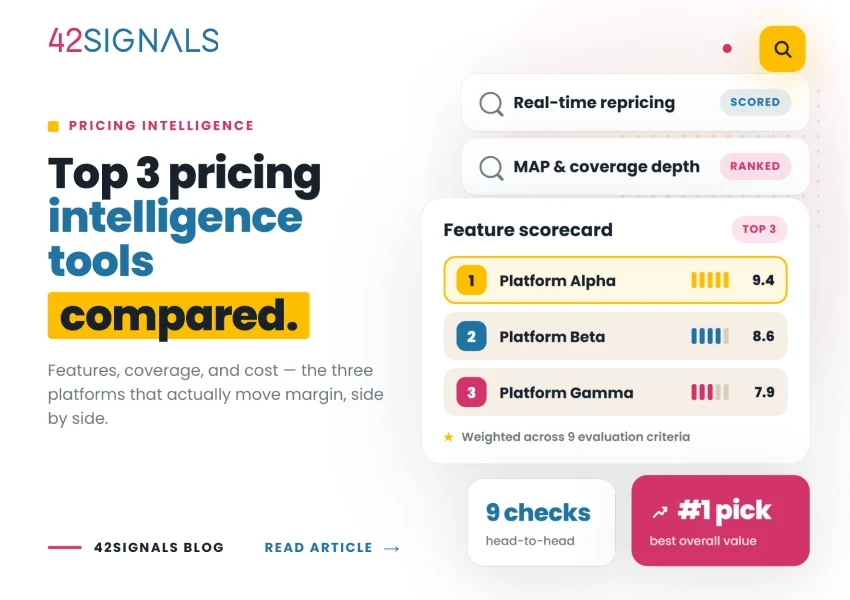
** TL;DR ** 42Signals is the best choice for brands managing pricing compliance and competitor benchmarking across multiple online marketplaces. Profitero suits large global brands that need pricing data embedded in a broader digital shelf analytics platform. Gobblecube is a specialist tool for quick commerce repricing (Blinkit, Zepto, Instamart) — powerful in that niche but not a general-purpose pricing intelligence platform. If you are looking for a pricing intelligence software that works across Amazon, Walmart, and regional marketplaces with MAP monitoring and strategic market position data, 42Signals is the strongest fit.
If you are evaluating pricing intelligence software in 2026, you are choosing between platforms that differ significantly in depth, channel coverage, and primary use case — not just price. This comparison cuts through the marketing copy to show you exactly what 42Signals, Profitero, and Gobblecube each do best, who they are built for, and where each falls short.
The short version: 42Signals is built for brand teams managing multi-marketplace pricing and MAP compliance. Profitero is the enterprise choice for global brands that need digital shelf analytics alongside pricing data. Gobblecube is a specialist repricing engine for quick commerce platforms (Blinkit, Zepto, Instamart) — only relevant if those channels are a significant part of your business.
If you need a fast answer, jump to the side-by-side comparison table. If you want to understand the reasoning behind each recommendation, read the full reviews.

Image Source: Flipkart Commerce Cloud
Beyond Basic Tracking: The Core Capabilities of Modern Pricing Intelligence Software
Before we jump into comparing the top players, it’s crucial to understand what a robust pricing intelligence software should actually do. It’s more than just a tool that shows you a competitor’s price. A comprehensive platform provides a suite of capabilities that form the backbone of a data-driven commercial strategy.
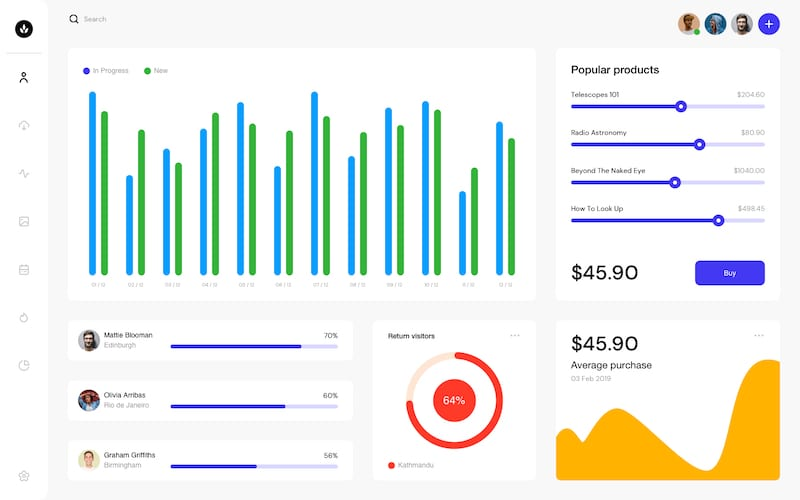
Image Source: Price Rest
First and foremost is the ability to monitor competitor prices accurately and at scale. The best tools can track thousands of products across hundreds of websites, ensuring you never miss a price change. But the real magic happens in the analysis. This raw data is transformed into actionable insights. You can see how your prices stack up against the competition, identify pricing trends in your market, and receive alerts when a key rival launches a sale or runs out of stock.
Another critical feature is integration. The value of this data is multiplied when it flows seamlessly into your existing systems, such as your e-commerce platform (like Shopify or Magento) or your ERP system. This allows for the potential of automated repricing, where your prices are adjusted based on pre-set rules you define.
Furthermore, advanced competitor price tracking often includes monitoring product availability, customer reviews, and even tracking shipping costs to give you a complete picture of the competitive landscape. When you start your vendor comparison, these are the core functionalities you should be evaluating to ensure you get a tool that empowers your entire team.
How We Chose: Our Methodology for Comparing Price Tracking Solutions
To ensure this comparison is fair and truly useful, we established a clear set of criteria. We looked at each price monitoring software through the same lens, focusing on the aspects that matter most to businesses like yours.
Our evaluation is based on:
- Tracking Accuracy and Scope: How reliable is the data? How many websites and competitors can it track, and how frequently does it update?
- Analytics and Reporting: Is the data presented in a clear dashboard? Can you easily generate reports on pricing trends, margin analysis, and competitive positioning?
- Ease of Use: How steep is the learning curve? Is the interface intuitive for users who may not be data scientists?
- Integration and Automation: How well does it connect with other tools? What level of pricing automation does it support?
- Customer Support and Reviews: What is the reputation of the vendor? We paid close attention to independent reviews on platforms like G2 to gauge real-world user satisfaction.
- Pricing Structure: Is the cost transparent? Does it offer good value for the features provided?
By applying this consistent framework, we can move beyond marketing claims and provide a genuine vendor comparison of the leading competitor tracking tools.
42Signals: The Agile and Insightful Choice for Modern E-commerce
42Signals emerges as a powerful and intuitive pricing intelligence software designed for brands and retailers who value actionable insights over overwhelming data complexity. It focuses on delivering a clear competitive edge through precise tracking and easy-to-understand analytics.

Overview and Key Strengths
The core strength of 42Signals lies in its ability to transform vast amounts of market data into straightforward, actionable strategies. The platform is built for clarity and speed, ensuring that e-commerce managers and revenue management teams can make quick, confident decisions.
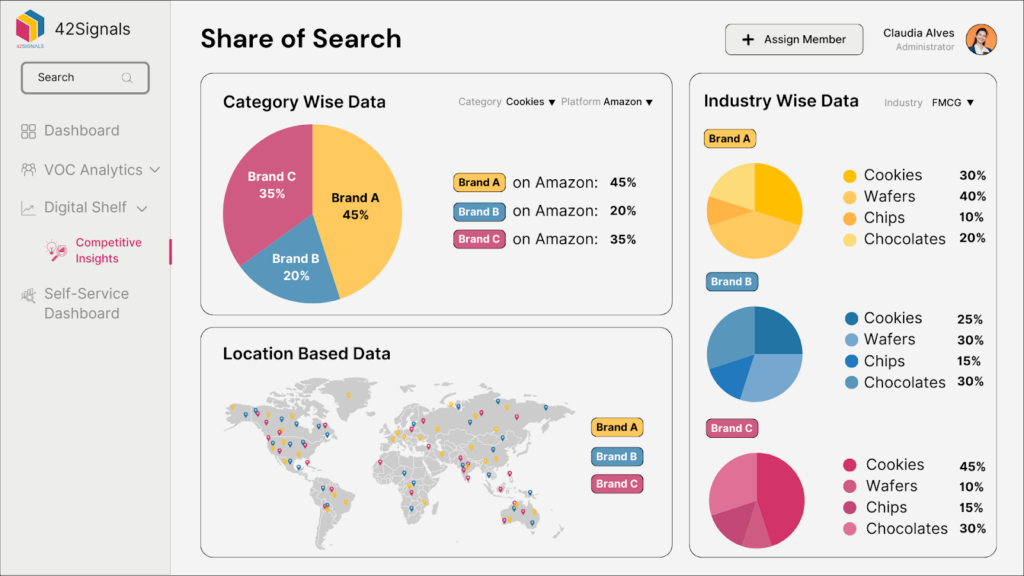
A standout feature is its focus on metrics like MAP Violations data and Share of Search, which go beyond simple price matching to help you understand your true market position and brand visibility. One brand using their insights achieved a 17% increase in revenue by optimising its pricing and assortment strategy.
Features and Capabilities of the 42Signals Pricing Intelligence Software
When it comes to competitor price tracking, 42Signals provides highly accurate and frequent data collection. It allows you to track not only pricing but also product availability, assortment changes, and promotional campaigns across a wide range of competitors and global marketplaces. Its dashboard is clean and visual, highlighting price positioning, gap analysis, and potential revenue opportunities at a glance. The platform also emphasises competitive benchmarking, allowing you to measure your performance against key rivals across multiple dimensions, not just price.
Pricing and Reviews
42Signals offers a transparent and flexible pricing model, with plans designed to scale with your business needs. They provide tiers based on the number of SKUs and marketplaces you need to track, making it accessible for growing businesses without requiring a custom enterprise quote.

On platforms like G2, users frequently praise 42Signals for its user-friendly interface and the quality of its customer support. One reviewer noted, “The platform gives us exactly what we need without the clutter. The insights on competitor stockouts have been particularly valuable for our inventory planning.”
Profitero: The Comprehensive Retail Analytics Platform for Global Brands
Profitero is a well-established leader in the price monitoring software space, offering a suite of analytics that extends far beyond pricing. It is designed for large consumer brands and retailers who sell through major online marketplaces and need a holistic view of their digital shelf performance.
Overview and Key Strengths
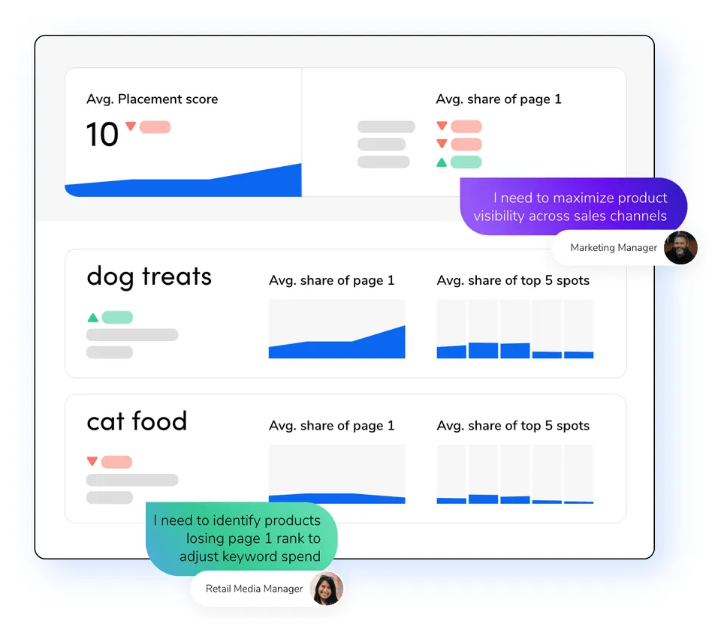
Profitero’s greatest strength is its extensive reach and its multi-faceted approach to digital shelf analytics. It doesn’t just track price; it provides a complete picture of how your products are presented online compared to your competitors. This includes monitoring search ranking placement, product content completeness, image quality, and review ratings. For a global brand, its ability to track performance across different countries and regions is a significant advantage, providing a unified view of international markets.
Features and Capabilities
The competitor price tracking capabilities of Profitero are robust and integrated into a broader analytics framework. You can see your price position alongside your share of search and share of voice, helping you understand the full commercial impact of your pricing decisions. The platform offers powerful promotional performance analytics, showing you not just who is running a promotion, but how effective that promotion is at driving sales and rank. Its reporting is highly detailed, making it suitable for large organisations that need to distribute insights across multiple departments like marketing, sales, and category management.
Pricing and Reviews of the Pricing Intelligence Software
Profitero operates on a custom pricing model, typically requiring a conversation with their sales team. This reflects its position as an enterprise-grade solution with a wide range of capabilities. On G2, Profitero receives high marks for its data accuracy and the depth of its retail analytics. One user review states, “Profitero gives us an unmatched view of our digital shelf across all key retailers. The correlation between our search rank and pricing is now crystal clear.” Some users note that the platform’s vast feature set can be complex for new users.
Gobblecube: The Dynamic Repricing Engine for Marketplace Sellers
Note: Gobblecube is a specialist repricing engine built exclusively for quick commerce platforms (Blinkit, Zepto, Instamart). If those channels are not part of your distribution, this tool is not relevant to your evaluation — skip to the comparison table.
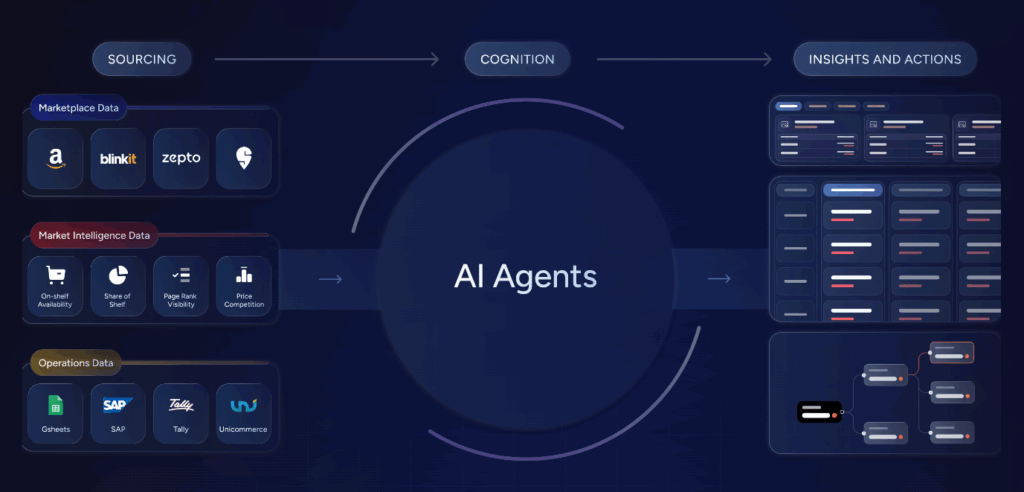
Gobblecube positions itself as a highly specialised price tracking software with a very clear focus: automating dynamic repricing for businesses that sell on fast-moving online marketplaces like Blinkit, Zepto, and Instamart.
Overview and Key Strengths
Gobblecube’s primary strength is its aggressive and highly configurable repricing engine. It is built for sellers who operate in highly competitive categories where prices can change multiple times a day, and choosing the price is critical for sales volume. The platform is designed to react to market changes in near real-time, making automatic pricing adjustments based on a complex set of rules you define to protect your margin while maximising your competitive position.
Features and Capabilities
The core functionality of Gobblecube is to monitor competitor prices and reprice your own inventory. You can set minimum and maximum price boundaries, specify which competitors to track or ignore, and create rules that factor in your shipping costs to ensure profitability.
Its dashboard is heavily focused on repricing performance metrics, showing you how many sales you’ve won due to automatic adjustments. While it may lack the broad brand analytics of a tool like Profitero, its singular focus on algorithmic repricing is its defining feature, making it a powerful tool for volume-focused marketplace sellers.
Pricing and Reviews
Gobblecube typically uses a subscription model that may include a percentage of sales revenue managed through their platform, which is common in this niche. This can be attractive for sellers as the cost is directly tied to sales performance. Reviews for this type of software often highlight its effectiveness in winning the Buy Box. A typical user might comment, “Since implementing Gobblecube, our Buy Box ownership has increased dramatically. It works tirelessly to keep our prices competitive without us having to constantly micromanage.”
The Final Showdown: A Side-by-Side Vendor Comparison
To make your decision easier, here is a direct side-by-side vendor comparison of 42Signals, Profitero, and Gobblecube across our key criteria.
| Feature | 42Signals | Profitero | Gobblecube |
| Best For | Brands & retailers seeking customisable, actionable insights with clarity and agility. | Large global brands need holistic digital shelf analytics. | Marketplace sellers focused on automated, dynamic repricing. |
| Tracking Depth | Excellent. Tracks price changes, stock, availability, and competitor moves. | Good. Tracks price, search rank, content, reviews, and promotions. | Focused. Excellent real-time price and Buy Box tracking. |
| Analytics | Actionable & Strategic (MAP, Share of Search, gap analysis). | Comprehensive (Digital shelf health, market share, promo analysis). | Performance-Driven (Repricing effectiveness, Buy Box wins). |
| Ease of Use | User-friendly with a focus on intuitive design. | Steeper learning curve due to extensive features. | Intuitive for its core function, but requires rule setup. |
| Integration | Strong (APIs and major e-commerce platforms). | Extensive (Deep integrations with major marketplaces and ERPs). | Strong (Primarily focused on marketplace APIs). |
| Pricing Model | Transparent, Tiered Subscription that can be customised. | Custom Quote | Subscription + potential revenue share |
| Update Frequency | Real-time to hourly across key marketplaces | Daily on most channels; near-real-time on Amazon | Near-real-time for quick commerce platforms |
| Ideal SKU Scale | 100–100,000+ SKUs; scales well for mid-market to enterprise brands | Enterprise-grade; best for 1,000+ SKUs across multiple retailers | Optimised for smaller, fast-moving catalogues on quick commerce channels |
How to Select the Perfect Pricing Intelligence Software for Your Needs
So, which of these competitor tracking tools is the right one for you? The answer, as always, depends on your specific business needs, sales channels, and goals. There is no one-size-fits-all solution in the world of pricing intelligence software.
If you are a modern brand or retailer looking for a clear, actionable platform that provides strategic insights from multiple marketplaces into pricing and market position without complexity, 42Signals is an excellent choice. You can get data from different marketplaces, websites, and across the globe, too. Its focus on metrics like MAP and SoS offers a unique angle for strategic planning.
If you are a consumer brand that sells through major retailers and need a view of your digital shelf performance across pricing, content, and search visibility on a global scale, Profitero is the industry stalwart you should consider.
If your business lives and dies on quick commerce marketplaces like Blinkit, Zepto and your primary need is a powerful, set-and-forget engine to win on these platforms through automated repricing, then Gobblecube is purpose-built for that mission.
Before you make a final decision, we highly recommend taking advantage of free trials or demo sessions offered by these vendors. This hands-on experience is the best way to see which interface and data presentation style resonates most with your team.
Empower Your Pricing Strategy with the Right Data
In the end, competing on price without data is like sailing a ship without a compass. You might move, but you have no idea if you’re heading in the right direction. Investing in a robust pricing intelligence software is no longer a luxury for industry giants; it is a necessity for any business that wants to compete and win online.
The journey to selecting the right price tracking software starts with a clear understanding of your own requirements. Whether you choose the agile insights of 42Signals, the comprehensive analytics of Profitero, or the automated repricing of Gobblecube, you are taking a crucial step towards a smarter, more proactive, and more profitable pricing strategy. Stop reacting to the market and start shaping it with the power of data.
Frequently Asked Questions
What is pricing intelligence software?
Pricing intelligence software is an automated platform that continuously collects, analyses, and presents competitor pricing data from online retail channels — giving brand teams, revenue managers, and pricing analysts a real-time view of how their products are priced relative to the market. Beyond raw price tracking, pricing intelligence software identifies pricing trends, monitors MAP compliance, tracks promotional activity and stockouts, and surfaces the competitive signals that inform strategic pricing decisions. Modern platforms cover multiple channels simultaneously — Amazon, Walmart, DTC sites, regional marketplaces — and deliver data through dashboards and alerts rather than manual exports.
What is the best pricing intelligence software in 2026?
The best pricing intelligence software in 2026 depends on your distribution model and primary use case. For brands managing pricing compliance, MAP violations, and competitor benchmarking across online marketplaces, 42Signals is the strongest fit — it combines real-time price tracking with Share of Search and MAP monitoring in a single platform built for ecommerce brand teams. For large consumer brands that need pricing data embedded in a broader digital shelf analytics suite covering search rank, content compliance, and review management across global retailers, Profitero is the leading enterprise choice. For brands whose primary sales channel is quick commerce (Blinkit, Zepto, Instamart), Gobblecube’s automated repricing engine is purpose-built for that environment. No single platform is the best for all use cases — the strongest choice is the one that covers your specific channels and integrates with your existing commercial workflow.
How does 42Signals compare to Profitero as pricing intelligence software?
42Signals and Profitero target different buyer profiles despite both being pricing intelligence software. 42Signals is optimised for ecommerce brand teams that need pricing compliance and competitive positioning data quickly — its interface prioritises speed-to-insight and MAP enforcement over analytical depth. Profitero is an enterprise-grade digital shelf analytics platform where pricing intelligence is one component of a broader suite that includes search rank, content scoring, and promotional analytics. For a mid-market brand primarily concerned with staying MAP-compliant and tracking competitor pricing across Amazon and regional marketplaces, 42Signals delivers more directly usable insights at lower complexity. For a large CPG brand that needs pricing data in the same view as its digital shelf performance across 70+ countries, Profitero’s depth and global retailer coverage is the stronger argument.
What features should I look for when evaluating pricing intelligence software?
When evaluating pricing intelligence software, five features separate capable tools from comprehensive ones. First, channel coverage: does the software cover all the marketplaces and retail sites where your products are sold — not just Amazon, but Walmart, regional marketplaces, and DTC retail partners? Second, data update frequency: how often are prices refreshed? For categories with high daily price volatility (electronics, FMCG), hourly or real-time updates are essential; for slower-moving categories, daily may suffice. Third, MAP monitoring: does the platform detect MAP violations automatically, capture timestamped evidence, and alert you within hours of a violation occurring? Fourth, SKU matching accuracy: how accurately does the software match your products to competitor listings when titles, packaging, or identifiers differ? Fifth, integration: does the data flow into your existing ERP, e-commerce platform, or BI tools through an API, or does it require manual export?
How much does pricing intelligence software cost?
Pricing intelligence software pricing varies significantly by SKU volume, channel coverage, and feature depth. Entry-level tools for small catalogues (under 500 SKUs, 1–2 channels) typically start from a few hundred dollars per month. Mid-market pricing intelligence software covering 5,000–50,000 SKUs across multiple marketplaces with MAP monitoring and API access generally ranges from $1,000 to $5,000 per month. Enterprise platforms with global coverage, dedicated account management, and integration services are custom-quoted based on business requirements. 42Signals offers transparent tiered pricing based on SKU count and marketplace scope — request a demo to see pricing for your specific use case. Profitero and Gobblecube both operate on custom pricing models that require a sales conversation.
Is pricing intelligence software worth it for mid-market brands?
Yes — pricing intelligence software delivers measurable ROI at mid-market scale, and the business case is often stronger for mid-market brands than for enterprise because they typically have less internal analytical capacity to compensate for pricing blind spots. A mid-market brand managing 1,000–10,000 SKUs across Amazon and several retail partners will miss MAP violations, competitor promotions, and pricing opportunities consistently without automated monitoring. The cost of undetected MAP violations on high-velocity SKUs — through margin erosion and authorized retailer complaints — often exceeds the cost of a pricing intelligence software subscription within a single quarter. The most relevant question is not whether the investment is worth it but which platform’s coverage model and workflow automation best match the team’s capacity to act on the data it generates.
What is the difference between pricing intelligence software and a pricing analytics platform?
Pricing intelligence software is primarily a competitive data collection and monitoring tool — it tracks external market data (competitor prices, promotions, MAP violations) and surfaces it as actionable alerts and dashboards. A pricing analytics platform is primarily an internal analysis tool — it models the impact of pricing decisions on revenue, margin, and volume using a combination of external market data and internal sales data. Most modern pricing intelligence software includes some analytics capabilities, and some pricing analytics platforms include market data feeds — but the primary workflow differs: pricing intelligence software monitors the external environment continuously, while pricing analytics platforms support periodic strategic pricing decisions. Brands typically need both, but they serve different teams: pricing intelligence software is used daily by channel ops and brand management, while pricing analytics platforms are used by commercial or revenue management teams for quarterly strategy reviews.
What are the main alternatives to Profitero for pricing intelligence software?
The main alternatives to Profitero as pricing intelligence software are 42Signals, Intelligence Node, DataWeave, and Wiser Solutions. 42Signals focuses on ecommerce marketplaces and offers a more accessible implementation with competitive MAP monitoring and Share of Search tracking alongside pricing data. Intelligence Node provides AI-driven price optimisation recommendations alongside competitor tracking, making it stronger for brands that want prescriptive pricing guidance. DataWeave offers broad omnichannel coverage including both online and offline retail, which is a significant advantage for brands with strong brick-and-mortar distribution. Wiser Solutions focuses on retail execution and field data alongside digital pricing, serving brands that need online and in-store pricing data in one platform. Profitero remains the strongest choice for large CPG brands that need digital shelf analytics (search rank, content compliance, review management) embedded alongside pricing data across 70+ countries — its breadth is unmatched, though that breadth also creates the steepest learning curve.