
** TL;DR ** Sticking with manual pricing strategies is a fast track to eroded profits, but modern price optimization solutions provide a vital safeguard. These powerful tools continuously monitor the entire digital marketplace, delivering instant alerts on competitor price changes, stockouts, and emerging trends directly to you. This real-time intelligence transforms your approach from reactive to proactive, allowing you to adjust your pricing strategy dynamically to protect margins, capitalize on competitors’ weaknesses, and avoid costly guesswork. By leveraging data-driven insights and a comprehensive competitor analysis dashboard, these solutions empower you to make smarter, faster pricing decisions that directly boost profitability and secure a durable competitive advantage.
Here’s the hard truth: that price you set for your bestselling item last month might be completely wrong today. While you’ve been focused on putting out daily fires, your competitors have been moving. They’ve launched surprise sales. New sellers have popped up offering similar products for less. How do you fix this? Price optimization solutions.
That number you tagged onto your bestseller a few weeks ago? It might be completely off base today. If you’re not tracking these changes as they happen, you’re essentially setting your prices blindfolded. You’re either leaving money on the table or pricing yourself so high that shoppers just click away to the next guy.
We’ve watched countless stores transform their profitability by implementing smart price optimization solutions. These aren’t the complex, corporate systems you might be imagining. Think of them more like having your most observant employee working 24/7, constantly monitoring the market and giving you plain-English advice on how to price your products.
What Price Optimization Solutions Really Mean
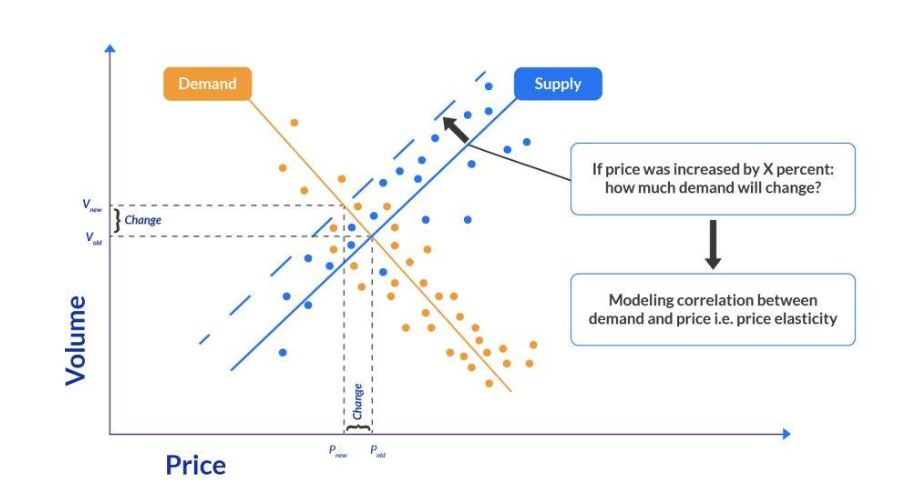
Image Source: Flipkart Commerce Cloud
At its core, price optimization means using real market data to make intelligent pricing decisions. Instead of guessing or copying what others are doing, you’re using actual information about your market to set prices that work for your specific business.
It watches how demand changes for your products throughout the day. It notices when your costs shift. It even keeps an eye on broader market trends that might affect your customers. Then, it takes all this scattered information and gives you practical suggestions on how to price your products to meet your specific goals.
The difference between basic price tracking and true optimization comes down to intelligence. A simple tool might just tell you to match the lowest price you find. A genuine optimization solution understands that sometimes you shouldn’t match prices – maybe your product is better quality, or you offer superior customer service. It might suggest a slightly higher price that still attracts customers while protecting your profit margin.
The High Cost of Doing Things Manually
Here’s what most store owners don’t consider: while you’re spending hours checking prices on different sites, the market is changing beneath your feet. Competitors are updating their prices. New sellers are entering the market. Customer demand is shifting.
Many of us started our businesses by keeping a few browser tabs open to check competitor websites. It feels proactive. You’re doing your research! But those days are long gone. The online market moves at a speed that manual checks can’t possibly keep up with.
Those hours you spend copying and pasting prices into spreadsheets are hours you’re not spending on growing your business. You’re not improving your marketing, not developing new products, not engaging with customers. You’re stuck doing administrative work that could be automated.
The biggest issue, though, is the delay. You’re always reacting. You’re always behind. Modern price optimization solutions fix this by giving you a live feed of the market. This is where price optimization solutions change everything. They eliminate the delay by giving you real-time information about your market.
Ready to Take the Next Step?
See how our solutions can help you achieve your goals and drive measurable results.
How Alerts Work With a Price Optimization Solution
Think of it like having your most reliable employee watching your competitors for you. Your phone buzzes. A notification tells you that “Competitor X just dropped the price on your top-selling product by 15%.” You know the second it happens. You don’t find out weeks later when your sales have mysteriously tanked.
The most valuable price alerts go beyond simple price tracking. You can set them to notify you when a competitor runs out of stock on a popular item – that’s your golden opportunity to capture their customers. Get a ping when a new seller enters your niche, or when product reviews suddenly tank.
This moves you from a reactive stance to a powerfully proactive one. You’re seizing opportunities and dodging threats before they ever impact your revenue. Setting up these smart alarms is a core function of any great competitor analysis dashboard.
From Numbers to a Clear Game Plan
The real value of a good tool isn’t the data it collects; it’s the story that data tells and the clear actions it suggests.
These platforms analyze both historical and live product data and prices to spot patterns you’d never see yourself. They can show you a graph of how a past price change on a product directly impacted its sales. They can identify which competitors are reckless with discounts and which ones hold the line on value.

They connect dots across your entire operation that would take you weeks to manually piece together. For instance, they might reveal that every time a specific competitor runs a weekend sale, your sales dip exactly 18 hours later. Or they could show that customers are actually willing to pay 12% more for your product during holiday seasons, something you might have been too cautious to test.
They can show you a graph of how a past price change on a product directly impacted its sales, but more importantly, they can predict what might happen if you make that change again today under current market conditions. They can identify which competitors are reckless with discounts and which ones hold the line on value, giving you a clear roadmap of who to watch closely and who to largely ignore.
This deep dive into ecommerce analytics answers the “why.” Why did sales spike last Tuesday? Why is that competitor always 5% cheaper? With these insights, you can move away from one-size-fits-all pricing rules.
That’s how you transition from guessing to knowing. You start making nuanced decisions. This intelligent use of information is what finally locks down your profitability.
Ready to Take the Next Step?
See how our solutions can help you achieve your goals and drive measurable results.
Your Mission Control Center: The Dashboard
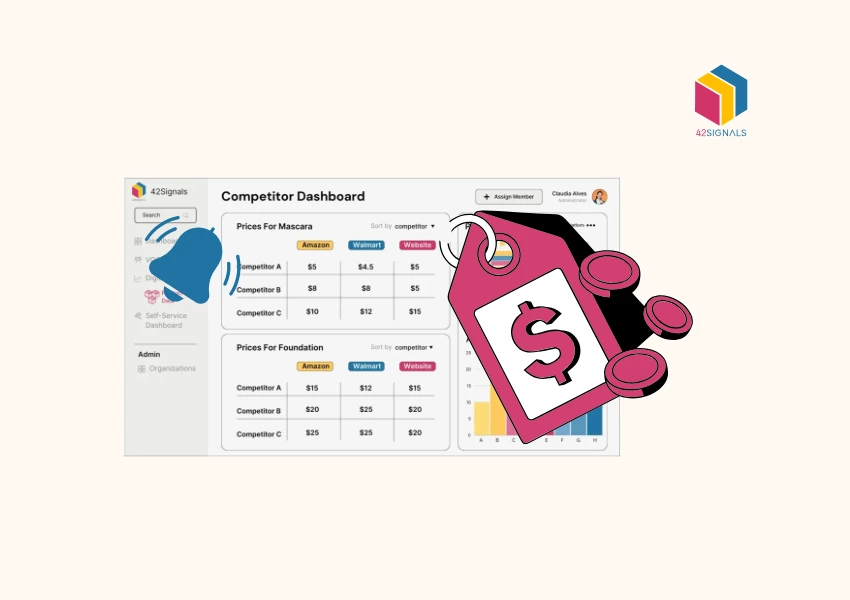
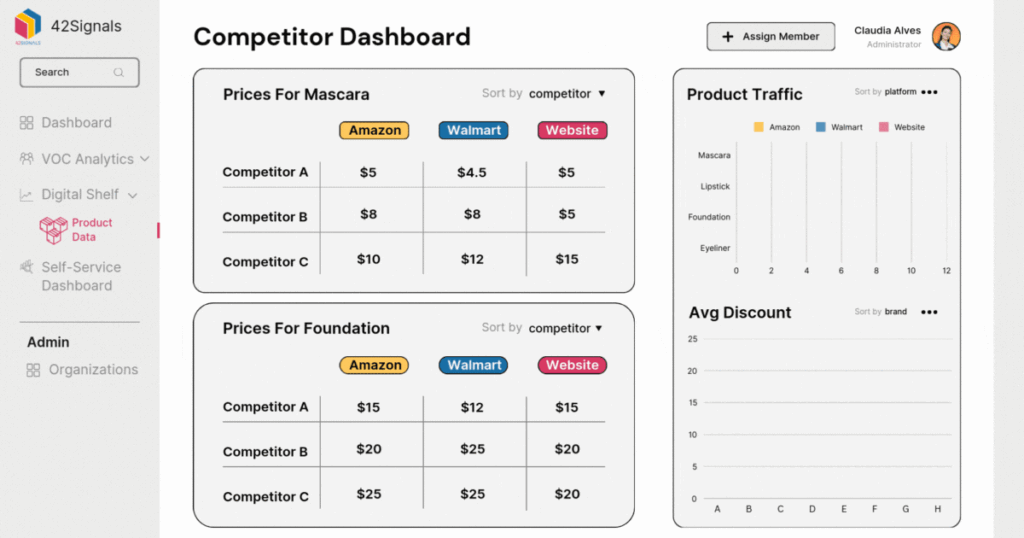
A unified competitor analysis dashboard gives you all the pieces at once.
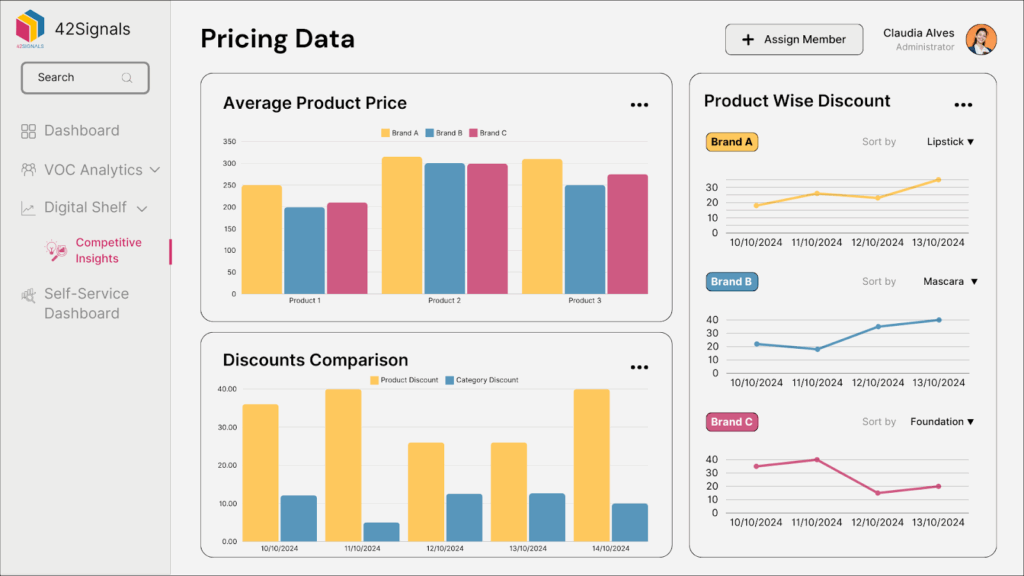
This is your mission control. It’s a single screen where you see how your entire lineup stacks up. You get immediate side-by-side comparisons on price, availability, and promotions. The good ones chart historical price movements, so you can predict a competitor’s next move.
You need to be able to customize it. Choose which competitors actually matter. Pick which products are priorities. A good dashboard like 42Signals gives you quick insights to see the whole picture: how your listings, images, and reviews compare, too.
Digital shelf analytics software looks at all of it: your photos, your descriptions, your reviews. The best price optimization solutions blend these worlds. They provide context. The data might show that because you have better images and reviews, you can price higher than a competitor with a weak listing. Or, if your page is lacking, even the lowest price might not be enough.
By combining pricing data with digital shelf analytics, you’re competing on total value, not just price. That’s a stronger place to be.
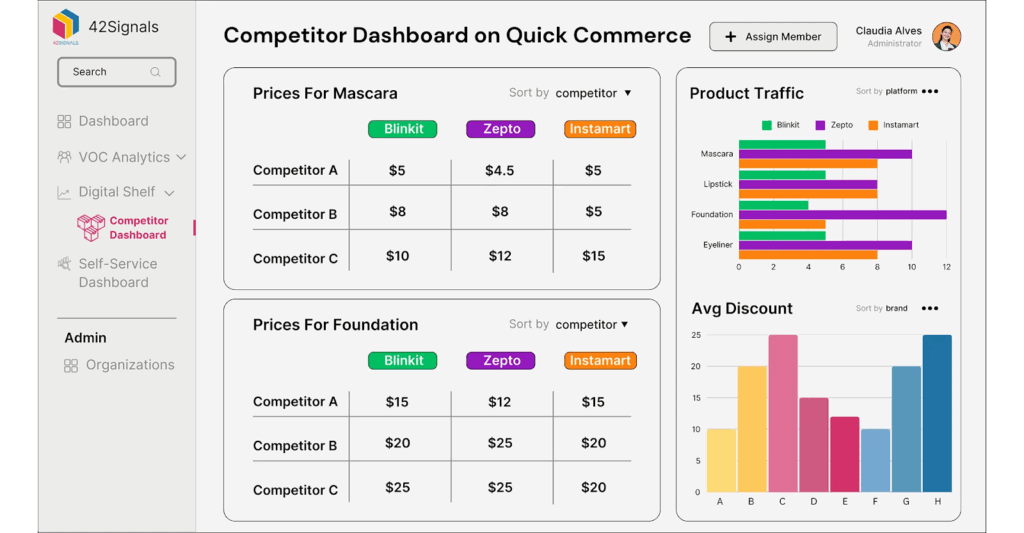
If you’re only watching traditional retailers, you’re missing this. Access to real-time quick commerce data is critical. A good solution tracks these channels. Understanding pricing there helps you make smarter decisions about your own promotions and inventory across all channels where your customers shop.
Quick commerce platforms often operate with completely different pricing dynamics than traditional online stores. Prices might change multiple times daily based on immediate demand and local availability. Promotions might be shorter and more targeted. Keeping up with these rapid changes requires tools that can monitor and respond almost instantly.
Picking a Tool That Works For You
The ability to monitor and respond to these fast-moving markets is another area where manual processes completely fall short. Trying to keep up with today’s retail environment using spreadsheets and manual checks is like trying to win a Formula 1 race with a bicycle – you might be pedaling furiously, but you’re never going to catch up. Automation isn’t just convenient anymore – it’s necessary for keeping pace with modern retail environments.
With options out there, choosing the right one is key. Look beyond the price tag and focus on the value it will deliver to your bottom line. The right tool should pay for itself within the first few months through recovered margin and increased sales.
- First, demand accuracy and speed. The value is in quality, timely data. Wrong or old data is worse than no data because it leads to disastrous decisions. Ask providers about their data sources and update frequency – if they can’t give you straight answers, walk away.
- Second, check the depth. Does it just show prices, or does it give you real insights and recommendations? Look for trend analysis and forecasting.
- Finally, think about usability. The best dashboard is useless if your team won’t use it. The platform should feel intuitive, not like you need a PhD to navigate it. And when you inevitably have a question or hit a snag, you need real human support. You want a provider who offers actual help—a real person who answers the phone or gets on a quick screen share to solve your problem—not just a chatbot or a library of outdated help articles. Remember, you’re not just buying software; you’re investing in peace of mind and the confidence to make smarter decisions.
Getting Started: How to Implement Without the Overwhelm
You’ve picked a tool—now what? The thought of implementing something new can be daunting, but it doesn’t have to bring your daily operations to a screeching halt. The key is to start focused, not broad.
Don’t try to boil the ocean on day one. Identify one product category or a handful of key SKUs that are most important to your business. These are your profit drivers or your most competitive items. Set up tracking and alerts just for these. This lets you and your team get comfortable with the software, learn how to interpret the alerts, and build confidence in the process without getting overwhelmed by notifications for your entire catalog.
Use this initial phase as a learning period. Watch how the data comes in. See how competitors move. Test out the recommendations on a small scale and measure the results. Once you’ve got a handle on it and can see the impact, then you can gradually expand monitoring to more of your assortment. This crawl-walk-run approach makes the whole process feel manageable and proves the value quickly, getting your whole team on board.
Time to Take Control with a Price Optimization Solution
Let’s be direct. The ecommerce world is too fierce to leave your pricing to chance. Protecting your margins means ditching the old, manual ways. Modern price optimization solutions are a must for brands that want to thrive.
The power to get instant alerts, to explore a live competitor analysis dashboard, and to use accurate quick commerce data gives you an edge you can’t get manually. By using ecommerce analytics and digital shelf analytics software, you build a strategy that’s smart, informed, and resilient.
The goal was never to win every race to the bottom. The goal is to make the smartest decisions for your business. It’s about protecting your margins while you strengthen your place in the market. It’s time to stop guessing. It’s time to start knowing. It’s time to take control.
Try 42Signals to see how these insights can help your business quickly.
Frequently Asked Questions
What is pricing optimization?
Pricing optimization is the process of using data analysis and algorithms to determine the most effective price for a product or service. The goal is to find a price that maximizes business outcomes—whether that’s profit, revenue, market share, or customer retention—based on demand, competitor pricing, seasonality, and buyer behavior.
Instead of guessing or using fixed markups, pricing optimization uses historical data, real-time market inputs, and predictive modeling to make smarter pricing decisions.
What is an example of price optimization?
A good example of price optimization is how airlines adjust ticket prices. An airline may raise or lower the price of a flight depending on how far in advance you’re booking, the current demand for that route, competitor pricing, and seat availability.
For instance, if a flight from Mumbai to Delhi is filling up quickly and competitor flights are already full, the airline may increase the price automatically using a pricing algorithm. Conversely, if sales are slow, prices may drop to stimulate bookings.
Retailers, e-commerce platforms, and subscription-based services also use similar techniques to optimize prices dynamically.
What is the formula for price optimisation?
There isn’t one universal formula, but a basic conceptual version used in many models is:
Optimal Price = (Customer Willingness to Pay × Perceived Value) – Discount or Adjustments
Alternatively, businesses may use a more data-driven formula like:
Profit = (Price – Cost) × Demand
Then, using predictive analytics or simulation tools, they adjust the Price until Profit is maximized, subject to constraints like inventory, competitor pricing, or customer sensitivity.
Machine learning models often iterate on this concept by analyzing historical pricing and sales data to predict the impact of different price points.
What is PROS price optimization software?
PROS is a software company that provides advanced price optimization and revenue management solutions for enterprises. Their pricing platform uses artificial intelligence and machine learning to help businesses determine the best price across various channels, products, and customer segments.
Key features of PROS price optimization software include:
Real-time dynamic pricing
Market-driven pricing recommendations
Segmentation and customer-specific pricing
Integration with CRM and ERP platforms
Optimization for promotions, discounting, and bundling strategies
PROS is widely used in industries like airlines, manufacturing, B2B distribution, and travel, where price sensitivity and demand fluctuations play a significant role in profitability.